
Tips & Tricks for a successful HORIZON-NEB-2027-02-NEB-SOIL-01 proposal
Opening
5 May 2027
Deadline
Keywords
Soil sealing
biodiversity
Soil restoration
NEB
Spatial planning
territorial design
climate resilience
Nature-based solutions
Multi-actor approach
Your microfluidic SME partner for Horizon Europe
We take care of microfluidic engineering, work on valorization and optimize the proposal with you
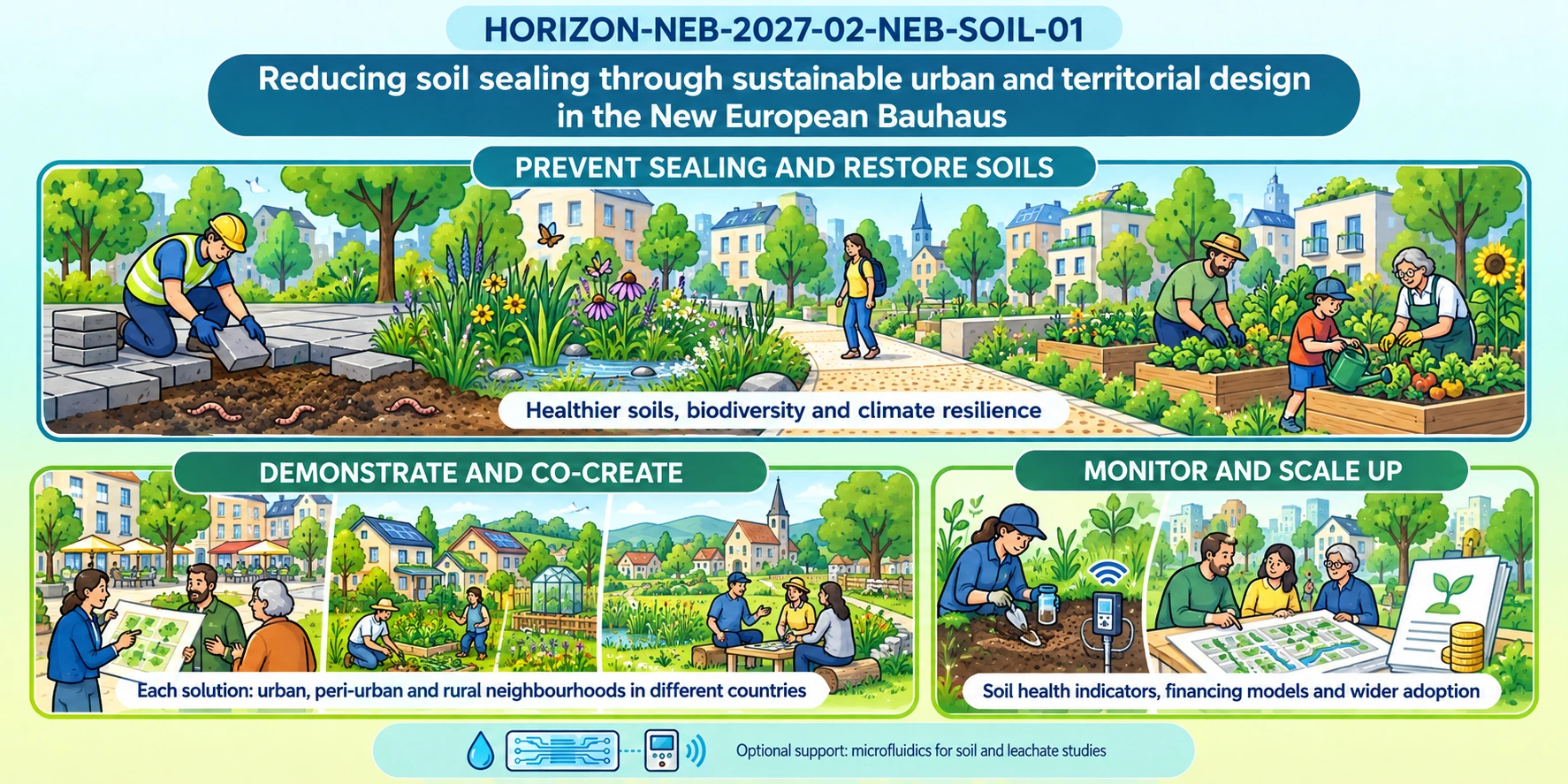
HORIZON-NEB-2027-02-NEB-SOIL-01: Reducing soil sealing through sustainable urban and territorial design in the New European Bauhaus
Why does removing pavement not automatically restore a functioning soil?
Removing impermeable cover reconnects soil with rainfall and vegetation, but compaction can still restrict water entry and biological recovery. In Milan, the highest unsaturated hydraulic conductivity was observed in greenspaces rehabilitated about five years earlier [1]. In Calgary, a model projected 1.5 °C lower mean hotspot air temperature under a 30% canopy-increase scenario during a heatwave [2]. These context-dependent findings support combining soil restoration with spatial design. HORIZON-NEB-2027-02-NEB-SOIL-01 seeks locally adapted solutions that reduce sealing while improving soil health and inclusive, climate-resilient neighbourhoods.
Download the MIC Horizon Europe 2026/2027 Calls Calendar:
Discover more!
Administrative facts: what do we know about the HORIZON-NEB-2027-02-NEB-SOIL-01 call?
Which call is it, and when is the opening and the deadline?
- Call: Joint Call between the New European Bauhaus Facility and the Soil Deal for Europe Mission; HORIZON-NEB-2027-02.
- Destination grouping: Joint topics. Topic: HORIZON-NEB-2027-02-NEB-SOIL-01.
- Opening: 5 May 2027.
- Deadline: 15 September 2027, 17:00 Brussels local time.
- Action: Innovation Action (IA). Expected end-of-project technology readiness level: TRL 6 to 8.
What about the budget and estimated size of the project?
- Topic budget: EUR 15 million. Indicative projects funded: two.
- Average allocation: EUR 15 million ÷ 2 = EUR 7.5 million. Different requested amounts remain possible.
What are the key eligibility and evaluation conditions?
- Multi-actor approach: mandatory, as defined in the Mission Soil work programme.
- Chinese universities linked to the Ministry of Industry and Information Technology (MIIT): the General Annex B participation condition applies.
- Built-environment interventions require relevant building-sector professionals, such as architects, urban planners and landscape designers.
- Expected contribution: social sciences, humanities and arts (SSHA).
- General Annexes A to G apply. Numerical evaluation thresholds are not restated in the supplied topic section.
- No topic-specific JRC participation condition is stated.
- Expected collaboration: Mission Soil Platform; sharing results with the NEB hub for results and impact.
Source: European Commission (2025). Horizon Europe Work Programme 2026–2027, Part 13: New European Bauhaus Facility, introduction pp. 5–6 and 8, call overview pp. 22–23 and topic pp. 76–78. Multi-actor definition: Part 12: Missions, pp. 184–185. Administrative data and mandatory scope above come from the work programme supplied with the generator. The supplied topic section refers to General Annex D without reproducing numerical evaluation thresholds.
Scientific range: what does the Commission expect from the HORIZON-NEB-2027-02-NEB-SOIL-01 grant?
What outcomes are expected?
The Commission expects regenerative planning solutions that reduce soil sealing and land take while supporting healthier soils and communities. Adoption needs workable financing and enabling policies. Your design must express sustainability, aesthetics and inclusivity (all three NEB principles matter).
What is within scope?
- Prevent sealing or unseal existing surfaces through locally adapted spatial planning.
- Combine ecosystem restoration with permeable pavements, green roofs, community gardens or urban agriculture.
- Demonstrate each solution in at least three neighbourhoods, including urban, peri-urban and rural settings, located in different Member States and/or Associated Countries.
- Address food systems transformation, climate resilience and biodiversity.
What are the specifically proposed research directions?
- Co-create solutions with residents, creative practitioners and territorial decision-makers.
- Monitor soil health, soil sealing and healthy-city indicators to inform policy.
- Develop upscaling plans, transferable methods, financing models and market deployment routes.
Scientific strategy: how can you enhance your chances of being funded through HORIZON-NEB-2027-02-NEB-SOIL-01?
What scientific choices matter most?
- Measure function. Track infiltration and soil condition alongside square metres unsealed. Include baseline measurements and comparable untreated areas.
- Match each solution to every territorial setting. A solution-by-site matrix will expose missing demonstrations before you commit the budget.
- Budget maintenance from the start.
- Test transferability. Record soil texture, previous land use and water availability. Similar landscaping can behave differently across sites (especially after drought).
- Make inclusion measurable. Assess who can use the restored spaces and who influences design decisions. We would also track affordability.
Consortium & proposal-writing plan: what works best with this type of call?
- A practical starting point is roughly 10 to 14 partners, adjusted to site responsibilities. This is advice, not an eligibility rule.
- Bring municipalities and land managers together with soil scientists, designers, water engineers and community organisations.
- Give social sciences, humanities and arts experts funded design responsibilities. Include an innovative SME with a clear deployment or monitoring role.
- If you involve residents, involve them throughout development and testing (attendance alone is weak evidence of co-creation).
- Name the future operator and financing route. Plan links with URSOILL and SPADES; explore Cities Mission and Cleverfood synergies where relevant.
How would microfluidics contribute to this topic?
Bulk soil measurements hide activity inside tiny pores. You can use soil-on-chip experiments to examine water movement and microbial interactions. Keep this a supporting task (the call centres on territorial demonstrations).
- Your restored plot drains poorly after rain. Recreate selected pore conditions on a chip and compare wetting cycles. You learn which mechanisms deserve field investigation.
- Your consortium could compare soil-leachate effects using controlled microfluidic ecotoxicity assays, followed by conventional validation.
- Use MIC’s soil restoration resources and bioremediation workshop to frame feasible experiments.
Your proposal gains a way to investigate mechanisms behind field observations. Chip results still need confirmation in real soils.
The MIC already brings its expertise in microfluidics to Horizon Europe:
H2020-NMBP-TR-IND-2020

Microfluidic platform to study the interaction of cancer cells with lymphatic tissue
H2020-LC-GD-2020-3

Toxicology assessment of pharmaceutical products on a placenta-on-chip model

About the author

Céleste Chidiac, PhD
Scientific writer and digital marketing specialist
Céleste Chidiac holds a doctorate in neuroscience and molecular biology from the University of Strasbourg. Since joining the Microfluidics Innovation Center in 2023, she has combined scientific writing with website management. For MIC’s Horizon Europe topic pages, she draws on her research background to explain scientific challenges and clarify funding priorities. Her writing helps prospective applicants understand each topic’s scope, expected outcomes and research directions.
FAQ: HORIZON-NEB-2027-02-NEB-SOIL-01
These scientific questions explore the soil processes and design trade-offs behind HORIZON-NEB-2027-02-NEB-SOIL-01. They examine how to distinguish visible greening from lasting environmental and social benefits.
How can an unpaved soil still generate substantial stormwater runoff?
An unpaved soil can generate runoff when rainfall reaches the surface faster than water enters the soil. Compaction reduces connected pore space, while vegetation and management influence how those pathways develop. Surface appearance therefore provides limited information about hydraulic function, particularly after construction traffic has crossed ground intended for planting.
Galli and colleagues compared rehabilitated and degraded greenspaces in Milan. Unsaturated hydraulic conductivity was highest at sites rehabilitated about five years earlier. Without soil and vegetation maintenance, conductivity could decline after roughly nine to twelve years [1]. These comparisons indicate that rehabilitation age, compaction and vegetation cover should be considered together.
The practical implication is to assess the whole soil profile and repeat measurements over time. Combine infiltration tests with bulk density and penetration resistance, recording antecedent moisture. The Milan findings describe particular sites rather than a universal recovery timetable. Neither removing pavement nor completing landscaping guarantees sustained infiltration without suitable management.
Can soil biology recover after desealing without importing agricultural topsoil?
Soil biology can recover after desealing without imported agricultural topsoil, provided the exposed material and subsequent management support living organisms. Biological recovery includes renewed microbial activity and colonisation by soil fauna. It should be distinguished from complete recovery of every soil function, particularly where contamination or poor drainage remains unresolved.
Maienza et al. compared excavated desealed soil with plots capped using agricultural topsoil at three Italian sites. Shrubs were planted and irrigated, with sampling in 2017, 2018 and 2019. Biological soil-quality scores increased after establishment. The authors found that managed desealed material could regain biological functionality without routinely replacing it with fertile imported soil [3].
This supports evaluating existing material before specifying wholesale soil replacement. The experiment involved small planted plots and managed irrigation, so its findings do not establish a universal recovery time. Soil history and intended use remain decisive. Biological indicators should accompany physical and chemical tests when assessing restoration success.
Why does permeable pavement lose infiltration capacity over time?
Permeable pavement loses infiltration capacity when particles obstruct its pores or joints, restricting water entry. Performance depends on material, loading and maintenance as well as rainfall conditions. A clean-looking surface can conceal blocked pathways, so appearance alone cannot establish whether a pavement still provides its intended stormwater function.
Singh and colleagues monitored two pervious-concrete parking lots and performed infiltration tests every three months over three years. They reported severe clogging within eighteen months where maintenance was ineffective, alongside structural weaknesses near joints and edges [4]. The study concerned specific installations, rather than every permeable pavement material or operating environment.
Maintenance planning should therefore combine repeated infiltration measurements with inspection of sediment accumulation and physical damage. Sampling one clean location is insufficient to represent an entire installation. Surface infiltration also cannot establish groundwater recharge by itself: storage layers, subsoil permeability and drainage outlets determine where infiltrated water ultimately goes.
How much rainfall can a green roof retain during a storm?
A green roof retains the part of rainfall that remains in its vegetation and substrate rather than leaving as runoff. Available storage depends on substrate properties and previous drying. Retention differs from detention: detention delays discharge, while retention keeps water out of the runoff measured for the event being assessed.
Mendes and colleagues tested an extensive pilot roof containing lightweight expanded clay aggregates. Under simulated rainfall, retention ranged from 10.1% for a five-minute event at 108.0 millimetres per hour to 39.8% for a fifteen-minute event at 39.56 millimetres per hour [5]. These values describe the tested roof and rainfall settings, rather than annual performance.
A fixed retention percentage is therefore inadequate for predicting every storm. Design assessment should include local rainfall sequences, antecedent moisture and safe overflow provision. Green roofs can complement ground-level restoration, but they do not reopen the soil beneath a building or demonstrate recovery of that soil’s biology.
Do trees and reduced impervious cover cool neighbourhoods in the same way?
Trees and reduced impervious cover influence neighbourhood temperatures through different, interacting processes. Trees provide shade and evaporative cooling. Replacing impermeable surfaces can change heat storage and permit vegetation or water movement. Their relative contributions depend on local climate, surrounding buildings and the spatial scale used to assess cooling.
Zaerpour and colleagues combined air-temperature observations with spatial modelling in Calgary. For a July 2023 heatwave day, their canopy-increase scenarios projected mean hotspot cooling of 0.8 °C and 1.5 °C for the study’s 10% and 30% increases, respectively [2]. These were modelled interventions, not measured temperature changes following a tree-planting programme.
The findings support testing combined planting and surface-redesign options against local conditions. They do not establish a universal canopy threshold or guaranteed cooling benefit. Air temperature should also be distinguished from pavement surface temperature. A cool-looking thermal image does not alone establish reduced heat exposure for people using a street or square.
How does plant diversity influence the functioning of urban garden soils?
Plant diversity can influence urban soil functioning through its effects on soil conditions and belowground organisms. Soil multifunctionality means supporting several ecological functions together, rather than maximising a single measure. A varied planting palette is therefore only one component of restoration; the soil community and its habitat also matter.
Fan and colleagues surveyed greenspaces in 56 municipalities across six continents, assessing 18 indicators representing nine ecosystem services. Soil biodiversity was positively associated with multiple functions. Plant diversity showed an indirect relationship through soil conditions associated with belowground biodiversity [6]. The analysis accounted for climate, location, vegetation, soil properties and management.
For a restored garden, this supports monitoring soil organisms alongside functional measurements, rather than relying on plant species counts alone. Retaining suitable soil habitat should accompany planting decisions. Because the evidence comes from a comparative survey, it does not show that adding a fixed number of plant species guarantees a predictable improvement everywhere.
Which measurements distinguish soil recovery from a simple increase in green cover?
Soil recovery requires evidence about physical condition, chemistry and biological activity, alongside the area made permeable or vegetated. Green cover describes a surface characteristic. It cannot reveal whether roots encounter compacted layers, whether nutrients are available, or whether potentially harmful substances remain in the soil or irrigation water.
Dondini and colleagues assessed soils and irrigation water from ten urban gardens in Barcelona. Soil pH ranged from 7.87 to 8.41, while organic matter varied among sites. Their contamination tests did not indicate significant overall pollution for the investigated variables, but they stressed that additional contaminants remained unassessed [7].
A practical monitoring set should connect each measurement to the function being restored and the site’s baseline. Combine relevant chemical tests with infiltration, compaction and biological indicators. Keep sampling season, depth and laboratory method consistent when assessing change. The Barcelona assessment illustrates site diagnosis; it does not demonstrate recovery over time or certify untested sites as safe.
Does urban food production automatically have a lower carbon footprint?
Urban food production does not automatically have a lower carbon footprint than conventional farming. Life-cycle assessment counts emissions from infrastructure and material inputs as well as production activities. Short transport distances can help, but they do not necessarily outweigh emissions associated with constructing beds or maintaining a small, short-lived growing site.
Across 73 urban agriculture sites in Europe and the United States, Hawes et al. reported average footprints of 420 versus 70 grams CO₂-equivalent per serving for urban and conventional food. Some crops and sites performed better than conventional alternatives. The study highlighted opportunities from longer site lifetimes, circular inputs and crop choices suited to urban production [8].
These averages should not be assigned to a proposed community garden without a local inventory. Compare equivalent food outputs and state infrastructure lifetimes explicitly. Carbon accounting also does not capture every benefit of food growing, such as learning or social connection. Those outcomes need separate evidence rather than being used to cancel unmeasured emissions.
Can neighbourhood greening increase environmental inequality?
Neighbourhood greening can increase environmental inequality when its benefits coincide with rising housing costs or exclusion of existing residents. Green gentrification describes this connection between environmental improvement and socioeconomic neighbourhood change. A new planted space may be physically accessible while the surrounding housing becomes less affordable to the people it was intended to serve.
Anguelovski et al. analysed 28 cities in nine European and North American countries. They found a positive relationship between earlier greening and subsequent gentrification in 17 cities for at least one studied decade [9]. The analysis used spatial statistical models and neighbourhood indicators; it did not establish that every green intervention causes individual households to be displaced.
This evidence supports evaluating distributional outcomes alongside ecological performance. Relevant questions include who participates, who uses the space and whether vulnerable households retain access over time. Local housing conditions differ substantially. Participation and affordability measures should therefore be assessed in context, with community input continuing beyond the opening of a redesigned public space.
What can soil-on-chip experiments reveal about microbial recolonisation?
Soil-on-chip experiments make selected pore-scale processes visible under a microscope. Their transparent microchannels reproduce aspects of the confined spaces occupied by soil organisms. Researchers can observe how water distribution and pore geometry affect movement, including interactions between organisms that are difficult to distinguish in an opaque bulk soil sample.
Mafla-Endara et al. used chips exposed to whole-soil communities in field and laboratory experiments. In initially air-filled channels later colonised in soil, bacterial abundance was more than sixfold higher where fungal hyphae were present. Hyphae helped bacteria cross air gaps [10]. The numerical comparison concerned paired channel observations, not a sixfold improvement in whole-soil restoration.
Such experiments can test hypotheses about recolonisation after wetting, drying or disturbance. Their value is mechanistic: they reveal interactions that bulk measurements average together. Chip materials and simplified geometry differ from natural soil. Any proposed application to desealed land must therefore be checked against intact soil samples and field measurements before claiming ecological benefit.
References
[1] Galli, A., Peruzzi, C., Beltrame, L., Cislaghi, A. and Masseroni, D. (2021). Evaluating the infiltration capacity of degraded vs. rehabilitated urban greenspaces: Lessons learnt from a real-world Italian case study. Science of the Total Environment, 787, 147612. doi:10.1016/j.scitotenv.2021.147612
[2] Zaerpour, M., Papalexiou, S. M. and Pietroniro, A. (2025). Increasing tree canopy lowers urban air temperature by up to 1.5 °C in heat-prone areas. npj Urban Sustainability, 5, 92. doi:10.1038/s42949-025-00277-x
[3] Maienza, A., Ungaro, F., Baronti, S., Colzi, I., Giagnoni, L., Gonnelli, C., Renella, G., Ugolini, F. and Calzolari, C. (2021). Biological Restoration of Urban Soils after De-Sealing Interventions. Agriculture, 11(3), 190. doi:10.3390/agriculture11030190
[4] Singh, A., Sampath, P. V. and Biligiri, K. P. (2023). Field performance monitoring of pervious concrete pavements. Road Materials and Pavement Design, 24(12), 3013–3028. doi:10.1080/14680629.2023.2176164
[5] Mendes, A. M., Monteiro, C. M. and Santos, C. (2025). Green Roofs Hydrological Performance and Contribution to Urban Stormwater Management. Water Resources Management, 39, 1015–1031. First published online 28 October 2024. doi:10.1007/s11269-024-04003-7
[6] Fan, K., Chu, H., Eldridge, D. J. et al. (2023). Soil biodiversity supports the delivery of multiple ecosystem functions in urban greenspaces. Nature Ecology & Evolution, 7, 113–126. doi:10.1038/s41559-022-01935-4
[7] Dondini, C., Úbeda, X., Certini, G. and Francos, M. (2024). Soil quality in the urban gardens of Barcelona (Spain). Journal of Soils and Sediments, 24, 1652–1664. doi:10.1007/s11368-024-03737-6
[8] Hawes, J. K., Goldstein, B. P., Newell, J. P., Dorr, E., Caputo, S., Fox-Kämper, R., Grard, B., Ilieva, R. T., Fargue-Lelièvre, A., Poniży, L., Schoen, V., Specht, K. and Cohen, N. (2024). Comparing the carbon footprints of urban and conventional agriculture. Nature Cities, 1, 164–173. doi:10.1038/s44284-023-00023-3
[9] Anguelovski, I., Connolly, J. J. T., Cole, H., Garcia-Lamarca, M., Triguero-Mas, M., Baró, F., Martin, N., Conesa, D., Shokry, G., Pérez del Pulgar, C., Argüelles Ramos, L., Matheney, A., Gallez, E., Oscilowicz, E., López Máñez, J., Sarzo, B., Beltrán, M. A. and Martinez Minaya, J. (2022). Green gentrification in European and North American cities. Nature Communications, 13, 3816. doi:10.1038/s41467-022-31572-1
[10] Mafla-Endara, P. M., Arellano-Caicedo, C., Aleklett, K., Pucetaite, M., Ohlsson, P. and Hammer, E. C. (2021). Microfluidic chips provide visual access to in situ soil ecology. Communications Biology, 4, 889. doi:10.1038/s42003-021-02379-5