
HORIZON-NEB-2027-01-REGEN-02: Reducing construction-site impacts on people and ecosystems
Opening
5 May 2027
Deadline
Keywords
Construction sites
Participatory design
Renovation
Visual quality
Environmental exposure
Ecotoxicity
Microfluidic testing
Sustainable construction
Your microfluidic SME partner for Horizon Europe
We take care of microfluidic engineering, work on valorization and optimize the proposal with you
HORIZON-NEB-2027-01-REGEN-02: Sustainable, beautiful and healthy construction and renovation sites
How does the timing of construction work change who experiences its impacts?
Exposure depends on when site activities overlap with people’s presence. Deliveries, excavation and cutting follow a work schedule; neighbours, workers and passers-by follow different daily routines. Connecting those timelines helps identify who would benefit from rescheduling an activity and who might inherit the disturbance. This gives HORIZON-NEB-2027-01-REGEN-02 a practical starting point: assess construction and renovation as changing parts of neighbourhood life.
Download the MIC Horizon Europe 2026/2027 Calls Calendar:
Discover more!
HORIZON-NEB-2027-01-REGEN-02: Call facts and research conditions
When is the opening and the deadline and what are the conditions to participate?
Topic: HORIZON-NEB-2027-01-REGEN-02 – Sustainable, beautiful and healthy construction and renovation sites. It belongs to the New European Bauhaus (NEB) call “Innovative models for neighbourhoods that integrate beauty, inclusiveness and sustainability”, under the destination “Circular and regenerative approaches for the built environment”.
- Action: Research and Innovation Action (RIA), single-stage, with lump-sum funding. The general RIA maximum funding rate is 100%.
- Schedule: opening on 5 May 2027; deadline on 1 December 2027 at 17:00 Brussels local time.
- Funding: an indicative topic budget of €8 million, with an expected EU contribution of around €4 million per project and an indicative two projects funded. Other requested amounts remain possible.
- Maturity: activities are expected to achieve Technology Readiness Level (TRL) 4–5 by project end and may start at any TRL.
- Consortium: the general minimum is three independent beneficiary legal entities in three different countries: at least one in an EU Member State and at least two others in different Member States or Associated Countries, subject to the applicable eligibility conditions.
- Proposal length: the general limit for a lump-sum RIA is 45 pages; the submission-system template specifies the applicable limits.
The NEB work programme sets the topic conditions; the General Annexes govern general admissibility, eligibility and funding. Budget at least 0.8% for engagement with the NEB hub for results and impact, including sharing findings and contributing to impact assessment.
What healthier construction and renovation sites must deliver
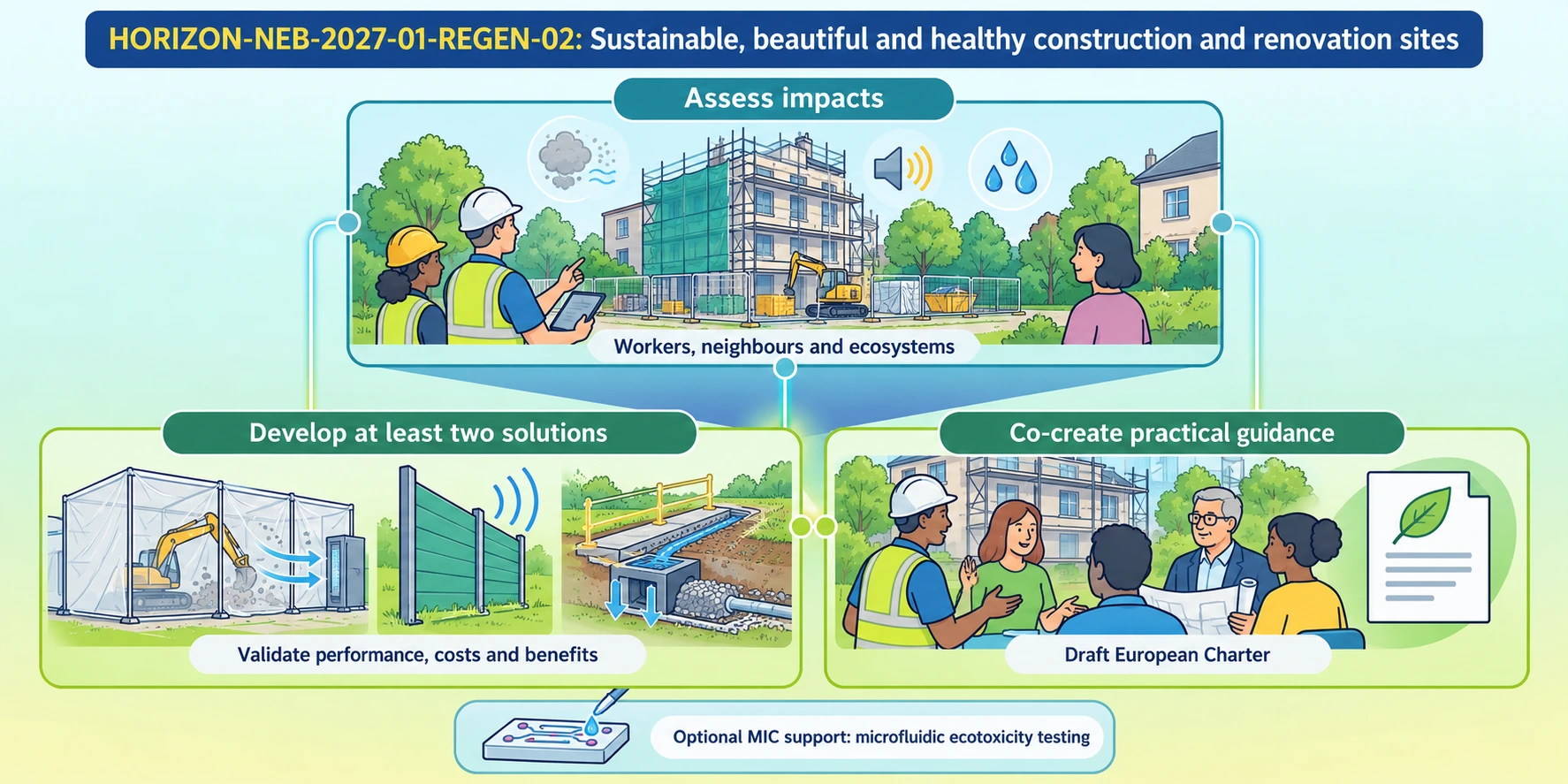
The HORIZON-NEB-2027-01-REGEN-02 topic seeks both better awareness of site impacts and a significant reduction in harm to ecosystems and people. Its scope includes noise, air pollution, litter, waste, soil compaction, dust, water contamination and vibration, alongside the visual disruption caused by construction and renovation.
Proposals are expected to address all of the following:
- Assess environmental, ecological and health effects on surrounding ecosystems, construction workers, and people living, working or passing nearby.
- Develop at least two solutions that reduce negative effects while considering the site’s visual impact.
- Validate the solutions and assess costs and benefits using suitable methods and indicators.
- Provide practical recommendations and guidance, including a draft “European Charter for sound environmental and working environment management of renovation and construction sites” that companies and entities could endorse.
Solutions could combine changes in site organisation with technical measures, such as dust containment, quieter operations or runoff management. These are possible design directions, not prescribed technologies. Define the mechanism by which each proposed measure would reduce an identified impact, and assess any additional resource use or maintenance it requires.
Visual quality deserves an explicit assessment: site boundaries, temporary routes and the relationship with nearby public space should be considered with affected users. Attractive screening alone does not establish an environmental or health benefit.
Validation that connects site activities to observable effects
Develop a comparison plan before selecting sensors or prototypes. Record the construction phase, activities, weather and nearby traffic so that a change in the measurements can be interpreted. Choose indicators for the people and ecosystems affected, with separate criteria for each solution.
Spatial coverage matters. Jaafar and colleagues used twelve low-cost sensors on balconies in a Toronto neighbourhood. After calibration, locations near construction recorded higher fine-particle concentrations than more distant locations. The study supports examining local variation, while its neighbourhood findings do not establish the performance of a particular mitigation measure. [1]
Experience and exposure need complementary evidence. A four-year study of the Turcot highway-interchange works in Montréal combined resident surveys with noise monitoring. Construction noise levels explained only a small part of the variation in annoyance; perceptions of other nuisances and safety also contributed. These observational findings support evaluating lived experience alongside physical measurements. [2]
For the proposed validation, pair comparable operating periods or use an appropriate reference location. Report uncertainty, changes in activity intensity and the conditions under which each solution works. For soil or water samples, agree collection, preservation and preparation procedures before comparing results between laboratories.
Include installation and operating costs, maintenance effort, resource consumption and disruption in the cost–benefit assessment. Describe the environments used to demonstrate TRL 4–5; this target does not establish commercial readiness or the maturity of every component supplied by a partner.
HORIZON-NEB-2027-01-REGEN-02 consortium that represents the site and its neighbourhood
A participatory and transdisciplinary approach and an effective contribution from social sciences and humanities (SSH) are explicit expectations. The NEB programme also requires participation by relevant building-sector professionals, such as architects, urban planners or landscape designers.
Organise responsibilities around the work:
- Contractors and site operators provide access, work schedules and practical constraints, and help test whether proposed measures can be maintained.
- Environmental and occupational-health specialists select appropriate exposure indicators and interpret their meaning for ecosystems and people.
- Architects, designers and SSH researchers investigate visual quality, accessibility, perceived disruption and differences between affected groups.
- Residents, workers and local authorities help define relevant problems and assess the acceptability of proposed changes.
- Technology partners develop and qualify the tools needed for the selected solutions and their evaluation.
As a practical planning choice, give participation a route into design decisions: record which concerns led to changes and which trade-offs remain. Assign responsibility for producing the draft Charter and translating results into guidance that different site operators can use. The topic does not prescribe a fixed number of demonstration sites; select enough relevant settings to support the claims made.
The MIC already brings its expertise in microfluidics to Horizon Europe:
H2020-NMBP-TR-IND-2020

Microfluidic platform to study the interaction of cancer cells with lymphatic tissue
H2020-LC-GD-2020-3

Toxicology assessment of pharmaceutical products on a placenta-on-chip model

About the author

Céleste Chidiac, PhD
Scientific writer and digital marketing specialist
Céleste Chidiac holds a doctorate in neuroscience and molecular biology from the University of Strasbourg. Since joining the Microfluidics Innovation Center in 2023, she has combined scientific writing with website management. For MIC’s Horizon Europe topic pages, she draws on her research background to explain scientific challenges and clarify funding priorities. Her writing helps prospective applicants understand each topic’s scope, expected outcomes and research directions.
FAQ — Interpreting construction-site measurements and ecological tests
These questions address practical limits in exposure monitoring, sample handling and biological interpretation when developing healthier construction and renovation sites.
Can a neighbourhood particle sensor establish a worker’s personal exposure?
No. A fixed sensor characterises air at its location; a worker moves between tasks and environments. Jaafar and colleagues’ balcony network revealed neighbourhood variation, not individual occupational exposure. [1] Define the population and exposure question first, then select suitable monitoring with occupational-health specialists.
Do fewer complaints demonstrate that a site has become less harmful?
No. Complaint counts are a participation signal, not a direct exposure measurement. In the Turcot study, annoyance changed over time and depended on factors beyond measured noise. [2] Assess complaint trends alongside monitoring and structured feedback, including from people who do not use the complaints channel.
What does a soil-leachate test leave out?
A leachate test examines substances released into a liquid under the chosen preparation conditions. It does not reproduce the full soil structure, every exposure route or the whole ecosystem. Interpret the biological response together with sample chemistry and relevant ecological observations; retain the extraction procedure when reporting results.
How can sample colour or turbidity affect an optical bioassay?
The sample itself can contribute to an optical signal or obscure the organism being imaged. Include sample blanks and suitable controls, and check readout performance over the intended sample range. Agree with the assay laboratory how to distinguish a biological response from interference before interpreting an apparent effect.
Can a nematode assay predict health effects in construction workers?
A nematode assay addresses a defined ecological test endpoint; it does not directly predict human health outcomes. MIC’s EDAPHOS work supports microfluidic ecotoxicity methods. Human exposure and health interpretation require appropriate methods and specialist partners, even when the samples originate from the same site.
How should visual improvements be evaluated with residents?
Use a defined comparison and ask about concrete experiences: orientation, views, perceived enclosure, access and the quality of temporary public space. Include people with different mobility needs and patterns of use. Keep these findings distinct from physical exposure measurements while considering both in design decisions.
What if chemical analysis and a bioassay give different impressions of a sample?
Investigate what each method measures before declaring a contradiction. Chemical analysis concerns the substances included in its analytical scope; a bioassay concerns the response of a particular organism or model under defined conditions. Check preparation, exposure and controls with both laboratories, and report unresolved differences.
References
[1] Jaafar, W.; Xu, J.; Farrar, E.; Jeong, C.-H.; Ganji, A.; Evans, G.; Hatzopoulou, M. Challenges and opportunities of low-cost sensors in capturing the impacts of construction activities on neighborhood air quality. Building and Environment. 2024;254:111363. https://doi.org/10.1016/j.buildenv.2024.111363
[2] Pinsonnault-Skvarenina, A.; Carrier, M.; Bockstael, A.; Gagné, J.-P.; Leroux, T. Construction noise annoyance and its evolution: Insights from the Turcot Project longitudinal study. The Journal of the Acoustical Society of America. 2025;157(5):3590–3603. https://doi.org/10.1121/10.0036643