
HORIZON-NEB-2027-01-PARTICIPATION-03: Combining community knowledge & research for a fair neighbourhood transition
Opening
5 May 2027
Deadline
Keywords
Community knowledge
Transdisciplinary research
Fair green transition
Social inclusion
green spaces
Neighbourhood validation
Knowledge co-production
Your microfluidic SME partner for Horizon Europe
We take care of microfluidic engineering, work on valorization and optimize the proposal with you
HORIZON-NEB-2027-01-PARTICIPATION-03: Novel combinations of knowledge and research methods to address social issues and advance a fair green transition of neighbourhoods
How can residents’ knowledge change what a neighbourhood study investigates?
Residents can reshape the research question by identifying problems and relationships that an initial research plan overlooks. A study of access to green space, for example, could begin with mapped distance and expand to opening hours, rental insecurity or concerns about former industrial land. The research design should show how these contributions change what is investigated and how findings are interpreted. This gives HORIZON-NEB-2027-01-PARTICIPATION-03 a starting point: involve local knowledge in defining the problem, as well as investigating it.
Download the MIC Horizon Europe 2026/2027 Calls Calendar:
Discover more!
Call facts and participation conditions
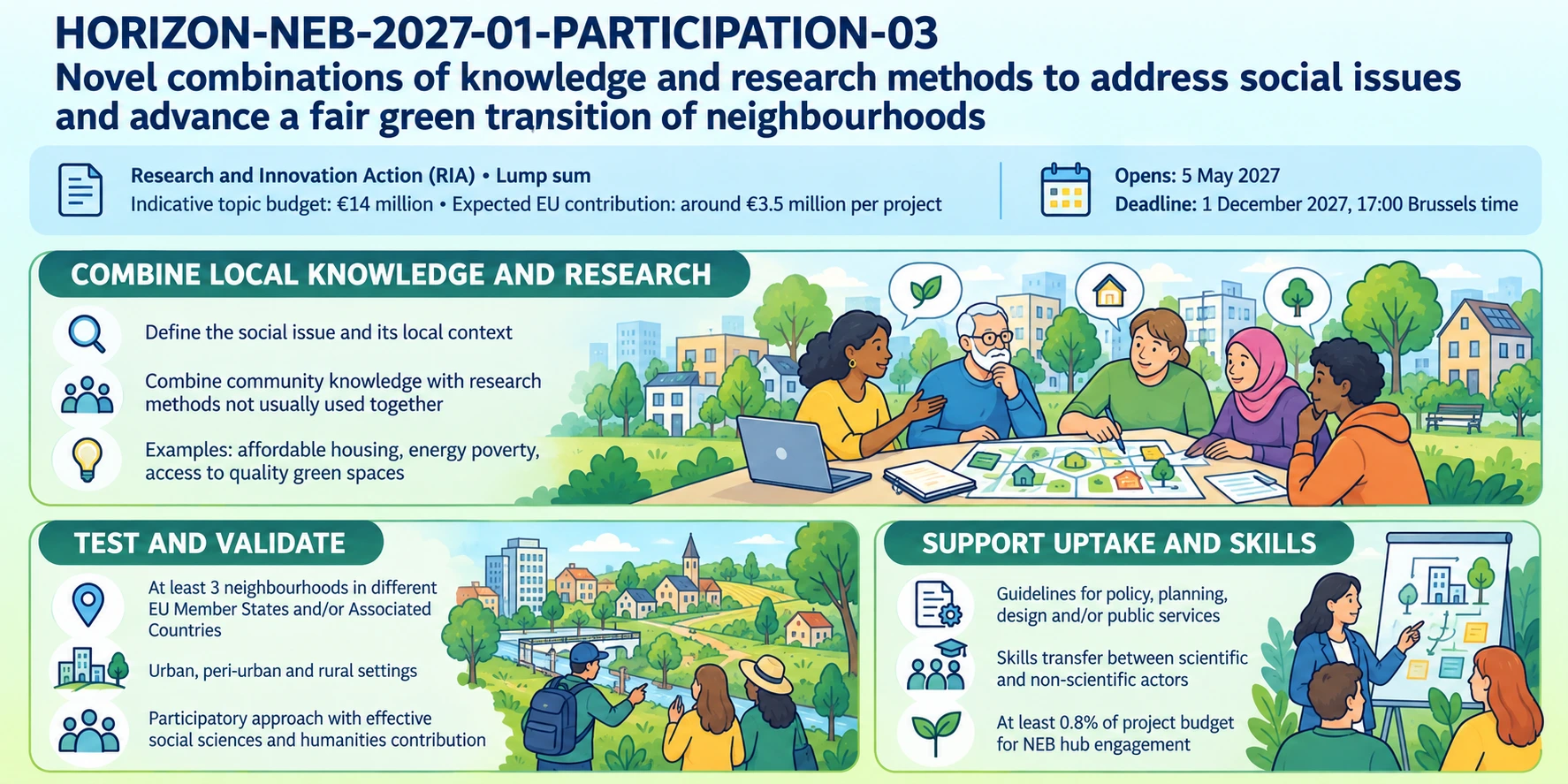
Topic: HORIZON-NEB-2027-01-PARTICIPATION-03 — Novel combinations of knowledge and research methods to address social issues and advance a fair green transition of neighbourhoods. It belongs to the New European Bauhaus (NEB) call “Innovative models for neighbourhoods that integrate beauty, inclusiveness and sustainability”, under the destination “Connecting the green transformation, social inclusion and local democracy”.
- Action and funding model: Research and Innovation Action (RIA); lump sum
- Planned opening: 5 May 2027
- Deadline: 1 December 2027, 17:00 Brussels local time; single-stage submission
- Indicative topic budget: €14 million
- Expected EU contribution: Around €3.5 million per project; proposals requesting different amounts may be submitted and selected
- Indicative number of projects: 4
- Target technology readiness level: No topic-specific TRL target is stated
The NEB Work Programme 2026–2027 sets these conditions. The General Annexes apply, including eligibility and country-specific restrictions. The standard consortium minimum is three independent legal entities in three different countries: at least one in an EU Member State and two others in different Member States or Associated Countries. This minimum is separate from the neighbourhood validation requirement.
Make the combination of knowledge the research contribution
The HORIZON-NEB-2027-01-PARTICIPATION-03 topic seeks new understanding of social issues that influence neighbourhood green transitions. Examples include affordable housing, energy poverty and access to quality green spaces. Define the issue, the people affected and the relevant local conditions before choosing methods.
The proposed approach must combine community or other non-scientific knowledge with scientific knowledge and/or formal research methods not usually combined. Explain what the combination reveals that the separate methods would miss. For example, resident accounts of an unused garden could be examined alongside land-use history, access mapping and environmental assessment, if those methods answer the identified social question.
Nettenbreijers and colleagues’ Rotterdam case study combined documents with six interviews. Residents contributed groundwater observations and monitoring, while participants disagreed about policy uptake. It illustrates both the value of local knowledge and the difficulty of tracing its influence. [1]
Expected results cover three functions: better understanding of social issues; robust evidence usable in decisions, policies, design, planning and/or public services; and skills transfer between scientific and non-scientific actors. The approach must also address the neighbourhood’s nature-positive transformation.
Validate the approach across different neighbourhoods
The approach is expected to be tested or validated in at least three neighbourhoods, in urban, peri-urban and rural areas, located in different Member States and/or Associated Countries. Explain the choice of sites and how the comparison will test the method under different social and institutional conditions.
Use the NEB definition when drawing boundaries: a neighbourhood has a maximum area of 25 km² or a maximum population of 10,000 inhabitants, and should correspond to or form part of the lowest level of public administration or an elected body. Describe the residential functions and actors within each boundary.
As a research-design choice, establish a shared core for comparison and allow locally justified adaptations. Record which knowledge enters the process, which assumptions change, and how interpretations are challenged. Evaluate both the quality of the resulting evidence and its usefulness for an identifiable local decision.
Include distributional outcomes when relevant. Anguelovski and colleagues’ spatial Bayesian analysis found a relationship between earlier greening and subsequent gentrification in 17 of 28 European and North American cities for at least one studied decade. The historical, city-level associations do not establish the effect of a particular neighbourhood intervention. [2] A local evaluation should therefore investigate who can access improvements and who may face additional burdens.
Build participation into the work and the uptake pathway
The HORIZON-NEB-2027-01-PARTICIPATION-03 topic requires an effective contribution from social sciences and humanities (SSH), including relevant experts and institutions. Depending on the chosen issue, combine social research, community organisations, local public authorities and the relevant environmental, housing or energy expertise. In interventions concerning the built environment, include the relevant architects, urban planners or landscape designers required by the programme.
Plan participation throughout problem definition, investigation, interpretation and the preparation of recommendations. Allocate time and resources for accessible formats and for returning findings to participants. These are practical design choices that make the proposed participation assessable.
The required guidelines and recommendations should specify their intended users, the decisions they support and the conditions for adapting the approach elsewhere. Proposed outputs could include a tested research protocol, comparative neighbourhood findings, a record of how local knowledge changed the analysis, and guidance for public authorities.
Proposals are expected to allocate at least 0.8% of their budget to engagement with the Horizon Europe-funded “New European Bauhaus hub for results and impact”, sharing intermediate and final findings and learning, and contributing to impact assessment. Include this work in the project plan.
The MIC already brings its expertise in microfluidics to Horizon Europe:
H2020-NMBP-TR-IND-2020

Microfluidic platform to study the interaction of cancer cells with lymphatic tissue
H2020-LC-GD-2020-3

Toxicology assessment of pharmaceutical products on a placenta-on-chip model
About the author
Céleste Chidiac, PhD
Scientific writer and digital marketing specialist
Céleste Chidiac holds a doctorate in neuroscience and molecular biology from the University of Strasbourg. Since joining the Microfluidics Innovation Center in 2023, she has combined scientific writing with website management. For MIC’s Horizon Europe topic pages, she draws on her research background to explain scientific challenges and clarify funding priorities. Her writing helps prospective applicants understand each topic’s scope, expected outcomes and research directions.
FAQ: combining neighbourhood knowledge and research
Practical questions about interpretation, participation and the transfer of evidence between neighbourhoods.
How should researchers handle disagreement between residents and technical experts?
Keep competing explanations visible and identify what evidence would distinguish them. Separate differences in observation, interpretation and priorities. In the Rotterdam groundwater case, residents and officials differed over whether local knowledge entered policy. [1] A shared interpretation session should therefore record unresolved disagreements as well as agreed findings.
Can an open invitation produce a representative account of a neighbourhood?
Do not assume that it does. Specify whose experiences the research needs, compare participation with that intended coverage, and document gaps. Targeted outreach, accessible venues and several ways to contribute can be planned alongside an open invitation. Avoid describing a workshop’s participants as the voice of every resident.
How can multilingual interviews remain comparable?
Agree the meaning of key concepts before comparing responses. Use translated prompts, check ambiguous terms with participants and retain context around quotations. Analyse whether words such as “access”, “security” or “community” refer to the same experience across sites; a literal translation alone does not establish that equivalence.
What distinguishes a participatory map from a validated environmental map?
A participatory map records knowledge, experience or reported observations according to its collection method. Label those categories explicitly. If a location is flagged for investigation, link any subsequent environmental measurement to its sampling date, method and uncertainty. A mapped concern should remain distinguishable from a measured contamination result.
Does a green-gentrification association prove that a new park displaced residents?
No. The multi-city analysis identifies associations using area-level indicators; it does not directly establish the displacement caused by an individual park. [2] To investigate a local intervention, combine an appropriate comparison with housing histories, tenure information and accounts from affected residents, including people who have moved away.
How can a project account for the work asked of community participants?
Make the expected tasks, time commitment and use of contributions explicit. Plan support around the actual barriers participants identify, such as travel, care responsibilities or digital access. Review whether the same small group is carrying repeated requests, and include the return of usable findings as part of the work.
Should different kinds of evidence be reduced to a single neighbourhood score?
Keep the underlying indicators visible. If a combined score is useful, explain the weighting, whose priorities it represents and how alternative weights change the interpretation. Preserve separate results for groups and locations when aggregation would conceal differences that matter to the research question.
How should a project report an approach that produces inconclusive findings?
State which question remains unresolved and why. Distinguish limited participation, missing observations and uncertainty in the analysis from an absence of the effect being investigated. Report what the combined methods clarified, where they failed to resolve the issue and what additional evidence would help.
References
[1] Nettenbreijers, K.; Tromp, E.; Perez, P. Knowledge uptake from lived experience regarding sustainable groundwater management: complementing scientific knowledge in urban policymaking. Sustainability Science. 2024;19:1763–1772. https://doi.org/10.1007/s11625-024-01525-2
[2] Anguelovski, I.; Connolly, J. J. T.; Cole, H.; Garcia-Lamarca, M.; Triguero-Mas, M.; Baró, F.; Martin, N.; Conesa, D.; Shokry, G.; Pérez del Pulgar, C.; Argüelles Ramos, L.; Matheney, A.; Gallez, E.; Oscilowicz, E.; López Máñez, J.; Sarzo, B.; Beltrán, M. A.; Martinez Minaya, J. Green gentrification in European and North American cities. Nature Communications. 2022;13:3816. https://doi.org/10.1038/s41467-022-31572-1