
Intergenerational neighbourhoods: shared places, meaningful roles and a measurable green transition
Opening
5 May 2027
Deadline
Keywords
Intergenerational living
Inclusive neighbourhoods
NEB
Co-design
Environmental assessment
Social participation
redesign spaces
Green transition
Your microfluidic SME partner for Horizon Europe
We take care of microfluidic engineering, work on valorization and optimize the proposal with you
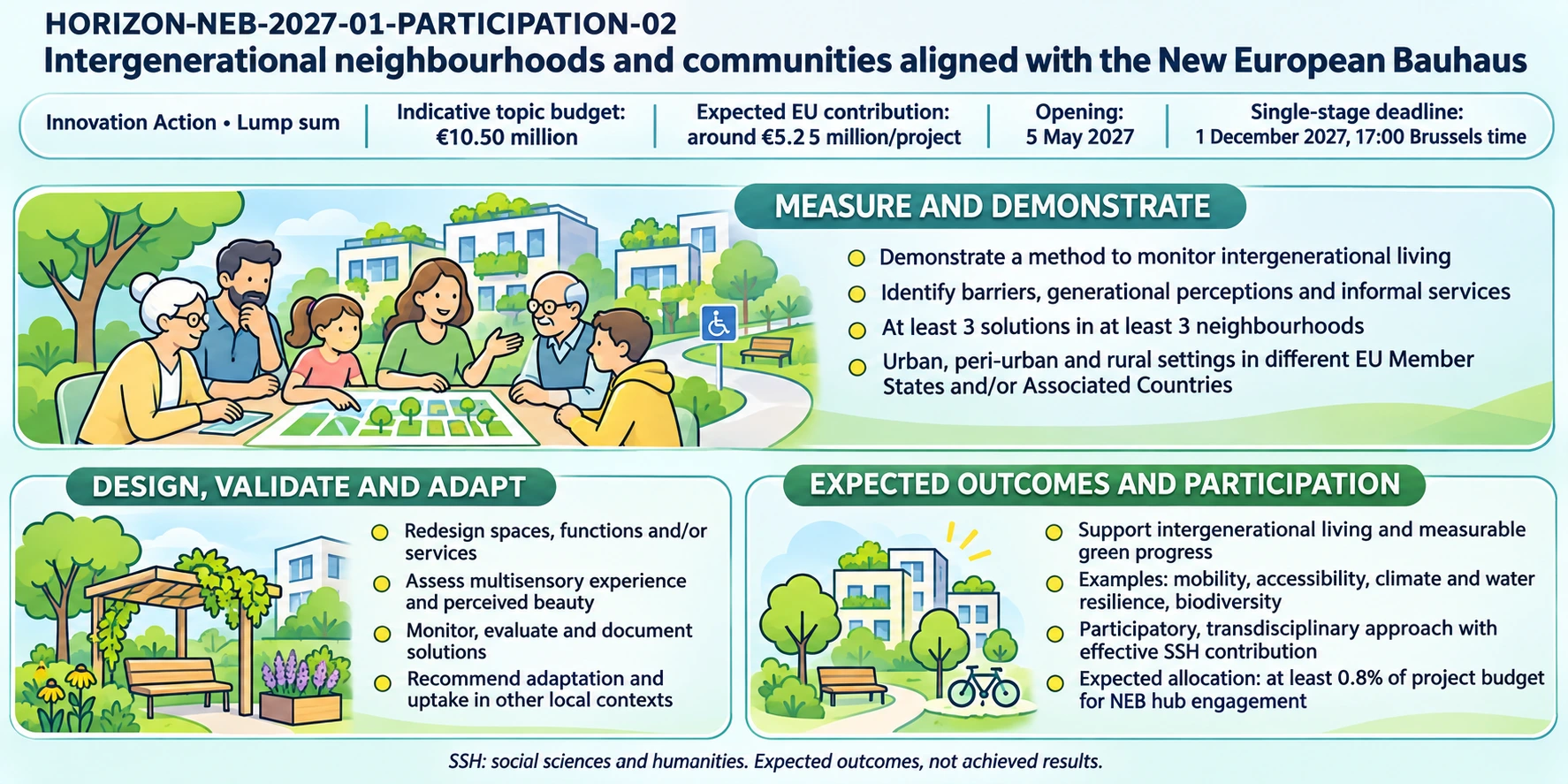
HORIZON-NEB-2027-01-PARTICIPATION-02: Intergenerational neighbourhoods and communities aligned with the New European Bauhaus
How can a shared neighbourhood activity give each generation a meaningful role?
A shared activity needs different, equally valued ways to contribute. Someone can suggest an idea, explain a local practice, operate a tool or help another participant take part. In public-space co-design workshops in Hong Kong, Ng and colleagues observed different patterns of discussion, facilitation and practical contribution across mixed-age teams. Their exploratory study examined cooperation during workshops, without establishing lasting neighbourhood effects. [1] This focus on reciprocal participation gives HORIZON-NEB-2027-01-PARTICIPATION-02 a practical starting point: design spaces and services around what residents can do together.
Download the MIC Horizon Europe 2026/2027 Calls Calendar:
Discover more!
Call facts and the demonstration framework
Which call is it, and when is the opening and the deadline?
- Topic: HORIZON-NEB-2027-01-PARTICIPATION-02. Official topic page. Destination: Connecting the green transformation, social inclusion and local democracy.
- Opening: 5 May 2027. Deadline: 1 December 2027, 17:00 Brussels local time.
- Action: Innovation Action (IA), with lump-sum funding.
- Total indicative topic budget: EUR 10.50 million. Expected EU contribution: around EUR 5.25 million per project; proposals requesting other amounts remain possible. The indicative number of funded projects is two.
- No topic-specific target Technology Readiness Level (TRL) is stated.
The NEB work programme gives the planned calendar; its call conditions allow changes to opening and deadline dates. Under the General Annexes, the standard consortium minimum is three independent legal entities established in three different countries: at least one in an EU Member State and at least two others in different Member States or Associated Countries. Additional country and entity conditions apply.
The standard IA funding rate is up to 70%, or up to 100% for non-profit legal entities. For lump sums, the applicable rate is incorporated when the grant amount is determined. The expected contribution is an indication of project scale, not a maximum award or a funding guarantee.
What the neighbourhood demonstrations need to achieve
The HORIZON-NEB-2027-01-PARTICIPATION-02 topic connects intergenerational living with measurable progress in the green transition. Its expected results include a demonstrated assessment methodology for architects, spatial planners and designers, and usable solutions for public authorities, property developers, owners and other local stakeholders.
Proposals are expected to address all of the following:
- Demonstrate a methodology to measure and monitor intergenerational neighbourhoods and communities. Identify legal, regulatory and institutional barriers, explore generational perceptions, and examine informal cultural, social, care and educational services.
- Demonstrate at least three solutions in at least three neighbourhoods, covering urban, peri-urban and rural settings in different Member States and/or Associated Countries.
- Redesign spaces, functions and/or services, drawing on cultural and creative sectors where possible. Assess users’ multisensory perceptions and perceived beauty, and make solutions adaptable to local contexts.
- Monitor, evaluate and document the demonstrations, then develop recommendations for adaptation and uptake.
Digital platforms, smart sensing and participatory data collection are possible methods. Sustainable mobility, accessibility, climate resilience, water resilience and biodiversity conservation are examples of green-transition outcomes; the proposal should specify which changes it will demonstrate.
For site selection, the work programme defines a neighbourhood as a residential area with a maximum of 25 km² or a maximum of 10,000 inhabitants, associated with the lowest administrative or elected level. A community is the social unit; the neighbourhood is the physical setting.
Evaluate social participation and environmental change together
Build the evaluation around a clear intervention: what changes, who uses it, and which result would justify keeping it. For example, a shared garden could combine accessible planting areas, a rainwater feature and recurring activities. These are design options, not prescribed solutions.
A useful evaluation plan would distinguish:
- Use and relationships: repeated participation, cross-age exchanges and residents’ influence on activities, with results broken down by relevant participant groups.
- Experience and access: comfort, affordability, sensory conditions and reasons why some residents do not attend.
- Environmental performance: indicators tied to the intervention, such as water use, habitat condition or travel behaviour, measured against a defined baseline.
- Continuity: maintenance effort, service responsibilities and resources needed after the demonstration.
Fang and colleagues’ virtual co-creation camps and qualitative survey identified sensory experience, physical and digital access, and social exclusion as connected design concerns. These findings describe participants’ perspectives and support broader evaluation questions; they do not quantify the effect of a completed neighbourhood redevelopment. [2]
As a design recommendation, compare observations before and after implementation, repeat them across relevant seasons, and use a comparison setting where feasible. Record changes in recruitment, weather and service provision that could influence the result. Combine observations with residents’ accounts, including people who stop participating. A rise in attendance alone does not demonstrate stronger relationships or environmental improvement.
Connect residents, designers and the organisations that will operate the solutions
The HORIZON-NEB-2027-01-PARTICIPATION-02 topic expects a participatory and transdisciplinary approach and requires an effective contribution from social sciences and humanities (SSH). Participation should connect age groups with different abilities, backgrounds and access needs. Built-environment interventions also require the involvement of relevant professionals such as architects, urban planners and landscape designers.
A practical division of work would connect resident organisations and service providers with SSH researchers, spatial designers, local authorities and environmental specialists. Agree who can change a service, maintain a space, interpret monitoring data and use the findings. For a pilot to continue, its future operator needs an affordable operating plan and a usable account of what worked.
Proposals are expected to allocate at least 0.8% of their budget to engagement with the Horizon Europe-funded New European Bauhaus hub for results and impact, including sharing intermediate and final findings and contributing to impact assessment. International cooperation is encouraged. Synergies are also encouraged with HORIZON-NEB-2027-01-BUSINESS-03 and HORIZON-CL2-2025-01-TRANSFO-10; these are opportunities for complementary work, not additional demonstration sites mandated by this topic.
The MIC already brings its expertise in microfluidics to Horizon Europe:
H2020-NMBP-TR-IND-2020

Microfluidic platform to study the interaction of cancer cells with lymphatic tissue
H2020-LC-GD-2020-3

Toxicology assessment of pharmaceutical products on a placenta-on-chip model
About the author

Céleste Chidiac, PhD
Scientific writer and digital marketing specialist
Céleste Chidiac holds a doctorate in neuroscience and molecular biology from the University of Strasbourg. Since joining the Microfluidics Innovation Center in 2023, she has combined scientific writing with website management. For MIC’s Horizon Europe topic pages, she draws on her research background to explain scientific challenges and clarify funding priorities. Her writing helps prospective applicants understand each topic’s scope, expected outcomes and research directions.
FAQ — Methods and practical choices for intergenerational neighbourhoods
These questions explore participation, design tools and environmental evidence beyond the call’s administrative requirements.
How does intergenerational living differ from having a mixed-age population?
A mixed-age population describes who lives in an area. Intergenerational living also concerns relationships: whether residents share activities, exchange help and have opportunities to contribute across age groups. A project can therefore examine the frequency, quality and voluntariness of exchanges alongside demographic composition, without treating every encounter as a durable relationship.
Can automated people counts measure intergenerational relationships?
Counts can describe presence or movement within the monitored area. They do not reveal whether people know each other, exchange support or feel included. Use them alongside observations and voluntary accounts of interactions. Keep the measurement question explicit: a busy space and a space that supports meaningful cross-age relationships are different outcomes.
How can co-design include residents who do not use digital tools?
Offer equivalent ways to express and revise ideas: facilitated conversations, drawings, physical models and accompanied site visits. Fang and colleagues combined creative methods with virtual co-creation, but recruited a convenience sample; their findings should not be treated as representative of residents excluded from online participation. [2] Evaluate whose views remain missing locally.
When is virtual reality useful for shared-space design?
Virtual reality can help residents explore a proposed layout before construction. In Ng and colleagues’ workshops, it also created communication and task-access difficulties. [1] Pair digital exploration with discussion and accessible alternatives. A virtual experience can inform spatial choices, while physical trials are still needed to assess actual movement, surfaces and sensory conditions.
How can perceived beauty be assessed across different generations?
Ask participants which features affect their experience and why, then compare responses without forcing agreement. Fang and colleagues identified acoustics, lighting, emotional comfort and belonging among relevant concerns. [2] A proposed evaluation could combine photographs, sensory walks and short interviews, recording differing preferences as design information rather than averaging them out.
How can mutual support avoid becoming an obligation to provide unpaid care?
Make participation voluntary and distinguish occasional neighbourly help from responsibilities that require sustained staffing or specialist support. As a project-design measure, record who performs recurring tasks, the time involved and whether they can stop without losing access to the activity. Evaluate benefits and burdens for those providing support as well as those receiving it.
How can a pilot check whether existing residents still benefit?
Follow established residents as well as new users. Track access costs, service availability, continued participation and reasons for leaving. The NEB destination framework explicitly recognises that greening can intensify gentrification and inequality. A proposed evaluation should therefore examine who retains access to the improved space and who becomes less able to use it.
What should accompany samples sent for an environmental method comparison?
A useful sample record would include collection location and timing, preparation method, storage conditions, dilution and the comparison method. Partners should agree the endpoint and acceptance criteria before testing. This proposed documentation makes disagreements interpretable: they may concern the sample, exposure conditions or measurement method, rather than an actual difference between neighbourhoods.
References
[1] Ng, P., Zhu, S., Li, Y. and van Ameijde, J. Intergenerational cooperation and co-creation in public space design assisted by Virtual Reality (VR) environments. Architectural Intelligence. 2025;4:1. doi:10.1007/s44223-024-00080-1
[2] Fang, M. L., Sixsmith, J., Hamilton-Pryde, A., Rogowsky, R., Scrutton, P., Pengelly, R., Woolrych, R. and Creaney, R. Co-creating inclusive spaces and places: Towards an intergenerational and age-friendly living ecosystem. Frontiers in Public Health. 2023;10:996520. doi:10.3389/fpubh.2022.996520