
Neighbourhood co-governance: bringing people and nature into green-transition decisions
Opening
5 May 2027
Deadline
Keywords
Neighbourhood co-governance
Ecological evidence
NEB
Public participation
Microfluidic ecotoxicology
More-than-human approaches
green transition
Your microfluidic SME partner for Horizon Europe
We take care of microfluidic engineering, work on valorization and optimize the proposal with you
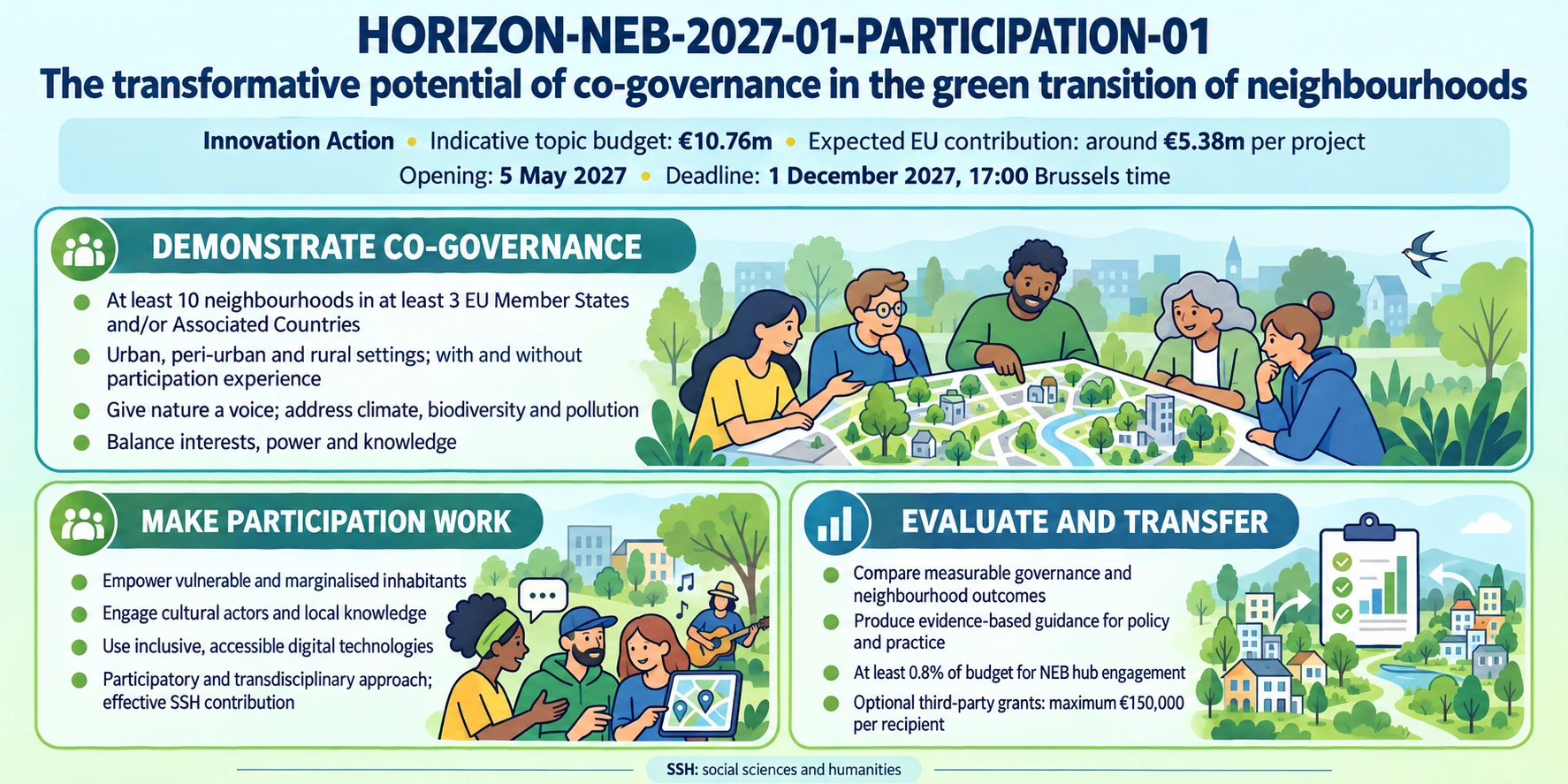
HORIZON-NEB-2027-01-PARTICIPATION-01: The transformative potential of co-governance in the green transition of neighbourhoods
How can nature influence neighbourhood decisions when it cannot join the discussion?
One practical approach is to make ecological interests explicit: identify the living systems affected, examine their responses to change, and make the interpretation of that evidence open to discussion. A more-than-human perspective considers how human lives depend on, and affect, other species and natural systems. In two Helsinki allotment gardens, Lukasik and colleagues used interviews and observation to examine how gardeners adjusted their practices in response to rats. Their study illustrates negotiated coexistence in a specific setting, rather than a universal governance model. [1]
Download the MIC Horizon Europe 2026/2027 Calls Calendar:
Discover more!
Call facts and the demonstration framework
Which call is it, and when is the opening and the deadline?
- Topic: HORIZON-NEB-2027-01-PARTICIPATION-01, under the destination ‘Connecting the green transformation, social inclusion and local democracy’. Official topic page
- Action: Innovation Action; forthcoming, single-stage call.
- Planned opening: 5 May 2027. Deadline: 1 December 2027, 17:00 Brussels local time.
- Indicative topic budget: €10.76 million. Expected EU contribution: around €5.38 million per project, with two projects indicatively expected. Proposals requesting different amounts may be submitted and selected.
The New European Bauhaus work programme expects demonstrations in at least ten neighbourhoods across at least three Member States and/or Associated Countries, spanning urban, peri-urban and rural contexts and differing participation experience.
Beneficiaries may provide financial support to third parties as grants, up to €150,000 per recipient, for the experimental and demonstration work. This is an optional mechanism. Proposals are also expected to allocate at least 0.8% of their budget to engagement with the NEB hub for results and impact.
The General Annexes govern eligibility and grant conditions. The usual consortium minimum is three independent legal entities in three different eligible countries, including at least one in a Member State and two others in Member States or Associated Countries. The neighbourhood demonstration requirement is additional.
What co-governance must change in neighbourhoods
The HORIZON-NEB-2027-01-PARTICIPATION-01 topic concerns shared public decision-making and management across organisations and levels of governance. Its ambition reaches society, culture, the arts, the natural environment and the perception of neighbourhoods. Proposals are expected to address all five dimensions below:
- Nature and the green transition: use more-than-human approaches while addressing climate, biodiversity and pollution.
- Power and knowledge: balance interests and asymmetries among inhabitants, developers, businesses, cultural institutions and other neighbourhood actors.
- Inhabitant agency: enable active participation, especially for vulnerable or marginalised groups.
- Digital participation: use digital technologies to improve inclusion, accessibility, transparency and efficiency. Artificial intelligence is an example, not a prescribed technology.
- Culture and local knowledge: involve cultural actors and informal knowledge, including knowledge embedded in communities and cultural heritage.
The demonstrations must support measurable evaluation and comparison. Expected outputs include evidence-based guidance for policymakers and neighbourhood actors, with recommendations for the administrative, legislative and regulatory changes that could enable co-governance at other levels.
Design evaluation around influence, context and ecological change
A useful evaluation plan should follow a decision from its initial framing to implementation. Record who helped define the problem, whose proposals changed the selected option, and how disagreements were resolved. Attendance alone does not show how participants influenced the outcome.
Hölscher and colleagues studied nature-based-solution co-production in Genk, Glasgow and Poznań. They identified tensions between adaptable collaborative processes and established municipal arrangements, and emphasised approaches suited to local contexts and sustained relationships. Their analysis centres on policy officers’ experience; it does not establish how every participant perceived the process. [2]
For this topic, a practical design would combine:
- A common comparison framework: decision influence, representation, access to knowledge, transparency and follow-through, with locally defined indicators.
- A baseline for each neighbourhood: existing institutions, previous participation, conflicts and the environmental issue being addressed.
- Linked social and ecological observations: record governance changes alongside appropriate environmental measures, while examining other explanations for change.
Agree with local actors how findings will be interpreted and returned to the community. Plan ownership, maintenance and continued use of the governance arrangements after the funded demonstrations end.
Build the consortium around neighbourhood relationships
The HORIZON-NEB-2027-01-PARTICIPATION-01 topic requires an effective social sciences and humanities contribution, including relevant experts and institutions, and expects a participatory, transdisciplinary approach. These responsibilities belong throughout the project design and evaluation.
- Local authorities and community organisations connect the work to real decisions, local access and participation arrangements.
- Governance and SSH specialists design the comparative inquiry, investigate power and knowledge, and evaluate inclusion.
- Cultural actors and practitioners contribute local interpretation, heritage knowledge and ways of engaging people beyond formal meetings.
- Ecologists and environmental specialists identify relevant living systems, observations and environmental assessment methods.
- Digital-participation partners develop accessible tools and connect their use with face-to-face processes.
These are recommended functions, not a prescribed consortium size. Assign responsibility for the relationship with each neighbourhood, for cross-site comparison and for NEB hub engagement. Where third-party grants are proposed, explain their connection to the demonstrations and the support recipients will need to carry out their work.
The MIC already brings its expertise in microfluidics to Horizon Europe:
H2020-NMBP-TR-IND-2020

Microfluidic platform to study the interaction of cancer cells with lymphatic tissue
H2020-LC-GD-2020-3

Toxicology assessment of pharmaceutical products on a placenta-on-chip model

About the author

Céleste Chidiac, PhD
Scientific writer and digital marketing specialist
Céleste Chidiac holds a doctorate in neuroscience and molecular biology from the University of Strasbourg. Since joining the Microfluidics Innovation Center in 2023, she has combined scientific writing with website management. For MIC’s Horizon Europe topic pages, she draws on her research background to explain scientific challenges and clarify funding priorities. Her writing helps prospective applicants understand each topic’s scope, expected outcomes and research directions.
FAQ — Ecological evidence and inclusive neighbourhood decisions
These questions explore practical choices behind more-than-human participation, comparison between neighbourhoods and a possible microfluidic testing contribution.
Who can speak for nature in a co-governance process?
No single representative can capture every ecological interest. A practical arrangement could combine ecological expertise, residents’ observations and explicit responsibility for considering affected species or habitats. Make the evidence, assumptions and disagreements visible so that the representation itself can be questioned.
Can findings from an urban garden be applied to an entire neighbourhood?
They can suggest questions to investigate, but need contextual testing. Lukasik and colleagues studied two allotment gardens and noted that their participants did not reflect Helsinki’s full social diversity. Other species, places and communities may require different arrangements. [1]
How should a project include people who avoid digital participation tools?
Design an equivalent route through in-person or assisted participation. A practical evaluation could compare who uses each route, what they can contribute and whether contributions reach the same decision process. Ask excluded groups about barriers before selecting the platform.
What should happen when local knowledge and measurements disagree?
First check whether they concern the same place, period and phenomenon. Keep both accounts visible while investigating the mismatch. A proposed protocol could record the disagreement, commission a targeted follow-up observation and document how any remaining uncertainty affects the decision.
How can neighbourhoods with different participation histories be compared?
Compare change from each neighbourhood’s starting conditions and describe the institutional context. Hölscher and colleagues found that co-production processes needed to fit their setting and intended participants. [2] A shared evaluation framework can retain local explanations instead of reducing every case to one score.
What sample information should accompany a proposed MIC experiment?
Agree the requirements with the environmental and assay partners before collection. A useful record would include sampling location and time, collection and preparation methods, storage conditions, dilution and sample identifiers. The experiment should retain a traceable link to the neighbourhood question it addresses.
How could laboratory results be presented without overstating them?
Present the measured endpoint, comparison condition and uncertainty together. Explain which sample and exposure the result describes, then separate that observation from the proposed environmental interpretation. The consortium could develop a short explanation with residents and test whether readers understand those boundaries.
References
[1] Lukasik, K. M., Linturi, M. and Aivelo, T. Codes of conduct for just coexistence in urban spaces. npj Urban Sustainability. 2025;5:55. doi:10.1038/s42949-025-00232-w
[2] Hölscher, K., Frantzeskaki, N., Kindlon, D., Collier, M. J., Dick, G., Dziubała, A., Lodder, M., Osipiuk, A., Quartier, M., Schepers, S., Van De Sijpe, K. and van der Have, C. Embedding co-production of nature-based solutions in urban governance: Emerging co-production capacities in three European cities. Environmental Science & Policy. 2024;152:103652. doi:10.1016/j.envsci.2023.103652