
Community investment and ownership: sustaining neighbourhood assets over time
Opening
5 May 2027
Deadline
Keywords
Community equity
Environmental assessment
Occupant equity
Collective ownership
service assets
Long-term affordability
Participatory research
Your microfluidic SME partner for Horizon Europe
We take care of microfluidic engineering, work on valorization and optimize the proposal with you
HORIZON-NEB-2027-01-BUSINESS-02: Innovative models for collective community investment and ownership
How can a community asset remain collectively owned as its members change?
Collective ownership needs rules that connect individual entry and exit to the asset’s continuing purpose. A departing member, a new occupant and the people maintaining the building have different needs. Examining those transitions makes long-term stewardship a research question. In a qualitative study of housing cooperatives in Geneva and Zurich, Sanchez-Bajo described member withdrawal alongside collective management and reinvestment practices. These observations concern specific Swiss cases, rather than a universal ownership formula. [1] For HORIZON-NEB-2027-01-BUSINESS-02, the challenge is to develop models that sustain community benefit beyond the founding group.
Download the MIC Horizon Europe 2026/2027 Calls Calendar:
Discover more!
Call facts and the choice between two thematic options
Which call is it, and when is the opening and the deadline?
Topic: HORIZON-NEB-2027-01-BUSINESS-02, under the destination “Innovative funding and new business models for the transformation of neighbourhoods”. Official topic page.
The New European Bauhaus (NEB) work programme sets the following conditions:
- Type of action: Research and Innovation Action (RIA), with lump-sum funding and a single-stage submission.
- Calendar: opening on 5 May 2027; deadline on 1 December 2027 at 17:00 Brussels local time. The work programme permits adjustments to the planned dates.
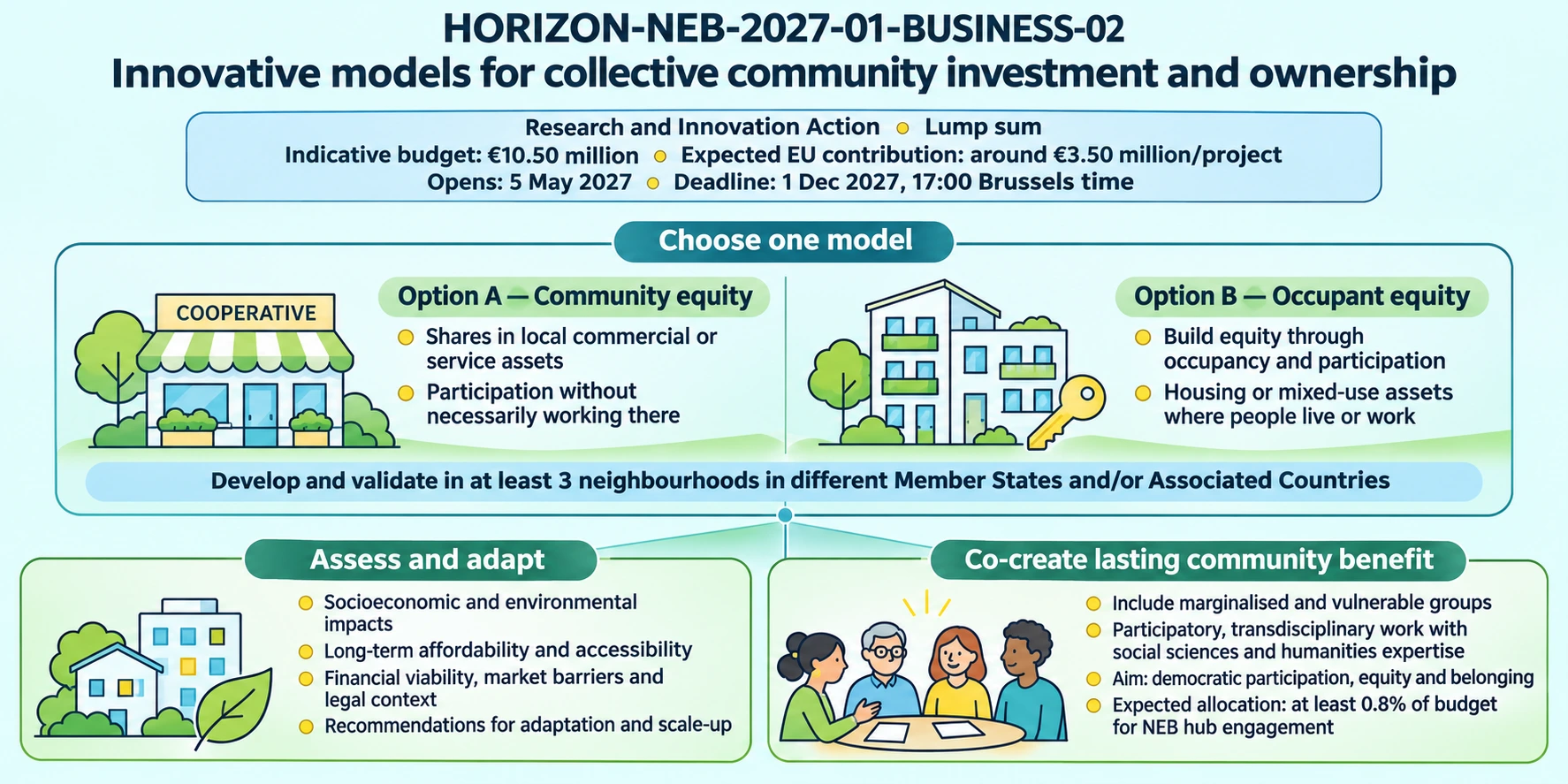
- Funding: indicative topic budget of €10.50 million; expected EU contribution of around €3.50 million per project. Different requested amounts remain possible. Three projects are indicatively expected to be funded.
- Thematic selection: proposals must clearly identify option A or B. The portfolio rule provides for at least the highest-ranked qualifying proposal in each option, provided all thresholds are met; awards therefore do not follow ranking alone.
Under the General Annexes, the standard consortium minimum is three independent legal entities in three different countries: at least one in an EU Member State and two others in different Member States or Associated Countries. The RIA maximum funding rate is 100%. Applicable entity, country, capacity and other eligibility conditions also apply. No topic-specific technology readiness level is prescribed.
Develop a model that gives residents a lasting stake
The HORIZON-NEB-2027-01-BUSINESS-02 topic addresses how communities can collectively invest in, own, manage and benefit from local assets. The model should involve diverse stakeholders, including marginalised people and those in vulnerable situations, in neighbourhood revitalisation aligned with the NEB.
- Option A — Community equity investment: enable stakeholders to acquire shares in cooperative and community-based commercial or service assets, benefit from them and participate in their development without necessarily working there.
- Option B — Occupant equity: enable stakeholders to build equity through occupancy and participation in developing cooperative and community-based housing or mixed-use assets where they typically live or work.
Proposals are expected to develop and validate the chosen model in at least three neighbourhoods in different Member States and/or Associated Countries. Assessment covers socioeconomic and environmental impacts, including long-term affordability, accessibility, community benefit and public interest. It also needs to address local capital and property-market conditions, long-term financial viability, relevant investment and ownership regulations, and barriers to uptake.
The intended outcomes combine community co-creation and participation with stronger local democracy, social equity, cohesion, belonging and local economic development. Recommendations should explain how the model can be adapted and expanded in other local and cultural settings. NEB alignment also calls for attention to the quality and cultural meaning of shared places, alongside sustainability and inclusion.
Validate the model across membership changes and local conditions
A useful research design follows the model through joining, using, maintaining and leaving. These are suggested evaluation choices, to be adapted to the selected option. Define whose contributions create equity, how participants exercise influence, and what happens when a household or business leaves.
For each neighbourhood, establish a baseline and an explicit comparison. Track access costs, participation, the distribution of benefits, maintenance responsibilities and the resources needed to keep the asset operating. Test scenarios such as changing occupancy, higher maintenance costs or delayed member replacement. Report assumptions separately from observed outcomes.
Combine financial and organisational records with residents’ experiences. Avilla-Royo and Bilbao examined Barcelona housing strategies using project analysis, stakeholder interviews and post-occupancy ethnography. Their work connects procurement decisions with how inhabitants actually use their homes and shared spaces. [2] For this topic, an analogous mixed-method approach could reveal whether formal access becomes practical participation.
Use shared core indicators across sites, with local measures for different assets and communities. Assess environmental effects relevant to each redevelopment, such as resource use or land condition. Explain which effects follow from the ownership model, which follow from physical works, and where attribution remains uncertain. Long-term projections should remain distinct from effects observed during the project.
Build the consortium around community decisions and implementation
The HORIZON-NEB-2027-01-BUSINESS-02 topic expects a participatory and transdisciplinary approach and requires effective contributions from social sciences and humanities (SSH). Community stakeholders should help shape the model and its evaluation, with workable arrangements for people who cannot attend frequent meetings or contribute substantial upfront capital.
A suitable consortium could combine community organisations and asset operators with housing or cooperative-finance researchers, legal specialists, local authorities, designers and environmental assessors. These are recommended interfaces, not a prescribed partner list. Legal and financial specialists would examine the model in each jurisdiction; community partners would test its usability and relevance.
Agree who records decisions, resolves practical disagreements, maintains the asset and uses the results after the research. Dissemination can include a model description, locally reviewed implementation guidance and evidence explaining where adaptation is needed. MIC could contribute technical specifications, laboratory transfer and exploitation planning for a relevant experimental task through its Horizon Europe partnership work.
Proposals are expected to allocate at least 0.8% of their budget to engagement with the Horizon Europe-funded “New European Bauhaus hub for results and impact”, including sharing intermediate and final findings and contributing to impact assessment. Give this work defined responsibilities and outputs.
The MIC already brings its expertise in microfluidics to Horizon Europe:
H2020-NMBP-TR-IND-2020

Microfluidic platform to study the interaction of cancer cells with lymphatic tissue
H2020-LC-GD-2020-3

Toxicology assessment of pharmaceutical products on a placenta-on-chip model

About the author

Céleste Chidiac, PhD
Scientific writer and digital marketing specialist
Céleste Chidiac holds a doctorate in neuroscience and molecular biology from the University of Strasbourg. Since joining the Microfluidics Innovation Center in 2023, she has combined scientific writing with website management. For MIC’s Horizon Europe topic pages, she draws on her research background to explain scientific challenges and clarify funding priorities. Her writing helps prospective applicants understand each topic’s scope, expected outcomes and research directions.
FAQ — Community assets, research methods and environmental evidence
These questions explore practical distinctions in collective ownership research and the use of laboratory evidence within neighbourhood assessment.
Does owning a share automatically give someone an effective voice?
No. Financial participation and practical influence are different dimensions. Evaluation should examine who can raise an issue, understand a proposal and influence a decision. Sanchez-Bajo’s Swiss case research describes collective decision-making alongside member investment; it does not show that ownership alone produces equal influence. [1]
How can a project preserve knowledge when founding members leave?
It can document why decisions were made, introduce new members to ongoing responsibilities and provide a way to revise procedures. A useful test is whether newcomers can explain and carry out essential tasks without relying on one founding member. This can be assessed through observed handovers and participant interviews.
Can a low monthly charge still conceal barriers to participation?
Yes. A research assessment should also examine the initial contribution, unpaid work, travel, childcare and the time needed to take part. Reporting these separately makes different barriers visible. A single average payment cannot describe the experience of households with different incomes or available time.
How can self-selection affect claims about community cohesion?
People who join may already be more motivated or better connected than those who do not. A study should therefore document recruitment, reasons for declining and changes from the initial situation. Comparisons and interviews can help distinguish existing differences from changes associated with participation, without assuming that association proves causation.
How can researchers assess the beauty of a collectively owned place?
Combine observation of spatial use with residents’ accounts of comfort, attachment and cultural meaning. The NEB definition of beauty concerns the whole experience of a place. Barcelona post-occupancy research illustrates how inhabitants’ experiences can inform assessment beyond drawings and housing counts. [2]
What can a replication guide share without exposing household finances?
It can share the model’s structure, decision procedures, indicator definitions and aggregated findings. Personal financial records need separate handling under the project’s agreed data arrangements. Illustrative scenarios should be clearly identified as constructed examples, so future users do not mistake them for observed household outcomes.
What does a soil-leachate test represent?
It represents the response to a liquid extract prepared from a soil sample under specified conditions. The microfluidic work within EDAPHOS used continuous leachate exposure to assess nematode growth inhibition. Interpretation must retain the extraction method and exposure conditions; the result does not describe every organism or exposure route in the original soil.
Why combine chemical analysis with an ecotoxicological endpoint?
Chemical analysis characterises substances in the sample; a biological endpoint records a response under the test conditions. EDAPHOS combines chemical, ecological and ecotoxicological evidence. Using these together helps the environmental team examine different aspects of contamination rather than treating a single laboratory response as a complete site assessment.
References
[1] Sanchez-Bajo, C. Emerging commons: cooperative housing in Switzerland. CIDADES, Comunidades e Territórios. 2024; Autumn Special Issue:24–48. DOI: 10.15847/cct.34674. Publication
[2] Avilla-Royo, R. and Bilbao, I. Domestic Cartographies: A Post-Occupancy Ethnographic Assessment of Barcelona’s Social Housing Strategies, 2015–2023. Urban Planning. 2024;9:Article 7860. DOI: 10.17645/up.7860. Publication