
EIC STEP Scale Up Defence: evidence, investment and industrial growth
Opening
1 December 2026
Deadline
Keywords
Critical defence technologies
Industrial scale-up
Equity investment
Investor pre-commitment
Defence end-user
Strategic dependency
TRL6
Your microfluidic SME partner for Horizon Europe
We take care of microfluidic engineering, work on valorization and optimize the proposal with you
HORIZON-EIC-2027-STEP-DEFENCE-01: EIC STEP Scale Up Defence
How can validation evidence remain useful when a technology changes?
Validation evidence remains useful when it can be traced to the product version, intended use and conditions actually assessed. A change to hardware, software or a manufacturing process can alter those conditions. The evidence must therefore show which conclusions still apply and which need further assessment.
For HORIZON-EIC-2027-STEP-DEFENCE-01, this makes the continuity of evidence part of the scale-up question. EIC STEP Scale Up Defence supports companies commercialising critical defence technologies. Its assessment connects technological readiness with customer adoption, industrial growth and the investment needed to deliver them. A credible growth plan explains how the company will maintain the basis for its performance and safety claims as its product and operations evolve.
Download the MIC Horizon Europe 2026/2027 Calls Calendar:
Discover more!
Call facts and investment conditions
Which call is it, and when is the opening and the deadline?
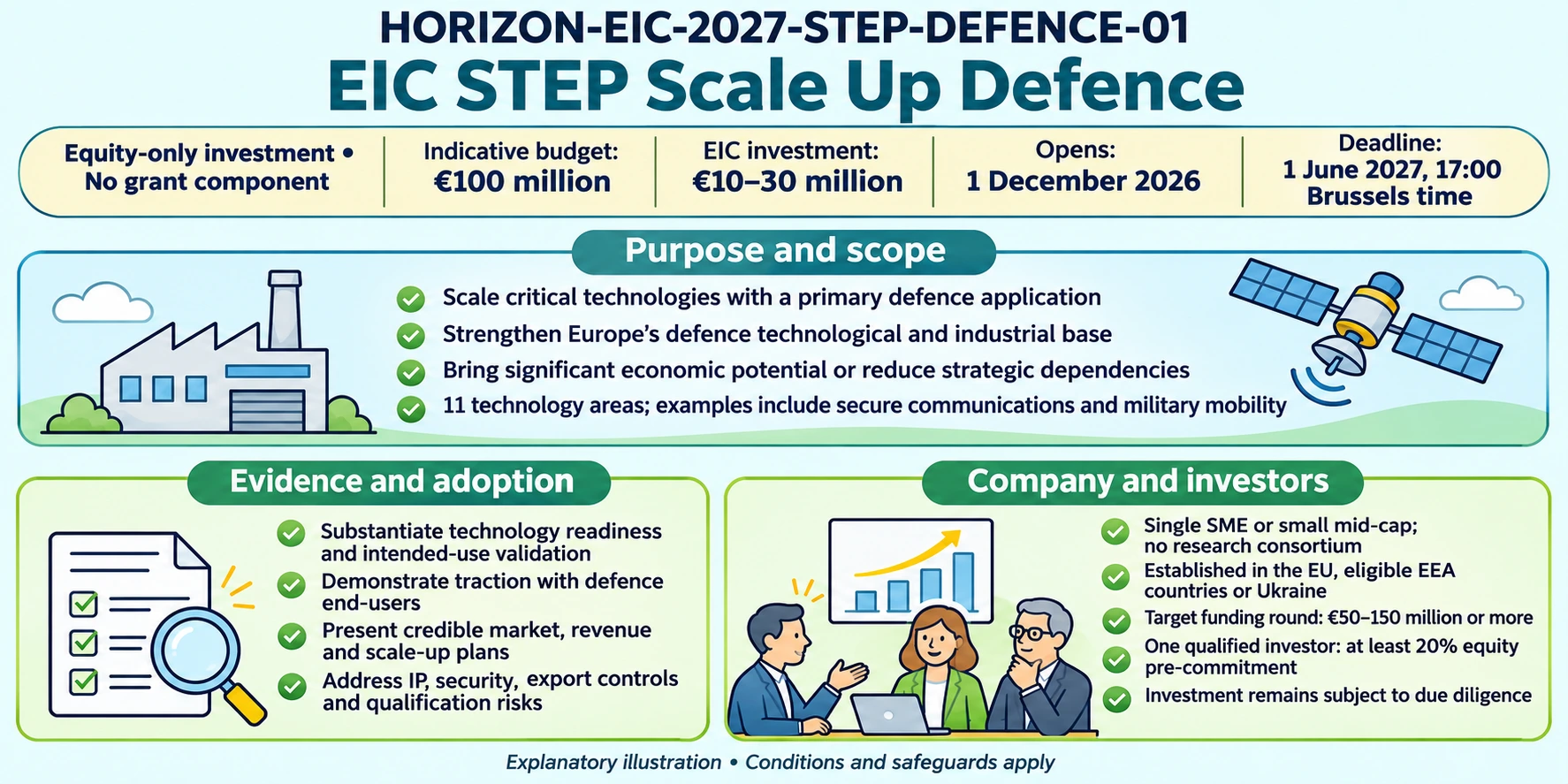
- Work-programme identifier: HORIZON-EIC-2027-STEP-DEFENCE-01. Official title: EIC STEP Scale Up Defence. Official page
- Funding: equity-only investment through the European Innovation Council (EIC) Fund, under a specific EIC Accelerator call. There is no grant component.
- Indicative 2027 budget: €100 million. Requested EIC investment: €10–30 million per company.
- Scheduled opening: 1 December 2026. Single evaluation batch: 1 June 2027 at 17:00 Brussels time. The work programme allows adjustments to the schedule.
Who can apply? A single small or medium-sized enterprise (SME), including a start-up, or a small mid-cap with up to 499 employees, established in the EU, Ukraine or a European Economic Area (EEA) country associated to Horizon Europe. An investor may apply on an eligible company’s behalf with prior agreement; the investment agreement is with the company. Any investment holding company must also meet the specified establishment conditions.
Investor pre-commitment. The target round is €50–150 million or more. One qualified investor must provide a non-binding equity pre-commitment covering at least 20% of that round. The portion meeting this threshold must be fully uninvested when the letter is dated. Quasi-equity does not count towards it; several smaller commitments cannot be pooled to meet the single-investor threshold. The financing plan must also address the call’s requirement to attract at least three to five times the EIC investment from other investors.
Ownership restrictions. Third-country control restrictions apply. For affected companies established in an EU Member State or eligible EEA country, participation requires guarantees approved through the relevant national procedure and made available to the Commission. The EIC’s defence call FAQ clarifies that this guarantee route is unavailable to affected entities established in Ukraine.
Application and selection. The HORIZON-EIC-2027-STEP-DEFENCE-01 submission includes a business plan of up to 50 pages, a pitch deck of up to 15 pages, the investor letter, financial plan, freedom-to-operate analysis or the permitted explanatory note, key personnel CVs and the ownership self-assessment, with guarantees where applicable. Eligibility assessment precedes a jury interview and GO/NO GO evaluation. A positive evaluation remains subject to investment due diligence, negotiation and the EIC Fund’s decision.
Concurrent submissions to the EIC Accelerator, STEP Scale Up and STEP Defence calls are not permitted. From 1 April 2026, three unsuccessful submissions across STEP Scale Up or STEP Defence prevent further applications to those calls under Horizon Europe. Companies should consult Section VII and Annex 2 of the EIC Work Programme 2027 for the complete conditions.
Scientific scope and strategic outcomes
The proposed product, technology or service must have a primary defence application. Predominantly civilian or dual-use solutions are directed to the general STEP Scale Up call. The innovation must also qualify as critical by bringing an innovative, emerging and cutting-edge element with significant economic potential to the internal market, or by reducing or preventing EU strategic dependencies.
The scope covers eleven areas: air and missile defence; artillery and precision strike; missiles and ammunition; drones and counter-drones; strategic enablers; cyber, artificial intelligence (AI) and electronic warfare; military mobility; ground combat; maritime; air combat; and medical and countermeasures. These are alternative areas of relevance, not a requirement to cover all eleven.
The intended outcomes are the growth of companies bringing critical technologies to market, a stronger European Defence Technological and Industrial Base and reduced strategic dependencies. The investment case must connect a specific technological advance to a credible market and a measurable contribution to these objectives.
The HORIZON-EIC-2027-STEP-DEFENCE-01 factsheet positions support at the scaling stage, from Technology Readiness Level (TRL) 6. The work programme requires the current TRL to be substantiated and the technology to be adequately assessed, validated or certified for its intended application. It does not specify a common final TRL for every supported technology.
Connect the growth plan to evidence and adoption
The jury assesses excellence, impact, and risk, implementation and the need for Union support. The following preparation choices help organise evidence against these criteria; they are editorial recommendations, not additional eligibility conditions.
- Separate demonstrated results from planned progress. Identify the version assessed, the responsible organisation, the relevant conditions and the limits of each result.
- Make growth assumptions inspectable. Distinguish confirmed demand, expressions of interest and forecast revenue. Explain how procurement and qualification schedules affect cash needs.
- Connect expenditure to business milestones. Explain how the financing supports industrial capacity, customer adoption and the company’s ability to deliver and support its products.
- Keep an evidence trail through changes. Identify who reviews the implications of product or supplier changes and which existing claims remain supported.
For AI-based products, a headline test score alone can conceal important differences in behaviour. D’Amour and colleagues found that models with similar conventional test performance could behave differently in additional evaluations across computer vision, language and health-related applications. Their study did not validate defence systems. [1]
The proposal should also show why the company cannot finance the full scale-up through market investors alone. A larger market forecast does not by itself explain the financing gap: the argument needs the relevant risks, investment discussions and timing assumptions.
Company, investor and end-user responsibilities
For HORIZON-EIC-2027-STEP-DEFENCE-01, it is a single-company investment application. There is no research-consortium size or multi-country partner quota to assemble. The company remains responsible for its business case, technology, management team and financing plan.
Different relationships still matter. Investors assess the round and commercial risk. Defence end-users provide evidence of demand and a realistic adoption pathway. Industrial suppliers and integration partners inform production assumptions and access to essential capabilities. Specialist advisers can address intellectual property, security, export controls and qualification where needed. These relationships should be described according to their actual status, without presenting discussions as signed commitments.
The award criteria ask whether the team has relevant defence-sector experience and, where necessary, appropriate security clearances. Skills gaps need a credible plan to fill them. Applicants must also demonstrate a credible commitment and concrete ability to engage with the European defence innovation ecosystem.
For planning purposes, assign ownership of each commercial assumption and supporting document. A customer letter should distinguish interest in an evaluation from a procurement commitment. An integration discussion should distinguish a potential route to market from an agreed supply relationship.
Intellectual property, safeguards and investment follow-through
The investment case needs an intellectual-property strategy suited to defence markets and evidence of freedom to operate. The assessment also considers control of the core technology and undue third-country dependencies. Investment safeguards can cover ownership changes, governance, intellectual property, activity location and supply-chain security; restrictions also apply to the lead or co-lead investor.
The company must identify defence-specific risks, including export controls, licensing, classification, security clearances, certification and procurement timelines. Additional ethical requirements include respect for international humanitarian law and meaningful human control in relevant AI-enabled weapon-system functions.
Classified supporting information has a separate submission route. Applicants wishing to provide it must contact EISMEA at least 30 working days before the deadline to arrange delivery. Classified material must not be uploaded to the Funding & Tenders Portal.
After selection, the EIC Fund examines the company in due diligence and negotiates investment terms. The amount may be reduced or the investment rejected for justified reasons. The Commission award decision can include up to €5 million of additional flexibility, subject to the conditions and available funds described in the work programme; this does not change the €10–30 million application range.
The Sovereignty (STEP) Seal recognises proposals meeting the relevant evaluation thresholds, including some proposals not retained because of budget limitations. It does not guarantee investment. Associated support includes Business Acceleration Services and fast-track access to the EU Defence Innovation Scheme’s accelerator. The funding aims to retain most of the company’s value, including intellectual property, in the EU, eligible EEA countries and Ukraine.
The MIC already brings its expertise in microfluidics to Horizon Europe:
H2020-NMBP-TR-IND-2020

Microfluidic platform to study the interaction of cancer cells with lymphatic tissue
H2020-LC-GD-2020-3

Toxicology assessment of pharmaceutical products on a placenta-on-chip model
About the author

Céleste Chidiac, PhD
Scientific writer and digital marketing specialist
Céleste Chidiac holds a doctorate in neuroscience and molecular biology from the University of Strasbourg. Since joining the Microfluidics Innovation Center in 2023, she has combined scientific writing with website management. For MIC’s Horizon Europe topic pages, she draws on her research background to explain scientific challenges and clarify funding priorities. Her writing helps prospective applicants understand each topic’s scope, expected outcomes and research directions.
FAQ - HORIZON-EIC-2027-STEP-DEFENCE-01: Evidence, adoption and scale-up planning
These questions explore how to interpret technical evidence and commercial relationships when preparing a defence technology scale-up case.
What is the difference between verification and validation?
Verification asks whether a product meets its specified requirements. Validation asks whether it is suitable for the intended use. A record can support one without answering the other, so the claimed result should identify the question assessed and the conditions covered.
Does a high TRL establish manufacturing readiness?
No. Technology Readiness Level describes technological maturity. A growth plan also needs evidence about repeatable production, supplier capacity, quality assurance and delivery. Treat manufacturing readiness as a separate question rather than inferring it from a TRL label.
Is a customer letter evidence of future revenue?
Only to the extent of the commitment it actually records. Interest in a demonstration, an intention to evaluate and a purchase order represent different commercial positions. Forecasts should preserve those distinctions and state which further decisions must occur before revenue is expected.
Does owning a patent establish freedom to operate?
No. Patent ownership and freedom to operate address different questions. A company may own rights to an invention while its commercial implementation depends on other protected technology. The assessment should concern the intended product, activities and markets, with appropriate specialist review.
Can an AI benchmark establish reliability in every application?
No. A benchmark supports conclusions within its evaluation setting. D’Amour and colleagues showed that similar conventional test performance could coexist with different behaviour in additional evaluations. Their evidence came from several civilian machine-learning domains, not defence qualification. [1]
How should simulated and measured results be presented?
Identify each result as simulated, calculated or measured. Describe the assumptions and conditions relevant to its interpretation. A simulation can inform a development decision, but it should not be presented as evidence that the physical product has achieved the same result.
Does interoperability mean that two products can connect?
Connection is only one part of interoperability. The products must also exchange and use information or services as intended. Any claim should identify the relevant interfaces and configurations, and distinguish a planned integration from one that has been assessed.
What makes a scale-up milestone useful to an investor?
A useful milestone identifies a decision, observable evidence and a responsible owner. It should show what uncertainty will be reduced and how that affects the commercial plan. Completing an activity alone does not establish customer acceptance or future sales.
Why include maintenance and support in the business model?
The customer’s ability to keep a product in use affects its value and the supplier’s continuing obligations. A business model should account for the support, updates, spares or training actually needed by the product, with assumptions consistent with the company’s resources.
How can a dependency claim be made more precise?
Name the capability or input involved and explain why it is difficult to replace. Distinguish supplier concentration, intellectual-property restrictions and access to production capacity. Then identify what the company’s proposed growth would change, without assuming that European establishment alone removes the dependency.
References
[1] D’Amour, A., Heller, K., Moldovan, D., et al. Underspecification Presents Challenges for Credibility in Modern Machine Learning. Journal of Machine Learning Research. 2022;23(226):1–61. Publisher record and full text.