
EIC STEP Scale Up: financing the expansion of strategic technologies
Opening
18 November 2026
Deadline
Keywords
Strategic technologies
Equity investment
IP strategy
Industrial scale-up
Private co-investment
Innovation
Digital & deep tech
Clean technology
Biotechnologies
Your microfluidic SME partner for Horizon Europe
We take care of microfluidic engineering, work on valorization and optimize the proposal with you
HORIZON-EIC-2027-STEP-01: EIC Strategic Technologies for Europe Platform (STEP) Scale Up Call
Why can a small supplier constrain the scale-up of an entire technology?
A supplier can become a bottleneck when it provides an essential input that customers cannot readily replace. Its importance then depends on its position in the production network as well as its size. Diem and colleagues reconstructed Hungary’s company supply network from tax records and modelled how individual company failures propagate. Their analysis found that company size alone did not explain systemic importance; these were simulated disruptions, not observed losses from a particular technology deployment. [1]
For HORIZON-EIC-2027-STEP-01, this provides one way to examine strategic value: identify which capability a growing company adds to a technology value chain and which dependency it can reduce. The European Innovation Council (EIC) STEP Scale Up call supports large investment rounds for critical technologies. Applicants can establish criticality through significant economic potential from an innovative, emerging and cutting-edge technology, or through reducing or preventing EU strategic dependencies.
Download the MIC Horizon Europe 2026/2027 Calls Calendar:
Discover more!
Call facts: equity, applicants and evaluation batches
Topic reference: HORIZON-EIC-2027-STEP-01 — EIC Strategic Technologies for Europe Platform (STEP) Scale Up Call (topic pdf). The application portal lists the call as EIC STEP Scale Up (HORIZON-EIC-2027-STEP).
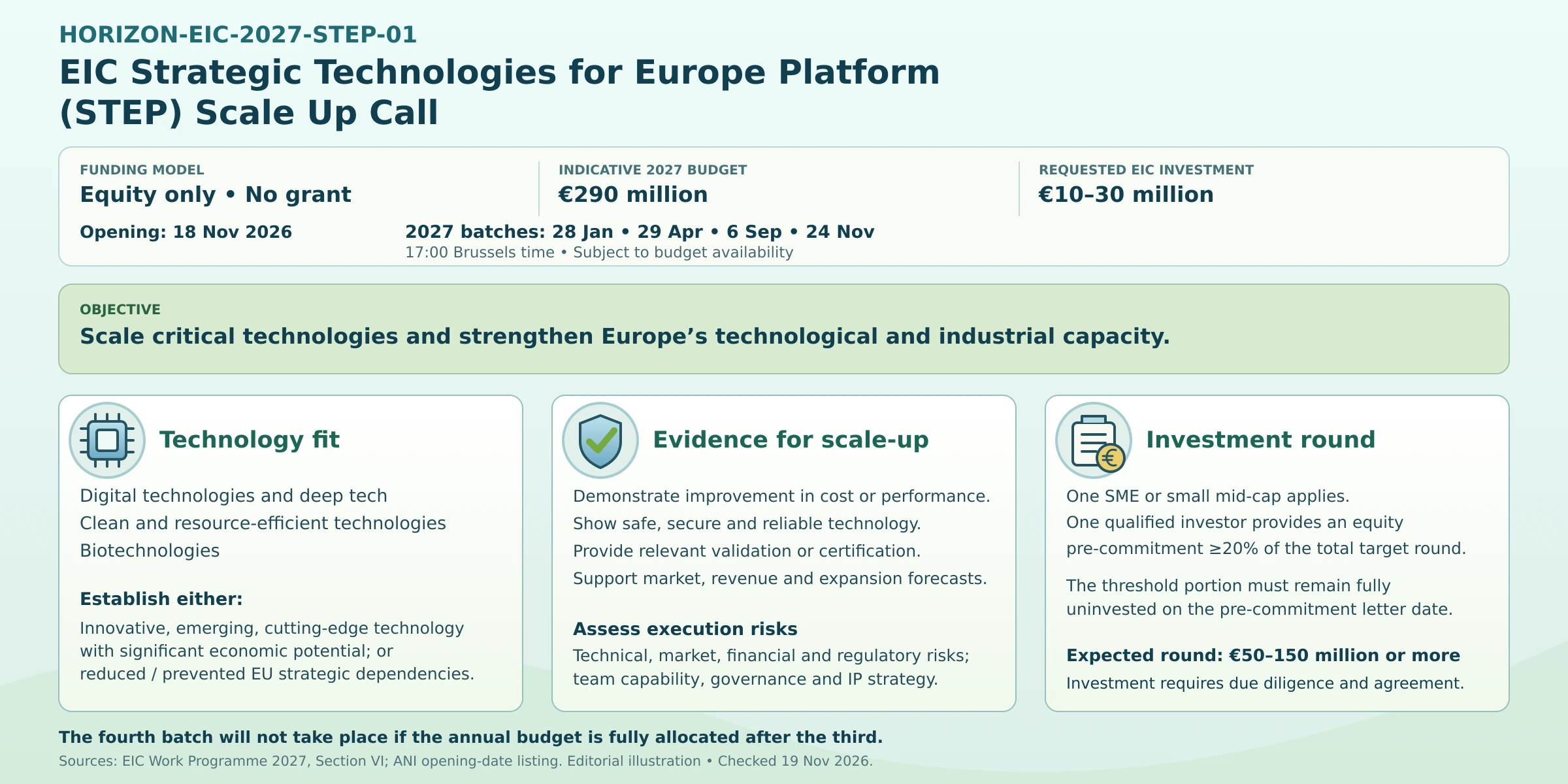
- Funding: EIC equity-only investment, managed by the EIC Fund, with no grant component. The indicative 2027 budget is €290 million; requested investments must be €10–30 million.
- Opening: 18 November 2026, as listed by Portugal’s Horizon Europe contact-point portal. Applications are submitted continuously and evaluated in batches.
- 2027 batching dates: 28 January, 29 April, 6 September and 24 November, each at 17:00 Brussels time. Batches depend on budget availability; the fourth will not take place if the annual budget is fully allocated after the third.
- Applicant: one small or medium-sized enterprise (SME), including a startup, or a small mid-cap with up to 499 employees, established in an EU Member State or an eligible Associated Country. The United Kingdom is excluded from EIC Fund investment. An investment holding company must also be established in a Member State or eligible Associated Country.
- Investor-led submission: an investor may apply on behalf of an eligible company with its prior agreement. The selected company signs the investment agreement.
- Pre-commitment: one qualified investor must provide an equity pre-commitment covering at least 20% of the total target round. That threshold portion must be fully uninvested on the letter’s date. Smaller commitments cannot be aggregated to meet it, and quasi-equity does not count. The pre-commitment is non-binding and subject to assessment.
The EIC Work Programme 2027, Section VI and Annex 2 governs the conditions. Concurrent applications to the Accelerator, STEP Scale Up and STEP Defence are prohibited. From 1 January 2026, three unsuccessful submissions across the two STEP calls prevent further applications to either under Horizon Europe.
Which technologies and strategic outcomes fit?
HORIZON-EIC-2027-STEP-01 covers three technology sectors. Digital technologies and deep-tech innovations include semiconductors, artificial intelligence, quantum technologies, advanced sensing and robotics. Clean and resource-efficient technologies include energy technologies, advanced materials, manufacturing, recycling and water technologies. Biotechnologies include molecular, cell and tissue technologies, process biotechnology and relevant critical medicines.
Belonging to one sector is only the starting point. The company must demonstrate an innovative, emerging and cutting-edge element with significant economic potential in the EU internal market, or a contribution to reducing or preventing EU strategic dependencies. The expected direction is commercial expansion of critical technologies and stronger European technological and industrial capacity.
Semiconductor and quantum startups receive particular attention in 2027. This call can also support potential dual-use applications while advancing civilian use; dedicated defence technologies have a separate STEP Defence call.
For a dependency-reduction case, map the affected input, production capability or service and the customers that need it. Production-network research shows why tracing supplier relationships can reveal vulnerabilities missed by looking at company size alone. Applying that insight to an applicant requires its own supply and substitution evidence. [1]
Build a technical case for production at scale
The award criteria assess the innovation’s scientific or technological advance, its improvement in cost or performance, technological feasibility and intellectual property (IP). They ask whether the technology has been developed safely, securely and reliably and adequately assessed, validated or certified.
A useful evidence plan links each scale-up claim to a test and an acceptance criterion. The following are preparation recommendations, to adapt to the technology:
- Compare equivalent functions. Benchmark the proposed solution against credible alternatives under comparable operating conditions. Explain the boundary of each cost or performance comparison.
- Demonstrate repeatable delivery. For manufactured products, examine variation between batches, usable output, rejection rates and production constraints. For digital technologies, examine performance, reliability and resource use at the intended deployment load.
- Separate evidence from projections. Identify measured results, modelled capacity and assumptions about future production. State what remains to be demonstrated before customers can use the expanded output.
- Connect failures to decisions. Define responses to technical, supplier, market and regulatory risks, including who acts and which milestone is affected.
Useful outputs include a comparative performance report, validation records, a scale-up plan and a risk register. These are suggested evidence formats, not additional mandatory call deliverables. The investment assessment concerns the company’s technology and expansion plan, rather than a prescribed consortium research programme.
Connect the company, investors and industrial partners
The applicant for HORIZON-EIC-2027-STEP-01 is a single company. Build the delivery model around its management team, investors, suppliers, manufacturing partners and customers. Define responsibilities for technical acceptance, production capacity, regulatory work and customer qualification without presenting external organisations as joint grant beneficiaries.
The financial plan should explain how the requested EIC investment enables a larger round, expected in the range of €50–150 million or more. The support description specifies a total round of at least three to five times the EIC contribution. The investment-leverage award criterion also asks for a credible plan to attract at least three to five times the EIC amount from other investors. Show the EIC contribution, other-investor commitments and total round separately.
The qualified investor providing the pre-commitment can be an existing investor and need not lead the round. Its relevant market, technology and jurisdiction experience and know-your-customer screening matter. Explain the investment gap, current discussions and intended closing timetable.
For planning, connect expenditure to an identifiable expansion milestone, such as qualified production capacity or customer deployment. Test how delayed sales, slower production ramp-up or additional validation affect financing needs. Keep the company’s governance, team capabilities and recruitment plan consistent with that timetable.
From business plan to investment decision
The required HORIZON-EIC-2027-STEP-01 application contains a business plan of up to 50 pages, a PDF pitch deck of up to 15 pages, the investor pre-commitment, the financial plan, freedom-to-operate evidence and key-personnel CVs. The business plan must explain ownership, financial structure and the contribution to STEP objectives. Where a freedom-to-operate analysis is unavailable, the programme allows an explanatory note of up to two pages; where irrelevant, a statement is required.
Eligible applications proceed to a jury interview. If no recent technology due-diligence report is available, a suitably qualified external expert conducts one. Evaluation covers excellence, market and STEP impact, team capability, investment risk, financing and risk management.
A positive jury recommendation does not complete the investment. Detailed due diligence, the EIC Fund Investment Committee’s decision and negotiation of the investment agreement follow. The authorised amount can be reduced or rejected for justified reasons.
Companies meeting the relevant evaluation thresholds can receive the Sovereignty (STEP) Seal and access Business Acceleration Services, including when budget availability prevents an investment recommendation. The Seal facilitates access to other funding opportunities; it does not guarantee finance. Investment safeguards address European interests and retention of most company value, including IP, in the EU or Associated Countries.
The MIC already brings its expertise in microfluidics to Horizon Europe:
H2020-NMBP-TR-IND-2020

Microfluidic platform to study the interaction of cancer cells with lymphatic tissue
H2020-LC-GD-2020-3

Toxicology assessment of pharmaceutical products on a placenta-on-chip model

About the author

Céleste Chidiac, PhD
Scientific writer and digital marketing specialist
Céleste Chidiac holds a doctorate in neuroscience and molecular biology from the University of Strasbourg. Since joining the Microfluidics Innovation Center in 2023, she has combined scientific writing with website management. For MIC’s Horizon Europe topic pages, she draws on her research background to explain scientific challenges and clarify funding priorities. Her writing helps prospective applicants understand each topic’s scope, expected outcomes and research directions.
FAQ — HORIZON-EIC-2027-STEP-01- Evidence and decisions for strategic technology scale-up
These questions explore technical comparisons, supply resilience and the evidence needed to connect industrial expansion with customer adoption.
Is a large addressable market enough to establish strategic value?
No. A large market does not by itself establish the technology’s criticality. The STEP criticality conditions require a qualifying innovation with significant economic potential or a contribution to reducing or preventing EU strategic dependencies. Explain the technology’s contribution within that route, rather than relying on a market-size headline.
Can a small supplier create a large disruption?
Yes, if other companies depend on an input that is difficult to replace. Diem and colleagues’ model of Hungary’s production network found that company size alone did not explain systemic importance. Its results concern simulated disruption propagation, not a prediction for a particular applicant. [1]
Does using two suppliers necessarily create independent supply?
No. Two direct suppliers may rely on the same upstream manufacturer, infrastructure or material source. As a practical assessment, trace the dependencies that could disable both routes and examine whether an alternative is technically qualified. Supplier count alone is an incomplete resilience measure.
How should a cost advantage be compared?
Compare the same useful output under stated assumptions about utilisation, quality, energy, maintenance and lifetime. Distinguish today’s measured cost from a forecast at higher production volume. A transparent comparison makes clear which part of the claimed advantage depends on achieving future scale.
What is the difference between installed capacity and usable output?
Installed capacity describes what equipment is designed to produce under specified conditions. Usable output also depends on uptime, process yield and whether the product meets acceptance criteria. A scale-up forecast should make these assumptions explicit instead of treating equipment capacity as guaranteed customer deliveries.
How can demand evidence be made technically useful?
Connect customer interest to an intended application, purchasing requirements and an acceptance process. Record whether evidence comes from exploratory discussions, a trial, a conditional order or a contract. These signals answer different questions about adoption and should not be presented as equivalent commitments.
Does a patent establish freedom to operate?
No. Patent protection and freedom to operate address different questions. An IP strategy concerns protection and use of the company’s assets; freedom-to-operate analysis considers relevant third-party rights for the intended market. The application treats them as distinct evidence needs, including a specific freedom-to-operate submission requirement.
How should technology evidence be organised for due diligence?
Make each important claim traceable to a test report, data source or justified model. State the tested configuration, operating conditions, acceptance criteria and remaining limitations. This helps reviewers distinguish a demonstrated capability from an assumption in the expansion plan.
Can a regulatory approval replace validation of every new use?
No. Evidence and approvals have a defined scope. A new configuration, application or operating environment may require additional assessment. Map the intended commercial use to the evidence that actually covers it, and include any remaining assessment in the implementation plan.
How can an expansion milestone show real progress?
Define an observable change, such as repeatable output meeting customer specifications or successful qualification of an additional production source. Set the evidence needed to accept the milestone and the decision it enables. Spending money or installing equipment alone does not establish the intended operational result.
References
[1] Diem, C., Borsos, A., Reisch, T., Kertész, J. and Thurner, S. Quantifying firm-level economic systemic risk from nation-wide supply networks. Scientific Reports. 2022;12:7719. doi:10.1038/s41598-022-11522-z