
EIC Accelerator Open 2027: evidence for deep-tech commercialisation and scale-up
Opening
Continuous short-proposal submission
Deadline
Keywords
Deep-tech innovation
Technology validation
Single-company support
Commercialisation
Scale-up
Blended finance
Investment readiness
Your microfluidic SME partner for Horizon Europe
We take care of microfluidic engineering, work on valorization and optimize the proposal with you
HORIZON-EIC-2027-ACCELERATOROPEN-01: EIC Accelerator Open
Can realistic operating cycles make a technology last longer than constant laboratory testing suggests?
Yes, in some systems. The sequence of loads and rest periods can change degradation, even when average operating conditions are comparable. Geslin and colleagues tested commercial lithium-ion cells at 35 °C and found longer life under dynamic discharge profiles than under constant current at the same average current and voltage window. This was a cell-level laboratory study, not a demonstration of vehicle lifetime. [1]
For HORIZON-EIC-2027-ACCELERATOROPEN-01, this raises a practical question about commercialisation: does the validation method represent how customers will use the technology? EIC Accelerator Open supports companies developing and scaling breakthrough innovations across technology fields. A credible proposal connects its technical advantage to evidence from relevant conditions, a viable business model and the resources needed to reach the market.
Download the MIC Horizon Europe 2026/2027 Calls Calendar:
Discover more!
Call facts, funding options and application stages
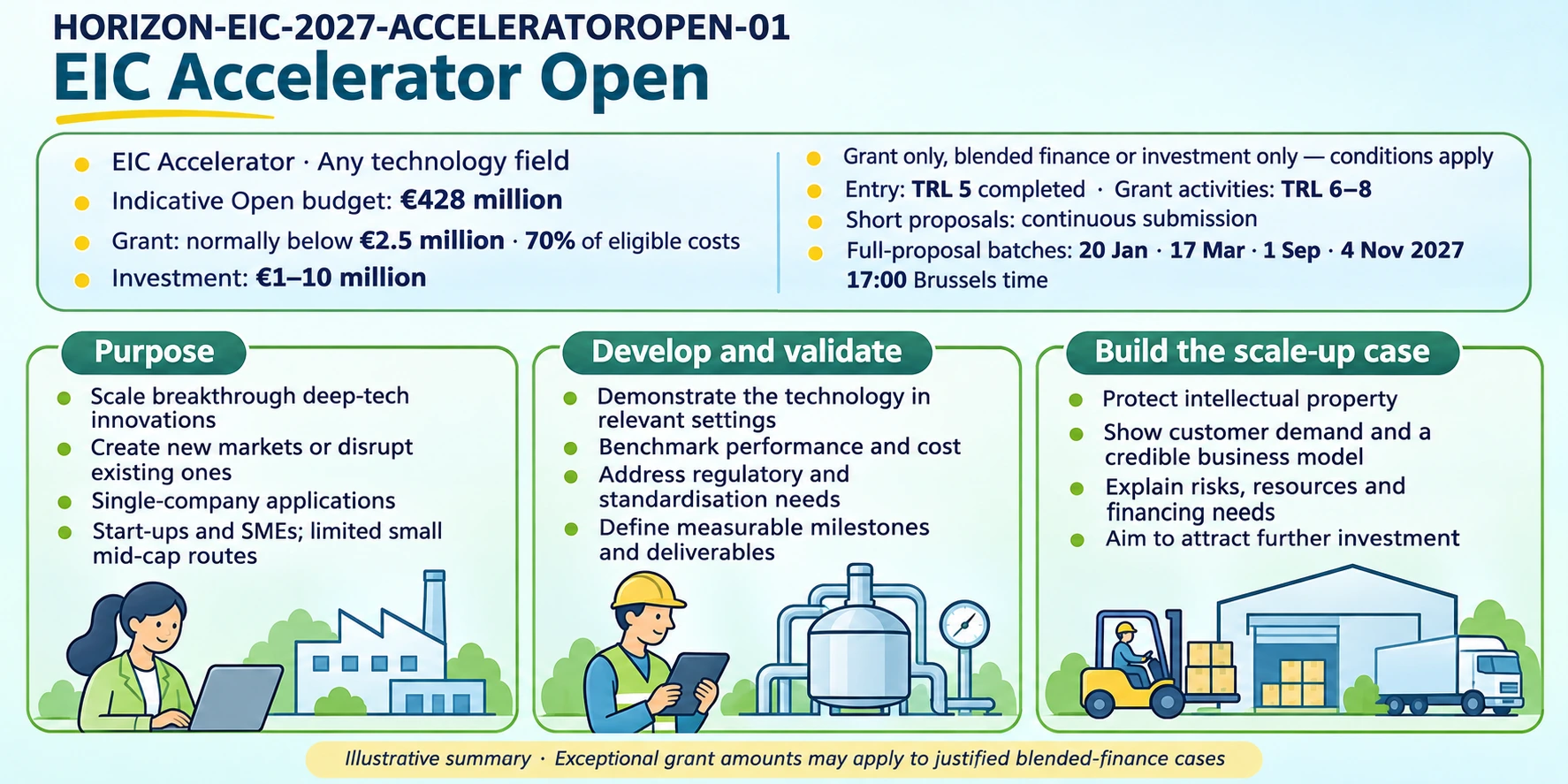
Topic: HORIZON-EIC-2027-ACCELERATOROPEN-01 — EIC Accelerator Open (official page). This is the European Innovation Council’s company-focused funding route for later technology development and scale-up, with no predefined thematic priorities. The indicative 2027 Open budget is €428 million.
Opening and batches. Short proposals may be submitted continuously. Full proposals are batched on 20 January, 17 March, 1 September and 4 November 2027, each at 17:00 Brussels time. These are four full-proposal batching dates, not successive deadlines that every applicant must meet.
Applicants. The principal route is a single start-up or small and medium-sized enterprise (SME) established in an EU Member State or an eligible Associated Country. Small mid-caps with up to 499 employees may request investment only, or exceptionally blended finance for rapid scale-up. The work programme also permits specified applications by people or entities establishing or investing in a company, subject to its establishment and representation conditions. Country-specific restrictions apply; UK applicants are eligible for grant-only support.
- Grant only: a lump sum for eligible innovation activities; available only once per beneficiary during Horizon Europe, with additional conditions including the capacity and willingness to scale up.
- Blended finance: a grant combined with equity or quasi-equity investment.
- Investment only: equity or quasi-equity for eligible companies and activities.
The standard grant ceiling for EIC-2027-ACCELERATOROPEN is €2,499,999, covering up to 70% of eligible costs. Exceptionally, a higher grant may be justified for blended finance. The beneficiary finances the remaining 30% of grant-component work packages from its own resources. The investment component ranges from €1 million to €10 million, with terms assessed individually.
Technology readiness. All aspects of Technology Readiness Level (TRL) 5 must be completed: validation in a relevant environment. Grant activities cover TRL 6–8 and should normally finish within 24 months; longer durations require justification.
The standard selection route is a short proposal, a full proposal and a jury interview. The short submission includes a 12-page form, up to ten pitch slides and a video of up to three minutes. The full form is limited to 20 pages, with a pitch deck, video and required annexes. Fast Track and Plug-in routes have separate conditions. Selection is followed by grant preparation and, where requested, investment due diligence.
Submission limits and concurrent-application restrictions also matter. After three unsuccessful submissions by the same legal entity counted from 1 January 2024, further Accelerator applications under Horizon Europe are barred. Concurrent submissions to Accelerator, STEP Scale Up and STEP Defence Scale Up before feedback on the earlier submission are not permitted. The EIC Work Programme 2027 and official Accelerator FAQs provide the detailed conditions.
What an open technology scope requires
EIC-2027-ACCELERATOROPEN describes the absence of thematic priorities. Applicants still need a breakthrough innovation grounded in scientific or technological advances, with a significant performance or cost improvement over existing or alternative solutions. The company must show the potential to create a market or change an existing one.
Define the product, the intended customer and the application before presenting the underlying technology. Explain the limiting feature of current solutions and the evidence that the proposed innovation overcomes it. Keep measured results, simulations and future targets distinct. An impressive component result needs a clear connection to the performance of the proposed product.
Expected progress combines technology maturation with business growth: a stronger technical demonstration, credible market entry and a route to further investment. The full evaluation examines excellence, impact, and risk, implementation and the need for Union support. Each criterion has a 4/5 threshold and the overall threshold is 13/15; reaching these thresholds does not itself secure funding.
Potential dual-use applications may be supported while advancing civilian use. Investment in artificial intelligence, quantum, semiconductor and biotechnology applications is subject to specific safeguards. These provisions do not impose a preferred technology on the Open call.
Build validation around the proposed product
A useful design approach is to connect each commercial claim to a test, a comparator and a decision. Define the operating conditions, acceptance limits and evidence needed to move to the next development step. Use the same product configuration when comparing performance, cost and reliability, or explain the differences.
The battery study illustrates why matching the average load alone can be insufficient when assessing ageing. Its findings concern the tested cell chemistry and protocols. [1] For another technology, the appropriate validation must follow that technology’s own failure mechanisms and use conditions.
- Technical demonstration: record performance against an identified alternative under relevant conditions.
- Product integration: test the interfaces, controls and maintenance requirements that affect the complete system.
- Production readiness: assess repeatability, yield, supply dependencies and quality controls where manufacturing is part of the business.
- Market access: identify the tests, standards and approvals relevant to the intended application.
Translate these activities into measurable milestones and deliverables. A demonstration report should state the configuration tested, method, results and remaining limits. A production assessment should connect output quality to resources and cost. These are planning recommendations; the call does not prescribe one universal pilot design or validation protocol.
Organise the company and its external interfaces
The EIC-2027-ACCELERATOROPEN funds a single-company application. Its implementation plan should therefore make the company’s responsibilities clear, including technical leadership, commercial decisions, financial management and ownership or access to the necessary intellectual property.
Identify skill gaps against the proposed work. A manufacturer, test laboratory, prospective customer or regulatory specialist may contribute a defined service or source of evidence. Explain the inputs each external organisation needs, the output expected and who accepts it. Letters of interest should distinguish an intended discussion, a planned trial and an actual purchasing commitment.
Subcontracting is permitted within the grant component; subcontracting activities essential to the project objectives requires justification. The company should retain the knowledge and oversight needed to use the results and manage dependencies. Avoid presenting access to an external facility as confirmed until the relevant arrangements exist.
For the team, connect recruitment and governance plans to delivery risks. Explain who will turn test results into product decisions and who will manage customer adoption as the company grows.
Connect development milestones to the financing need
For EIC-2027-ACCELERATOROPEN, the investment case should explain why the financing requirement exceeds what market actors can provide alone and how EIC support would help attract further capital. Identify the unresolved technological, market, regulatory and financial risks, together with specific measures to reduce them.
A useful financial model links development milestones to spending and commercial assumptions. Show when the company needs production capacity, specialist staff, regulatory work and working capital. Test the consequences of slower customer adoption, delayed validation or lower manufacturing yield. Keep the size of the addressable market separate from the share the company expects to win.
For grant-only support, demonstrate access to the resources needed for commercialisation and scale-up. For blended finance or investment only, explain the proposed financing path and the role of other investors. EIC Fund due diligence determines the investment decision and terms; selection is not an automatic investment payment.
Successful applicants also receive access to Business Acceleration Services. Coaching, market connections and investor engagement can support implementation, while the company remains responsible for the quality of its evidence and business decisions.
The MIC already brings its expertise in microfluidics to Horizon Europe:
H2020-NMBP-TR-IND-2020

Microfluidic platform to study the interaction of cancer cells with lymphatic tissue
H2020-LC-GD-2020-3

Toxicology assessment of pharmaceutical products on a placenta-on-chip model

About the author

Céleste Chidiac, PhD
Scientific writer and digital marketing specialist
Céleste Chidiac holds a doctorate in neuroscience and molecular biology from the University of Strasbourg. Since joining the Microfluidics Innovation Center in 2023, she has combined scientific writing with website management. For MIC’s Horizon Europe topic pages, she draws on her research background to explain scientific challenges and clarify funding priorities. Her writing helps prospective applicants understand each topic’s scope, expected outcomes and research directions.
FAQ - EIC-2027-ACCELERATOROPEN: Technical evidence and commercialisation decisions
These questions examine how to interpret product evidence, manage uncertainty and make validation useful for commercial decisions.
What is a duty cycle?
A duty cycle describes how operating conditions change over time, including active periods, peaks and rests. In the battery study, dynamic discharge and constant-current protocols produced different ageing trajectories. [1] For a product test, the duty cycle should correspond to the use pattern the test is intended to represent.
Does a conservative laboratory test always predict customer performance?
No. A test may deliberately stress a product, but the resulting performance cannot automatically be translated into a customer-use estimate. Explain which conditions the test represents and which remain outside its scope. Keep a stress-test result separate from a validated service-life prediction.
What makes a comparison with an existing solution meaningful?
The comparison must address the same user task with compatible boundaries and conditions. Include the resources and supporting equipment needed by each solution. If one result comes from measurement and another from a model or supplier specification, make that difference explicit.
Why should a test report include unsuccessful runs?
Unsuccessful runs help distinguish a repeatable capability from a favourable result. Record exclusions, failures and their causes using criteria defined before analysis. Otherwise, the evidence can hide the operating conditions in which customers would encounter problems.
How can a company distinguish measurement uncertainty from product variation?
Measurement uncertainty concerns how well a test estimates a quantity; product variation concerns differences between units or runs. Use calibration, repeated measurements and suitable sampling to assess them separately. A precise measurement of one selected unit does not establish consistency across production.
What is the difference between a deliverable and a milestone?
A deliverable is an output, such as a test report or integrated demonstrator. A milestone is a decision point supported by evidence. A useful milestone states what must be demonstrated before the team proceeds, changes the design or revises its development plan.
Does customer interest establish willingness to pay?
No. Interest, participation in a trial and a purchase commitment provide different kinds of evidence. Ask who controls the purchasing decision, what adoption requires and how value is assessed. Describe the status of each customer interaction accurately.
Does a patent establish freedom to operate?
No. Protection for an invention and the ability to commercialise a product without infringing others’ rights are separate questions. The product, intended markets and relevant third-party rights need their own assessment. The EIC full-proposal requirements include an intellectual-property strategy and a freedom-to-operate analysis if available.
How should software updates be handled during validation?
Record the software version used for each result and identify which functions an update changes. Reassess the tests affected by those changes. Combining results from different versions without explaining their differences can obscure which product configuration the evidence supports.
How should a company choose between redesigning and narrowing the first application?
Compare the evidence needed for each route, the resources available and the customer problem still addressed. A narrower initial use may be useful if it retains a meaningful advantage and can be supported by the validation data. State the restricted use clearly and test broader claims separately.
References
[1] Geslin, A., Xu, L., Ganapathi, D., Moy, K., Chueh, W. C. and Onori, S. Dynamic cycling enhances battery lifetime. Nature Energy. 2025;10(2):172–180. Published online 9 December 2024. doi:10.1038/s41560-024-01675-8