
EIC PATHFINDER CHALLENGE 2 2027: Controlled continual learning for reliable AI agents
Opening
27 May 2027
Deadline
Keywords
CLOWAI
Continual learning
Open-world AI
Novelty detection
Reliable adaptation
resilience
Update governance
Long-horizon evaluation
Your microfluidic SME partner for Horizon Europe
We take care of microfluidic engineering, work on valorization and optimize the proposal with you
HORIZON-EIC-2027-PATHFINDERCHALLENGES-01: Safe and Controlled Continual Learning in Open World for Reliable AI Agents (CLOWAI)
Why can an AI agent retain old skills yet lose its ability to learn new ones?
Retaining old skills and remaining able to acquire new ones are different properties. A neural network can preserve previous behaviour while becoming less responsive to further training, a problem called loss of plasticity. Dohare and colleagues observed declining learning capacity in continual image-classification experiments and simulated reinforcement-learning tasks. Selectively reinitialising less-used units helped maintain plasticity in those settings; the experiments did not establish the safety of deployed agents. [1]
For EIC Pathfinder challenge 2 2027, this distinction makes reliability a moving target. CLOWAI seeks agents that can adapt after deployment while keeping their behaviour within a defined operational purpose. The research must connect learning mechanisms to evidence that updates remain controlled, explainable and auditable over time.
Download the MIC Horizon Europe 2026/2027 Calls Calendar:
Discover more!
Call conditions and the CLOWAI funding framework
Which call is it, and when does it open?
Call identifier: HORIZON-EIC-2027-PATHFINDERCHALLENGES-01. CLOWAI is the second Challenge, described in section II.2.2 of the EIC Work Programme 2027.
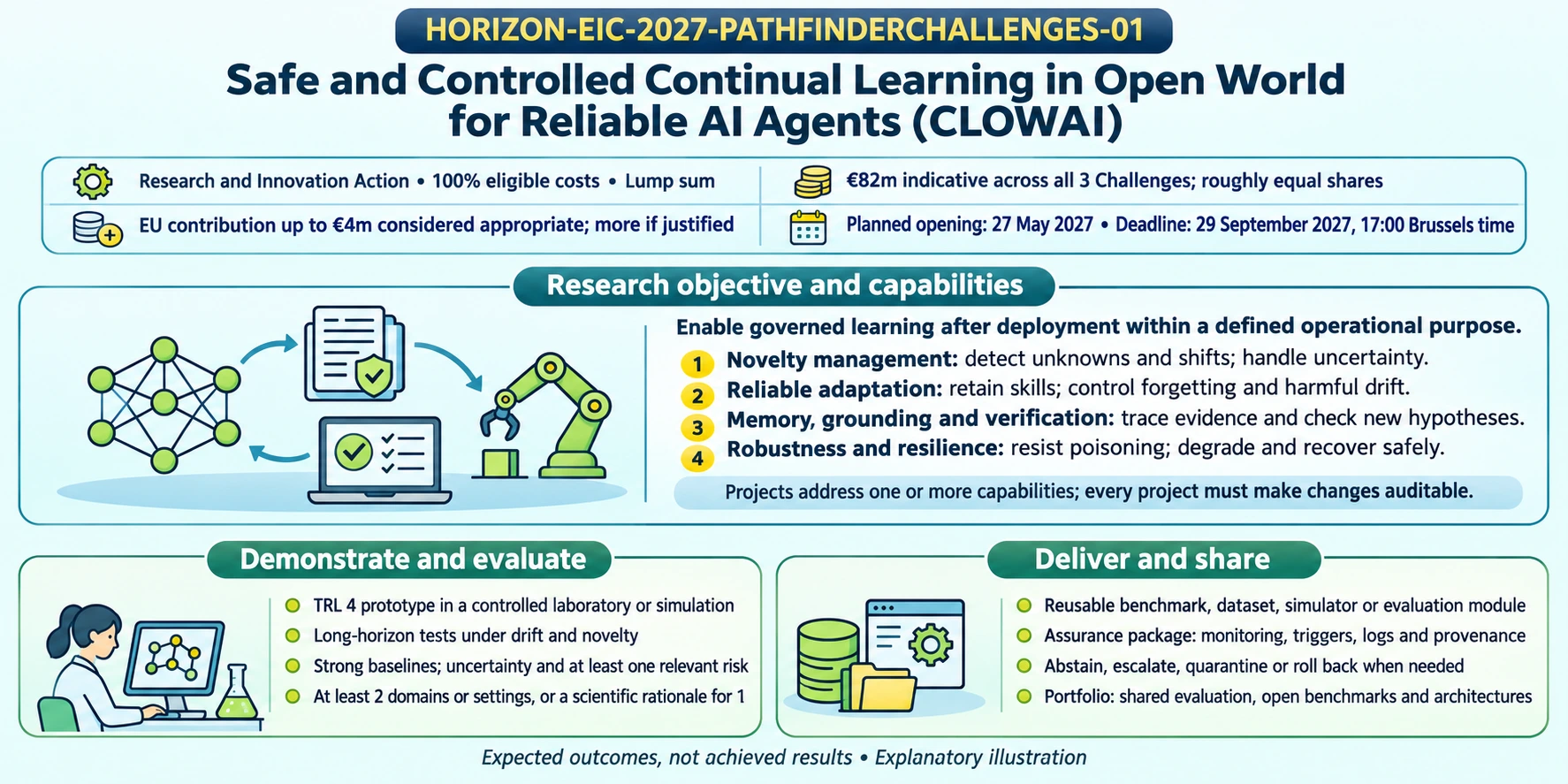
- Action and funding: Research and Innovation Action, with a lump-sum grant covering 100% of eligible costs. An EU contribution of up to €4 million is considered appropriate; a larger request is possible with due justification.
- Schedule: opening 27 May 2027; deadline 29 September 2027 at 17:00 Brussels local time. The work programme permits adjustments to these dates.
- Budget: €82 million indicative for the entire Pathfinder Challenges call, expected to be shared approximately equally among its three Challenges. This is not a CLOWAI-only allocation.
- Application: one submission, followed by individual proposal assessment and portfolio selection. Sections 1–3 of Part B have a maximum of 30 A4 pages.
Who can apply?
A single applicant must be established in an EU Member State or Associated Country; mid-caps and larger companies cannot apply alone. Two-entity consortia need independent entities in two different Member States or Associated Countries. Larger consortia must include at least three independent beneficiaries in three different countries, with at least one in a Member State and two others in Member States or Associated Countries. Annex 2 governs additional eligibility, funding and participation restrictions.
Evaluation considers Excellence, Impact and Implementation, weighted 50%, 30% and 20%, with respective thresholds of 4/5, 4/5 and 3/5. Passing these thresholds leads to portfolio consideration, where scientific complementarity also matters.
Which research capabilities does CLOWAI target?
EIC Pathfinder challenge 2 2027, CLOWAI, funds scientific foundations, methods and validation assets for continual learning in open worlds. Here, open-world conditions mean that tasks, contexts or data distributions evolve beyond those anticipated during training. Proposals should address one or more of four capability areas:
- Novelty management: recognise unfamiliar inputs, diagnose shifts and use uncertainty to decide when to abstain or escalate.
- Reliable adaptation: balance learning capacity with retention, control harmful drift and support verification and rollback.
- Memory, grounding and verification: manage persistent knowledge and conflicting evidence, connect decisions to trusted sources, and check exploratory hypotheses or plans.
- Robustness and resilience: withstand manipulation and poisoning, with appropriate degradation and recovery when information or sensors become unreliable.
Every EIC Pathfinder challenge 2 2027 funded project must demonstrate auditable and explainable learning and model changes, including provenance, data/model lineage and operational controls. Human-readable explanations are expected where appropriate to the deployment context. The scope includes updates to model parameters and/or persistent adaptive state; a frozen model with an ordinary retrieval interface does not, by itself, demonstrate the requested governed adaptation.
Safety must be assessed after adaptation. Qi and colleagues found that benign fine-tuning could weaken safety alignment in the tested GPT-3.5 Turbo and Llama-2-7b-Chat configurations. These experiments concern particular models, datasets and evaluation procedures; they motivate update-specific testing rather than a universal failure rate. [2]
How should a demonstrator establish reliable adaptation?
In EIC Pathfinder challenge 2 2027, the expected endpoint is a validated TRL 4 prototype or proof-of-concept demonstrator in a controlled laboratory or simulated setting relevant to the application. Technology readiness level (TRL) 4 here is an early validation target, not evidence of unrestricted operational deployment.
The call expects long-horizon evaluation under drift and novelty, quantitative reliability improvements against strong baselines, and uncertainty handling alongside at least one relevant risk dimension. Proposals should demonstrate applicability in at least two distinct application domains or deployment settings, or provide a scientifically justified rationale for single-domain validation.
A useful evaluation design would specify the sequence of changes before comparing methods. Include periods of stability, unexpected inputs, recurring conditions and recovery after a rejected update. Compare the proposed method with a frozen system and credible adaptation baselines under the same data access, memory and computational constraints. These are design recommendations, not additional prescribed baselines.
Measure the cost of adaptation as well as its benefit: retained task performance, response to new conditions, failures during transition, recovery time and resource use. Separate the data used to trigger learning from the evidence used to accept an update.
Uncertainty should also be evaluated over time. Gibbs and Candès developed adaptive conformal prediction methods and tested them on financial-volatility and COVID-19 forecasting data. Their results concern prediction-set coverage under changing distributions; they do not establish end-to-end agent safety. [3]
Organise the team around learning and evaluation interfaces
For EIC Pathfinder challenge 2 2027, build the research team around the interfaces between learning, system integration and evaluation. Continual-learning specialists need a shared specification with the people responsible for memory, tools, runtime controls and the chosen application. Evaluation expertise should shape the experimental design early enough to expose failures in the proposed architecture.
For a multi-setting demonstration, identify what transfers between settings: a novelty detector, an update policy, a memory mechanism or an assurance method. Explain what changes, such as observations, tools, consequences of error or available human oversight. Two datasets from nearly identical conditions may offer little evidence of transfer; justify the scientific distinction between the selected settings.
Assign responsibility for accepting or rejecting changes, maintaining evaluation assets and interpreting failures. Specify which partners provide application knowledge and access to test environments, without treating those contributions as already committed unless agreements exist.
Selected projects are expected to collaborate within a Programme Manager-led portfolio. The work programme advises a dedicated portfolio work package with at least 10 person-months. This is advice, distinct from the expectation to participate in joint activities. Plan dissemination and intellectual-property protection around the specific outputs that others should be able to reuse.
Make update assurance and reusable outputs part of the research
Each EIC Pathfinder challenge 2 2027 project is expected to contribute a reusable asset, such as an evaluation harness, simulator scenario, benchmark task, dataset slice, baseline implementation or documented module. Describe who will use the asset, what it tests and which assumptions limit its reuse.
The expected assurance and governance package should connect monitoring signals to update decisions. Specify triggers for abstention, escalation, quarantine and rollback, together with logs that explain what changed and why. A practical implementation could version the model, persistent memory and relevant configuration together, so an evaluator can reconstruct the state behind a decision.
At portfolio level, the aims include a common evaluation framework, at least one open benchmark suite spanning virtual and physical or embodied agents, and complementary reference architectures for cloud and edge/hybrid deployment. These are collective portfolio outputs; an individual project should make its contribution explicit without claiming responsibility for the entire portfolio.
Expected benefits include sustained performance as conditions change, fewer costly re-engineering cycles and greater control over agent behaviour. An exploitation plan should explain the evidence an intended user would need before adopting the research output. Laboratory results should retain their application boundaries when presented to future users.
The MIC already brings its expertise in microfluidics to Horizon Europe:
H2020-NMBP-TR-IND-2020

Microfluidic platform to study the interaction of cancer cells with lymphatic tissue
H2020-LC-GD-2020-3

Toxicology assessment of pharmaceutical products on a placenta-on-chip model

About the author

Céleste Chidiac, PhD
Scientific writer and digital marketing specialist
Céleste Chidiac holds a doctorate in neuroscience and molecular biology from the University of Strasbourg. Since joining the Microfluidics Innovation Center in 2023, she has combined scientific writing with website management. For MIC’s Horizon Europe topic pages, she draws on her research background to explain scientific challenges and clarify funding priorities. Her writing helps prospective applicants understand each topic’s scope, expected outcomes and research directions.
FAQ — EIC Pathfinder challenge 2 2027: Technical choices for controlled continual learning
These questions examine persistent memory, uncertainty, oversight and evaluation choices that affect how a learning agent behaves over time.
Does retrieval-augmented generation count as continual learning?
Not automatically. Retrieval-augmented generation supplies external information to a model without necessarily changing its parameters. CLOWAI also allows persistent adaptive state, so a memory-based approach can be relevant when it learns from deployment experience and includes governed updates, validation and traceability. Adding retrieval alone does not establish those properties.
What is normative drift?
Normative drift is a gradual departure from the operational, safety, legal or ethical constraints specified for an agent. It differs from a change in input distribution. Evaluation should therefore check whether the agent still respects its constraints even when its task performance improves.
Does replaying old examples guarantee continued learning capacity?
No. In the class-incremental CIFAR-100 experiments of Dohare and colleagues, loss of plasticity arose even though earlier data remained available. Retention and the ability to acquire new knowledge therefore need separate measurements. The result concerns the tested learning systems, not every replay method. [1]
Does a well-calibrated prediction set make an agent safe?
No. Prediction-set coverage describes how frequently outcomes fall within the reported sets under the method’s evaluation conditions. It does not verify tool permissions, action consequences or the integrity of stored memory. Gibbs and Candès studied online predictive uncertainty; an agent needs additional application-specific controls. [3]
How does grounding differ from a plausible explanation?
Grounding connects a claim or action to evidence that can be checked, such as a tool result, sensor observation, database entry or explicit constraint. A fluent explanation can still lack that connection. For an updating agent, preserve the evidence source and test whether the connection remains valid after changes.
Should a user correction immediately enter persistent memory?
A user correction should first pass the system’s evidence and update policy. Check its source, scope and possible conflicts with established information. When evidence is insufficient, quarantine the candidate update or seek review. CLOWAI allows human feedback as evidence or an approval signal; it does not require accepting every correction.
What should a safety regression test compare after fine-tuning?
Compare behaviour before and after the update on relevant safety cases, alongside the intended task benefit. Keep evaluation conditions comparable and record the training configuration. Qi and colleagues’ benign fine-tuning experiments show why an initially aligned checkpoint cannot substitute for checking the updated model. [2]
Why might restoring model weights fail to reverse an update?
An agent can retain changes in memory, configuration, tool state or external systems as well as in its model weights. Define the recovery boundary and test what is actually restored. Where an action has already affected an external environment, restoring software state alone may not reverse its consequences.
How can human oversight be evaluated?
Test whether overseers receive enough information to decide, can intervene in time and can verify the effect of that intervention. Report escalation frequency, response delays and unresolved cases under the intended operating conditions. Merely including an approval button does not establish effective oversight.
What makes a continual-learning benchmark reproducible?
Record the order and timing of observations, when labels become available, allowed updates, memory limits, random seeds and evaluation checkpoints. Include the initial state and recovery rules. A static dataset can support this work, but the sequential protocol is needed to reconstruct what the agent knew at each decision.
References
[1] Dohare, S., Hernandez-Garcia, J. F., Lan, Q., Rahman, P., Mahmood, A. R. and Sutton, R. S. Loss of plasticity in deep continual learning. Nature. 2024;632:768–774. doi:10.1038/s41586-024-07711-7
[2] Qi, X., Zeng, Y., Xie, T., Chen, P.-Y., Jia, R., Mittal, P. and Henderson, P. Fine-tuning Aligned Language Models Compromises Safety, Even When Users Do Not Intend To! International Conference on Learning Representations (ICLR). 2024. Conference paper
[3] Gibbs, I. and Candès, E. J. Conformal Inference for Online Prediction with Arbitrary Distribution Shifts. Journal of Machine Learning Research. 2024;25(162):1–36. Publication record