
EIC Pathfinder Challenge 1 2027: Advanced materials for electricity grids
Opening
27 May 2027
Deadline
Keywords
Advanced materials
Electricity generation
Grid storage
Power transmission
Laboratory validation
durability
grid resilience
Grid integration
Critical raw materials
Your microfluidic SME partner for Horizon Europe
We take care of microfluidic engineering, work on valorization and optimize the proposal with you
HORIZON-EIC-2027-PATHFINDERCHALLENGES-01: Breakthroughs in Advanced Materials for Electricity Generation, Storage & Transmission
Where should charge move inside an advanced material, and what should stay in place?
An electricity device needs selective transport: the intended charge carriers must move while harmful migration is controlled. In a flow-battery membrane, that can mean conducting charge-balancing ions while restricting the passage of redox-active molecules. Junkai Fang and colleagues showed that changing the chemistry of polymer membrane pores altered chloride transport and molecular selectivity, even with closely comparable pore sizes. [1]
This focus on the paths available to charge connects materials design to device function. For EIC Pathfinder Challenge 1 2027, the research must carry that connection through to a laboratory-validated device and a roadmap for future electrical-grid integration.
Download the MIC Horizon Europe 2026/2027 Calls Calendar:
Discover more!
Call facts, eligibility and the application route
Which call is it, and when does it open?
HORIZON-EIC-2027-PATHFINDERCHALLENGES-01 is the Pathfinder Challenges call identifier. This page concerns EIC Pathfinder Challenge 1 2027 on advanced materials, described in section II.2.1 of the EIC Work Programme 2027.
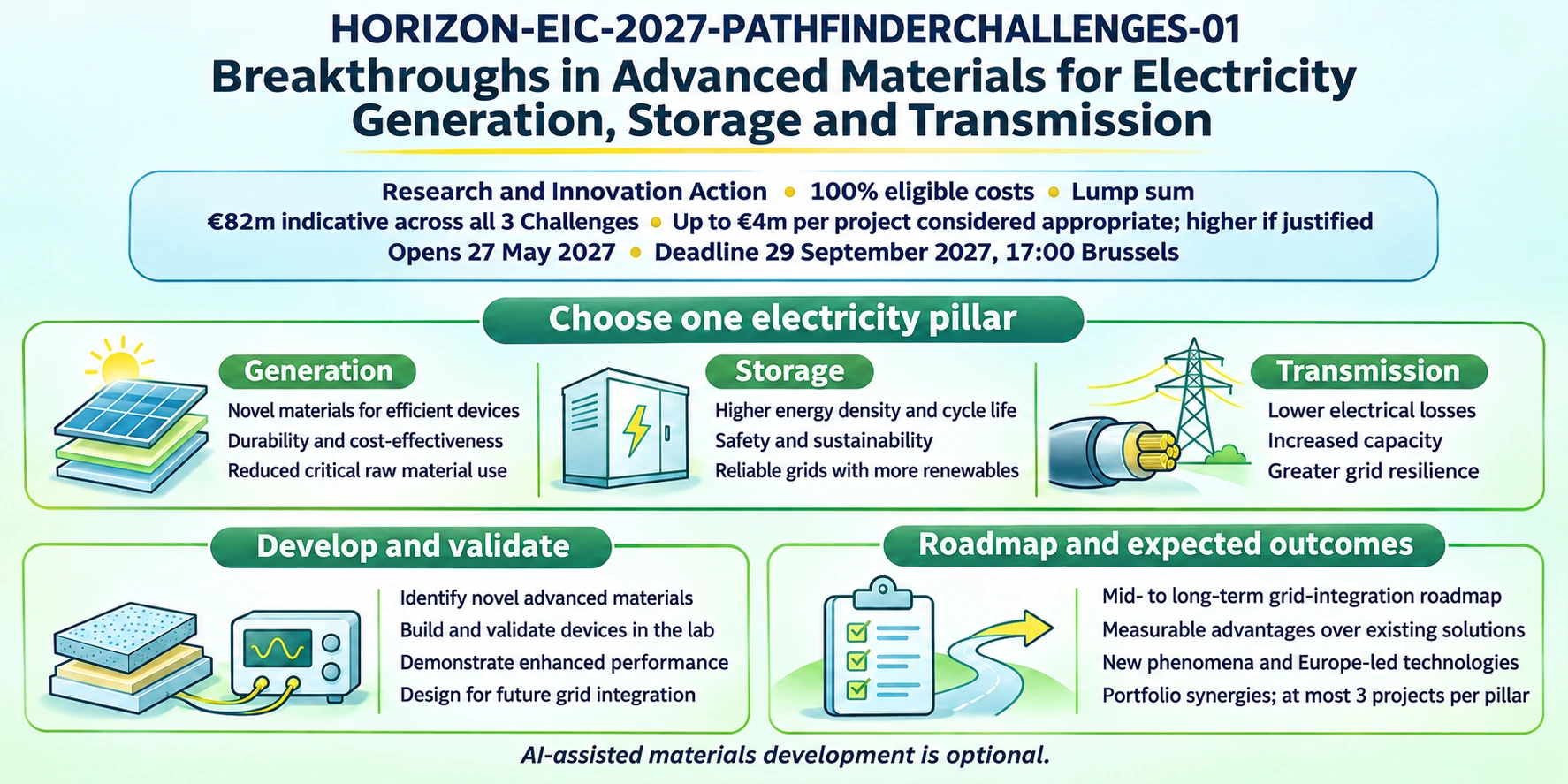
- Action and funding: Research and Innovation Action (RIA), with a lump sum covering 100% of eligible costs. An EU contribution of up to €4 million is considered appropriate; larger requests are possible when duly justified.
- Budget: €82 million indicative for all three Pathfinder Challenges, expected to be allocated in approximately equal shares. This is not a dedicated €82 million allocation to materials.
- Schedule: opening 27 May 2027; deadline 29 September 2027 at 17:00 Brussels local time. The work programme permits adjustments to these dates.
- Application: one submission deadline, followed by individual assessment and portfolio selection. Sections 1–3 of Part B have a 30-page A4 limit.
Who can apply?
A single eligible entity in an EU Member State or Associated Country may apply, except a mid-cap or larger company. Two-entity consortia need independent entities in two different Member States or Associated Countries. Larger consortia need at least three independent entities in different countries, including one Member State and two other Member States or Associated Countries. Annex 2 governs admissibility, country restrictions and funding eligibility.
The common Pathfinder Challenges framework starts at early technology readiness levels, for example TRL 2, and progresses towards proof of concept or laboratory validation, for example TRL 3 or 4. The materials Challenge requires laboratory validation; it does not set a separate numerical final TRL.
One electricity pillar, with a clear materials breakthrough
The EIC Pathfinder Challenge 1 2027 seeks new advanced materials, including nanomaterials, whose novel properties enable a substantial improvement in an electricity device. Proposals should address one of three pillars:
- Generation: breakthrough generators combining higher efficiency, durability and cost-effectiveness with lower use of critical raw materials.
- Storage: systems improving energy density, cycle life, safety and sustainability, with a clear function in renewable-rich grids that need stability, reliability and resilience.
- Transmission: technologies that reduce electrical losses, increase capacity and strengthen grid resilience.
For example, Zheng Fang and colleagues combined surface nano-polishing and passivation in wide-bandgap perovskites, improving charge collection and limiting ion migration. Their four-terminal perovskite/silicon tandem achieved a certified 33.10% efficiency on a 1 cm² aperture area. This was a research-cell result, not a grid-scale generation demonstration. [2]
The membrane study in the introduction offers a storage example: pore chemistry and ion transport were investigated together with an aqueous organic flow-battery application. [1] Neither example defines a required technology. A proposal should explain the new material property, the device function it enables and the scientific uncertainty that makes the research ambitious.
All projects must design their innovations for practical implementation in devices or systems intended for grid integration. Artificial intelligence may accelerate materials development; its use is optional. The Challenge favours European AI engines and data storage in Europe when this route is used.
Validation that connects a material property to device performance
For EIC Pathfinder challenge 1 2027, a useful validation plan follows the proposed causal chain: material composition or structure, measured property, device response and eventual grid benefit. Define the baseline and operating conditions before selecting the most favourable result. The following are proposal-design recommendations, rather than additional call conditions.
- Material evidence: establish composition, structure, interfaces and reproducibility across independently prepared samples. Identify the property that should change and the measurement capable of resolving that change.
- Device evidence: compare the novel material with a relevant reference in a matched device configuration. Report the test area or volume, loading, temperature and electrical operating conditions.
- Durability evidence: examine performance during repeated operation and after relevant stress. State the failure criterion and distinguish laboratory observations from extrapolated service life.
- System evidence: account for auxiliary equipment and integration requirements when projecting a benefit beyond the laboratory device.
Transmission research illustrates why assembly matters. Wu and colleagues measured alternating-current losses in rare-earth barium copper oxide (REBCO) superconducting coil assemblies at 77 K. Adding an iron cylinder increased coil losses under their test conditions. Their simulation-guided method separated coil and core contributions. [3] For a proposed grid device, this supports testing the assembled electromagnetic environment rather than relying on a material label.
Choose milestones that change a technical decision: retaining a composition, revising an interface or rejecting an unsuitable operating range. Quantitative targets should follow the proposed architecture and comparator; the Challenge does not supply a universal percentage improvement for every device.
Consortium expertise and portfolio collaboration
For EIC Pathfinder Challenge 1 2027, build responsibilities around the selected pillar. Materials researchers should connect synthesis and characterisation to the device team’s operating requirements. Electrical engineers can define the relevant grid interface and interpret how laboratory performance would translate into an eventual application. These are expertise recommendations, not prescribed partner categories or a mandatory consortium size.
Assign responsibility for reference measurements, sample traceability and independent replication where useful. Establish who will investigate degradation, quantify critical-raw-material use and assess safety and circularity. The work plan should also address protection and exploitation of results, scientific publication, and relevant regulation, certification and standardisation.
Portfolio participation is part of Pathfinder Challenges. Selected projects work with an EIC Programme Manager and other funded teams towards shared objectives. The work programme advises a dedicated portfolio work package with at least 10 person-months; this is a planning recommendation, not a separate eligibility threshold.
The materials portfolio will compare devices and systems across generation, storage and transmission, with no more than three projects per pillar. Synergies across pillars influence selection. Explain what your approach contributes to that comparison and which results could be shared meaningfully, while respecting intellectual-property arrangements.
A roadmap for future grid integration
In EIC Pathfinder Challenge 1 2027, each project must produce a mid- to long-term roadmap explaining how and when the innovation can enter electrical grids and the measurable advantages it would offer over existing solutions. Laboratory validation and future deployment belong to different stages of that roadmap.
Make the connection concrete by naming the intended device or subsystem and its operating envelope. A useful roadmap can distinguish the evidence produced during the project from subsequent engineering, manufacturing and qualification steps. Identify dependencies such as material supply, repeatable fabrication, interfaces with existing equipment and access to larger testing facilities.
Define comparisons around the service delivered. Generation proposals can relate efficiency gains to durability and material demand. Storage proposals can specify the required discharge duration and duty cycle. Transmission proposals can compare losses and capacity under the intended electrical and thermal conditions. Include assumptions and uncertainty in projections.
The expected contribution is broader than one improved sample: the Challenge aims to reveal new phenomena, establish foundations for European grid technologies, strengthen strategic energy autonomy and create opportunities in the energy-technology sector. Explain which project results would support those outcomes and which later developments remain necessary.
The MIC already brings its expertise in microfluidics to Horizon Europe:
H2020-NMBP-TR-IND-2020

Microfluidic platform to study the interaction of cancer cells with lymphatic tissue
H2020-LC-GD-2020-3

Toxicology assessment of pharmaceutical products on a placenta-on-chip model

About the author

Céleste Chidiac, PhD
Scientific writer and digital marketing specialist
Céleste Chidiac holds a doctorate in neuroscience and molecular biology from the University of Strasbourg. Since joining the Microfluidics Innovation Center in 2023, she has combined scientific writing with website management. For MIC’s Horizon Europe topic pages, she draws on her research background to explain scientific challenges and clarify funding priorities. Her writing helps prospective applicants understand each topic’s scope, expected outcomes and research directions.
FAQ — Material behaviour, measurement and grid-device research
These questions examine experimental interpretation and design choices for advanced materials in EIC Pathfinder Challenge 1 2027.
Can membranes with similar pore sizes transport ions differently?
Yes. Pore chemistry also matters. Junkai Fang and colleagues compared related framework membranes and found different chloride transport and selectivity despite closely comparable pore-size distributions. [1] A membrane comparison should therefore retain chemical composition, hydration and electrolyte conditions alongside pore dimensions.
Does brighter photoluminescence prove higher solar-cell efficiency?
No. Photoluminescence probes how a material emits light; electrical efficiency requires device measurements. Zheng Fang and colleagues combined optical characterisation with electrical testing and independent certification. [2] Use optical signals to investigate the mechanism, then evaluate useful electrical output in the intended device.
Can a laboratory ageing test establish an outdoor service lifetime?
Not on its own. In the perovskite study, the reported stability test used continuous illumination in nitrogen. [2] An outdoor lifetime claim would need evidence covering relevant environmental stresses and operating histories. Report the actual test conditions and distinguish observed degradation from any lifetime model.
Which mass or volume should an energy-density claim use?
State the denominator explicitly: active material, complete cell, module or installed system. For a proposed grid-storage device, report the relevant level and identify excluded components. A material-level value cannot establish an installed system value without accounting for packaging and other necessary equipment.
What makes cycle-life comparisons meaningful?
Specify the cycling protocol and the end-of-life criterion. Include depth of discharge, temperature, charge and discharge rates, rest periods and capacity retention. Compare devices under conditions relevant to the intended grid service; a cycle count without that context gives little basis for choosing between materials.
Does a superconducting material make an AC device loss-free?
No. Superconducting assemblies can still dissipate energy under alternating-current operation. Wu and colleagues measured losses in REBCO coils at 77 K and showed that the surrounding iron cylinder changed those losses. [3] A proposed system assessment should also include the energy required for cooling and auxiliary equipment.
Why can a copper reference coil bias a superconducting loss measurement?
Matching coil ampere-turns does not necessarily reproduce the same magnetic-field distribution in an iron core. Wu and colleagues showed that this mismatch can distort the subtraction used to infer superconducting-coil losses. Their finite-element modelling guided a more appropriate reference geometry. [3]
How should an AI-selected material enter the experimental programme?
Treat it as a candidate requiring synthesis and testing. Record the model, training-data scope, uncertainty and selection rationale, then compare predicted and measured properties. Reserve an experimental test set and report unsuccessful candidates where useful. AI-assisted discovery does not replace the Challenge’s required laboratory device validation.
Does lower critical-raw-material use establish a safer material?
No. Assess resource dependence and safety separately. A proposal should identify the replacement composition, likely exposure routes, hazards and end-of-life handling. Track raw-material demand against a defined device function so that an apparent reduction is not achieved simply by changing the comparison boundary.
How can early experiments support a circularity assessment?
Record material inputs, processing losses, recovery routes and the condition of recovered material. Test whether recovery preserves the property required for a subsequent use. At an early research stage, distinguish measured recovery evidence from proposed recycling processes and document assumptions used in any environmental comparison.
References
[1] Fang, J., Zhang, G., Goulet, M.-A., Zuo, P., Zhou, Y., Li, H., Jiang, J., Guiver, M. D., Yang, Z. and Xu, T. High selectivity framework polymer membranes chemically tuned towards fast anion conduction. Nature Communications. 2025;16:3282. doi:10.1038/s41467-025-58638-0
[2] Fang, Z., Deng, B., Jin, Y., Yang, L., Chen, L., Zhong, Y., Feng, H., Yin, Y., Liu, K., Li, Y., Zhang, J., Huang, J., Zeng, Q., Wang, H., Yang, X., Yang, J., Tian, C., Xie, L., Wei, Z. and Xu, X. Surface reconstruction of wide-bandgap perovskites enables efficient perovskite/silicon tandem solar cells. Nature Communications. 2024;15:10554. doi:10.1038/s41467-024-54925-4
[3] Wu, Y., Fang, J., Miyagi, D., Amemiya, N., Badcock, R. A., Long, N. J. and Jiang, Z. Experimental AC loss study on REBCO coil assemblies coupled with an iron cylinder. Superconductor Science and Technology. 2024;37(5):055010. doi:10.1088/1361-6668/ad3f81