
EIC 2027 ACCELERATOR CHALLENGES 04: Scaling climate solutions and resilient carbon supply
Opening
Continuous short-proposal submission
Deadline
Keywords
Carbon removal, utilisation & storage
Industrial scale-up
climate change
air capture
Environmental verification
EIC challenge
Resource efficiency
Carbon value chains
Your microfluidic SME partner for Horizon Europe
We take care of microfluidic engineering, work on valorization and optimize the proposal with you
HORIZON-EIC-2027-ACCELERATORCHALLENGES-01: Carbon removal and utilisation for climate change mitigation and EU industrial resilience
How does the origin of captured carbon change what a technology can claim?
The origin determines whether a process withdraws atmospheric carbon or recirculates carbon from an industrial source. Its destination then determines whether that carbon stays stored or returns to the atmosphere. Together, origin and destination distinguish carbon removal from the use of captured carbon as a replacement feedstock.
Deutz and Bardow compared direct air capture followed by storage with capture followed by synthetic methane production in a life-cycle assessment using industrial process data. The climate outcome depended on the energy supply and subsequent carbon use; producing a fuel did not provide the same outcome as storage. [1]
EIC 2027 ACCELERATOR CHALLENGES 04 brings these pathways into one industrial challenge: scale technologies that support climate mitigation while strengthening Europe’s supply of carbon for fuels, chemicals and materials.
Download the MIC Horizon Europe 2026/2027 Calls Calendar:
Discover more!
Call facts: company, funding and application stages
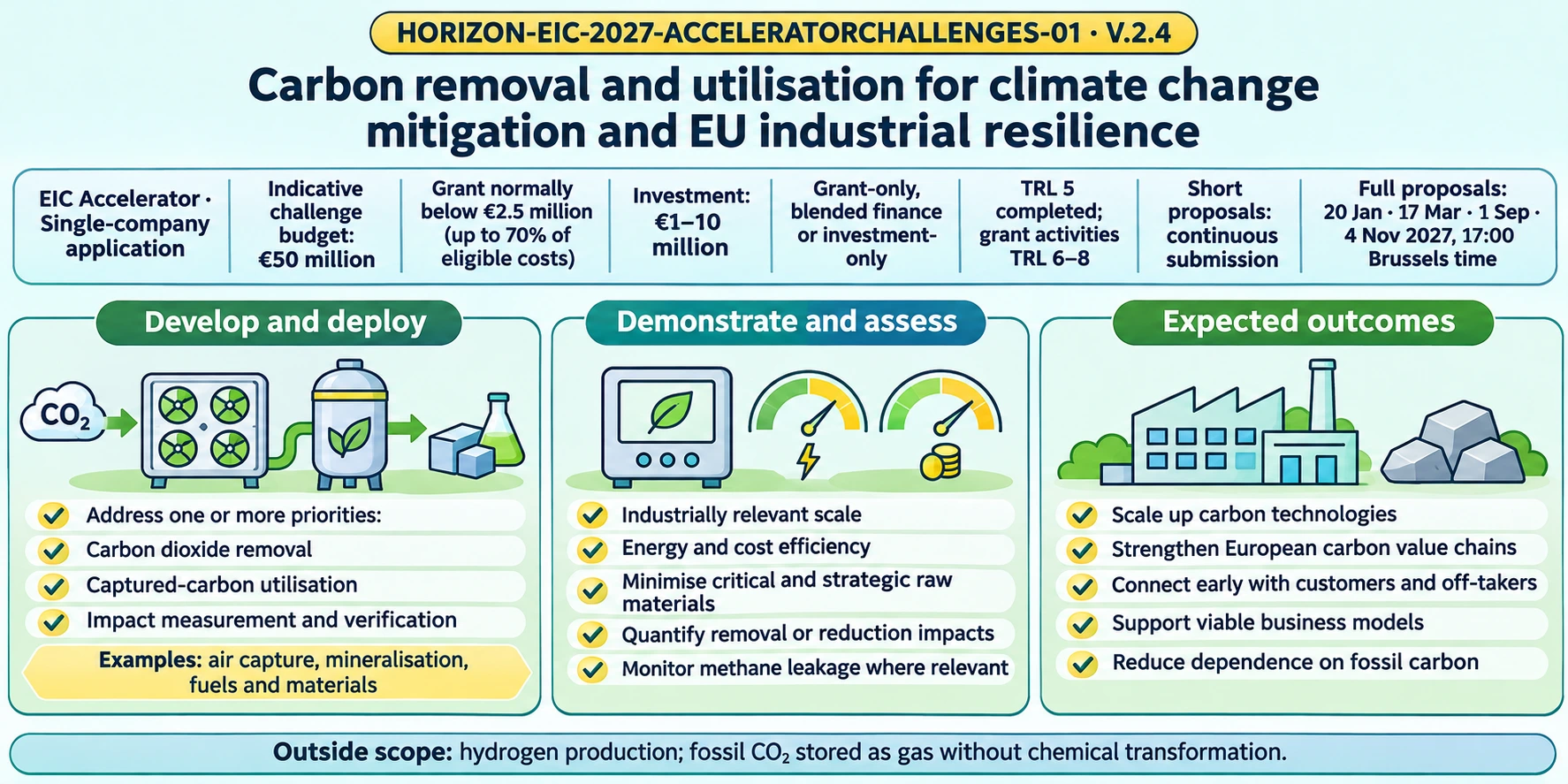
Call: HORIZON-EIC-2027-ACCELERATORCHALLENGES-01, EIC Accelerator Challenges, section V.2.4: Carbon removal and utilisation for climate change mitigation and EU industrial resilience. The indicative budget for this challenge is €50 million.
Applicant: a single small or medium-sized enterprise (SME), including a start-up, established in an EU Member State or eligible Associated Country. Small mid-caps with up to 499 employees may seek investment-only support, or exceptional blended finance for rapid scale-up. Company-formation and relocation routes have their own conditions in section V and Annex 2 of the EIC Work Programme 2027; country-specific restrictions also apply, including grant-only access for UK applicants.
- Funding forms: grant-only, blended finance combining a grant and investment, or investment-only. The standard grant ceiling is €2,499,999, covering up to 70% of eligible costs as a lump sum. Exceptionally, a higher grant may be justified within blended finance. Grant-only support is available once during Horizon Europe.
- Investment component: €1 million–€10 million in equity or quasi-equity, subject to the investment assessment.
- Technology readiness: all aspects of technology readiness level (TRL) 5 must be completed. Grant-supported innovation activities cover TRL 6–8 and normally last up to 24 months, with longer durations possible when justified.
Submission: short proposals may be submitted continuously and are batched on the first Tuesday of each month at 17:00 Brussels time. Successful short proposals proceed to a full proposal. The 2027 full-proposal batches close on 20 January, 17 March, 1 September and 4 November, each at 17:00 Brussels local time. The process then includes expert assessment and, for selected applicants, a jury interview. The EIC Accelerator application guidance explains the submission stages.
Three technology priorities and clear scope boundaries
EIC 2027 ACCELERATOR CHALLENGES 04 applicants must develop and deploy deep-tech innovations addressing one or more of three priorities:
- Carbon dioxide removal: permanent removal or removal with storage in products. Examples include direct air capture with carbon storage, biogenic emissions capture with carbon storage, biochar, enhanced rock weathering, direct ocean capture, alkalinity enhancement and mineralisation. Activities may address capture, transport or storage. Capture technologies in this priority concern air, ocean, biogenic or mixed biogenic waste streams.
- Carbon capture and utilisation: conversion of captured carbon into fuels, chemicals or materials, alongside agriculture, food and feed uses. This priority is open to different carbon sources.
- Environmental impact technologies: quantification, monitoring and verification of effects such as carbon removal, emission reductions or methane leakage.
Outside scope: hydrogen production technologies and solutions focused on storing captured fossil carbon dioxide as a gas without chemical transformation.
The expected outcomes connect scale-up with demonstrations at industrially relevant scales, energy and cost efficiency, and reduced use of critical and strategic raw materials. The challenge also seeks European carbon value chains and commercially viable business models linked early to customers, procurement channels and off-takers.
Design a demonstration around the claimed benefit
A useful EIC 2027 ACCELERATOR CHALLENGES 04 demonstration plan should define the industrial service being sold and the evidence needed to accept it. The following are proposal-design recommendations, to adapt to the selected technology.
- Define the operating envelope: feedstock composition, throughput, energy inputs, maintenance and the intended customer specification.
- Compare equivalent functions: assess a replacement material or fuel against a baseline delivering the same useful service.
- Separate evidence levels: label measured performance, engineering calculations and projected commercial-scale performance, with assumptions attached to each.
Ravikumar and colleagues modelled life-cycle impacts using published experiments on carbon dioxide curing and mixing in concrete. Increased binder demand to compensate for lower compressive strength, and electricity used in curing, could outweigh the benefit of incorporating carbon. The analysis concerned those concrete pathways and did not establish performance for every mineralised product. [2]
For a material technology, this supports testing product function alongside carbon uptake. For a removal technology, a proposed evidence package can connect the capture balance to transport, storage and process emissions. Set acceptance criteria before the demonstration and identify who will review the resulting evidence.
Plan industrial interfaces around the applicant company
The EIC 2027 ACCELERATOR CHALLENGES 04 uses a single-company application. Its industrial relationships should be organised around delivery and market access. A supplier, test facility, storage operator or customer is not automatically a co-beneficiary.
As a practical planning step, map each external dependency to a named interface: feedstock quality, energy availability, access to a demonstration site, product acceptance or independent assessment. Describe the evidence already available and the agreements still to be secured. Keep proposed arrangements distinct from signed commitments.
The work programme expects early links to end-users and customers. An off-taker’s acceptance specification can help define a meaningful demonstration, while the commercial plan should explain installation, operation and recurring costs. Selected beneficiaries gain tailored Business Acceleration Services, including facilitated access to the EU Carbon Removals and Carbon Farming (CRCF) Buyers’ Club for carbon removal. This access supports buyer engagement; it does not guarantee a purchase.
Make verification usable beyond the demonstration
A monitoring and verification technology needs a defined decision to support: for example, estimating net removal, detecting leakage or assessing an environmental effect. A useful proposed output is a traceable record linking observations, calibration, calculations, uncertainty and the reported claim.
He and Tyka’s ocean-circulation simulations of coastal alkalinity addition showed that carbon uptake depends on gas exchange and water movement, with effects extending beyond the addition site. These model results illustrate why the location of treatment need not match the location or timing of atmospheric uptake; they do not demonstrate a field installation’s performance or ecological safety. [3]
For an ocean-based application, a validation plan should therefore identify what is observed locally and what is inferred through a model. Other pathways need their own evidence boundaries and storage-risk assessment.
The EU carbon-removal certification framework provides a voluntary route with quality criteria and independent verification. A funding award does not itself certify a removal. Explain the relevant methodology, where applicable, alongside the engineering and commercial evidence needed for deployment.
The MIC already brings its expertise in microfluidics to Horizon Europe:
H2020-NMBP-TR-IND-2020

Microfluidic platform to study the interaction of cancer cells with lymphatic tissue
H2020-LC-GD-2020-3

Toxicology assessment of pharmaceutical products on a placenta-on-chip model

About the author

Céleste Chidiac, PhD
Scientific writer and digital marketing specialist
Céleste Chidiac holds a doctorate in neuroscience and molecular biology from the University of Strasbourg. Since joining the Microfluidics Innovation Center in 2023, she has combined scientific writing with website management. For MIC’s Horizon Europe topic pages, she draws on her research background to explain scientific challenges and clarify funding priorities. Her writing helps prospective applicants understand each topic’s scope, expected outcomes and research directions.
FAQ: EIC 2027 ACCELERATOR CHALLENGES 04 - carbon pathways, measurement and product performance
These questions examine scientific distinctions and evidence limits that matter when turning a carbon technology into an industrial proposition.
Can carbon-containing fuels count as permanent removal?
Using captured carbon in fuel does not establish permanent removal: combustion returns that carbon to the atmosphere. In the direct-air-capture pathways assessed by Deutz and Bardow, synthetic methane and geological storage had different life-cycle outcomes, strongly influenced by energy supply. [1]
What needs to be traced in a mixed biogenic waste stream?
The biogenic and fossil carbon fractions need to remain distinguishable in the proposed accounting. Treating all captured carbon as atmospheric removal would obscure its origin. The challenge’s removal priority permits capture from mixed biogenic waste streams; that scope does not make every captured tonne a removal.
Does low-carbon electricity eliminate the footprint of an air-capture plant?
No. Sorbent manufacture, replacement and plant construction remain part of the life cycle. Deutz and Bardow included these contributions when assessing industrial temperature–vacuum swing adsorption systems; low-carbon energy did not make the other inputs disappear. [1]
Can a stronger carbonated concrete be assumed to last longer?
No. Compressive strength and durability are different properties. Ravikumar and colleagues identified durability as a limitation of a comparison based on compressive strength. Exposure conditions, deterioration and repair needs require additional evidence for the intended concrete application. [2]
Why does the treatment of industrial by-products affect a life-cycle comparison?
Environmental burdens must be allocated between the main product and its by-products. In the concrete analysis by Ravikumar and colleagues, alternative allocation methods changed the attribution of impacts to supplementary cementitious materials. Changing the accounting method did not itself change physical emissions. [2]
Does a local rise in ocean alkalinity measure atmospheric carbon uptake?
No. Added alkalinity changes seawater chemistry, while atmospheric uptake also depends on gas exchange and circulation. He and Tyka simulated cases where uptake continued after treated water moved away. A local chemistry observation alone cannot establish the complete removal claim. [3]
Can an ocean model provide a universal safe operating limit?
No. He and Tyka used selected pH and carbonate-saturation constraints to compare locations; they did not establish universally acceptable ecological limits. Modelled capacity must remain distinct from site-specific environmental assessment and evidence of safe operation. [3]
Should missing monitoring data be treated as zero emissions?
No. Zero is a measured or justified estimate, not a substitute for missing information. A proposed monitoring protocol should identify data gaps, specify how estimates are made and show how uncertainty affects the final claim. Keep estimated values distinguishable from observations.
What does a customer specification add to an off-take discussion?
It defines what the customer can actually use: composition, quality, delivery conditions and acceptable variation. As a planning recommendation, connect those requirements to demonstration measurements and distinguish technical acceptance from a commitment to buy.
Does independent verification mean that every carbon technology is certified?
No. Verification assesses specified evidence against defined criteria. Certification under the CRCF framework follows applicable methodologies and recognised certification processes. A successful test, an independent review or participation in a funding programme does not automatically complete that process.
References
[1] Deutz, S. and Bardow, A. Life-cycle assessment of an industrial direct air capture process based on temperature–vacuum swing adsorption. Nature Energy. 2021;6:203–213. doi:10.1038/s41560-020-00771-9
[2] Ravikumar, D., Zhang, D., Keoleian, G., Miller, S., Sick, V. and Li, V. Carbon dioxide utilization in concrete curing or mixing might not produce a net climate benefit. Nature Communications. 2021;12:855. doi:10.1038/s41467-021-21148-w
[3] He, J. and Tyka, M. D. Limits and CO2 equilibration of near-coast alkalinity enhancement. Biogeosciences. 2023;20:27–43. doi:10.5194/bg-20-27-2023