
EIC 2027 ACCELERATOR CHALLENGES 03: Fusion power plants: qualifying concepts and enabling technologies
Opening
Continuous short-proposal submission
Deadline
Keywords
Fusion power plants
Alternative fusion concepts
Advanced materials
Tritium fuel cycle
Fusion magnets
High-repetition-rate lasers
Digital control
Your microfluidic SME partner for Horizon Europe
We take care of microfluidic engineering, work on valorization and optimize the proposal with you
HORIZON-EIC-2027-ACCELERATORCHALLENGES-01: Alternative Concepts and Key Enabling Technologies for Fusion Power Plants
Can irradiation deform a fusion material when thermal creep is suppressed?
Yes. Irradiation can rearrange crystal defects under mechanical stress, allowing a material to deform even when ordinary temperature-driven creep is negligible. Feichtmayer and colleagues observed stress relaxation in thin tungsten wires exposed to tungsten ions at temperatures no higher than 100 °C. Their multiscale model linked this behaviour to the organisation of irradiation defects. The experiment used ion-irradiated wires, not a component operating in a fusion neutron environment. [1]
This makes material response depend on exposure history as well as operating temperature. For EIC 2027 ACCELERATOR CHALLENGES 03, such mechanisms illustrate why an enabling technology needs evidence tied to its intended plant function. The Challenge supports alternative fusion concepts and technologies that address obstacles to the design, construction and operation of commercially viable fusion power plants.
Download the MIC Horizon Europe 2026/2027 Calls Calendar:
Discover more!
Call conditions for the fusion Accelerator Challenge
Which call is it, and when can companies apply?
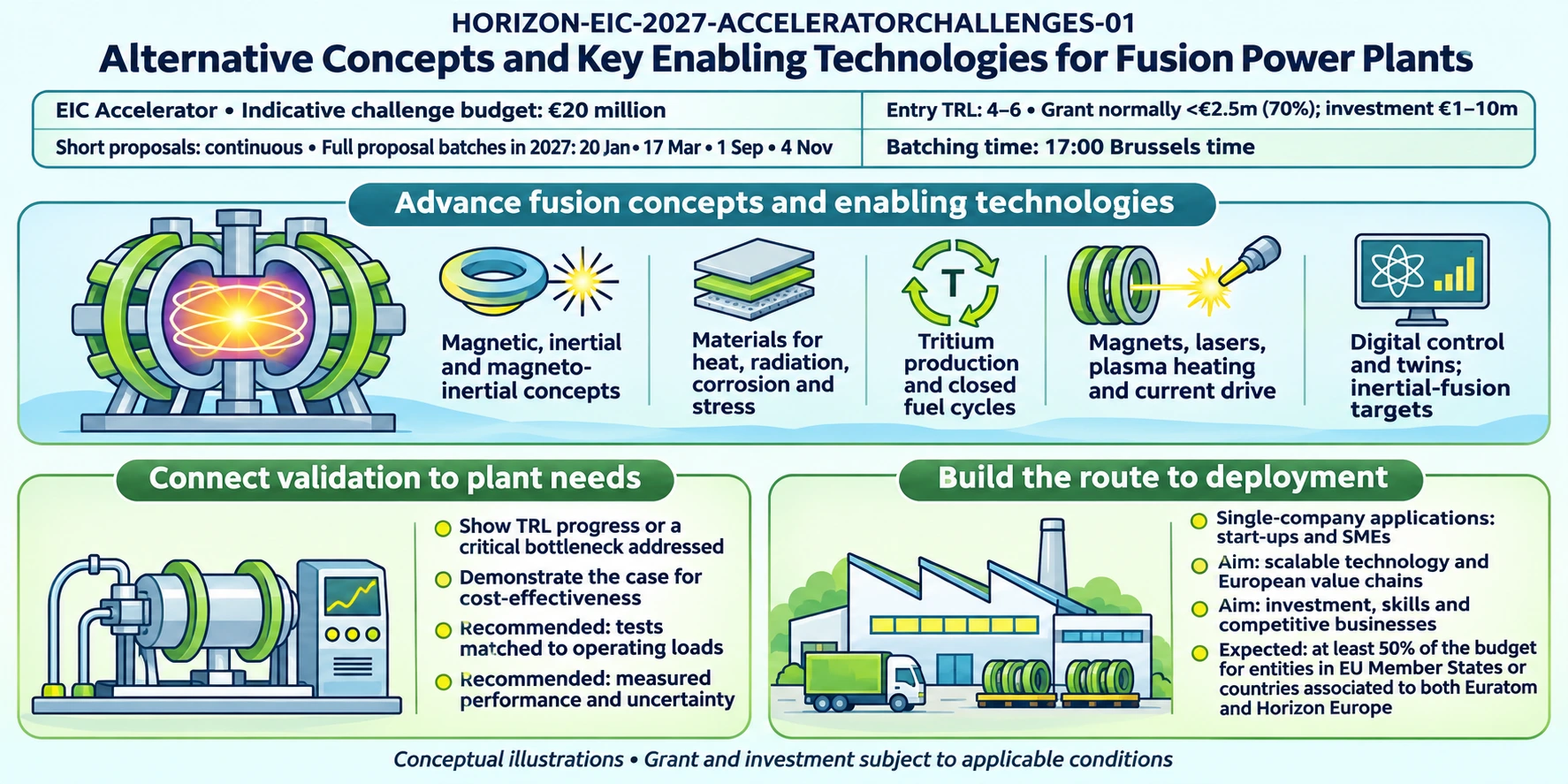
HORIZON-EIC-2027-ACCELERATORCHALLENGES-01 includes the fusion Challenge, listed as section V.2.3 in the EIC Work Programme 2027. The official title is Alternative Concepts and Key Enabling Technologies for Fusion Power Plants.
- Action and application route: EIC Accelerator, with a single applicant company. Short proposals can be submitted continuously. A successful short proposal gives access to the full-proposal stage, followed by an interview for shortlisted applicants.
- Full-proposal batching dates: 20 January, 17 March, 1 September and 4 November 2027, at 17:00 Brussels time. These are evaluation batches, not successive mandatory submission stages. The responsible Director-General may delay cut-offs by up to two months.
- Indicative fusion budget: €20 million in 2027, within the €150 million Accelerator Challenges envelope. The fusion allocation is not an amount per company.
- Funding: grant only, blended finance or investment only, subject to the relevant conditions. The grant uses lump-sum funding at up to 70% of eligible costs, normally below €2.5 million; the stated ceiling is €2,499,999. Exceptionally, a higher grant may be justified under blended finance. The investment component is €1–10 million. The beneficiary finances the remaining 30% of grant work-package costs from its own resources.
- Fusion-specific maturity: applicants may enter at Technology Readiness Levels (TRLs) 4–6. This specific provision differs from the general Accelerator entry requirement. The proposal must demonstrate maturity advancement or resolution of a critical plant bottleneck, including cost-effectiveness; the Challenge does not prescribe one common final TRL for every technology.
Eligible applicants to EIC 2027 ACCELERATOR CHALLENGES 03 include start-ups and small and medium-sized enterprises established in EU Member States or Horizon Europe Associated Countries. Small mid-caps with up to 499 employees can seek investment only, or exceptionally blended finance for rapid scale-up. Routes for founders, investors applying on a company’s behalf and relocating companies carry additional establishment conditions. Grant-only support is available only once per beneficiary during Horizon Europe.
Because Euratom contributes to this Challenge, at least 50% of its indicative budget is expected to go to legal entities in Member States or countries associated to both Euratom and Horizon Europe. This is an allocation expectation, not a requirement that each application form a consortium. The Accelerator application procedure and the work programme’s Annex 2 set out the applicable company-level conditions.
Which fusion technologies are within scope?
A EIC 2027 ACCELERATOR CHALLENGES 03 proposal must address one or more parts of the fusion value chain. It can concern a reactor concept, a core component or an enabling technology with a clear function in a future plant. The scope includes:
- Alternative concepts: magnetic, inertial and magneto-inertial fusion, including conceptual or engineering design and core technologies.
- Advanced materials: resistance to temperature, heat and particle fluxes, neutron loading, corrosion and mechanical stress.
- Fuel systems: tritium production and a closed tritium fuel cycle.
- Lasers and targets: efficient, powerful lasers with high repetition rates and associated optics; target materials, performance and insertion for inertial fusion.
- Plasma systems and magnets: heating, current drive and magnet designs compatible with plant loads.
- Digital technologies: artificial intelligence, machine learning and digital twins for design, control, monitoring and operation.
Other enabling technologies can also be considered. Explain the plant bottleneck, the innovation’s role and the improvement sought. Covering every listed technology is unnecessary. A component supplier should identify the reactor architectures and operating conditions it intends to serve; a concept developer should show how the critical subsystems fit together.
The intended outcomes include scalable technologies, stronger European supply chains, investment, skills and competitive fusion companies. The work programme’s 2040 commercialisation horizon is an expectation, not a guaranteed market date or a project delivery deadline.
Build validation around the intended operating conditions
The following are proposal-design recommendations. Start with a testable claim and define the operating envelope in which it matters: temperature, irradiation exposure, mechanical load, pulse sequence, interfaces and service duration, as applicable. Keep measured results separate from simulation and projected plant performance.
Use a component demonstrator to test integration. Hartwig and colleagues reported a 20.1 T peak field on the conductor of the approximately three-metre SPARC Toroidal Field Model Coil. That measurement establishes a magnet result under the test conditions, not an operating power plant’s output. [2] For a proposed magnet, connect the magnetic specification to structural support, cooling, joints and protection.
Validate digital functions on relevant hardware. Degrave and colleagues trained reinforcement-learning controllers in simulation and demonstrated plasma-shape and current control on the Tokamak à Configuration Variable (TCV). This was experimental tokamak control, not validation of autonomous operation of a commercial fusion plant. [3]
Define acceptance criteria before testing. Report uncertainty, repeatability, the reference method and any conditions left untested. Useful outputs can include a qualified component, an experimentally checked model, an interface specification or a reproducible manufacturing process. Choose the output that resolves the stated bottleneck rather than assigning the same demonstration to every technology.
Organise the company and its technical interfaces
The EIC 2027 ACCELERATOR CHALLENGES 03 funds an applicant company. Its execution plan should explain which capabilities are internal and which depend on suppliers, research facilities, subcontractors or prospective customers. These relationships support delivery; they do not create a mandatory multi-beneficiary consortium.
For each external dependency, identify the input needed, the interface, responsibility for interpretation and the evidence of access. A materials developer may need irradiation and mechanical-test facilities; a magnet supplier may need cryogenic and high-current testing; a laser developer may need an agreed target and chamber interface. These are technology-specific planning examples.
Secure the rights needed to develop and exploit the innovation. Distinguish ownership of background knowledge, use of third-party results and access to test data. Subcontracting is possible under the grant component, including essential activities only where justified. The company should retain a credible plan for technical management, industrial scale-up and customer qualification.
Show how the innovation becomes a usable fusion product
Connect cost-effectiveness to a defined customer decision. For a component supplier, that may be qualification by a reactor developer. For a system developer, it may be evidence that the proposed architecture can be built and operated within credible performance and cost assumptions.
As a planning recommendation, separate prototype cost from repeat-production cost. Explain material demand, manufacturing yield, inspection, installation and replacement requirements. Include service availability and maintenance assumptions when they materially change the business case. Avoid transferring the economics of one reactor architecture to another without justification.
Set milestones that make the next engineering or investment decision possible: a design frozen against agreed interfaces, a repeatable production batch, a component test accepted by an intended user, or a demonstrated reduction in a critical cost driver. Link each milestone to evidence and a decision owner. This gives the proposed TRL progression and scale-up plan a practical meaning.
The MIC already brings its expertise in microfluidics to Horizon Europe:
H2020-NMBP-TR-IND-2020

Microfluidic platform to study the interaction of cancer cells with lymphatic tissue
H2020-LC-GD-2020-3

Toxicology assessment of pharmaceutical products on a placenta-on-chip model

About the author

Céleste Chidiac, PhD
Scientific writer and digital marketing specialist
Céleste Chidiac holds a doctorate in neuroscience and molecular biology from the University of Strasbourg. Since joining the Microfluidics Innovation Center in 2023, she has combined scientific writing with website management. For MIC’s Horizon Europe topic pages, she draws on her research background to explain scientific challenges and clarify funding priorities. Her writing helps prospective applicants understand each topic’s scope, expected outcomes and research directions.
FAQ — EIC 2027 ACCELERATOR CHALLENGES 03 - Fusion component qualification and system integration
These questions explain experimental limits, component behaviour and the interfaces that connect a fusion technology to its intended use.
How do magnetic and inertial fusion differ?
Magnetic fusion uses magnetic fields to confine a hot plasma. Inertial fusion compresses a small fuel target so that reactions occur before it disperses. Magneto-inertial approaches combine magnetic and compression effects. The fusion Challenge includes these approaches; component requirements depend on the selected architecture.
Does fusion energy gain establish net electricity production?
No. A gain figure compares fusion output with a specified energy input. Net electricity additionally depends on energy conversion and the electricity consumed by plant systems. A proposal should state the boundary of its gain metric and account separately for the equipment needed to operate the plant. The Challenge objectives explicitly extend beyond fusion gain towards commercial viability.
Can ion irradiation replace neutron qualification?
Ion irradiation can isolate damage mechanisms in accessible experiments, but it exposes a limited material depth. Feichtmayer and colleagues used tungsten ions to study stress relaxation in thin wires. That result cannot establish bulk-component behaviour under a different neutron spectrum, exposure and temperature. [1]
What does displacements per atom tell an engineer?
Displacements per atom, or dpa, expresses irradiation damage in terms of atomic displacements. It is not a service-life measurement. The irradiation profile, temperature, stress and material microstructure remain necessary to interpret a response; the tungsten-wire study combined a calculated dose profile with mechanical measurements. [1]
Why test a superconducting magnet during a quench?
A quench involves loss of superconducting operation and can produce local heating. The SPARC model-coil programme included an intentional open-circuit quench that caused local thermal damage in a coil not optimised for quench resilience. Peak-field performance and protection therefore require separate evidence. [2]
Does a high-temperature superconductor remove the need for cooling?
No. “High-temperature” is relative to other superconductors, not to room-temperature operation. The SPARC model-coil tests used a helium cooling system operating at 20 K. Cooling, electrical joints and mechanical support remain part of the magnet’s integrated engineering requirements. [2]
Why does laser repetition rate matter for inertial fusion?
A power-plant concept must repeat its energy-producing cycle. Laser repetition rate therefore has to work with target delivery, optics performance and chamber recovery. The inertial-fusion scope addresses both high-repetition-rate lasers and target insertion; a single successful pulse does not demonstrate repeated operation.
Why is tritium production only one part of the fuel problem?
A usable fuel cycle also has to recover unconsumed fuel, separate it from exhaust products and return it for use. The ITER fuel-cycle design illustrates these linked functions. A production result alone does not establish a self-sufficient closed cycle or the inventory needed by a commercial plant.
What separates a useful digital twin from an unchecked simulation?
A useful model has a defined purpose and has been compared with relevant measurements. Its accuracy must be assessed where it will guide decisions. In the TCV control study, sensor delays, actuator behaviour and varying plasma parameters were incorporated before transferring the trained controller to hardware. [3]
Can one component be designed for several reactor concepts?
Yes, if the shared function and compatible operating envelopes are demonstrated. Define the interfaces that stay common and the adaptations each architecture requires. The Challenge scope accommodates enabling technologies across the value chain, but it does not establish that a component tested for one concept is qualified for all others.
References
[1] Feichtmayer, A., Boleininger, M., Riesch, J., Mason, D. R., Reali, L., Höschen, T., Fuhr, M., Schwarz-Selinger, T., Neu, R. and Dudarev, S. L. Fast low-temperature irradiation creep driven by athermal defect dynamics. Communications Materials. 2024;5:218. doi:10.1038/s43246-024-00655-5
[2] Hartwig, Z. S., Vieira, R. F., Dunn, D., et al. The SPARC Toroidal Field Model Coil Program. IEEE Transactions on Applied Superconductivity. 2024;34(2):0600316, pp. 1–16. First published online 13 November 2023. doi:10.1109/TASC.2023.3332613
[3] Degrave, J., Felici, F., Buchli, J., et al. Magnetic control of tokamak plasmas through deep reinforcement learning. Nature. 2022;602:414–419. doi:10.1038/s41586-021-04301-9