
EIC 2027 ACCELERATOR CHALLENGES 02: Scaling deep-tech solutions for climate-neutral cities
Opening
Continuously open
Deadline
Keywords
Smart cities
Urban decarbonisation
quality of life
Energy & buildings
Public transport
Circular resources
City deployment
Deep-tech scale-up
carbon footprint
Your microfluidic SME partner for Horizon Europe
We take care of microfluidic engineering, work on valorization and optimize the proposal with you
HORIZON-EIC-2027-ACCELERATORCHALLENGES-01: Climate-Neutral and Smart Cities
What can an annual energy balance conceal about a city’s carbon footprint?
An annual balance can conceal when electricity is imported and exported. Electricity consumed during one period can have a different carbon intensity from electricity supplied during another. Rouws and colleagues explored this accounting issue by simulating a Dutch terraced dwelling with weather and electricity-grid records from 2016–2022. Using annual-average emission factors generally produced more optimistic operational-emissions estimates than using 15-minute factors; the study concerned modelled building configurations, not measured city-wide savings. [1]
For EIC 2027 ACCELERATOR CHALLENGES 02, this makes the relationship between an innovation and its claimed carbon benefit a central design question. The Challenge supports companies developing and deploying deep-tech solutions for urban energy, mobility and resource management. Their evidence should explain how the solution changes a city service and how that change contributes to measurable decarbonisation.
Download the MIC Horizon Europe 2026/2027 Calls Calendar:
Discover more!
Call facts and the single-company application route
Which call is it, and when are applications assessed?
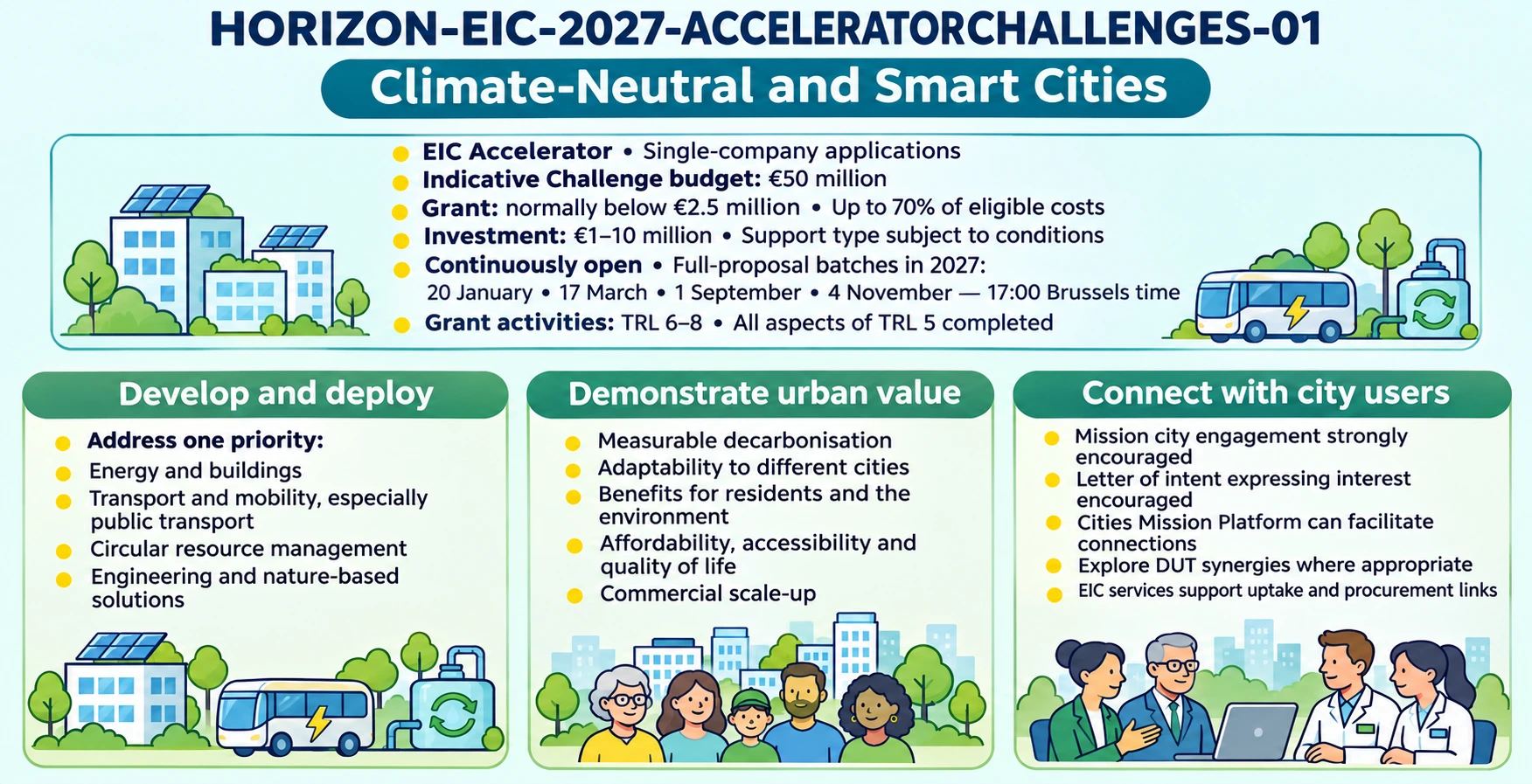
HORIZON-EIC-2027-ACCELERATORCHALLENGES-01 includes the Climate-Neutral and Smart Cities Challenge, section V.2.2 of the EIC Work Programme 2027. Its indicative budget is €50 million, within the €150 million allocation for EIC Accelerator Challenges.
- Action: EIC Accelerator, supporting an individual company’s innovation and commercial scale-up.
- Opening: continuously open. Short proposals can be submitted at any time. Following a successful short proposal, the 2027 full-proposal batching dates are 20 January, 17 March, 1 September and 4 November, at 17:00 Brussels time.
- Funding: grant only, blended finance or investment only, subject to the applicable conditions. The grant is a lump sum covering up to 70% of eligible costs, normally below €2.5 million; the investment component ranges from €1 million to €10 million. Exceptionally, a higher grant component may be justified for blended finance.
- Maturity: applicants must have completed all aspects of technology readiness level (TRL) 5, meaning validation in a relevant environment. Grant-funded innovation activities cover TRL 6–8 and should normally finish within 24 months, with longer durations possible when justified.
The principal applicants are single start-ups and small and medium-sized enterprises (SMEs) established in EU Member States or eligible Associated Countries. Small mid-caps with up to 499 employees can seek investment-only support, or exceptionally blended finance for rapid scale-up. The programme also provides routes for eligible individuals or entities establishing or investing in a company, with specific establishment conditions. Association agreements can restrict access to investment support.
The beneficiary must finance the 30% co-funding of grant work packages from its own resources. Grant-only support is available only once per legal entity during Horizon Europe. The EIC Accelerator application procedure covers short proposals, full-proposal assessment and selection interviews. A city relationship does not turn this into a multi-beneficiary consortium application.
Three priorities for urban deployment
EIC 2027 ACCELERATOR CHALLENGES 02 applicants must address one of three priorities. The scope includes engineering approaches and nature-based solutions. The technology examples below illustrate possible routes; they are not a compulsory package.
- Energy and buildings: reduce emissions from energy use, supply and management. Examples include building retrofits, renewable integration, electricity or thermal storage, waste-heat recovery and district energy management.
- Transport and mobility: decarbonise urban transport, with a specific focus on public transport. Examples include bidirectional charging, autonomous mobility within defined operating conditions, traffic management and data-supported multimodal travel.
- Resource management: enable circular use of urban resources. Examples include recovering value from construction waste, electronic waste or organic matter, improving water planning and processing wastewater.
The expected contribution combines measurable decarbonisation with solutions that can adapt to different urban contexts. Resident benefits include affordability, accessibility, health and quality of life, alongside environmental improvements. A strong proposal explains the particular service it improves and which of these benefits it can substantiate.
Building electrification illustrates why several performance dimensions matter. Hong and colleagues modelled more than 43,000 residential buildings in Portland, Oregon. Their electrification scenario reduced operational greenhouse-gas emissions but increased peak electricity demand; combining electrification with efficiency upgrades reduced both. These were simulated scenarios using calibrated models, not observed retrofit outcomes or predictions for European cities. [2]
Design validation around a defined urban service
For EIC 2027 ACCELERATOR CHALLENGES 02 proposal planning, start with a testable service claim: heating a building, moving passengers or recovering a resource. Define the existing service and the proposed change, then keep their comparison consistent. This validation approach is editorial advice, rather than an additional call condition.
Useful evidence connects technical performance to actual operating constraints. An energy solution should account for demand patterns and local network capacity. A mobility solution should relate vehicle operation to passenger service. A resource-recovery process should establish the quantity and quality of its output and the inputs needed to produce it. Select measurements that can demonstrate the claimed benefit at the intended deployment scale.
- Baseline and boundary: specify the reference service, assets, operating period and emissions included.
- Operating evidence: distinguish measured data, calibrated modelling and forecasts. Record missing data and conditions outside the tested range.
- Acceptance criteria: agree useful performance thresholds with the intended operator, including reliability and service quality.
- Environmental assessment: explain assumptions about energy supply, materials, maintenance and replacement when they affect the comparison.
A useful validation output combines the technical results with an explanation of where the system can operate reliably. Pair the results with the installation and operating requirements that a second city would need to assess.
Work with cities and operators on deployment
EIC 2027 ACCELERATOR CHALLENGES 02 applicants are strongly encouraged to engage at least one city participating in the Climate-Neutral and Smart Cities Mission and secure a letter of intent expressing interest in the proposed solution. This is encouragement in the Challenge text, not a stated mandatory city-partnership eligibility condition. The Cities Mission Platform can facilitate connections.
For a useful deployment relationship, identify the organisation that controls the relevant assets and the people who will operate the technology. A municipality, public-transport operator, building owner or utility may have different responsibilities. Clarify access to infrastructure, data and users before treating a demonstration setting as secured.
A letter of intent can describe the problem the city wants to address and the proposed setting for evaluating the solution. It should distinguish current interest from any later purchasing decision. The applicant company should retain a clear account of its own technology, implementation capacity and commercial responsibilities.
Where appropriate, applicants can explore synergies with projects supported by the Driving Urban Transitions (DUT) Partnership. EIC Business Acceleration Services, particularly the innovation procurement programme, are intended to connect supported companies with Mission cities and support uptake. These links provide opportunities for engagement; they do not establish a purchase commitment.
Make replication and commercial scale-up credible
A convincing scale-up plan identifies what remains repeatable when the solution moves to another city. Separate the core technology from local configuration, installation work and operating arrangements. Explain which differences in infrastructure or user needs require fresh validation.
Commercial planning should connect the technical offer to an identifiable customer and purchasing route. Describe installation costs, maintenance responsibilities, supplier dependencies and the evidence a customer needs before adoption. An attractive pilot result is more useful when another operator can understand the resources required to reproduce it.
Assess resident benefits alongside operator performance. For example, a mobility service can be evaluated for accessibility and service coverage, while a building solution can be assessed for comfort and household costs. Select indicators that match the proposed use, and investigate who receives the benefits and who bears the costs.
Useful proposed outputs include a validation report, an operator-facing deployment specification and a replication plan with explicit assumptions. Link their milestones to the company’s financing and market-development plans. These are practical planning suggestions, not a prescribed list of Challenge deliverables.
The MIC already brings its expertise in microfluidics to Horizon Europe:
H2020-NMBP-TR-IND-2020

Microfluidic platform to study the interaction of cancer cells with lymphatic tissue
H2020-LC-GD-2020-3

Toxicology assessment of pharmaceutical products on a placenta-on-chip model

About the author

Céleste Chidiac, PhD
Scientific writer and digital marketing specialist
Céleste Chidiac holds a doctorate in neuroscience and molecular biology from the University of Strasbourg. Since joining the Microfluidics Innovation Center in 2023, she has combined scientific writing with website management. For MIC’s Horizon Europe topic pages, she draws on her research background to explain scientific challenges and clarify funding priorities. Her writing helps prospective applicants understand each topic’s scope, expected outcomes and research directions.
FAQ: EIC 2027 ACCELERATOR CHALLENGES 02 - assessing urban climate technologies
These questions explore carbon accounting, operational evidence and transfer between urban settings.
Are average and marginal electricity-emission factors interchangeable?
No. An average factor allocates emissions from an electricity mix to consumption. A marginal factor estimates the generation response to a change in demand. They answer different questions. Rouws and colleagues used an attributional approach and identified consequential accounting as a separate extension; a proposal should state which approach supports its claim. [1]
What does an operational carbon footprint leave out?
It leaves out impacts assigned to manufacturing, construction, maintenance and end of life unless they are explicitly added. Those stages matter when comparing technologies with different equipment requirements. Rouws and colleagues recommend comparing production-related impacts with operational estimates before refining operational modelling alone. [1]
Does calibration make a building model universally transferable?
No. Calibration improves agreement with the data used, within the model’s assumptions. Hong and colleagues calibrated their Portland analysis at an aggregated scale; they did not individually calibrate every home. A new city needs its own assessment of building stock, weather, occupancy and energy-system assumptions. [2]
How should a bidirectional-charging test protect the transport service?
Define the vehicle’s service needs before scheduling electricity export. A useful test records departure readiness, available battery charge and the effect of charging decisions on vehicle availability. Set acceptable operating limits with the fleet operator and assess grid services within those limits.
What should an autonomous-mobility trial define first?
Its operational design domain: the roads, weather, speeds and other conditions in which automated operation is intended. Describe how the service handles conditions outside that domain. A successful demonstration on one route should not be presented as evidence of unrestricted autonomous operation.
How can a mobility assessment avoid overstating passenger benefits?
Measure the service passengers actually receive. Alongside vehicle performance, examine waiting time, missed connections, accessibility and the journeys displaced by the new service. Record empty vehicle movements separately so that apparent efficiency improvements are not based only on occupied trips.
What makes recovered material a usable product?
It must meet the requirements of a defined next use. A useful assessment tests output quality and consistency, identifies contaminants relevant to that use, and establishes how users will handle the material. A high recovery rate alone does not demonstrate that the recovered output can substitute for an existing product.
How should a water-reuse demonstration define success?
Begin with the intended reuse and its quality requirements. Assess treatment performance under representative influent conditions, alongside energy use, residuals and operating reliability. Express success in terms of water suitable for the identified use, rather than treating all treated water as interchangeable.
How can nature-based solutions be assessed alongside engineered systems?
Use a common service definition while retaining the outcomes specific to each solution. Compare their contribution under relevant site conditions and include maintenance needs. Where biodiversity, cooling or water retention is claimed, assess those outcomes directly instead of inferring them from the presence of vegetation.
What evidence shows that a pilot can work in a second city?
Evidence should identify the conditions the technology needs and show whether the second city meets them. Compare infrastructure, operating practices, environmental conditions and user requirements. A replication assessment should explain any adaptation and the tests needed to confirm performance after that adaptation.
References
[1] Rouws, A. L., Loonen, R. C. G. M. and Hensen, J. L. M. The role of the electricity grid in operation-induced greenhouse gas emissions by a residential building: A multi-year retrospective simulation study. Energy and Buildings. 2024;324:114870. https://doi.org/10.1016/j.enbuild.2024.114870
[2] Hong, T., Lee, S. H., Zhang, W., Li, H., Sun, K. and Kace, J. Informing electrification strategies of residential neighborhoods with urban building energy modeling. Building Simulation. 2025;18(1):3–18. https://doi.org/10.1007/s12273-024-1214-6