
Tips & Tricks for a successful HORIZON-HLTH-2027-01-ENVHLTH-02 proposal
Opening
10 February 2027
Deadline
Keywords
Exposome
Climate change
Human biomonitoring
FAIR data
Environmental health
AI analytics
Longitudinal cohort
cumulative exposure
heat events
Your microfluidic SME partner for Horizon Europe
We take care of microfluidic engineering, work on valorization and optimize the proposal with you
HORIZON-HLTH-2027-01-ENVHLTH-02: Integrating climate-related exposures into the human exposome and characterising its changes in response to climate change
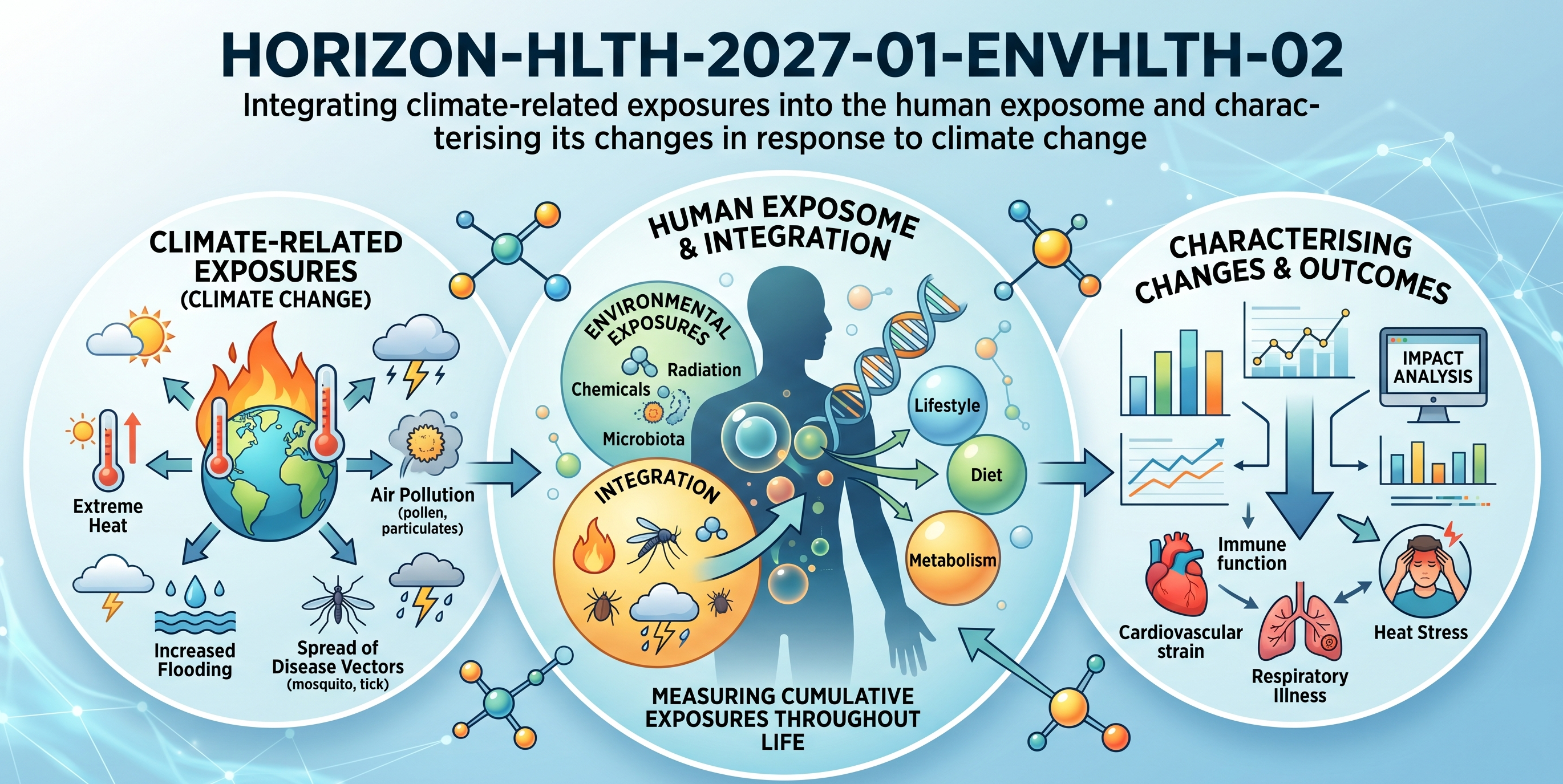
It is a topic for funding Research and Innovation Actions (RIA) in Horizon Europe Cluster 1 – Health (Single stage – 2027/1). The Commission is seeking to seal a loophole that has been hiding in plain sight: climate factors continue to be under-represented in large-scale exposome studies. This call advocates inclusion of heat events, air pollution changes, impacts of drought and other climate stressors in the overall picture of what humans experience throughout their lifetime. The final aim is FAIR data that connects those exposures with real disease outcomes, rather than the theoretical risk only.
Download the MIC Horizon Europe 2026/2027 Calls Calendar:
Discover more!
Administrative facts: what do we know about the HORIZON-HLTH-2027-01-ENVHLTH-02 call?
Which call is it, and when is the opening and the deadline?
- Call name: Cluster 1 – Health (Single stage – 2027/1)
- Call identifier: HORIZON-HLTH-2027-01
- Destination: Living and working in a health-promoting environment
- Topic: HORIZON-HLTH-2027-01-ENVHLTH-02
- Opening date: 10 February 2027
- Deadline: 13 April 2027, 17:00 Brussels local time
- Type of action: Research and Innovation Action (RIA)
What about the budget and estimated size of the project?
- Overall topic budget: EUR 45.00 million
- Indicative number of projects funded: 4
- EU contribution per project: EUR 10.00 to 11.00 million
What are the key eligibility and evaluation conditions?
- Thresholds: 4 (Excellence), 4 (Impact), 4 (Implementation). Cumulative threshold: 12.
- US entities are eligible for EU funding (NIH reciprocity clause).
- JRC may join as a beneficiary with zero funding or as an associated partner. The JRC won’t participate in proposal preparation.
- If satellite data is used, Copernicus and/or Galileo/EGNOS are mandatory.
- Mandatory clustering: funded projects form a cluster with joint networking activities. Allocate roughly 2% of total budget to a dedicated work package for this.
- Chemical monitoring and human biomonitoring data must be shared through IPCHEM (via JRC) and the environmental sustainability database.
- SSH contribution required: social sciences and humanities expertise is not optional.
- Granting authority retains the right to block transfer of ownership or exclusive licensing of results up to 4 years after the end of the action.
Scientific range: what does the Commission expect from the HORIZON-HLTH-2027-01-ENVHLTH-02 grant
What outcomes are expected?
When climate is included in the equation, the Commission is after an actual upgrade in the way we comprehend the exposome. At the close of the project, the researchers and policy makers are expected to have FAIR datasets between climatic, environmental and socio-behavioural exposures and disease outcomes. Evidence-based information should also be made more accessible to the public regarding the impact of the environment on their health. Publication series are not what the Commission is after; they want usable knowledge and data infrastructure.
What is within scope?
- The complete exposome: chemical, physical, biological, nutritional, psychosocial exposures throughout a lifetime, since conception.
- Exposure to climatic factors particularly: excessive heat, air pollution, drought and compound climatic events.
- Real-World Data was exposed to new exposome data analytics methods, such as AI and machine learning.
- Longitudinal cohorts of personal exposome information and medical, omics and biological data.
- Intersectional vulnerability and resilience: Socioeconomic, demographic, and behavioral determinants of exposure patterns.
- Data collection and analysis: Sex, gender, and racial/ethnic-disaggregated data collection and analysis.
- Collaboration with other international partners, especially those that are under-represented in exposome studies.
Note: clinical studies can be taken into consideration but must have the special annex.
What are the specifically proposed research directions?
- Include various climate exposures in exposomics research and demonstrate their interaction with other exposomes to determine disease burden.
- Anticipate and track the modifications of the exposome caused by climate pressures over time, and find the manifestations of health risks (and, curiously enough, the possible health benefits of climate change)
- Determine the biological pathways by which the exposome causes health effects, in a combined approach to climate and non-climate exposures.
- Discover exposome-related health risk biomarkers and indicators considering individual patterns and exposures.
- Normalise exposome-related disease burden reporting using standardised measures across regions, using existing toolboxes, such as IHEN.
- Examine how income, energy poverty, occupation, gender, age and public trust influence exposure and non-exposure and devise interventions to decrease these disparities.
Scientific strategy: how can you enhance your chances of being funded through HORIZON-HLTH-2027-01-ENVHLTH-02?
What scientific choices matter most?
- Expand upon what is already there. The Commission specifically mentions the EHEN, IHEN, ICOS ERIC and EIRENE RI. Evaluators will see that in the case your proposal does not take them into consideration. Show that you are familiar with the landscape and that your work carries on from the work of the landscape.
- Do not consider climate as a one-dimensional variable. Compound and cascading climatic events, synergistic interactions are discussed in the work programme. A hypothesis that only the factor of heat causes climate will likely appear shallow.
- Data infrastructure is not an additional consideration. FAIR data, IPCHEM integration, IHEN Data Catalogue uploads, common data management strategy: these are not nice-to-have requirements. Your data management plan must be tangible at the beginning.
- Transform AI and machine learning into a structural, rather than a decorative, element. The call refers to Real-World Data advanced analytics. Evaluators will desire a believable computational plan, and not a paragraph on leveraging AI.
- The wording on social determinants is strong. Income, energy poverty, occupation, trust, ethnic origin: all these are spelled out. We have proposals that lose marks because they put the social aspect as an appendix in the impact section. Incorporate it into the research design.
- Here, intersectional vulnerability is not a buzzword. The Commission would like to see how several disadvantageous factors compound to determine who becomes injured amid climate-driven exposome changes. It is not mentioned but designed around.
- Address the 2% clustering budget seriously. Explain your plan of joint activities. Evaluators are aware of it and they examine it.
Consortium & proposal-writing plan: what works best with this type of call?
- It should have between eight and thirteen partners, or so. At EUR 10-11 million apiece on the projects and the scope of disciplines involved, you will already have enough seats at the table without making coordination a full-time endeavor.
- You require epidemiologists, exposure scientists, climate scientists, bioinformaticians, social scientists (in this case not optional), and at least one or two partners with access to big longitudinal cohorts. In case you do not have the cohort access, evaluators will raise a red flag.
- At least one innovative SME with sensor technology, data analytics platform, or biomonitoring tool should be included. The call does not specifically demand SME, but the presence of such will bolster the innovation aspect and the exploitation strategy (this has worked on evaluation more than once).
- Foreign collaborators in underexplored geographical areas in exposome studies provide credibility. This is promoted in the work programme, and when it is performed well, it is rewarded by evaluators and not tokenistically.
- You do not fill in the last week the special annex if you intend to undertake some clinical studies. Start early.
- Prepare the data management plan as though it was a deliverable on its own. A vague plan won’t work with IPCHEM, IHEN and FAIR obligations.
- It is not enough to validate results after 36 months and have your SSH partners co-design research questions. The call “effective contribution” and evaluators follow it literally.
How would microfluidics contribute to this topic?
The exposome is a measurement of many things simultaneously, at biological scales, often on small or difficult to obtain samples. This can be done with conventional lab techniques, but those are often slow, they require large volumes, and it is not easy to run hundreds of biomarker assays simultaneously. Microfluidic platforms come in that.
- You are interested in knowing the time-dependent changes in inflammatory markers in blood based on a cocktail of air pollutants and heat stress. Thousands of these assays can be performed on a microfluidic chip per finger-prick sample, providing you with high-throughput biomonitoring data without taking people to a clinical laboratory each time.
- The organ-on-chip models can be used to study the effect of combined exposures on tissue, such as lung epithelium under heat stress and in the presence of atmospheric particulate matter, and the level of control offered by population studies is not feasible. It is not correlation you see, it is cause and effect.
- In the field work involving under-represented areas or isolated location, portable microfluidic devices imply that you can gather and analyse biomonitoring data in the field. The same population with a different population. That is important in constructing FAIR datasets in the geographies.
- Microfluidic systems with sensors can be connected directly to the data infrastructure that is necessary to the call. In case your consortium requires real-time biological and environmental exposure to inform AI-based analytics, a microfluidic sensing platform is likely to be the most viable path to follow.
In your proposal, you need to demonstrate that you can produce exposome data on a scale and granularity that is hard to achieve using conventional methods. Microfluidics does precisely that and it aligns with the focus of the call on innovative methods, tools that can be deployed on fields and interoperability of data.
The MIC already brings its expertise in microfluidics to Horizon Europe:
H2020-NMBP-TR-IND-2020

Microfluidic platform to study the interaction of cancer cells with lymphatic tissue
H2020-LC-GD-2020-3

Toxicology assessment of pharmaceutical products on a placenta-on-chip model

FAQ – HORIZON-HLTH-2027-01-ENVHLTH-02
What is the exposome and why does HORIZON-HLTH-2027-01-ENVHLTH-02 focus on it?
The exposome is the cumulative exposure that a person has gone through in their lifetime since they were born. It involves chemical, physical, biological, nutritional and psychosocial aspects. The Commission lays specific emphasis on addressing the inclusion of climate-related exposures, including extreme heat, air pollution, and drought into large-scale exposome studies, which were previously under-represented.
What is the budget and how many projects will be funded under HORIZON-HLTH-2027-01-ENVHLTH-02?
The indicative budget of HORIZON-HLTH-2027-01-ENVHLTH-02 is EUR 45.00 million. The Commission anticipates financing 4 projects, where the EU contribution to the projects is EUR 10.00-11.00 million. It is a Cluster 1 under Research and Innovation Action (RIA) – Health.
What are the specific eligibility conditions for HORIZON-HLTH-2027-01-ENVHLTH-02?
What are the evaluation thresholds for this call?
All the evaluation criteria are based on the threshold of 4 out of 5: Excellence (4), Impact (4), and Implementation (4). The cumulative limit is 12. This implies that a balanced proposal that scores high in all the three criteria is a must. The total can be set below the threshold by a weak dimension, especially in data management or integration of social sciences.
What are the FAIR data and IPCHEM obligations?
The projects that will be financed in this topic will constitute a cluster and will have to engage in common networking. A work package of around 2% of the total requested budget is to address: common kick-off and annual meetings, periodic joint activity reports, common dissemination and communication activities, common data management and policy strategy, and thematic workshops on issues of common interest.
What are the mandatory clustering activities?
The projects that will be financed in this topic will constitute a cluster and will have to engage in common networking. A work package of around 2% of the total requested budget is to address: common kick-off and annual meetings, periodic joint activity reports, common dissemination and communication activities, common data management and policy strategy, and thematic workshops on issues of common interest.
How is international cooperation encouraged in this topic?
The collaboration of international cooperation is promoted, in particular, with the regions that are not adequately represented in human exposome studies. The US organizations may receive EU funding. The projects must be based on previous projects like EHEN and current projects like IHEN, ICOS ERIC and EIRENE RI. Infrastructure of European studies in the environment, climate and health arena should be taken into consideration.
What role does AI and machine learning play in this call?
The call particularly seeks to promote data generation, analysis, integration and interpretation in human exposomics, such as by developing methodologies that combine new methods such as AI technologies and machine learning to perform advanced data analytics, even of Real-World Data. This ought to be structural in the proposal and not a figurative reference.
How can microfluidics contribute to a HORIZON-HLTH-2027-01-ENVHLTH-02 proposal?
Microfluidic systems can be used to support high-throughput screening of biomarkers using small sample volumes, portable biomonitoring systems that can be placed in the field for analysis, and organ-on-chip systems to investigate synergistic effects of exposure on tissue in a highly controlled manner. Microfluidic systems with sensors can feed directly into the data network that this call needs, to provide real-time exposure data to AI-driven analytics.
What is the ideal consortium composition for HORIZON-HLTH-2027-01-ENVHLTH-02?
Strive to have between eight and thirteen partners. You will require epidemiologists, exposure scientists, climate researchers, bioinformaticians, SSS experts and collaborators with access to large longitudinal cohorts. At least one innovative SME with sensor technology or data analytics capability. The international partners in the under-represented regions of exposome research lend credibility and the evaluators reward participation as substantive.