Tips & Tricks for a successful HORIZON-NEB-2026-01-PARTICIPATION-02 proposal
Opening
05 May 2026
Deadline
Keywords
New European Bauhaus
spatial design
public space
neighbourhoods
Innovation Action
co-creation
water resilience
climate resilience
biodiversity
Your microfluidic SME partner for Horizon Europe
We take care of microfluidic engineering, work on valorization and optimize the proposal with you
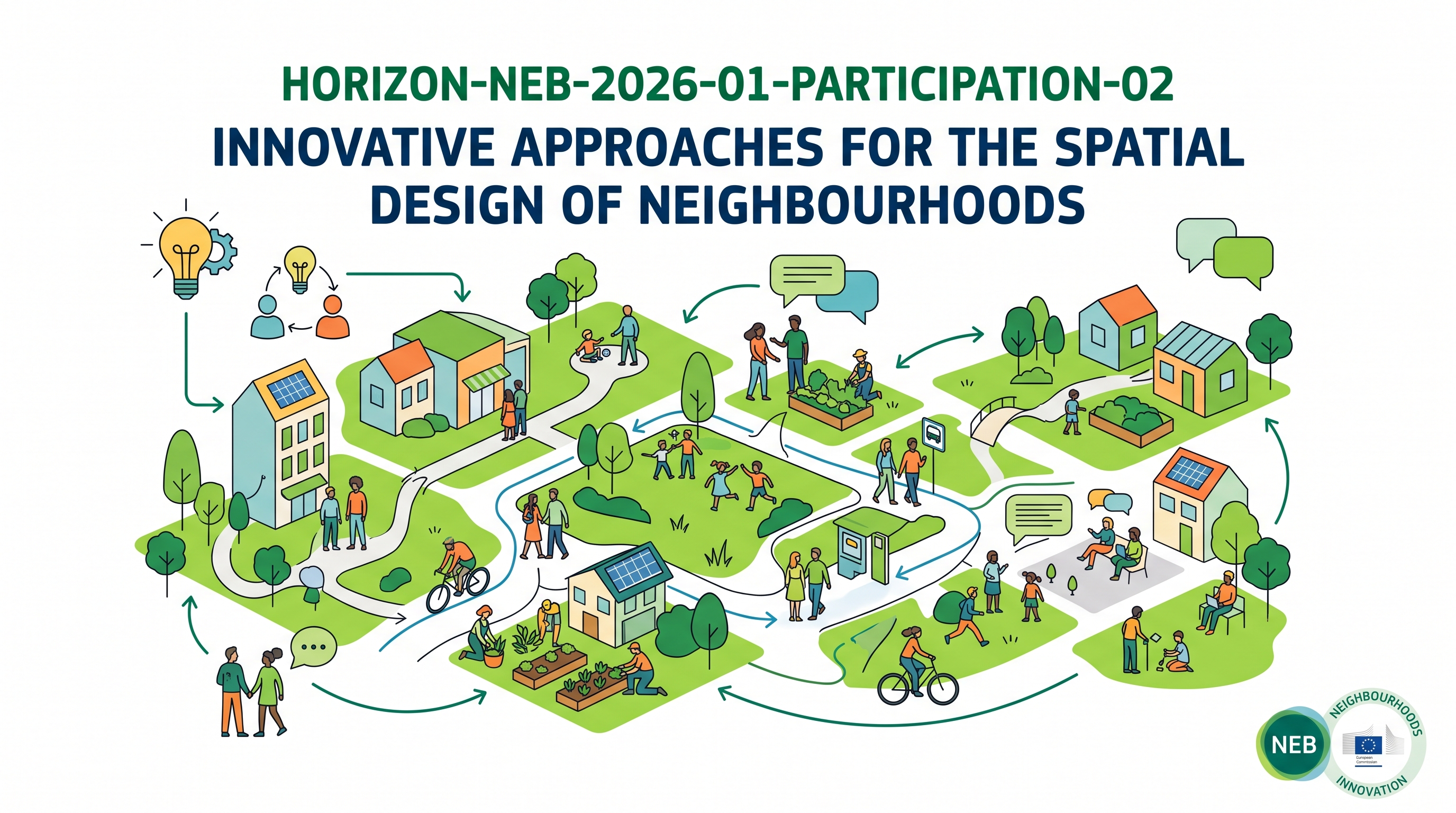
HORIZON-NEB-2026-01-PARTICIPATION-02: Innovative approaches for the spatial design of neighbourhoods
Public space is never neutral. The Commission wants new ways to design and plan it, ways that bring inhabitants in without stalling the process. Two projects will be funded, and each has to prove its approach on real ground. It is an Innovation Action, so a methodology living in a deliverable will not pass.
Download the MIC Horizon Europe 2026/2027 Calls Calendar:
Discover more!
Administrative facts: what do we know about the HORIZON-NEB-2026-01-PARTICIPATION-02 call?
Which call is it, and when is the opening and the deadline?
- Call name: Beautiful, inclusive and sustainable neighbourhoods for communities
- Call identifier: HORIZON-NEB-2026-01
- Destination: Connecting the green transformation, social inclusion and local democracy
- Topic: HORIZON-NEB-2026-01-PARTICIPATION-02, Innovative approaches for the spatial design of neighbourhoods
- Opening date: 05 May 2026
- Deadline: 01 December 2026, 17.00.00 Brussels time
- Type of action: Innovation Action (IA)
What about the budget and estimated size of the project?
- Topic budget: EUR 10.00 million
- Number of projects expected: 2
- Budget per project: around EUR 5.00 million
What are the key eligibility and evaluation conditions?
- Admissibility, eligibility and award criteria: General Annexes A, B, D
- Eligible costs take the form of a lump sum
- At least 0.8% of the budget goes to the New European Bauhaus hub for results and impact
- Social sciences and humanities contribution required
- Demonstration in at least three neighbourhoods (urban, peri-urban, rural) in different Member States or Associated Countries
- No TRL range is specified for this topic
Scientific range: what does the Commission expect from the HORIZON-NEB-2026-01-PARTICIPATION-02 grant?
What outcomes are expected?
Architects, planners and neighbourhood decision makers should end up with a demonstrated approach that folds user perspectives into how public space gets designed. It also has to deliver climate, environmental, social and cultural impact, from reduced inequalities to a stronger sense of belonging. A methodology report is not what the Commission is after.
What is within scope?
- Architectural design and spatial planning of neighbourhood public space
- New methods: research-by-design, security-by-design, life-centric design
- Co-creation drawing on cultural, creative and educational sectors
- Climate resilience, water resilience, civil security, biodiversity of public space
- Multisensory perception of public space, beauty included, as judged by users
- Approaches that stay adaptable, replicable, scalable to local specificities
One boundary. Neighbourhood is defined tightly here: 25 km2 maximum or 10,000 inhabitants, mapped onto the lowest administrative level.
What are the specifically proposed research directions?
- Assess how spatial design produces gendered, age-appropriate and identity-related patterns of use: mobility, safety, access
- Analyse the values, practices and stakeholder relations behind current public space design
- Develop one approach. Not a toolbox of five
- Demonstrate it across urban, peri-urban and rural sites in several countries
- Produce take-up plans, and assess transfer to water resilient planning or procurement
- Identify skills needs and gaps
Scientific strategy: how can you enhance your chances of being funded through HORIZON-NEB-2026-01-PARTICIPATION-02?
What scientific choices matter most?
- Commit to one approach. Proposals hedging with a menu of methods usually read as unfocused.
- Solve the speed problem. The scope names the tension between fast planning and slow deliberation.
- Treat beauty as data. The call asks for multisensory perception to be assessed but stays vague on how. That vagueness is room to set your own indicators.
- Put environmental measurement next to the social work.
- Embed SSH from work package one.
- Show replication logic, not replication promises.
Consortium & proposal-writing plan: what works best with this type of call?
- Somewhere between ten and fourteen partners, a couple more if your sites sit in countries with very different planning law.
- Municipalities or district authorities as full beneficiaries. Letters of support will not carry an IA.
- Architecture and planning practices, SSH institutes, a cultural organisation, plus an innovative SME bringing measurement or digital capability.
- If you already run a NEB-linked initiative on a site, lead with it.
- Lump sum funding means your work package structure is your budget. Get it right early (this catches people off guard).
- Write the demonstration section first.
How would microfluidics contribute to this topic?
Environmental evidence in neighbourhood projects usually arrives late. Samples go to a lab, results come back weeks later, and by then the workshop is over. Microfluidic devices move that analysis onto the site, with tiny samples and answers in minutes.
- Water resilience is written into the scope. Portable microfluidic sensors let your team check a fountain or retention basin on the spot.
- Say your designers claim a new planted swale improves water quality. You need proof. A chip-based contaminant test, run monthly across your sites, gives the same measurement everywhere. Same answer twice.
- Biodiversity monitoring through environmental DNA. Droplet platforms cope well with tiny volumes and very low target levels.
- Contaminant screening near play areas. Small devices, quick answers.
- Co-creation works better when residents hold the instrument. A handheld test turns a workshop into a measurement session, and people trust numbers they watched appear.
What this brings to your proposal is an evidence layer under claims that would otherwise stay soft. You say the redesign improved water quality near the playground. With microfluidics you show it. That is the difference between a nice narrative and a demonstrated approach.
The MIC already brings its expertise in microfluidics to Horizon Europe:
H2020-NMBP-TR-IND-2020

Microfluidic platform to study the interaction of cancer cells with lymphatic tissue
H2020-LC-GD-2020-3

Toxicology assessment of pharmaceutical products on a placenta-on-chip model

FAQ - HORIZON-NEB-2026-01-PARTICIPATION-02
What is HORIZON-NEB-2026-01-PARTICIPATION-02 about?
The topic funds the development and demonstration of one innovative approach to designing and planning neighbourhood public space. The approach has to bring inhabitants into the process through co-creation, and it has to show climate, environmental, social and cultural benefit.
When does the call open and when is the deadline?
Opening is 05 May 2026. The deadline is 01 December 2026 at 17.00.00 Brussels time. Note that the Director-General may open the call up to one month earlier or later, and may delay the deadline by up to two months.
How much money is available and how many projects will be funded?
The indicative topic budget is EUR 10.00 million. Two projects are expected, so around EUR 5.00 million per project. Requesting a different amount is allowed, but you would need a good reason.
What type of action is this topic, and what does that change?
It is an Innovation Action. That means demonstration on real sites, not a desk study. No TRL range is set for this particular topic, unlike some other NEB topics.
What exactly counts as a neighbourhood under this topic?
The NEB glossary defines a neighbourhood as an area of maximum 25 km2 or maximum 10,000 inhabitants. It should also correspond to the lowest level of public administration or elected body, such as a quarter, borough or district. Choose your sites against that definition.
Check the Funding and Tenders Portal for more information.
How many demonstration sites do we need, and where?
At least three neighbourhoods, covering urban, peri-urban and rural areas, located in different Member States or Associated Countries.
Is social sciences and humanities involvement really mandatory?
Yes. The work programme states that the topic requires the effective contribution of social sciences and humanities disciplines and the involvement of SSH experts and institutions. Treat it as a scored requirement, not a courtesy.
What does lump sum funding mean in practice for our work plan?
Eligible costs take the form of a lump sum. Your work package structure becomes your budget structure, and payment follows completion of work packages. Build the work breakdown early and keep it stable.
What consortium profile fits this topic best?
Municipalities or district authorities as full beneficiaries, architecture and planning practices, SSH institutes, a cultural or creative organisation, and at least one innovative SME bringing measurement or digital capability. Somewhere between ten and fourteen partners works well for this budget.
Where does microfluidics fit into a spatial design project?
Mostly as the evidence layer. Microfluidic sensors give on-site readings of water quality and contaminants, and droplet platforms support environmental DNA work for biodiversity. Residents can run the tests themselves, which turns a participation workshop into a measurement session.