Tips & Tricks for a successful HORIZON-NEB-2026-01-BUSINESS-03 proposal
Opening
05 May 2026
Deadline
Keywords
New European Bauhaus
vacant spaces
adaptive reuse
neighbourhoods
RIA
brownfield
co-creation
underutilised spaces
gentrification
social inclusion
Your microfluidic SME partner for Horizon Europe
We take care of microfluidic engineering, work on valorization and optimize the proposal with you
HORIZON-NEB-2026-01-BUSINESS-03: Approaches to reuse vacant, obsolete or underutilised spaces
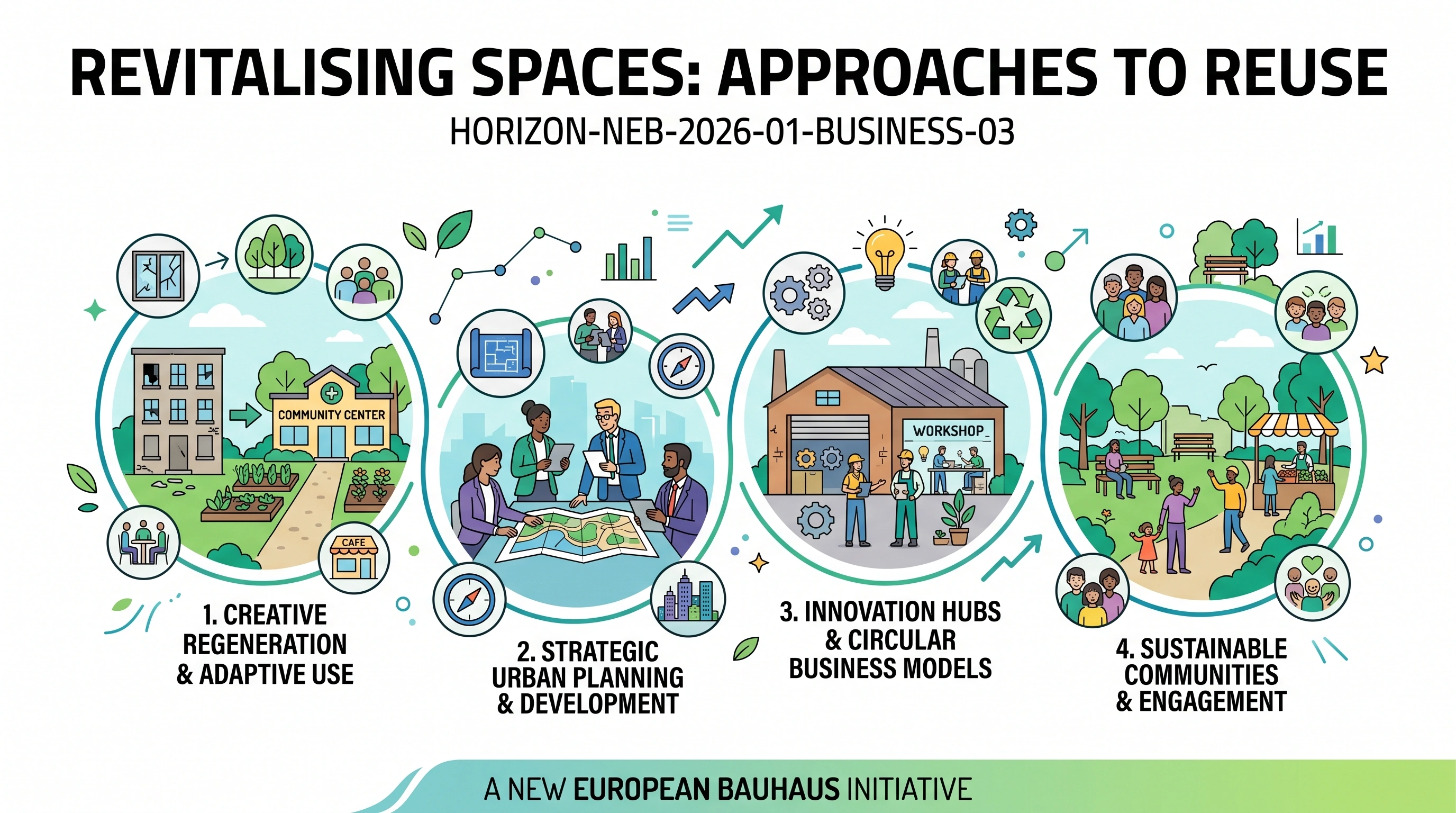
Europe sits on a lot of empty floor space. Roughly 19,000 km2 of underutilised brownfield land, plus around 300 km2 of vacant or underused offices. The Commission wants a systematic, context sensitive way to find those spaces, judge which ones are worth reusing, and bring the community into that decision. Not another one off renovation pilot.
Download the MIC Horizon Europe 2026/2027 Calls Calendar:
Discover more!
Administrative facts: what do we know about the HORIZON-NEB-2026-01-BUSINESS-03 call?
Which call is it, and when is the opening and the deadline?
- Call name: Beautiful, inclusive and sustainable neighbourhoods for communities
- Call identifier: HORIZON-NEB-2026-01
- Destination: Innovative funding and new business models for the transformation of neighbourhoods
- Topic: HORIZON-NEB-2026-01-BUSINESS-03
- Opening: 05 May 2026
- Deadline: 01 December 2026, 17:00 Brussels time
- Type of action: Research and Innovation Action, lump sum grant
What about the budget and estimated size of the project?
- Total indicative topic budget: EUR 9.00 million
- Number of projects expected: 2
- Budget per project: around EUR 4.50 million
What are the key eligibility and evaluation conditions?
- General Annexes A to G apply, with no topic specific derogation beyond the lump sum set up
- Standard RIA evaluation: threshold 3 out of 5 per criterion, 10 out of 15 overall
- Validation required in at least three neighbourhoods, covering urban, peri urban and rural areas, in different Member States or Associated Countries
- Effective contribution of social sciences and humanities is mandatory
- At least 0.8% of the budget reserved for the New European Bauhaus hub for results and impact
Scientific range: what does the Commission expect from the HORIZON-NEB-2026-01-BUSINESS-03 grant?
What outcomes are expected?
Two outcomes, both about uptake. More local authorities should be able to identify and quantify their vacant, obsolete or underutilised spaces in a way that fits local needs. And more spaces should actually end up renovated, renatured or converted. A report series is not what the Commission is after.
What is within scope?
- A systematic and context sensitive approach covering the full chain: why spaces stand empty, which ones to prioritise, what the community actually needs
- Assessment of side effects such as gentrification, displacement, overcrowding, loss of green areas, affordability
- Governance measures where a vacant space already serves an ecological or social function, for instance as a refuge for species or for non typical community uses
- Co-creation methods with local stakeholders
- Funding and financing mechanisms for the reuse itself
- Social, cultural, environmental and economic valuation of the approach
The work programme is clear that not every space is suitable for reuse. A proposal that reuses everything will read as naive.
What are the specifically proposed research directions?
- Drivers analysis: building or infrastructure condition, location, spatial limits, zoning rules, legal barriers, missing data, absent incentives for owners
- Identification and prioritisation methods at neighbourhood scale
- Validation across three neighbourhoods minimum, in urban, peri urban and rural settings
- Recommendations for adapting the approach to different neighbourhood contexts
Scientific strategy: how can you enhance your chances of being funded through HORIZON-NEB-2026-01-BUSINESS-03?
What scientific choices matter most?
- Make the data problem explicit. Most municipalities have no reliable vacancy register. Say how you will build one and who keeps it alive after the project ends.
- Take the unsuitable sites seriously. Evaluators notice a consortium that can say no to a plot.
- Bring hard evidence on site condition. Structural, environmental, contamination. Mapping without physical diagnosis stays theoretical, and reviewers read it that way.
- Name your three neighbourhoods early.
- The wording on financing mechanisms is vague, which gives you room to frame it your way. Use that.
- Do not treat SSH as a bolt on work package. From what we have seen, evaluators spot it immediately.
Consortium and proposal writing plan: what works best with this type of call?
- Somewhere between eight and twelve partners, maybe a couple more if your three sites need extra local coverage.
- Municipalities or housing agencies as full beneficiaries, not letters of support. This one matters more than people expect.
- Urban planners, architects, sociologists, legal experts on property and zoning. Plus a real environmental assessment capability, which most consortia underweight.
- Include at least one innovative SME. It keeps the methods practical and gives the exploitation section something to stand on.
- Lump sum funding means your work package structure is the budget. Build it once, carefully.
- If you already coordinate an urban regeneration project, say so, and explain what is different here.
How would microfluidics contribute to this topic?
Site diagnosis is the quiet blocker in reuse projects. Laboratory analysis of soil, groundwater or building materials takes weeks and costs enough that municipalities postpone it. Microfluidic sensing moves that analysis to the site, with answers in minutes rather than weeks.
- Say a brownfield parcel sits on your priority list and nobody knows what is in the soil. A portable microfluidic contaminant screen gives you a first answer the same day, before design work starts.
- Water quality after renaturing. You want the same answer twice, cheaply, across the whole project.
- Chip based eDNA sampling to check which species are really using a plot that looks vacant on paper. More on this kind of environmental application in our Cluster 6 overview.
For your consortium, this turns environmental screening from a cost line into a decision tool. That is what makes the prioritisation step credible in front of reviewers. If you want to see how we read the whole 2026-2027 programme, our call ranking by microfluidic relevance is a good place to start.
The MIC already brings its expertise in microfluidics to Horizon Europe:
H2020-NMBP-TR-IND-2020

Microfluidic platform to study the interaction of cancer cells with lymphatic tissue
H2020-LC-GD-2020-3

Toxicology assessment of pharmaceutical products on a placenta-on-chip model

FAQ - HORIZON-NEB-2026-01-BUSINESS-03
What is HORIZON-NEB-2026-01-BUSINESS-03 about?
The topic funds work on approaches to reuse vacant, obsolete or underutilised spaces in neighbourhoods. It sits in the New European Bauhaus Facility work programme, under the destination on innovative funding and new business models. The point is a systematic, context sensitive method that local authorities can actually apply, not a single demonstration building.
When does the call open and close?
The call HORIZON-NEB-2026-01 opens on 05 May 2026. The deadline is 01 December 2026 at 17:00 Brussels time. Single stage submission.
How much funding is available per project?
The total indicative topic budget is EUR 9.00 million. Two projects are expected, with an EU contribution of around EUR 4.50 million each. Requesting a different amount is allowed, but you need a reason.
Check the Funding and Tenders Portal for more information.
What type of action is it?
A Research and Innovation Action. Eligible costs take the form of a lump sum, so your work package breakdown carries the whole budget logic.
How many demonstration sites are required?
At least three neighbourhoods, covering urban, peri urban and rural areas, located in different Member States or Associated Countries. Name them in the proposal.
Is social sciences and humanities involvement mandatory?
Yes. The topic requires an effective contribution of SSH disciplines, with named experts and institutions. Treating it as a dissemination task is a common way to lose points.
What does the 0.8% budget rule mean?
Proposals must allocate at least 0.8% of their budget to engaging with the Horizon Europe funded New European Bauhaus hub for results and impact. It covers sharing intermediate and final results and contributing to impact assessment.
Are all vacant spaces in scope for reuse?
No. The work programme states that not every space is suitable. Some vacant plots already serve ecological or social functions, and the proposal should identify governance measures for those cases instead of converting them.
What kind of consortium fits this topic?
Roughly eight to twelve partners works well. Municipalities or housing agencies as full beneficiaries, plus urban planners, architects, sociologists, property and zoning lawyers, and an environmental assessment capability. Adding an innovative SME keeps the method grounded and strengthens exploitation.
How can microfluidics support a proposal on this topic?
Through fast, on site diagnosis. Portable microfluidic sensing screens soil and water contamination in minutes, monitors water quality after renaturing, and supports chip based eDNA sampling for biodiversity checks. That evidence makes the prioritisation of sites defensible. The Microfluidics Innovation Center contributes this capability as an SME partner.