Tips & Tricks for a successful HORIZON-MISS-2027-07-CLIMA-CIT-CCRI-02 proposal
Opening
09 February 2027
Deadline
Keywords
Mission Cities
Mission Adaptation
CCRI
wastewater treatment
water reuse
climate change
resource recovery
IA
valorisation solutions
Your microfluidic SME partner for Horizon Europe
We take care of microfluidic engineering, work on valorization and optimize the proposal with you
HORIZON-MISS-2027-07-CLIMA-CIT-CCRI-02: Deploying innovative wastewater management, treatment and valorisation solutions in European cities and regions in the context of climate change
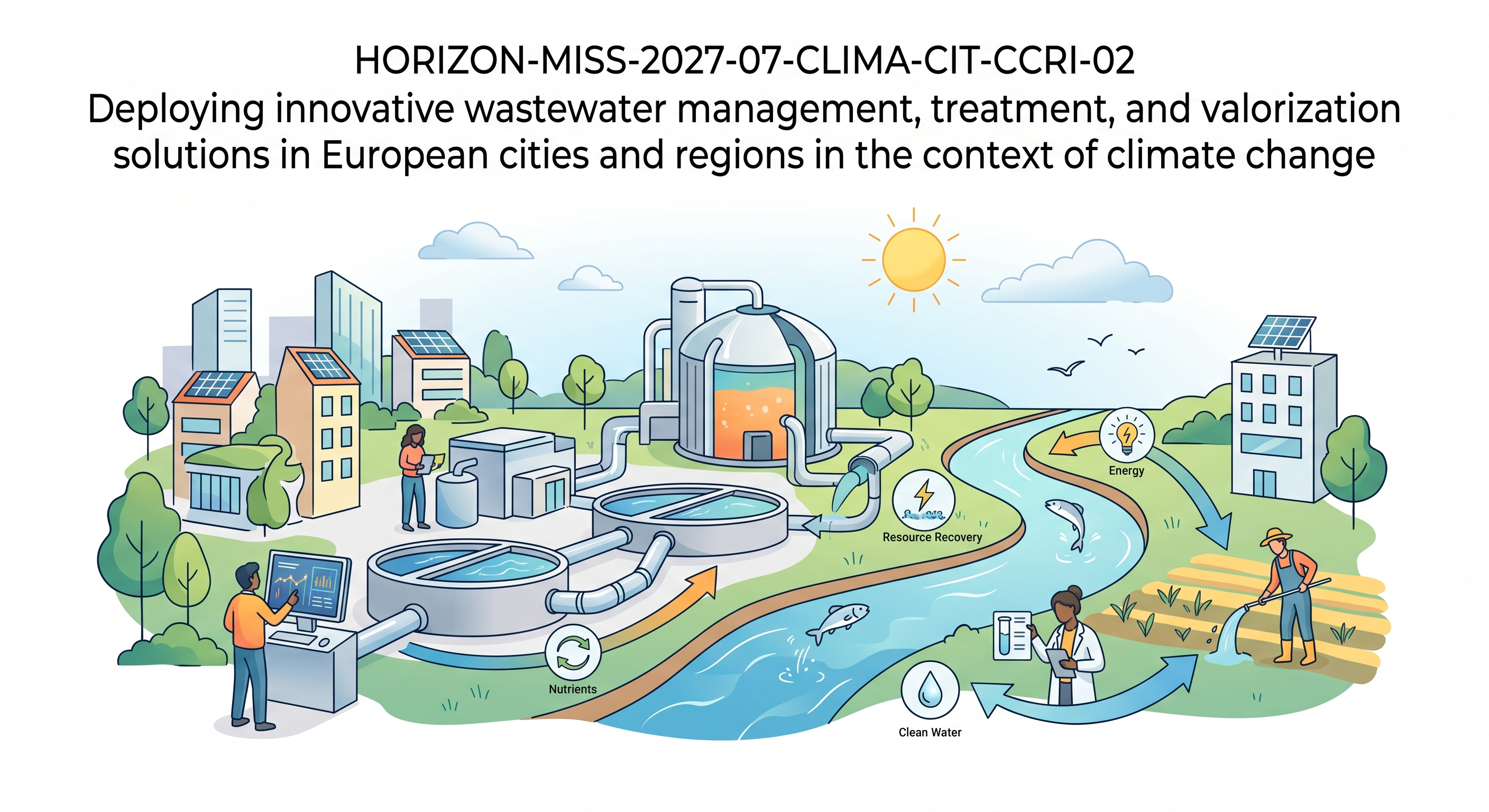
Wastewater infrastructure eats a large share of municipal budgets, and most of that money only buys collection and treatment. The Commission wants more out of it. This topic asks for integrated wastewater management that recovers water, energy and materials while coping with heavier rain and drought. Deployment, not another pilot.
Download the MIC Horizon Europe 2026/2027 Calls Calendar:
Discover more!
Administrative facts: what do we know about the HORIZON-MISS-2027-07-CLIMA-CIT-CCRI-02 call?
Which call is it, and when is the opening and the deadline?
- Call name: Joint Call between the Climate-Neutral and Smart Cities Mission and the Adaptation to Climate Change Mission
- Call identifier: HORIZON-MISS-2027-07
- Destination: EU Missions’ Joint Calls
- Topic: HORIZON-MISS-2027-07-CLIMA-CIT-CCRI-02
- Opening date: 09 February 2027
- Deadline: 22 September 2027, 17:00:00 Brussels time
- Type of action: Innovation Actions
What about the budget and estimated size of the project?
- Overall indicative call budget: EUR 68.50 million
- Topic budget: EUR 28.50 million
- Number of projects expected: 3
- Budget per project: EUR 9.50 million
- Expected TRL at project end: 7 to 8
What are the key eligibility and evaluation conditions?
- Entities from at least four cities or regions, each from a different Member State or Associated Country, as beneficiaries
- At least one entity from the 112 Climate-Neutral and Smart Cities Mission cities
- At least one entity from an Adaptation Mission Charter signatory
- The local water management organisation of each participating city or region should be in the consortium
- Testing in at least two demonstrator cities or regions, engagement with at least two replicators
- Memorandum of Understanding with the Mission Platform, soon after project start
- Clustering with Cities Mission, Adaptation Mission and CCRI projects, dedicated task required
Scientific range: what does the Commission expect from the HORIZON-MISS-2027-07-CLIMA-CIT-CCRI-02 grant?
What outcomes are expected?
Working infrastructure, running in real cities. The Commission expects treatment and management solutions deployed and upscaled for water, storm water and wastewater, with measurable gains on energy efficiency, reuse, pollution and biodiversity. It also wants governance and business models packaged so other cities can copy. A report series is not what the Commission is after.
What is within scope?
- Nature-based solutions: vegetated ditches, treatment wetlands, storage ponds, rainwater harvesting
- Sustainable urban drainage and green-blue stormwater management, extreme weather included
- Energy efficiency and recovery from sewers and treatment plants: solar, waste heat, sludge biogas
- Pooling resource recovery investment regionally, plus local end-of-waste criteria
- Reuse of wastewater, which every project must address
Your approach must cover at least three of the first four areas. Single-technology proposals will not fly.
What are the specifically proposed research directions?
- Test combinations of treatment, valorisation and reuse in demonstrator cities
- Identify enabling conditions (regulatory, policy, governance, financing) for the replicators
- Nitrogen and phosphorus recovery, per the recast Urban Wastewater Treatment Directive
- Energy neutrality for plants above 10 000 population equivalent
- Actionable insights on administrative and financing barriers
The work programme is prescriptive here. Your room to manoeuvre is which three aspects you combine.
Scientific strategy: how can you enhance your chances of being funded through HORIZON-MISS-2027-07-CLIMA-CIT-CCRI-02?
What scientific choices matter most?
- Pick your three aspects early: stormwater management plus energy recovery plus reuse reads better than a shopping list.
- Start from TRL 6: You must reach 7 to 8 with real assets running.
- Quantify everything: kWh saved, cubic meters reused, tonnes of phosphorus recovered, per site.
- Name your demonstrator sites: Evaluators check whether they exist.
- Build a serious monitoring plan (underestimated more often than you would think).
- The call insists on replication: What evaluators respond to is proof you already sat down with the replicator cities.
Consortium and proposal-writing plan: what works best with this type of call?
- Four cities or regions is the floor, not the target. These projects usually run somewhere between twelve and eighteen partners, a couple more if utilities join separately.
- The local water management organisation should be in. Treat that as mandatory.
- Mix municipalities, utilities, technology providers, a university, plus someone who knows permitting.
- Include an innovative SME with instrumentation or process technology. It keeps the innovation content credible and helps at exploitation.
- If your coordinator is a city, put a professional project office behind them.
- Budget the Mission Platform collaboration and the clustering task as visible lines.
- Write the impact section first.
How would microfluidics contribute to this topic?
Conventional water analysis means grab samples sent to a lab, results three days later. By then the storm is over and the overflow already happened. Microfluidic sensors move the measurement into the pipe, small enough and cheap enough to install in many places at once.
- Say you want to prove your treatment wetland really removes phosphate. A chip-based nutrient analyser at inlet and outlet gives numbers every fifteen minutes, not once a month.
- Micropollutant screening on small sample volumes, same protocol in every demonstrator city. So your numbers compare.
- Droplet microfluidics for the microbial side of sludge digestion. Biogas yield drops, you want to know why, and sorting at cell level tells you which population crashed.
- Membrane and fouling tests on chip, before you commit to a full-scale reuse train.
- Low unit cost means you can instrument a whole sewer network. That is what makes overflow prediction usable.
For your consortium, microfluidics is not the headline technology. It gives you the data. And data turns a demonstrator into an evidence base replicator cities will actually trust.
The MIC already brings its expertise in microfluidics to Horizon Europe:
H2020-NMBP-TR-IND-2020
Microfluidic platform to study the interaction of cancer cells with lymphatic tissue
H2020-LC-GD-2020-3
Toxicology assessment of pharmaceutical products on a placenta-on-chip model
FAQ - HORIZON-MISS-2027-07-CLIMA-CIT-CCRI-02
What is HORIZON-MISS-2027-07-CLIMA-CIT-CCRI-02 about?
It funds the deployment of innovative wastewater management, treatment and valorisation solutions in European cities and regions, in a climate change context. The topic sits under the Joint Call between the Climate-Neutral and Smart Cities Mission and the Adaptation to Climate Change Mission and also supports the EU Circular Cities and Regions Initiative (CCRI). The aim is to accelerate the climate neutral, climate resilient and circular transition of the water sector.
When does the call open and when is the deadline?
Opening is on 09 February 2027. The deadline is 22 September 2027 at 17:00:00 Brussels local time. Note that the Director-General responsible may open the call up to one month earlier or later, and may delay the deadline by up to two months.
How much money is available and how many projects will be funded?
The topic budget is EUR 28.50 million, within an overall call budget of EUR 68.50 million. Three projects are expected to be funded. The Commission estimates an EU contribution of around EUR 9.50 million per project, which does not preclude proposals requesting a different amount.
What type of action is this, and what TRL is expected?
It is an Innovation Action (IA). Activities are expected to reach TRL 7 to 8 by the end of the project. In practice that means real assets operating in a real urban environment, not a laboratory demonstration. Check the Funding and Tenders Portal for more information.
Who has to be in the consortium?
Entities from at least four cities or regions, each from a different Member State or Associated Country, must participate as beneficiaries. At least one entity must come from one of the 112 cities selected for the Climate-Neutral and Smart Cities Mission, and at least one from a signatory of the Adaptation Mission Charter. In each participating city or region, the local water management organisation should be part of the consortium.
What is the difference between demonstrators and replicators?
Demonstrators are the cities or regions where solutions are conceptualised, implemented and tested on the ground. At least two are required. Replicators are cities or regions that do not host the testing but are engaged to identify the enabling conditions for wider deployment. At least two of those are required as well.
Which aspects must a proposal cover?
Proposals must build an integrated approach covering at least three of four aspects: nature-based solutions, sustainable urban drainage and green-blue stormwater management, energy efficiency and recovery from sewers and treatment plants, and the pooling of resource recovery at regional level. On top of that, every project must address water reuse, testing in demonstrators, enabling conditions for replicators, and actionable insights on barriers.
How does the Urban Wastewater Treatment Directive affect this topic?
The recast Urban Wastewater Treatment Directive (Directive (EU) 2024/3019) introduces energy neutrality requirements at national level for plants treating more than 10 000 population equivalent. It also requires stormwater overflow management plans and circular economy measures for nitrogen, phosphorus and water reuse. Proposals must give due consideration to those requirements.
What collaboration obligations come with the grant?
Collaboration with the Cities Mission Platform and the Mission Adaptation Platform is essential, and it must be formalised through a Memorandum of Understanding concluded as soon as possible after the project starting date. Projects are also encouraged to cluster with other Horizon Europe projects linked to the two Missions and the CCRI, with a dedicated task and allocated resources.
How can microfluidics strengthen a proposal on this topic?
Microfluidic analysers put nutrient, micropollutant and microbial measurement directly on site, at a cost per unit that allows many measurement points across a sewer network. That gives continuous evidence of what a treatment wetland, a reuse train or a heat recovery scheme actually delivers. For a topic evaluated on deployment and replication, this kind of data is what makes performance claims credible. The Microfluidics Innovation Center has contributed to more than 60 collaborative European projects on this basis.