Tips & Tricks for a successful HORIZON-MISS-2027-06-SOIL-CANCER proposal
Opening
04 February 2027
Deadline
Keywords
Living labs
PFAS
Soil contamination
Cancer risk
Biomonitoring
Heavy metals
Multi-actor approach
carcinogenic substances
mitigation strategies
Your microfluidic SME partner for Horizon Europe
We take care of microfluidic engineering, work on valorization and optimize the proposal with you
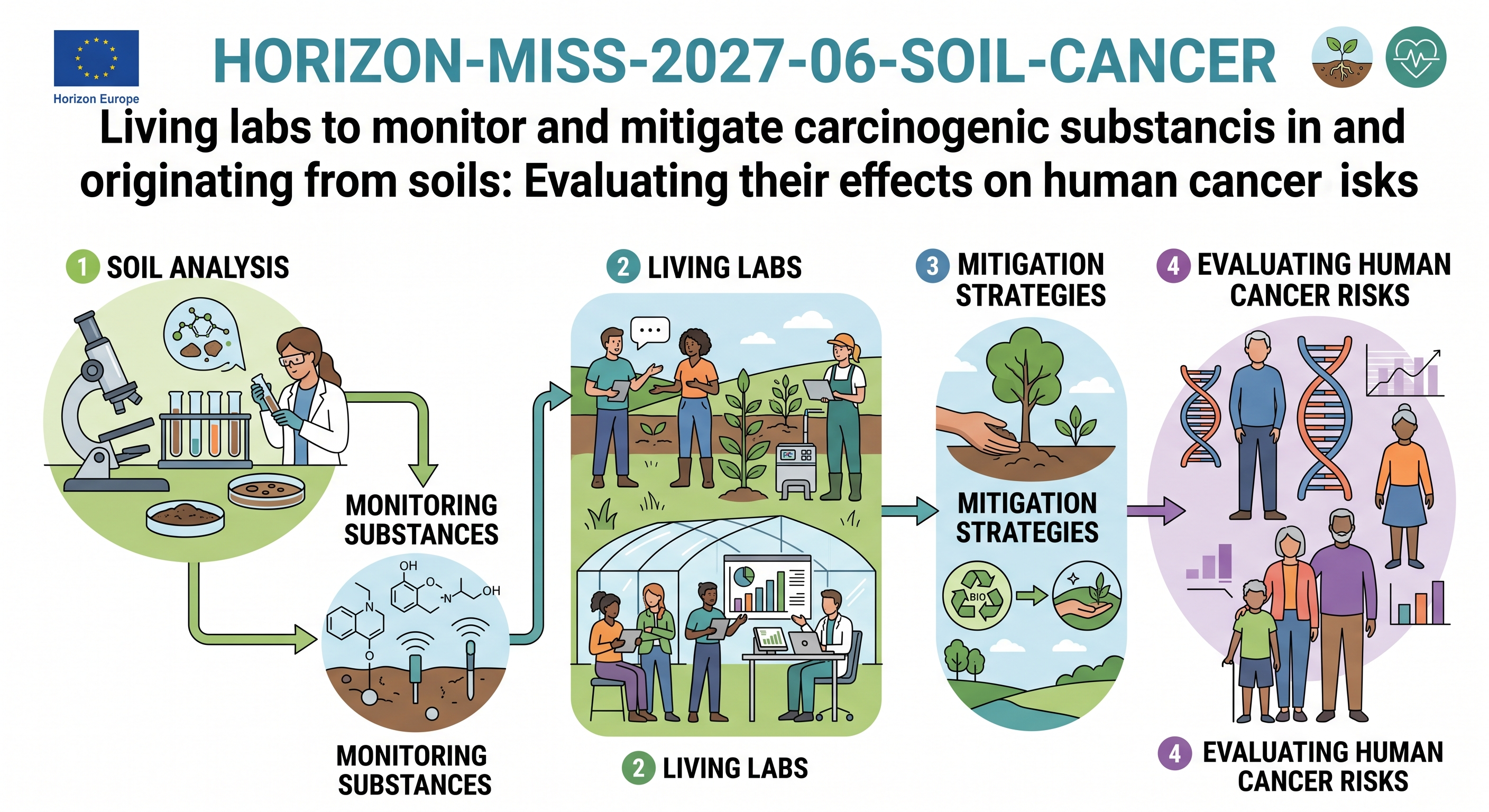
HORIZON-MISS-2027-06-SOIL-CANCER: Living labs to monitor and mitigate carcinogenic substances in and originating from soils: Evaluating their effects on human cancer risks
Contaminated soil doesn’t stay in the ground. The Commission wants living labs that track how carcinogenic substances move from soil into water, air, crops and people, then test ways to stop them. It’s a joint Soil and Cancer Mission call, so the science reaches from soil chemistry to cancer registries. Prove the link and act on it.
Download the MIC Horizon Europe 2026/2027 Calls Calendar:
Discover more!
Administrative facts: what do we know about the HORIZON-MISS-2027-06-SOIL-CANCER call?
Which call is it, and when is the opening and the deadline?
- Call name: Joint Call between the Soil Deal for Europe Mission and the Cancer Mission
- Call identifier: HORIZON-MISS-2027-06
- Destination: EU Missions’ Joint Calls
- Topic: HORIZON-MISS-2027-06-SOIL-CANCER
- Opening date: 04 February 2027
- Deadline: 21 September 2027
- Type of action: Research and Innovation Action (RIA)
What about the budget and estimated size of the project?
- Overall topic budget: EUR 24.00 million
- Number of projects funded: 2
- Budget per project: EUR 12.00 million (24.00 divided by 2)
What are the key eligibility and evaluation conditions?
- General Annex B applies, with one exception: proposals must use the multi-actor approach
- Financial support to third parties is allowed, capped at EUR 60 000 per third party
- Living labs must sit in at least three Member States or Associated Countries
- Standard award thresholds apply (General Annex D)
Scientific range: what does the Commission expect from the HORIZON-MISS-2027-06-SOIL-CANCER grant?
What outcomes are expected?
Two things by the end. Real capacity to co-create soil health solutions for carcinogen-contaminated land, and a clearer picture of how those substances reach humans and drive cancer. Publication lists are not what the Commission is after. It wants living labs running and remediation that works on real sites.
What is within scope?
- Four to five research-driven living labs working across land uses: agricultural, urban, post-industrial, forest, natural
- Carcinogenic substances of concern such as PFAS, heavy metals like arsenic and cadmium, and pesticides
- Remediation to isolate, immobilise, reduce or remove these substances from soils
- Monitoring across the soil-water-air nexus, plus uptake into the food chain
- Human biomonitoring linked to cancer incidence, mortality and prevalence
- Baseline soil characterisation using the proposed Soil Monitoring and Resilience Directive indicators
One boundary. This is not a lab-only chemistry project. Work that never touches real sites and real people falls outside scope.
What are the specifically proposed research directions?
- Link soil parent material, land management and soil properties to the presence of carcinogens (still largely unknown territory)
- Trace bioavailable fractions and bioaccumulation in crops, then the critical exposure pathways
- Correlate contaminant biomonitoring in humans with cancer data from regional or national registries
- Combine field data with modelling, pulling from HBM4EU, PARC and the Cancer Data Space
- Convert high-performing sites into lighthouses with the SOILL structure
Scientific strategy: how can you enhance your chances of being funded through HORIZON-MISS-2027-06-SOIL-CANCER?
What scientific choices matter most?
- Prove the soil-to-cancer chain: Evaluators look hard at whether your monitoring genuinely ties a contaminant in the ground to a health outcome. Weak causal logic sinks proposals.
- Pick real hotspots: Regions carrying the greatest carcinogen burden score better than convenient sites near your labs.
- Sort the human biomonitoring ethics early (this one catches people off guard).
- Design for the long game: Soil processes are slow, so justify a duration beyond four years if you need it.
- Bring social sciences in as real partners, not decoration.
Consortium & proposal-writing plan: what works best with this type of call?
- Size: somewhere between ten and fifteen partners, maybe a couple more if three-country coverage demands it.
- Mix: soil scientists, environmental chemists, epidemiologists, cancer registry people, land managers, local authorities.
- If you can bring a public-health partner with cancer registry access, do it. That link is the hard part.
- Include an innovative SME. Beyond the multi-actor rule, an SME sharpens remediation and monitoring, and helps build the post-grant business model.
- Writing tip. One clear diagram of the soil-water-air-human pathway beats three pages of prose.
- Budget the financial support to third parties properly. Small local actors will need it to take part.
How would microfluidics contribute to this topic?
Standard analysis of soil contaminants is slow and stuck in central labs. You ship samples off, you wait, and you get a number with no biology attached. Microfluidics works both ends. Small chips screen near the site, and they let you watch what a contaminant does to living tissue.
- Field detection. Compact microfluidic sensors can flag PFAS or arsenic in a soil-extract or water sample, no shipping to a central lab.
- Say you want to know whether a soil-borne carcinogen actually crosses the gut wall or just passes through. A gut-on-chip runs that transfer experiment directly, with human cells.
- Barrier-on-chip models cover the routes the call cares about: gut, lung, skin.
- Tumour-on-chip work lets your consortium test whether a contaminant mixture pushes cells toward cancer, not just whether it’s toxic.
- Droplet systems screen many contaminant combinations fast. Real soils are mixtures; single-compound tests miss that.
Here’s the honest version. This call lives or dies on the soil-to-human link, and that link is where reviewers stay sceptical. Microfluidics lets you show it in cells, not just a correlation table. Bring that to your living labs and the evidence gets harder to argue with.
The MIC already brings its expertise in microfluidics to Horizon Europe:
H2020-NMBP-TR-IND-2020

Microfluidic platform to study the interaction of cancer cells with lymphatic tissue
H2020-LC-GD-2020-3

Toxicology assessment of pharmaceutical products on a placenta-on-chip model

About the author
Julia Sepulveda Diaz, PhD
Chief Executive Officer, Microfluidics Innovation Center
Julia holds a PhD in glycobiology and neurobiology from Université Paris-Est Créteil. Before moving into microfluidics, she spent several years as a postdoctoral researcher at the Paris Brain Institute, on Parkinson’s disease, neuroinflammation, and the role of heparan sulfate in protein aggregation. Today she leads the Microfluidics Innovation Center as CEO, steering its researchers and engineers and its collaborative research and innovation projects.
FAQ: HORIZON-MISS-2027-06-SOIL-CANCER
What is the HORIZON-MISS-2027-06-SOIL-CANCER topic about?
It funds living labs that track carcinogenic substances from soil to humans and test remediation. It is a joint call between the Soil Deal for Europe Mission and the Cancer Mission.
When does the call open and close?
Opening is 04 February 2027. The deadline is 21 September 2027. Both are the envisaged dates and may shift slightly.
What is the budget and how many projects will be funded?
The topic budget is EUR 24.00 million. Two projects are expected, so around EUR 12.00 million per project.
What type of action is it?
It is a Research and Innovation Action (RIA).
What are the main eligibility conditions?
General Annex B applies, plus one exception: the multi-actor approach is mandatory. Living labs must sit in at least three Member States or Associated Countries. Check the Funding and Tenders Portal for more information.
How many living labs should a proposal set up?
Four to five research-driven living labs, working together across different land uses.
Which carcinogenic substances are in focus?
PFAS, heavy metals like arsenic and cadmium, and pesticides.
Can small local actors be funded?
Yes, through financial support to third parties, capped at EUR 60 000 per third party.
Which data platforms should projects connect to?
Connect to HBM4EU, PARC, the Cancer Data Space, EUSO and IPCHEM, and collaborate with the SOILL structure.
How can microfluidics strengthen a proposal?
Organ-on-chip and biosensor tools help show the soil-to-human link in cells, and they speed up contaminant detection. That is exactly where reviewers are most sceptical.