Tips & Tricks for a successful HORIZON-MISS-2026-04-CIT-NEB-B4P-CCRI-03 proposal
Opening
04 February 2026
Deadline
Keywords
circular economy
construction sector
Cities Mission
NEB
urban mining
CCRI
reuse and recycling
material banks
reduce, reuse, recycle
Your microfluidic SME partner for Horizon Europe
We take care of microfluidic engineering, work on valorization and optimize the proposal with you
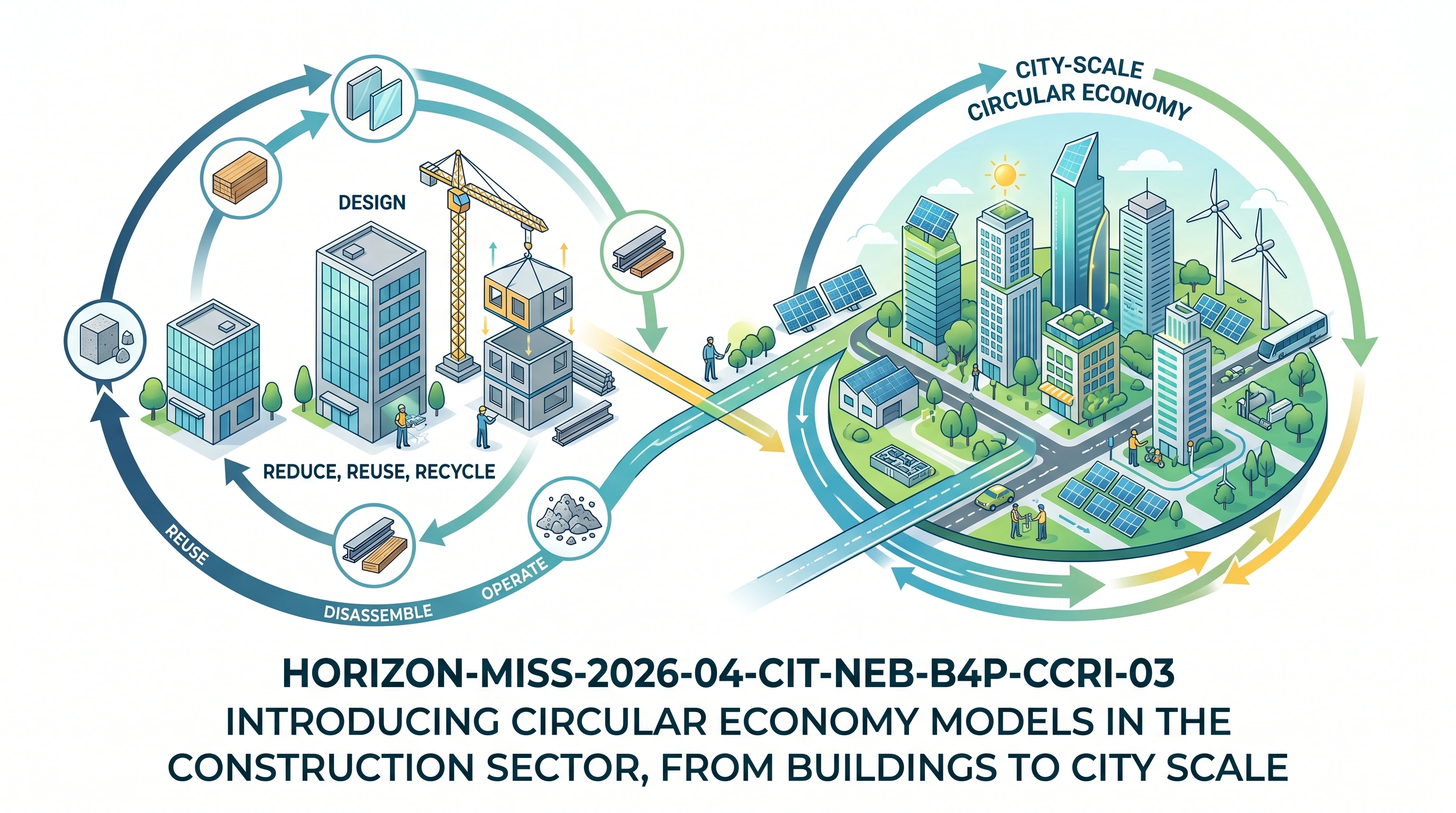
HORIZON-MISS-2026-04-CIT-NEB-B4P-CCRI-03: Introducing circular economy models in the construction sector, from buildings to city scale
The Commission wants circularity to leave the whiteboard and land in real cities. This topic asks you to build tools, solutions and business models that cut material use and life-cycle emissions across the building stock. It sits at the crossroads of the Cities Mission, the New European Bauhaus, the Built4People partnership and the CCRI. In short, demonstrate circular construction that actually works, in at least three cities.
Download the MIC Horizon Europe 2026/2027 Calls Calendar:
Discover more!
Administrative facts: what do we know about the HORIZON-MISS-2026-04-CIT-NEB-B4P-CCRI-03 call?
Which call is it, and when is the opening and the deadline?
- Call name: Supporting the implementation of the Climate-Neutral and Smart Cities Mission
- Call identifier: HORIZON-MISS-2026-04
- Destination: 100 Climate-Neutral and Smart Cities by 2030 (EU Missions’ Joint Calls)
- Topic: HORIZON-MISS-2026-04-CIT-NEB-B4P-CCRI-03
- Opening date: 04 February 2026
- Deadline: 08 October 2026 (single stage)
- Type of action: Innovation Action (IA)
What about the budget and estimated size of the project?
- Overall indicative budget for the topic: EUR 47.50 million
- Number of projects expected: 5
- EU contribution per project: around EUR 9.50 million (47.50 divided by 5)
What are the key eligibility and evaluation conditions?
- At least three cities, each from a different Member State or Associated Country, must participate as beneficiaries. Each is represented by a local authority, or by an entity with explicit consent from one.
- At least one of the three cities must be among the 112 cities of the EU Cities Mission.
- Target TRL 7-8 by project end.
- Grants are lump sum. Collaboration with the Cities Mission Platform is mandatory, formalised through a Memorandum of Understanding.
- Grants will be linked to HORIZON-MISS-2021-CIT-02-03, the Mission Platform action.
- Clustering with NEB, B4P and CCRI projects is expected, with a dedicated task and budget.
Scientific range: what does the Commission expect from the HORIZON-MISS-2026-04-CIT-NEB-B4P-CCRI-03 grant?
What outcomes are expected?
By the end, something has to be measurable. The Commission is after more circular-economy tools in real use, less virgin material going in, more reuse and recycling coming out, and lower whole-life-cycle emissions across the building stock. A collection of papers is not what they want here.
What is within scope?
- Tools and solutions at district or city level that push circularity principles into construction, with quantified impact.
- Diagnosis and performance characterisation of used construction products and demolition waste, plus inventories of reclaimed materials.
- Marketplace tools, material banks and business models that make reuse a market, not a one-off pilot.
- Whole life-cycle GHG inventories of buildings, aligned with the EPBD recast.
- Work on regulatory barriers and standards, where it helps.
This is an Innovation Action. Basic research dressed up as innovation will not pass.
What are the specifically proposed research directions?
- Urban mining, reuse and recycling of construction products, and secondary biobased materials.
- Adaptive design, renovation and repurposing of buildings under a waste-prevention logic.
- On-site diagnosis of used products: what condition are they in, can they be reused, at what performance level.
- Cross-border reuse of materials across the three demonstrator cities (this one is easy to underplay, and evaluators notice).
Scientific strategy: how can you enhance your chances of being funded through HORIZON-MISS-2026-04-CIT-NEB-B4P-CCRI-03?
What scientific choices matter most?
- Prove replicability: One clever building is not the point. Show it travels to another city.
- Quantify everything: Material saved, tons reused, GHG avoided.
- Nail the diagnosis step: Reuse decisions live or die on whether you can trust the condition of a reclaimed product, and this is where a lot of proposals stay vague.
- Build the business model early: The call says market potential and means it.
- Bring the people impacted in from day one: Building owners, SMEs, and civil society. Not a dissemination afterthought.
Consortium & proposal-writing plan: what works best with this type of call?
Three cities is the floor, not the target. Aim for somewhere between eight and fifteen partners, maybe a couple more if your city coverage needs it. Mix local authorities, the construction industry, material scientists, digital and marketplace developers, and at least one innovative SME to turn demonstrators into products. If you are light on characterisation or sensing, that is a gap worth filling with a specialist partner. For the writing: one clear circularity story, three cities that visibly do the same thing in different contexts, and a real plan for the Mission Platform MoU. Besides, budget the clustering task properly. Evaluators check.
How would microfluidics contribute to this topic?
Microfluidics is not the headline here. But there is a real angle. Conventional material testing is slow and lab-bound, which is a problem when you need to decide, fast, whether a reclaimed beam or panel is safe to reuse. Lab-on-a-chip changes that.
- Say you pull materials off a demolition site and need to know if they leach heavy metals or other contaminants. A microfluidic screening test can give you an answer on site, not in three weeks.
- Self-healing and biobased binders often rely on tiny capsules. Microfluidics makes those capsules at controlled size, so you get the same answer twice when you scale up.
- Water and leachate from construction and demolition waste can be characterised on-chip for quality control before reuse.
Point is, if your consortium wants trustworthy diagnosis of reclaimed materials, microfluidics is a quiet enabler. MIC can bring that piece as your innovative SME partner and connect it to the diagnosis and material-bank tasks the call already asks for.
The MIC already brings its expertise in microfluidics to Horizon Europe:
H2020-NMBP-TR-IND-2020
Microfluidic platform to study the interaction of cancer cells with lymphatic tissue
H2020-LC-GD-2020-3
Toxicology assessment of pharmaceutical products on a placenta-on-chip model

FAQ - HORIZON-MISS-2026-04-CIT-NEB-B4P-CCRI-03
So what is this call actually about?
It funds tools, solutions and business models that bring circular economy into the construction sector, from single buildings up to district and city scale, demonstrated in real cities.
When does the call open and close?
The call opens on 04 February 2026 and closes on 08 October 2026, in a single stage. Note the deadline can be delayed by up to two months.
How much funding is available and how many projects?
The topic budget is EUR 47.50 million, with around EUR 9.50 million per project, and about five projects expected.
What type of action is it, and what TRL?
It is an Innovation Action (IA), targeting TRL 7-8 by the end of the project. Grants take the form of a lump sum.
What are the city eligibility rules?
At least three cities from three different Member States or Associated Countries must join as beneficiaries. At least one must be among the 112 EU Cities Mission cities.
Check the Funding and Tenders Portal for more information.
Do we have to work with the Cities Mission Platform?
Yes. Collaboration with the Cities Mission Platform is mandatory and formalised through a Memorandum of Understanding signed soon after the project starts.
Which outcomes will evaluators look for?
Measurable increases in circular tools in use, measurable cuts in material use, more reuse and recycling, and lower whole life-cycle emissions of the building stock.
What is in scope for the proposal?
Urban mining, reuse and recycling, secondary biobased materials, diagnosis of used products, material banks and marketplace tools, whole life-cycle GHG inventories, plus work on standards and regulatory barriers.
How big should the consortium be?
Three cities is the minimum. In practice, expect somewhere between eight and fifteen partners, mixing local authorities, industry, material scientists, marketplace developers, and an innovative SME.
How can microfluidics help in this topic?
Microfluidics supports fast on-site diagnosis of reclaimed materials, contaminant and leachate screening, and controlled encapsulation for self-healing or biobased binders, giving your consortium trustworthy data for reuse decisions.