
Tips & Tricks for a successful HORIZON-INFRA-2027-TECH-01-01 proposal
Opening
09 March 2027
Deadline
Keywords
research infrastructures
co-creation
INFRATECH
deep-tech innovation
ESFRI and ERIC
technological sovereignty
industry partnership
Your microfluidic SME partner for Horizon Europe
We take care of microfluidic engineering, work on valorization and optimize the proposal with you
HORIZON-INFRA-2027-TECH-01-01: Testing and optimising models of co-creation of advanced research infrastructure technologies
How can one X-ray detector record both weak and intense signals?
An adaptive-gain detector changes its amplification as charge accumulates: high gain resolves weak signals, while lower gain extends the range before saturation. JUNGFRAU uses this principle, and Leonarski and colleagues demonstrated its integration into a synchrotron crystallography setup. [1] This illustrates a concrete challenge for HORIZON-INFRA-2027-TECH-01-01: translating experimental needs into technologies that improve research infrastructure services. The call combines that technical development with testing co-creation models involving infrastructures, other research organisations and industry, and exploring uses beyond the science market.
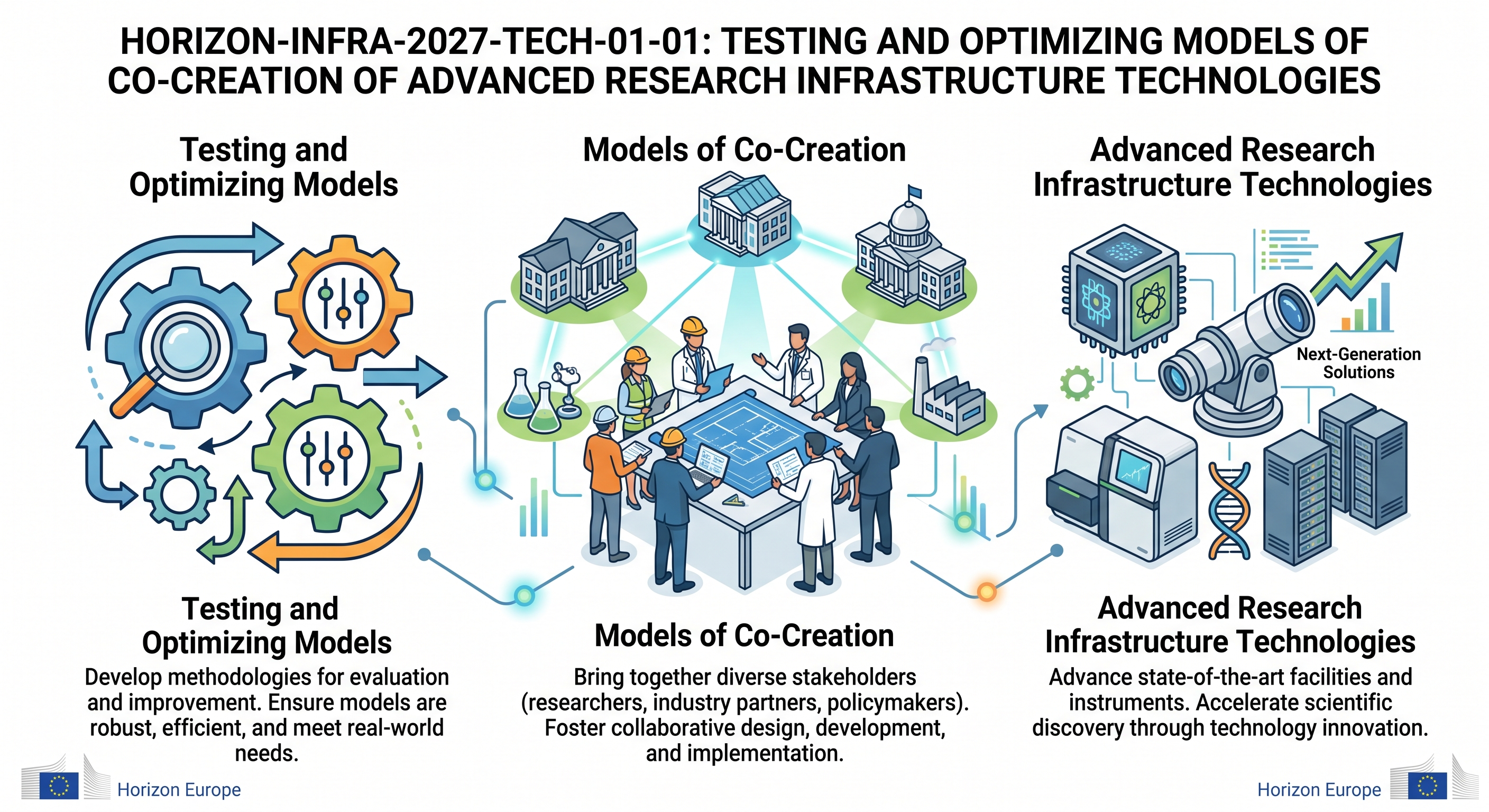
Download the MIC Horizon Europe 2026/2027 Calls Calendar:
Discover more!
Administrative facts: what do we know about the HORIZON-INFRA-2027-TECH-01-01 call?
Which call is it, and when is the opening and the deadline?
- Call name: Research Infrastructures 2027
- Identifier: HORIZON-INFRA-2027-01
- Destination: INFRATECH
- Topic: HORIZON-INFRA-2027-TECH-01-01
- Opening date: 09 Mar 2027
- Deadline: 15 Jun 2027, at 17.00 Brussels time
- Type of action: Research and Innovation Action (RIA)
What about the budget and estimated size of the project?
- Overall topic budget: EUR 30 million
- Number of projects: 2
- Budget per project: around 10–15 M€
What are the key eligibility and evaluation conditions?
- At least two different research infrastructures as beneficiaries, each an ESFRI infrastructure, an ERIC, or an international European research organisation, all explicitly named in the proposal
- Two nodes of the same infrastructure do not count as two
- Financial support to third parties allowed, capped at EUR 500,000 per third party
- PCP subcontracting permitted
- Legal entities established in China cannot participate under this destination
- Thresholds follow General Annex D (standard RIA: 3/5 per criterion, 10/15 overall)
- JRC research infrastructures may be included; that collaboration is set up after approval
Scientific range: what does the Commission expect from the HORIZON-INFRA-2027-TECH-01-01 grant?
What outcomes are expected?
Brussels wants RIS positioned as centres of gravity for deep-tech innovation, with EU technological sovereignty stronger at the end than at the start. Publication series are not what the Commission is after. They want working partnerships, and technologies that survive outside the lab.
What is within scope?
- Co-creation of advanced technologies answering real RI needs, with resource efficiency and environmental impact kept in view
- Partnerships between RIs and industry, including SMEs, startups and scaleups, to co-develop solutions and drive their uptake
- A shared reading of commercial potential, with RI technology transfer teams brought in early
- Developments for the RI use case beyond TRL 4; wider applications up to TRL 3-4
A boundary worth flagging: a pure academic exercise with no exploitation path sits outside what this topic funds.
What are the specifically proposed research directions?
- Piloting new modes of co-creation and co-innovation between RIs and industry
- Growing innovation ecosystems around RIs, not one-off supplier contracts
- Testing how technologies get exploited outside the science market
- Sharing co-creation experience with the project funded under HORIZON-INFRA-2025-01-DEV-05, area 3
The wording leans toward the collaboration model itself, not a specific piece of hardware. That vagueness is an opening. It gives you room to frame your consortium’s method as the innovation.
Scientific strategy: how can you enhance your chances of being funded through HORIZON-INFRA-2027-TECH-01-01?
What scientific choices matter most?
- Make the co-creation model the star: Reviewers judge how you co-create here, not only what you build.
- State your TRL endpoint for each development: The topic asks for this explicitly.
- Bring industry in as a co-creator: Not a subcontractor you invoice at the end.
- Show the exploitation path early: This one trips people up more than you’d expect.
- Address greening and resilience: Not optional dressing.
- Plan the knowledge exchange with the 2025 DEV project.
Consortium & proposal-writing plan: what works best with this type of call?
- Two RIs is the floor, not the target. Spread them across different RI types so your model gets tested more than once.
- Somewhere around eight to twelve partners usually reads well for a 15 million RIA, maybe a couple more if you cover several technology domains.
- Mix public labs, established industry, and at least one innovative SME that actually builds the technology. A technology transfer office helps too.
- If you’re proposing a method for partnership, the consortium has to look like one. Intersectoral balance matters here more than usual.
- Writing tip: give the co-creation methodology its own work package, with its own evaluation. Don’t bury it in a task.
- Keep the impact section concrete about uptake outside the science market.
How can a project distinguish technological progress from the benefits of co-creation?
Assess both the improvement in the research service and the contribution of the collaboration method. The official topic scope connects advanced technology development with co-creation. A practical evaluation should therefore use separate evidence for each.
For the technology, define the service limitation, the existing performance and the proposed improvement before testing. Select measures suited to the application, such as measurement uncertainty, usable throughput, reliability or resource consumption. Agree acceptance criteria with infrastructure operators and test the relevant operating conditions. Record unsuccessful trials and remaining limitations alongside improvements.
For co-creation, keep a record of how joint decisions changed the design. Useful evidence includes requirements revised after user feedback, problems resolved through exchanges between infrastructure staff and industry, and design changes accepted after prototype tests. Compare development cycles where meaningful, while accounting for differences in technical difficulty and resources. A shorter development time alone cannot establish that the collaboration model caused the improvement.
A useful final deliverable pairs a technical validation report with an assessment of the collaboration method: which decisions helped, which caused delays, and which practices another infrastructure could reuse.
The MIC already brings its expertise in microfluidics to Horizon Europe:
H2020-NMBP-TR-IND-2020

Microfluidic platform to study the interaction of cancer cells with lymphatic tissue
H2020-LC-GD-2020-3
Toxicology assessment of pharmaceutical products on a placenta-on-chip model

About the author

Julia Sepulveda Diaz, PhD
Chief Executive Officer, Microfluidics Innovation Center
Julia holds a PhD in glycobiology and neurobiology from Université Paris-Est Créteil. Before moving into microfluidics, she spent several years as a postdoctoral researcher at the Paris Brain Institute, on Parkinson’s disease, neuroinflammation, and the role of heparan sulfate in protein aggregation. Today she leads the Microfluidics Innovation Center as CEO, steering its researchers and engineers and its collaborative research and innovation projects.
FAQ - HORIZON-INFRA-2027-TECH-01-01
Practical questions about instrument performance, meaningful comparisons and transfer of research technologies.
Why does a higher detector frame rate not guarantee more usable data?
Readout, transfer and storage must sustain acquisition. In synchrotron tests, Leonarski and colleagues used data conversion and compression to enable continuous JUNGFRAU acquisition where raw-data recording exhausted intermediate storage. [1]
What is the difference between instrument calibration and validation?
Calibration relates instrument readings to reference values, with associated uncertainties, under specified conditions. Validation establishes that requirements appropriate to an intended use are fulfilled. A calibration curve therefore needs to be complemented by evidence that the instrument suits the planned research application.
Why should an adaptive-gain detector be tested at its switching points?
Changing gain can introduce a discontinuity in detector response. Matheson and colleagues observed this in Jungfrau-1M tests, with an effect that depended on the illuminated area. Its significance was application-dependent; the tested macromolecular crystallography data showed no apparent degradation from the discontinuity. [2]
Can temperature changes affect the baseline of an integrating detector?
Yes. Leakage currents contribute signal even without illumination, and their contribution depends on operating conditions. Jungfrau-1M tests showed that cooling reduced the dark baseline and electronic noise. Dark measurements should match the acquisition conditions; one cooling setting cannot be assumed suitable for every detector or exposure time. [2]
How can instrument comparisons avoid confusing speed with data quality?
Control relevant exposure conditions. In their lysozyme comparison, Leonarski and colleagues adjusted beam transmission and sample delivery to make dose and illuminated sample area comparable across acquisition rates, then assessed diffraction quality. [1]
How can different infrastructures identify genuinely shared technology needs?
Compare required functions, operating ranges and acceptance criteria before choosing a common design. Identify which requirements overlap and which remain facility-specific. This is a practical way to pursue the topic’s aim of addressing common infrastructure needs where applicable, without assuming that every participating facility needs identical equipment.
How should environmental performance be compared between instrument designs?
Compare designs delivering an equivalent research service, with explicit assumptions about workload and lifetime. Include manufacturing, operation, consumables and end-of-life impacts rather than electricity use alone. The Commission’s Product Environmental Footprint method provides a life-cycle assessment framework; using that specific method is not a requirement of this topic.
What should be defined at the interface between a detector and its software?
Define triggering, timing, data formats, calibration handling and sustained transfer capacity. The JUNGFRAU integration at MAX IV illustrates why detector control and downstream data handling must be designed together. [1]
How can an instrument-development project assess supplier dependence?
Map critical components, software dependencies and the consequences of losing support. Identify qualified alternatives, available design information and the testing needed after substitution. This is one practical approach to the topic’s technological-sovereignty objective; replacing a component should not be assumed to preserve performance without verification.
Does a successful research demonstrator establish suitability for another market?
No. A new use can change performance requirements, operating conditions, maintenance needs and acceptable cost. The topic distinguishes infrastructure developments from additional applications. For each proposed transfer, identify the new user’s requirements and the evidence still needed. A functioning research prototype does not establish commercial demand.
References
[1] Leonarski F, Nan J, Matej Z, et al. Kilohertz serial crystallography with the JUNGFRAU detector at a fourth-generation synchrotron source. IUCrJ. 2023;10(6):729–737. doi:10.1107/S2052252523008618
[2] Matheson J, Axford D, Bergamaschi A, et al. Experience with the Jungfrau-1M detector at Diamond Light Source. Journal of Synchrotron Radiation. 2026;33(2):331–343. doi:10.1107/S1600577526000342