Tips & Tricks for a successful HORIZON-INFRA-2027-SERV-01-02 proposal
Opening
09 March 2027
Deadline
Keywords
Research infrastructures
trans-national access
EOSC
virtual access
ESFRI Landmark
ERIC
EU priorities
emerging challenges
Ecodesign Regulation
RIA
Your microfluidic SME partner for Horizon Europe
We take care of microfluidic engineering, work on valorization and optimize the proposal with you
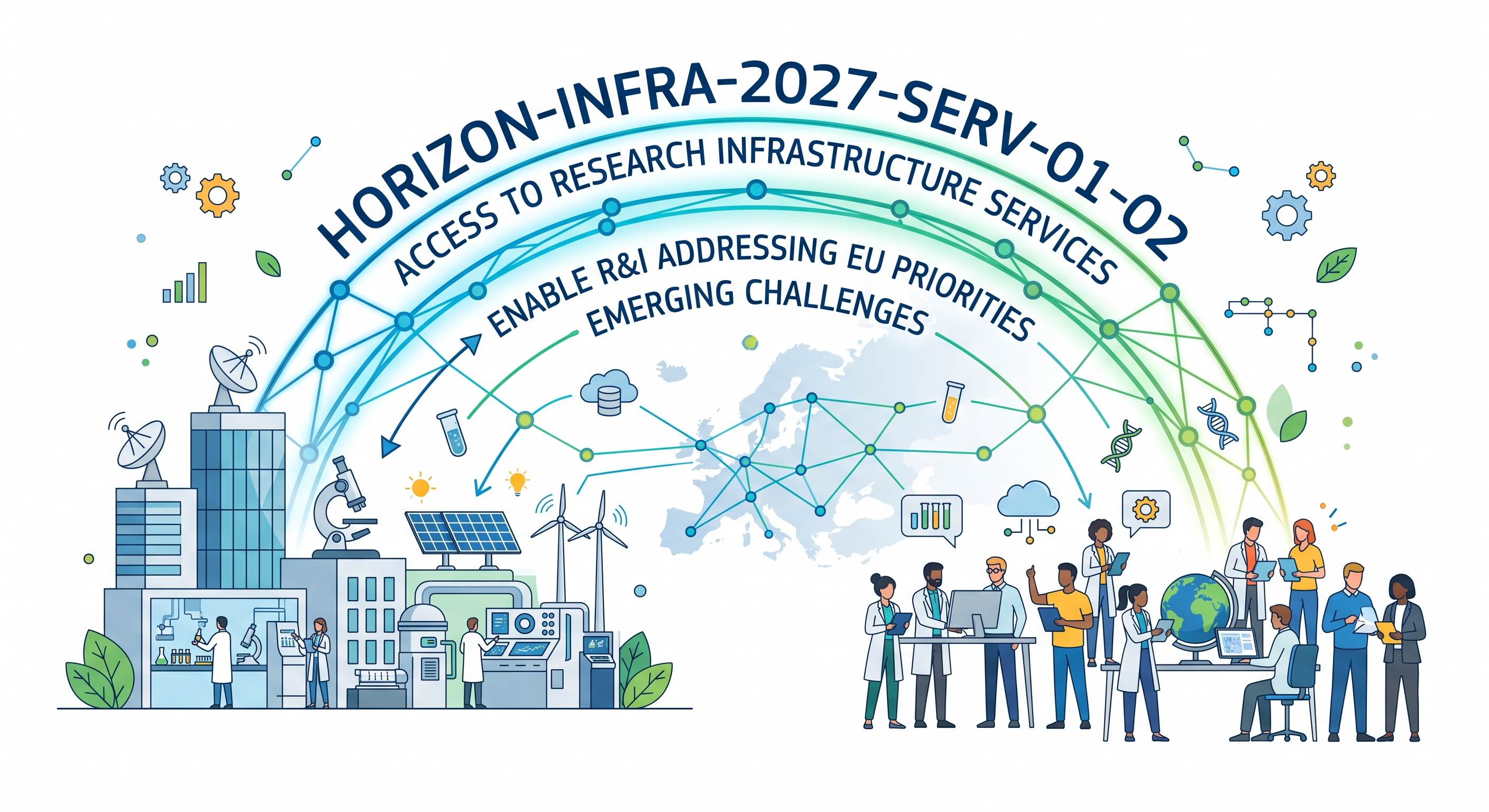
HORIZON-INFRA-2027-SERV-01-02: Access to research infrastructure services to enable R&I addressing EU priorities and emerging challenges
This topic pays for access, not for a research programme of your own. The Commission wants existing top level facilities to open their doors to outside users working on six named challenges. Access provision must dominate the workplan and the budget.
Download the MIC Horizon Europe 2026/2027 Calls Calendar:
Discover more!
Administrative facts: what do we know about the HORIZON-INFRA-2027-SERV-01-02 call?
Which call is it, and when is the opening and the deadline?
- Call name: Research Infrastructures 2027
- Call identifier: HORIZON-INFRA-2027-01
- Destination: INFRASERV
- Topic: HORIZON-INFRA-2027-SERV-01-02
- Opening: 09 March 2027
- Deadline: 15 June 2027, 17:00:00 Brussels time
- Type of action: Research and Innovation Action (RIA)
What about the budget and estimated size of the project?
- Total indicative topic budget: EUR 35.00 million
- Indicative number of projects funded: 6
- Expected EU contribution per project: around EUR 6.00 million (35 divided by 6 gives 5.83, the work programme rounds up)
What are the key eligibility and evaluation conditions?
- Award criteria and thresholds: General Annex D, with Excellence additions on access quality and integration of access procedures
- At least one ESFRI Landmark or ERIC as beneficiary; for a distributed ERIC, a hosting entity can take that slot
- Access provision activities are mandatory
- Page limit 100 pages, no exploitation plan required
- Eleven third countries eligible for EU funding when providing access: Australia, Brazil, Canada, Chile, India, Japan, Mexico, New Zealand, Korea, Singapore, USA
- The JRC may join after selection, as zero funding beneficiary or associated partner
- The highest ranked proposal in each area gets funded, thresholds permitting
Scientific range: what does the Commission expect from the HORIZON-INFRA-2027-SERV-01-02 grant?
What outcomes are expected?
Efficient access to the best facilities, through a single entry point portal, with converging conditions and selection procedures. Also a trained new generation of users, early career researchers first. Publication series are not what the Commission is after. Units of access delivered are.
What is within scope?
- Trans-national access, on site or remote, and virtual access to customised services
- Ad hoc user training, technical support, data stewardship
- Service improvement, if the improved service opens during the action
- Data management, interoperability, digital services connected to EOSC
- Outreach to industry, SMEs, widening and candidate countries
This is not a topic for building new infrastructure. Mid term service development (2 to 3 years) passes only when justified well.
What are the specifically proposed research directions?
Proposals address one area and must say which one.
- Area 1: cancer research through integrated biomedical infrastructures. Imaging, genomics, proteomics, trial management, AI on big datasets
- Area 2: sustainable agrifood systems and agroecological transitions, One Health, access to genetic resources
- Area 3: polar ecosystems, climate, biodiversity, pollution, science diplomacy
- Area 4: material circularity, tied to the Ecodesign Regulation and Critical Raw Materials Act
- Area 5: semiconductors, in line with the European Chips Act
- Area 6: geosphere infrastructures and geohazards
Scientific strategy: how can you enhance your chances of being funded through HORIZON-INFRA-2027-SERV-01-02?
What scientific choices matter most?
- Name your area on page one. Do not hedge across two.
- Quantify the access. Each installation, its unit of access, the number of units offered. From what we have seen, evaluators go to that table first.
- Make access the biggest cost line.
- Build for complementarity, not prestige. Six facilities that chain into a workflow beat fifteen offering the same thing.
- Show the selection machinery: published calls, independent peer review of user projects. Use the unit costs allowed for access.
- The wording on service development is vague, which leaves room to frame short R&D as part of the access offer.
Consortium & proposal-writing plan: what works best with this type of call?
- Somewhere between eight and fifteen partners, a few more if the area needs wide coverage.
- One ESFRI Landmark or ERIC as beneficiary. Non negotiable.
- Mix facility operators with data centres, and bring in at least one innovative SME. They help on service customisation and make the industrial outreach plausible.
- Widening participation is evaluated here, not decorative. Budget real training slots.
- 100 pages is generous. Spend it on access tables, not prose.
How would microfluidics contribute to this topic?
Conventional lab platforms deliver a service that is standardised but rigid. Users get the assay the facility already runs, not much else. Microfluidics works differently: tiny volumes, controlled flow, a chip you redesign around the user project in front of you.
- Say a user group wants to know whether a compound hits the tumour or the healthy tissue next door. A tumour-on-chip run answers that in weeks, and you get the same answer twice.
- Organ-on-chip and vessel-on-chip map onto Area 1. Part of Area 2 too, since One Health needs toxicity data that does not come from animals.
- Droplet platforms for single cell screening. Thousands of conditions, one run.
- Chip fabrication and test structures for Area 5.
- Sample preparation modules plugged in front of a genomics or imaging line.
For your consortium, microfluidics offers users something they cannot get at home. Exactly what the Commission means by customised services. It also gives the Microfluidics Innovation Center a concrete role: chip design, service customisation, user support.
The MIC already brings its expertise in microfluidics to Horizon Europe:
H2020-NMBP-TR-IND-2020

Microfluidic platform to study the interaction of cancer cells with lymphatic tissue
H2020-LC-GD-2020-3

Toxicology assessment of pharmaceutical products on a placenta-on-chip model

FAQ - HORIZON-INFRA-2027-SERV-01-02
What is HORIZON-INFRA-2027-SERV-01-02 actually funding?
Access provision to existing research infrastructure services. Trans-national access, on site or remote, and virtual access to integrated and customised services. Not the construction of new facilities. The main goal of the topic is access to existing services, and this has to show in the activities and in the allocated resources.
When does the call open and when is the deadline?
Opening on 09 March 2027, deadline on 15 June 2027 at 17:00:00 Brussels local time. The call identifier is HORIZON-INFRA-2027-01, Destination INFRASERV. The Director-General may open the call up to one month earlier or later, and may delay the deadline by up to two months.
How much money is on the table for this topic?
The total indicative budget is EUR 35.00 million, for 6 projects expected. The work programme states an expected EU contribution of around EUR 6.00 million per project. The straight division gives 5.83 million. Requesting a different amount is not excluded.
Which areas can a proposal address?
Six areas. Cancer research through integrated biomedical infrastructures. Agrifood systems and agroecological transitions with a One Health approach. Polar ecosystems. Material circularity. Semiconductors under the European Chips Act. Geosphere infrastructures for geohazards. A proposal addresses one area and must explicitly state which one.
Do we really need an ESFRI Landmark or an ERIC in the consortium?
Yes. At least one ESFRI Landmark or ERIC must be a beneficiary. For a distributed ERIC, a legal entity hosting ERIC facilities, resources or related services can take that slot instead. In that case the legal representative of the ERIC signs a declaration confirming support for the participation.
Can facilities outside Europe be funded under this topic?
Exceptionally, yes. Legal entities established in Australia, Brazil, Canada, Chile, India, Japan, Mexico, New Zealand, Republic of Korea, Singapore and the USA are eligible for EU funding under this topic, provided they give access to their infrastructures to researchers from Member States and Associated Countries.
Check the Funding and Tenders Portal for more information.
What is the role of the Joint Research Centre?
The JRC may participate as a beneficiary with zero funding, or as an associated partner. It does not take part in preparing the proposal. The work programme points to the JRC Nanobiotechnology Laboratory for Area 1 and Area 2, and to the European Laboratory for Structural Assessment for Area 4. Collaboration is set up after approval.
How are proposals evaluated?
General Annex D applies, with two additions under Excellence. First, how far the access activities offer access to state-of-the-art infrastructures of European interest and to high quality services. Second, how far the project facilitates and integrates access procedures and develops online services. To keep a balanced portfolio, the highest ranked proposal in each area is funded, thresholds permitting.
What should the budget look like?
Access provision should be the dominant cost line. Unit costs for trans-national and virtual access are allowed, as defined in Annex 2a of the Model Grant Agreement. Reserve resources for training slots for early career researchers and technical staff from widening and candidate countries. Beneficiaries also grant royalty free access to tools, standards and specifications generated by the action.
How does microfluidics fit into a proposal for this topic?
As a customised service that users cannot run at home. Organ-on-chip and tumour-on-chip platforms for Area 1, non animal toxicity work for Area 2, chip fabrication for Area 5. The Microfluidics Innovation Center can take on chip design, service customisation and user support for the groups your access calls bring in.