
Tips & Tricks for a successful HORIZON-INFRA-2027-SERV-01-01 proposal
Opening
09 March 2027
Deadline
Keywords
Research Infrastructures
trans-national access
ESFRI Landmark
ERIC
RIA
single-entry point portal
FSTP
open access
large-scale pilots
Your microfluidic SME partner for Horizon Europe
We take care of microfluidic engineering, work on valorization and optimize the proposal with you
HORIZON-INFRA-2027-SERV-01-01: Access to research infrastructures, their resources and services: large-scale pilots for more integrated scheme across (sub)domains
How can researchers trace a result across several research infrastructures?
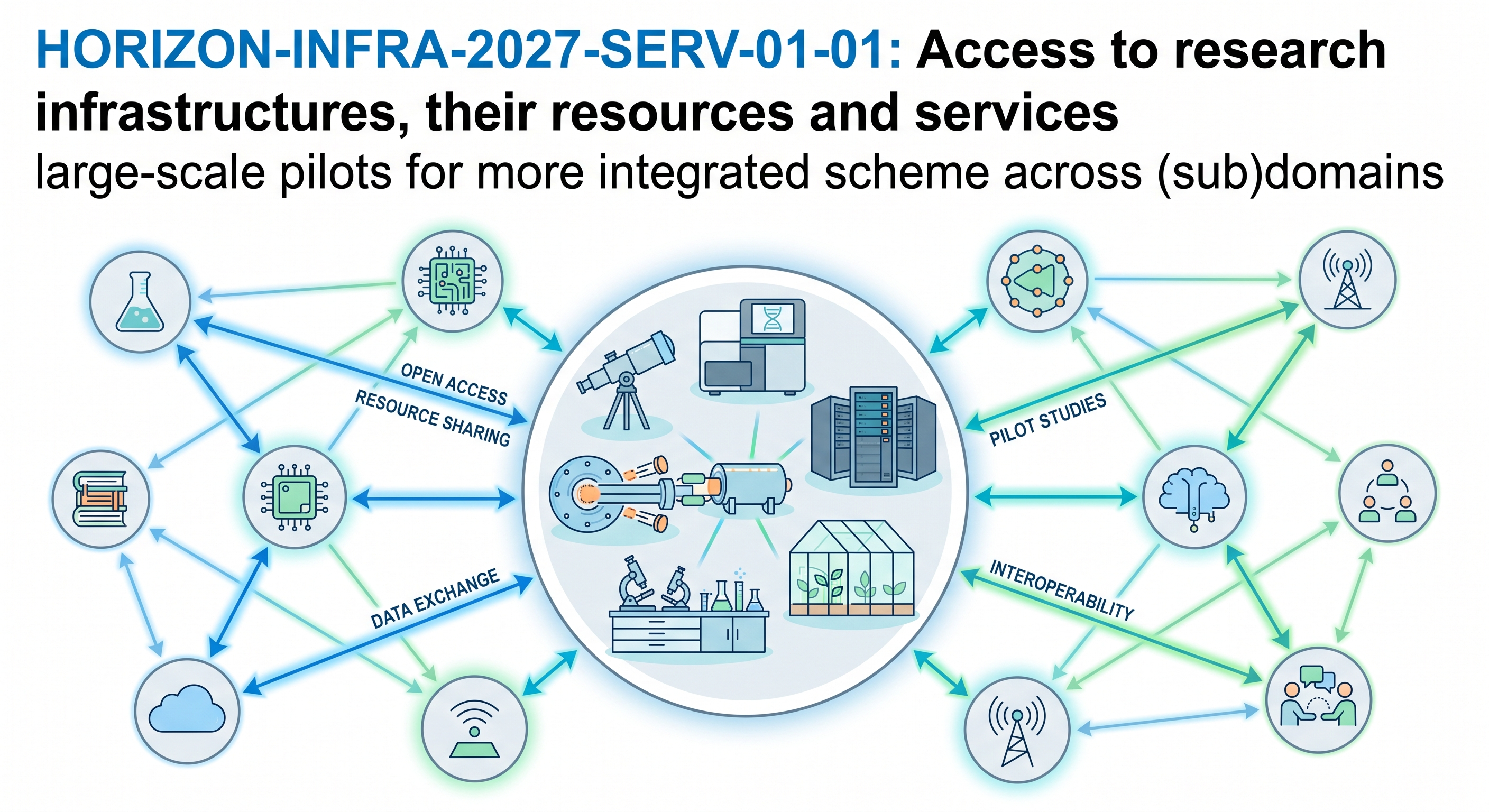
By preserving its provenance: a linked record of the input data, processing steps and software that produced it. Leo and colleagues developed Workflow Run RO-Crate (Research Object Crate) to package this information for computational workflows across different execution systems. [1] For an integrated access programme, the practical question is whether users can follow that history when combining services. HORIZON-INFRA-2027-SERV-01-01 connects access to complementary research infrastructures with interoperable service catalogues, converging access procedures and better management of research data.
Download the MIC Horizon Europe 2026/2027 Calls Calendar:
Discover more!
Administrative facts: what do we know about the HORIZON-INFRA-2027-SERV-01-01 call?
Which call is it, and when is the opening and the deadline?
- Call name: Research Infrastructures 2027
- Call identifier: HORIZON-INFRA-2027-01
- Destination: INFRASERV
- Topic: HORIZON-INFRA-2027-SERV-01-01
- Opening: 09 March 2027
- Deadline: 15 June 2027, 17.00 Brussels time
- Type of action: Research and Innovation Actions (RIA)
What about the budget and estimated size of the project?
- Total indicative topic budget: EUR 105.00 million
- Indicative number of projects: 3
- EU contribution per project: around EUR 35.00 million
What are the key eligibility and evaluation conditions?
- Thresholds: standard RIA rules of General Annex D, no topic-level exception.
- Extra Excellence aspects: quality of the access offered, integration of access procedures, improvement of online services.
- Portfolio rule: the highest ranked proposal in each area is funded, provided all thresholds are met.
- Page limit: 100 pages. No exploitation and dissemination plan required.
- At least two ESFRI Landmarks and/or ERICs as beneficiaries.
- The JRC may join as a beneficiary with zero funding or as associated partner.
- Exceptionally eligible for funding when providing access: Australia, Brazil, Canada, Chile, India, Japan, Mexico, New Zealand, Republic of Korea, Singapore, USA.
- FSTP allowed, capped at EUR 300 000 per third party.
- Royalty-free access rights on tools and standards for EU institutions and other EU-funded projects.
Scientific range: what does the Commission expect from the HORIZON-INFRA-2027-SERV-01-01 grant?
What outcomes are expected?
By the end of the grant a researcher should find, request and obtain access through one portal, under conditions that look the same whatever the facility. The Commission is after a working prototype of a harmonised access scheme, not a report describing one. Training new users, notably early-career and widening-country researchers, sits right next to that.
What is within scope?
- Trans-national access, on-site or remote, and virtual access to integrated and customised installations.
- One area per proposal, and you must say which: Area 1 (Physical Sciences and Engineering, plus Data, Computing and Digital RIs), Area 2 (Health & Food, plus Social Sciences and Humanities), Area 3 (Environment, Energy).
- Short-term service improvement, provided the improved service is actually offered during the action.
Long-term R&D on instrumentation is not what this topic buys. Access is.
What are the specifically proposed research directions?
- Converging call conditions, selection procedures and access modalities across domains that have never shared any.
- A single-entry point portal per pilot, designed so the three can later merge into a common front page.
- Peer review of user projects, with joint applications pairing a user group and the third party provider it needs.
- Continuous coordination with HORIZON-INFRA-2025-01-DEV-05, HORIZON-INFRA-2026-01-DEV-02 and HORIZON-INFRA-2027-SERV-01-02.
Scientific strategy: how can you enhance your chances of being funded through HORIZON-INFRA-2027-SERV-01-01?
What scientific choices matter most?
- Pick your area early and defend it: Cross-area ambition is welcome through third-party providers, but the pilot itself belongs to one area.
- Define your units of access precisely: Reviewers read this part closely, and vague units are a classic weak point (worth checking twice).
- Budget the FSTP envelope generously: A thin third-party line signals you did not believe your own design.
- Show governance: Who arbitrates between domains when demand shifts.
- The call says collaboration with the other pilots; in practice, evaluators want a named mechanism, not goodwill.
Consortium & proposal-writing plan: what works best with this type of call?
- Somewhere between fifteen and thirty beneficiaries, maybe more, because an area covers several communities and each needs a credible provider.
- Two ESFRI Landmarks or ERICs minimum. Above all, pick ones with real transnational access experience.
- Bring in an innovative SME as service or technology provider. It sharpens the industrial user story, and industry users are eligible.
- Widening and candidate country partners: not a box to tick here, they are part of the outcome.
- Write the access tables first, then the narrative around them.
- If your portal partner is weak, the whole proposal reads weak.
What should an integrated research-infrastructure access pilot demonstrate?
Demonstrate a complete pathway from a research question to delivered services and usable outputs. Test how a user identifies suitable facilities, requests access, receives a decision, prepares the work and obtains results. For studies using several infrastructures, check that referrals, scheduling and transfers of samples or data work across the participating providers.
Define each service’s inputs, outputs, support arrangements and operational constraints. Agree who handles technical feasibility, preparation, data delivery and unresolved problems at each handover. Users should be able to understand what they will receive and which specialist help is included. The European Charter for Access to Research Infrastructures provides a reference for transparent access processes, user support and quality assurance.
Monitor where users encounter delays or abandon a request. Useful indicators include the time from request to decision, completion of approved access, support workload and user feedback; these are proposed monitoring measures, not additional call requirements. Use the findings to improve the service pathway. Under the topic’s service-improvement provisions, supported short-term development must lead to services offered during the action, with their longer-term sustainability addressed.
The MIC already brings its expertise in microfluidics to Horizon Europe:
H2020-NMBP-TR-IND-2020

Microfluidic platform to study the interaction of cancer cells with lymphatic tissue
H2020-LC-GD-2020-3
Toxicology assessment of pharmaceutical products on a placenta-on-chip model

About the author

Julia Sepulveda Diaz, PhD
Chief Executive Officer, Microfluidics Innovation Center
Julia holds a PhD in glycobiology and neurobiology from Université Paris-Est Créteil. Before moving into microfluidics, she spent several years as a postdoctoral researcher at the Paris Brain Institute, on Parkinson’s disease, neuroinflammation, and the role of heparan sulfate in protein aggregation. Today she leads the Microfluidics Innovation Center as CEO, steering its researchers and engineers and its collaborative research and innovation projects.
FAQ - HORIZON-INFRA-2027-SERV-01-01
Practical questions about research services, interoperable data and reliable access across research infrastructures.
Is remote access the same as virtual access?
No. Remote access can involve selected users sending samples for analysis or using computing resources without visiting a facility. Under the work programme’s access definitions, virtual access provides network-based services without selecting individual users, subject to the infrastructure’s access policy. Both can happen online, but their delivery models differ.
What should a service catalogue tell a researcher?
Describe the scientific task a service supports, required inputs, delivered outputs, operating limits and available expert support. This helps users judge suitability before requesting access. For the topic’s integrated service portfolio, a useful catalogue should connect complementary services and make their dependencies clear; an equipment name alone cannot explain the complete offer.
Does a shared file format make research data interoperable?
No. Two readable files can use different meanings, units or conventions for apparently identical variables. Semantic interoperability requires explicit descriptions of what the data represent and how entities relate. The GO FAIR guidance on knowledge representation explains why a shared, machine-interpretable meaning matters when combining resources across disciplines.
How much detail should a computational provenance record contain?
Match the detail to the intended use. Recording a workflow’s overall inputs and outputs may support an overview, while investigating a processing error can require intermediate results and individual step parameters. Leo and colleagues defined progressively richer Research Object Crate (RO-Crate) profiles for these different levels of computational provenance. [1] Select the level deliberately.
How should corrected research datasets be versioned?
Document the change and identify the version used in an analysis. DataCite’s versioning guidance allows minor changes under the same digital object identifier (DOI) with updated metadata, while recommending a new DOI for major changes and explicit links between versions. Follow the repository’s policy so users can distinguish successive releases.
Must FAIR research data be openly downloadable?
No. FAIR means findable, accessible, interoperable and reusable; it does not require unrestricted access. The FAIR accessibility guidance allows authentication and authorisation where needed. Describe access conditions clearly, including permitted uses, so an authorised researcher or software service can determine how to request and use the resource.
Does a high FAIR score establish scientific data quality?
No. A FAIR assessment checks specified aspects of data and metadata management; it does not establish that an experiment or interpretation is correct. In their evaluation of the F-UJI automated assessment tool, Devaraju and Huber identified a need for additional quality and usability criteria. [2] Retain scientific quality checks alongside the FAIR assessment.
Do identical access units imply equivalent services?
No. An instrument hour, sample analysis or computing session can include different preparation, support and outputs at different facilities. The work programme requires an access unit to be defined for each service or installation. For meaningful comparison, state what the unit includes and how delivery is recorded.
Why assess technical feasibility as well as scientific merit?
A valuable research question may still need a different method, sample preparation or instrument configuration. The European access charter includes technical and ethical feasibility within excellence-driven access. Explain how scientific review and facility expertise inform the decision, and provide useful feedback when the requested service cannot meet the study’s needs.
How can an access pilot prepare for service interruptions?
Identify critical dependencies and plan how users will be informed, ongoing work protected and alternatives assessed. The European access charter encourages crisis access-management plans. A practical plan can cover interrupted experiments, stored samples, data access and rescheduling, while making clear when another facility cannot provide an equivalent service.
References
[1] Leo, S.; Crusoe, M. R.; Rodríguez-Navas, L.; Sirvent, R.; Kanitz, A.; De Geest, P.; et al. Recording provenance of workflow runs with RO-Crate. PLOS ONE. 2024;19(9):e0309210. doi:10.1371/journal.pone.0309210
[2] Devaraju, A.; Huber, R. An automated solution for measuring the progress toward FAIR research data. Patterns. 2021;2(11):100370. doi:10.1016/j.patter.2021.100370