
Frontier AI for healthcare: building the evidence, data and shared roadmap
Opening
03 June 2027
Deadline
Keywords
Healthcare
Artificial General Intelligence
CSA
foundation models
EHDS
AI Act
AI Factories
drug discovery
pan-European community
prevention
Your microfluidic SME partner for Horizon Europe
We take care of microfluidic engineering, work on valorization and optimize the proposal with you
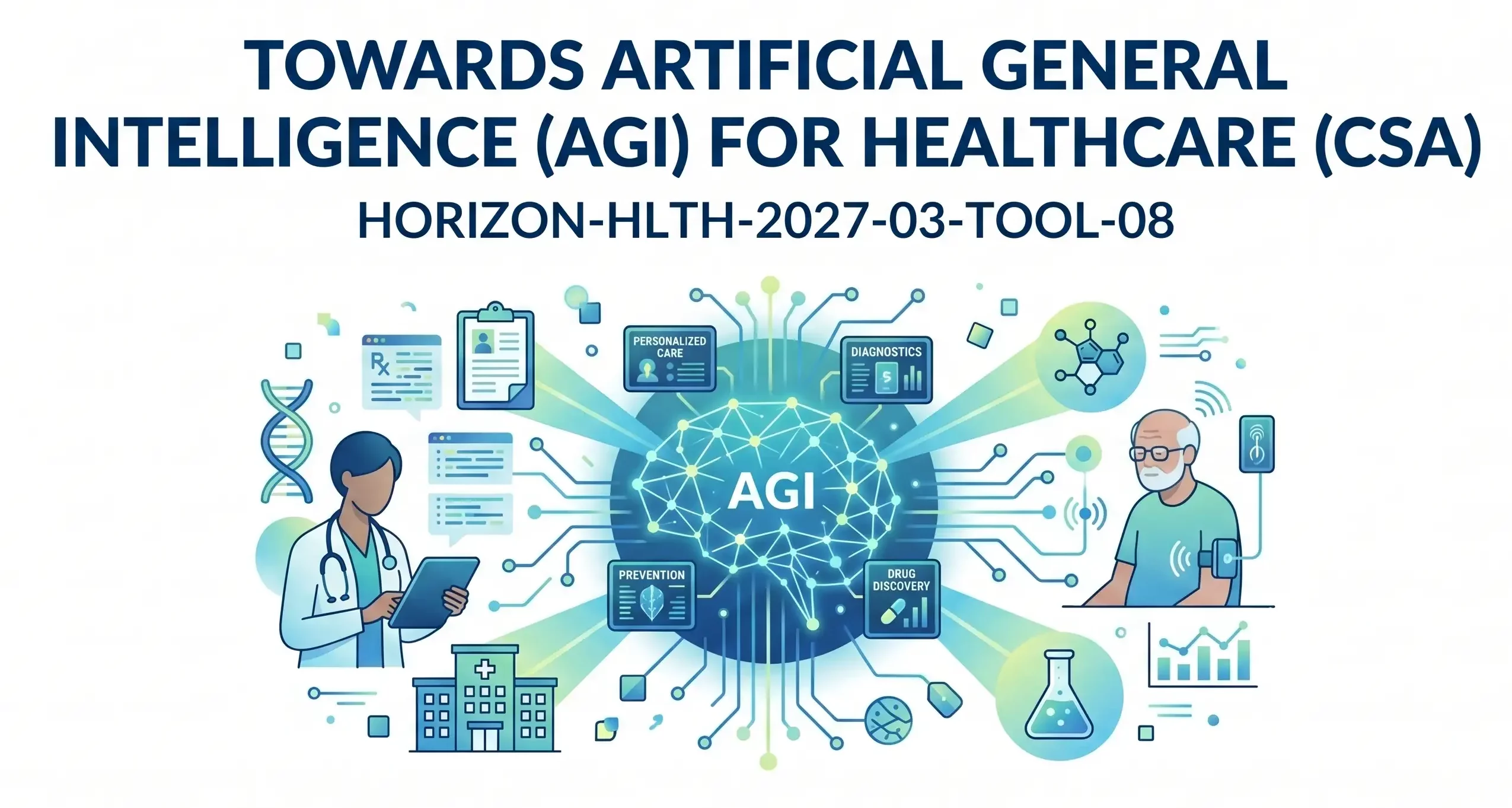
HORIZON-HLTH-2027-03-TOOL-08: Towards the next generation of frontier Artificial Intelligence models for healthcare
Why can a health AI model recognise a data source instead of a disease?
A model can learn shortcuts when data-source characteristics correlate with the diagnosis it is trained to predict. DeGrave and colleagues demonstrated this in chest-radiograph models for COVID-19 detection: image markings and acquisition-related features influenced predictions, and performance deteriorated on external datasets. These findings concern the models and radiographic datasets studied, rather than every healthcare AI system. [1]
For HORIZON-HLTH-2027-03-TOOL-08, this makes the origin and interpretation of health data part of the scientific preparation. The action brings stakeholders together to identify suitable datasets, review existing evidence and map training and evaluation approaches for future frontier artificial intelligence (AI) models. Its central output is a shared development roadmap grounded in what the evidence can support.
Microfluidics Innovation Center (MIC) could contribute as a consortium partner by reviewing measurement conditions and quality-control requirements for microfluidic datasets. Within MFMET II, MIC is helping refine procedures for stable low-flow operation, pressure–flow characterisation and repeatable flow verification. This experience supports a defined technical assessment alongside the consortium’s biological and data-engineering expertise.
Download the MIC Horizon Europe 2026/2027 Calls Calendar:
Discover more!
HORIZON-HLTH-2027-03-TOOL-08: Scope, funding and participation conditions
Which call is it, and when are the opening and deadline?
- Topic: HORIZON-HLTH-2027-03-TOOL-08 — Towards the next generation of frontier Artificial Intelligence models for healthcare. (Official page)
- Call: Cluster 1 – Health (Single stage – 2027/2), HORIZON-HLTH-2027-03.
- Destination: Developing and using new tools, technologies and digital solutions for a healthy society.
- Scheduled opening: 3 June 2027. Submission deadline: 16 September 2027, 17:00 Brussels local time.
- Action: Coordination and Support Action (CSA), with lump-sum funding.
What funding is indicated? The topic has an indicative budget of EUR 2.90 million, with an expected EU contribution of around EUR 2.90 million per project and an indicative expectation of one funded project. Proposals requesting different amounts may be submitted and selected; these figures do not guarantee an award.
Which participation restrictions matter? Participation is limited to legal entities established in EU Member States and Associated Countries. Including entities established elsewhere makes a proposal ineligible. An eligible-country entity controlled directly or indirectly by a non-eligible country or entity may participate only with guarantees positively assessed by its country of establishment. Entities controlled by China or by a legal entity established in China cannot submit such guarantees. The topic-specific conditions set out the required safeguards.
The evaluation thresholds are 4 for Excellence, 4 for Impact and 4 for Implementation, with a cumulative threshold of 12. The General Annexes apply alongside these specific conditions. CSA applications may involve one or more legal entities, but this topic also calls for broad, multidisciplinary stakeholder representation. It specifies no consortium-size target.
If satellite-based Earth observation, positioning, navigation or related timing services are used, beneficiaries must use Copernicus and/or Galileo/EGNOS; additional services may also be used. The work programme permits changes to the scheduled opening and deadline, so the Portal remains the submission reference.
Scientific scope: four connected coordination activities
The action seeks three connected outcomes: better understanding of how to develop and use frontier AI models, better use of heterogeneous health data across anatomical scales, and a collaboratively created roadmap. It covers life sciences and healthcare delivery, including the combination and extension of existing foundation models towards inclusive, personalised medicine.
The HORIZON-HLTH-2027-03-TOOL-08 work programme asks proposals to include all four activity areas:
- Community building: establish a diverse pan-European community that can draw on AI Factories and strengthen existing networks where relevant.
- Roadmap creation: review promising models and development approaches, assess risks, and examine safety and efficacy evidence alongside ethical, security and regulatory considerations.
- Datasets: identify suitable existing resources, methods for validation and interoperable conversion, missing datasets or annotations, and infrastructure for privacy-preserving use and expansion.
- Model preparation: map approaches to training and evaluation, including ways to combine life-science and healthcare foundation models, covering all trustworthy-AI aspects.
As a CSA, this topic supports coordination and preparation. Under the General Annexes, it does not fund original research and innovation such as developing a new model or experimental platform. The topic does not require a clinical study or specify a target technology readiness level.
Scientific strategy: turn the roadmap into usable decisions
A practical HORIZON-HLTH-2027-03-TOOL-08 proposal can organise the roadmap around decisions that future developers and users need to make: which health problem to address, which data can support it, how models might be combined, and what evidence would justify further development. This is proposal-design advice, rather than an additional call requirement.
Useful outputs could include an evidence map, a dataset and infrastructure inventory, a comparison of evaluation approaches, and a prioritised roadmap with named responsibilities and dependencies. Define how stakeholders will review these outputs and how unresolved evidence gaps will influence priorities.
Keep model performance and performance with users distinct. In a randomised study involving 50 physicians working on clinical vignettes, Goh and colleagues found no statistically significant improvement in diagnostic reasoning from access to a GPT-4-based assistant compared with conventional resources. The study assessed a particular interaction setting, not patient outcomes. [2] A roadmap should therefore examine evidence about intended users and workflows as well as standalone benchmarks.
Use the European guidelines for trustworthy AI to structure the review of human oversight, robustness, privacy, transparency, fairness, societal and environmental effects, and accountability. Identify evidence for each dimension instead of treating a single accuracy score as a complete assessment.
Consortium and work plan: connect expertise to decisions
The HORIZON-HLTH-2027-03-TOOL-08 work programme calls for broad representation, including healthcare professionals, patients, biomedical scientists, AI developers, data engineers and ethics experts. Social sciences and humanities (SSH) must contribute effectively. Their input can shape the questions asked about acceptability, inclusion, professional practice and the distribution of benefits.
Assign each partner a concrete interface: clinicians define intended uses; data holders explain access and provenance; AI specialists compare training and evaluation approaches; infrastructure specialists assess computing needs; patient and SSH contributors examine relevance and societal implications. Plan community participation beyond the beneficiary list without inventing a required number of partners or an SME quota.
Build on results from relevant EU-funded projects, particularly those supported under HORIZON-HLTH-2025-01-CARE-01 and HORIZON-HLTH-2025-01-TOOL-03, the two named GenAI4EU topics. They are funding topics, not the names of two individual projects.
Explain how the work will draw on AI Factories, specialised health-data infrastructures, biobanks and relevant European Research Infrastructure Consortia. Distinguish confirmed access from arrangements still to establish; identifying an infrastructure does not itself secure its data or computing resources.
The European Health Data Space (EHDS) framework has a phased application timetable. Most secondary-use provisions begin applying in March 2029, with remaining categories such as genomic data following in March 2031. Distinguish resources accessible now from those dependent on later implementation, and identify lawful access and secure processing arrangements for each proposed use.
Microfluidics: assess the measurements behind the datasets
Microfluidic data deserve a place in the dataset assessment. Droplet-based single-cell sequencing uses microscopic fluid compartments and molecular barcodes to associate sequencing reads with individual cells. [3] Cui and colleagues evaluated the single-cell foundation model scGPT on paired gene-expression and chromatin-accessibility data from nuclei isolated from a healthy donor’s blood cells using 10x Multiome. This is a concrete connection between microfluidic measurements and foundation-model research; it does not establish clinical readiness. [4]
Microfluidic origin does not guarantee reproducibility or interoperability. Heiser and colleagues showed why ambient RNA and empty droplets complicate cell identification in droplet-sequencing data. [3] A useful inventory should therefore record sample preparation, capture method, quality-control decisions, batch information, annotations and population coverage. Matching file formats does not establish biological comparability.
Organ-on-chip measurements require their own context: cell source, tissue model, perfusion, exposure sequence and measured endpoint. The MFMET II metrology programme addresses gaps in device characterisation and comparability. Assess the measurements’ suitability for the intended biological question before including them in a development roadmap.
MIC could contribute a brief on acquisition conditions and measurement requirements for the microfluidic datasets considered by the consortium. Its MFMET II work provides relevant experience in flow verification and fluidic failure modes. The proposed task would review existing protocols and instrument records, identify missing measurement metadata and distinguish instrument checks from biological validation.
The brief could map each dataset’s measurement method, available quality evidence, limitations and missing annotations. Data holders and biological specialists would check its interpretation against existing records; data engineers would assess the proposed fields for interoperability, and AI specialists their relevance to model evaluation. These reviews would inform the CSA’s dataset inventory and development roadmap.
The MIC already brings its expertise in microfluidics to Horizon Europe:
H2020-NMBP-TR-IND-2020

Microfluidic platform to study the interaction of cancer cells with lymphatic tissue
H2020-LC-GD-2020-3
Toxicology assessment of pharmaceutical products on a placenta-on-chip model

About the author

Julia Sepulveda Diaz, PhD
Chief Executive Officer, Microfluidics Innovation Center
Julia holds a PhD in glycobiology and neurobiology from Université Paris-Est Créteil. Before moving into microfluidics, she spent several years as a postdoctoral researcher at the Paris Brain Institute, on Parkinson’s disease, neuroinflammation, and the role of heparan sulfate in protein aggregation. Today she leads the Microfluidics Innovation Center as CEO, steering its researchers and engineers and its collaborative research and innovation projects.
FAQ - HORIZON-HLTH-2027-03-TOOL-08: Data, microfluidics and evaluation for healthcare AI
These questions clarify model evidence, the limits of experimental data and the interfaces between measurement specialists, biologists and data engineers.
Are frontier models and foundation models the same thing?
The terms describe different aspects. A foundation model is pretrained for adaptation across tasks. “Frontier” describes advanced capabilities at the leading edge of AI. This topic considers how existing foundation models might be combined or extended; it does not prescribe a single architecture or require a claim of artificial general intelligence.
Does multimodal AI require every patient to have every data type?
No. An evaluation plan should specify the combinations available in the intended setting and how missing inputs will be handled. Report which patients have each modality and compare performance under realistic availability patterns. Requiring complete records can exclude the people the application is intended to serve.
What makes a reference label suitable for evaluation?
The label must correspond to the question being evaluated. A recorded diagnosis, an expert interpretation of an image and a later clinical outcome answer different questions. Record how labels were obtained, when they were established and how uncertainty or disagreement was handled before comparing model results.
Why can an external test still miss shortcut learning?
A shortcut may remain correlated with the outcome in both datasets. In DeGrave and colleagues’ radiographic study, some potential confounders generalised across sources. External testing should therefore be complemented by investigation of the features driving predictions and by tests designed around plausible confounding factors. [1]
How should evaluation guard against data leakage?
Specify which patients, institutions, time periods and source documents belong to each evaluation split. Check duplicates and whether reference answers or related records could enter training or tuning. For pretrained models, record what is known about training-data overlap and state the limits of any independence claim.
Does keeping data at its source automatically protect privacy?
No. A federated arrangement still needs rules for access, permitted processing, security and outputs. The EHDS framework combines technical arrangements with conditions for lawful reuse. Assess the proposed processing workflow and its safeguards rather than treating the location of the data as sufficient protection.
What should subgroup evaluation reveal?
It should reveal whether errors, reliability or usefulness differ across relevant populations and settings. Define groups according to the intended use and available evidence, report uncertainty, and identify groups that cannot be assessed adequately. This supports the fairness and inclusion dimensions of trustworthy AI.
Does strong standalone performance show that an assistant helps clinicians?
No. Assistance depends on how people interact with the system. Goh and colleagues’ vignette study distinguished standalone model scores from physicians’ performance with access to the model. Its findings support evaluating the combined workflow; they do not establish whether autonomous use would be safe or beneficial. [2]
Can organ-on-chip results be treated as patient observations?
No. An organ-on-chip measurement describes a defined in-vitro model under a specified exposure protocol. A roadmap should identify what biological question it can inform and what further evidence would be needed to connect it to a clinical endpoint. Keep experimental-model data distinguishable from patient records, even when both are used in a multimodal approach.
How would MIC work with the consortium’s data engineers?
MIC could review the fluidic acquisition conditions and measurement-quality evidence behind selected datasets, drawing on its MFMET II work. Data engineers would address schemas, software conversion and access workflows; biological specialists would assess the meaning of the readouts. Together, they could identify missing metadata without treating calibrated instruments as proof of biological or clinical validity.
References
[1] DeGrave, A. J., Janizek, J. D. and Lee, S.-I. AI for radiographic COVID-19 detection selects shortcuts over signal. Nature Machine Intelligence. 2021;3:610–619. doi:10.1038/s42256-021-00338-7
[2] Goh, E., Gallo, R., Hom, J., et al. Large Language Model Influence on Diagnostic Reasoning: A Randomized Clinical Trial. JAMA Network Open. 2024;7(10):e2440969. doi:10.1001/jamanetworkopen.2024.40969
[3] Heiser, C. N., Wang, V. M., Chen, B., Hughey, J. J. and Lau, K. S. Automated quality control and cell identification of droplet-based single-cell data using dropkick. Genome Research. 2021;31(10):1742–1752. doi:10.1101/gr.271908.120
[4] Cui, H., Wang, C., Maan, H., Pang, K., Luo, F., Duan, N. and Wang, B. scGPT: toward building a foundation model for single-cell multi-omics using generative AI. Nature Methods. 2024;21(8):1470–1480. doi:10.1038/s41592-024-02201-0