
Tips & Tricks for a successful HORIZON-HLTH-2027-03-TOOL-02 proposal
Opening
03 June 2027
Deadline
Keywords
bio-printing
vascularization
regenerative medicine
GMP manufacturing
in-situ bioprinting
human cells
ATMP
regulatory pathway
advanced therapies
Your microfluidic SME partner for Horizon Europe
We take care of microfluidic engineering, work on valorization and optimize the proposal with you
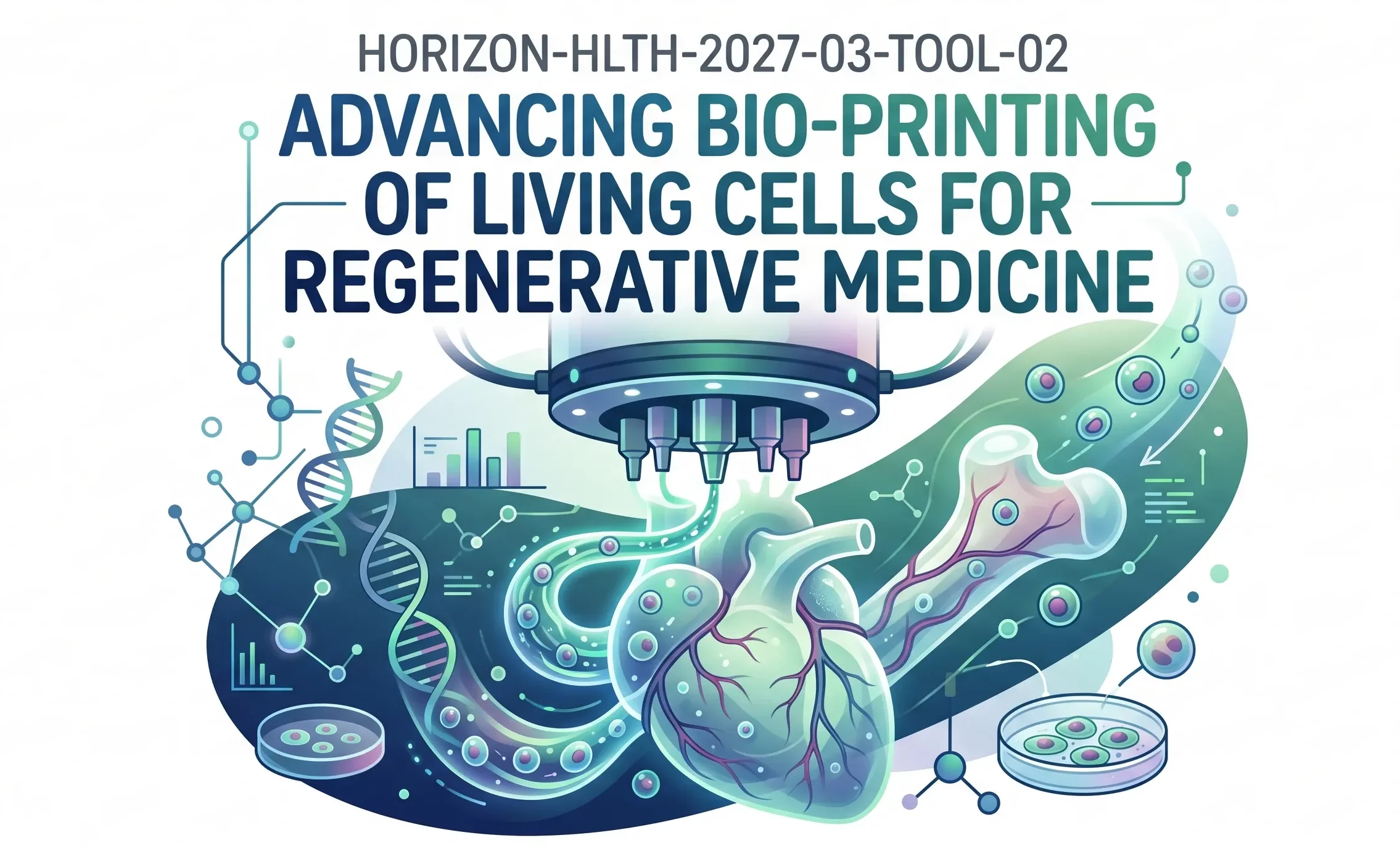
HORIZON-HLTH-2027-03-TOOL-02: Advancing bio-printing of living cells for regenerative medicine
The Commission wants 3D bio-printing of live human cells outside the lab and into clinical use rather than the research of a fundamental topic. Projects have to reach up to the first in human trial and demonstrate the clinical efficacy. Autologous personalized solutions are preferred and the work package has to address engineering as well as regulatory pathway.
Download the MIC Horizon Europe 2026/2027 Calls Calendar:
Discover more!
Administrative facts: what do we know about the HORIZON-HLTH-2027-03-TOOL-02 call?
Which call is it, and when is the opening and the deadline?
- Call name: Cluster 1 – Health (Single stage – 2027/2)
- Call number: HORIZON-HLTH-2027-03
- Destination: Developing and using new tools, technologies and digital solutions for a healthy society
- Topic: HORIZON-HLTH-2027-03-TOOL-02
- Opening date: 03 June 2027
- Deadline: 22 September 2027, 17:00 Brussels local time
- Type of action: RIA (Research and Innovation Action)
What about the budget and estimated size of the project?
- Overall topic budget: EUR 39.30 million
- Number of projects expected to be funded: 4
- EU contribution per project: EUR 7.00 to 10.00 million
What are the key eligibility and evaluation conditions?
- Standard eligibility conditions apply per General Annex B
- US legal entities are eligible to receive EU funding (NIH reciprocity arrangement)
- JRC may join as beneficiary with zero funding or as associated partner; JRC will not participate in proposal preparation or submission
- Award thresholds: 4 for Excellence, 4 for Impact, 4 for Implementation; cumulative threshold of 12
- If satellite-based data are used, Copernicus and/or Galileo/EGNOS must be included
- Proposals must use human cells throughout
- Clinical studies annex required using the template in the submission system
- Transfer of ownership or exclusive licensing of results may be restricted up to 4 years post-project
- SME involvement is explicitly encouraged
- Clustering and cross-project networking activities expected; budget should be allocated accordingly
Scientific range: what does the Commission expect from the HORIZON-HLTH-2027-03-TOOL-02 grant?
What outcomes are expected?
By the end of the project, biomedical scientists within academia as well as within industry should have ready-to-use, integrated and functional units available for the bio-printing of human tissue. Health care providers should be able to apply systems for the purpose of advanced therapies. The first end-user will be a patient whose unmet medical needs can be met by a bespoke personalized solution using the bio-printed device.
What is within scope?
A variety of bio-printing technologies are welcome, covering in vitro followed by transplantation as well as in situ approaches.
- Function of 3D human cell bio-printing for transplantation purpose and regeneration of functional tissues
- Autologous graft transplantation to avoid immune reaction to transplant organ
- Bio-printed 3D complex tissue and organ transplantation
- In situ bio-printing using printhead/endoscope during surgery at the patient’s body
- High density cell printing using minimal extra biomaterial matrix
- Interaction with micro-surgery instruments and medical imaging equipment
- Real-time stimuli during in-situ bio-printing
- All diseases, defects or disorders in the human body as therapeutic area
- Clinical development stage
The Commission is not interested in papers describing tissue-engineering studies but rather in a demonstration of clinical application.
What are the specifically proposed research directions?
Three activities are stated clearly in the work program:
- Developing or optimizing bio-printing equipment (from composition formulation to the device itself) capable of high-density cells and vascularization to facilitate quick wound healing.
- Producing the selected bio-printing solution under GMP. This point is non-negotiable.
- Undertaking the necessary regulatory steps to pave the way to clinical investigations and applying the solutions on human beings in first in-human studies.
Priority is given to life-saving organs and in-situ printing using a printhead/endoscope in surgery. Sex differences have to be included in the cell-based testing. National and European contacts of regulatory authorities should be included.
Scientific strategy: how can you enhance your chances of being funded through HORIZON-HLTH-2027-03-TOOL-02?
What scientific choices matter most?
- No exploration. Technologies that haven't been proven pre-clinically will have very few chances.
- Focus on vascularization strategies. Without effective vascularization, the high-density cell construction will not survive in vivo. This will be critically evaluated.
- Show a clear regulatory pathway. Provide evidence of contact with EMA and national authorities or a notified body. Consider also the applicable SoHO framework and regulations for ATMPs and medical devices.
- Sex differences have to be considered in the cell biology phase. The sex difference point should not only be part of the ethical declaration.
- In-situ bio-printing is assumed to be more important than in vitro bio-printing. You have to demonstrate credible surgical integration and probe/endoscope integration.
- Plan the GMP phase early. Its timeline and budget are often underestimated.
- Include a budget for networking activities to collaborate between projects.
Consortium & proposal-writing plan: what works best with this type of call?
A consortium of 8 to 12 partners is probably the best, maybe more, if extensive clinical coverage is required. Ensure genuine participation from the four disciplines of engineering, cell biology, surgery, and regulatory affairs.
The proposal MUST include a university hospital or a research center with surgery capabilities to enable first-in-human studies and ideally with multi-center, multi-country settings. Including a biotech SME with GMP manufacturing capabilities will be an asset.
The ability to present such a partner is a key advantage that could strengthen exploitation and commercialization efforts. Surgical robotics or surgical imaging may be necessary if the study is concerned with the transplantation of vital organs.
Regulatory experts with an ATMP and SoHO background would increase credibility to the proposal. For proposal writing, start with the clinical case to clearly present to reviewers what unmet medical needs are targeted, even before reaching the impact section. Make the technical developments relevant to the patient's benefit.
How would microfluidics contribute to this topic?
Conventional cell culture methods lack of precision control of the microenvironment with high-density constructs. The cell viability, gradients, or shear forces are becoming critical issues. Microfluidics is essential for controlling and measuring these parameters during bio-printing. With regards to the bio-ink preparation and formulation, microfluidics can provide a great benefit over bulk mixing.
- Bio-ink preparation at micro scale: Chip-based microfluidic systems provide very accurate cell encapsulation within droplets with a precisely determined diameter and cell density compared to bulk mixing. Thus, this is an ideal approach for making high-density cell constructs.
- Vascularization modeling: perfusable microfluidic channels integrated into or alongside bio-printed constructs can serve to mimic a capillary system and to assess nutrient delivery for the cells at the center of the construct before applying to human trials.
- Real-time in-situ monitoring during bio-printing: Incorporating microfluidic sensors into bio-printing devices will allow for real-time measurements of the cell construct's pH, O2 and metabolic products. This allows to perform quality controls for GMP manufacturing.
- Testing sex-specific cellular response: A small-scale test on a chip made with human male or female cells provides a quick answer to any differences in their response to stimuli without requiring a specific work package to study it.
- Endoscope integration of bio-ink: As the printhead of the endoscope is a microfluidic system, MIC experience can be relevant in defining the suitable flow control and surface characteristics of the printhead to print at the site of interest.
Although microfluidics might not become the entire focus of the bio-printing application it can provide significant advantages and benefits when developing robust systems, GMP quality assurance and assessing the safety of human trial applications.
The MIC already brings its expertise in microfluidics to Horizon Europe:
H2020-NMBP-TR-IND-2020

Microfluidic platform to study the interaction of cancer cells with lymphatic tissue
H2020-LC-GD-2020-3

Toxicology assessment of pharmaceutical products on a placenta-on-chip model

About the author
Julia Sepulveda Diaz, PhD
Chief Executive Officer, Microfluidics Innovation Center
Julia holds a PhD in glycobiology and neurobiology from Université Paris-Est Créteil. Before moving into microfluidics, she spent several years as a postdoctoral researcher at the Paris Brain Institute, on Parkinson’s disease, neuroinflammation, and the role of heparan sulfate in protein aggregation. Today she leads the Microfluidics Innovation Center as CEO, steering its researchers and engineers and its collaborative research and innovation projects.
FAQ – HORIZON-HLTH-2027-03-TOOL-02
What is the main goal of HORIZON-HLTH-2027-03-TOOL-02?
The area of interest is the translation of 3D bio-printing of living human cells into clinical use, including first-in-human studies. These projects should include the development of bio-printing equipment, GMP scale-up and all other regulatory procedures.
Who can apply to HORIZON-HLTH-2027-03-TOOL-02?
It can be eligible by any legal entity of an EU Member State or an affiliated country. An arrangement of NIH reciprocity can also be made by US organizations. The participation of SMEs is highly promoted.
What is the budget available per project?
The overall indicative budget is EUR 39.30 million on 4 projects. The EU will contribute between EUR 7.00 and 10.00 million to each project.
What bio-printing approaches are in scope?
Is GMP manufacturing mandatory for this topic?
Yes. Scaling the chosen bio-printing technology into a GMC-conforming production process is one of three crucial tasks. Projects that regard GMP as a choice will not receive high marks.
How must sex differences be addressed in the proposal?
The sex differences at the cellular level must be included in the scientific design, not just mentioned in the ethics section. This is applicable to any cell biology work under the project.
What role can an SME play in this consortium?
The gap in providing the GMP manufacturing experience is a requirement for a biotech SME, which academic consortia often find difficult to meet. It reinforces the exploitation strategy and indicates a viable course to clinical implementation.
How does microfluidics contribute to a bio-printing proposal?
Microfluidics enables the proper preparation of bio-inks at the drop scale, testing of vascularization with perfusable channels, and real-time quality checks using embedded sensors. It can also be applied to in-situ bio-printing printhead design based on an endoscope.
What regulatory frameworks apply to bio-printed tissue?
Each of them can be applicable based on the approach: SoHo frameworks, medical device regulations, and ATMP regulations. Combinations are likely. Recommendations should document contact with national competent authorities, and the framework should be used for each step.
What are the evaluation score thresholds for this call?
All criteria (Excellence, Impact, Implementation) have a threshold of 4 out of 5. The cumulative limit will be 12. The three criteria have to be fulfilled separately and in combination.