
Tips & Tricks for a successful HORIZON-HLTH-2027-01-IND-01 proposal
Opening
10 February 2027
Deadline
Keywords
Cell-Free Protein Synthesis
Generative AI
Biologicals
Synthetic Biology
GMP Manufacturing
health industry
protein production
Biopharmaceuticals
RIA
Your microfluidic SME partner for Horizon Europe
We take care of microfluidic engineering, work on valorization and optimize the proposal with you
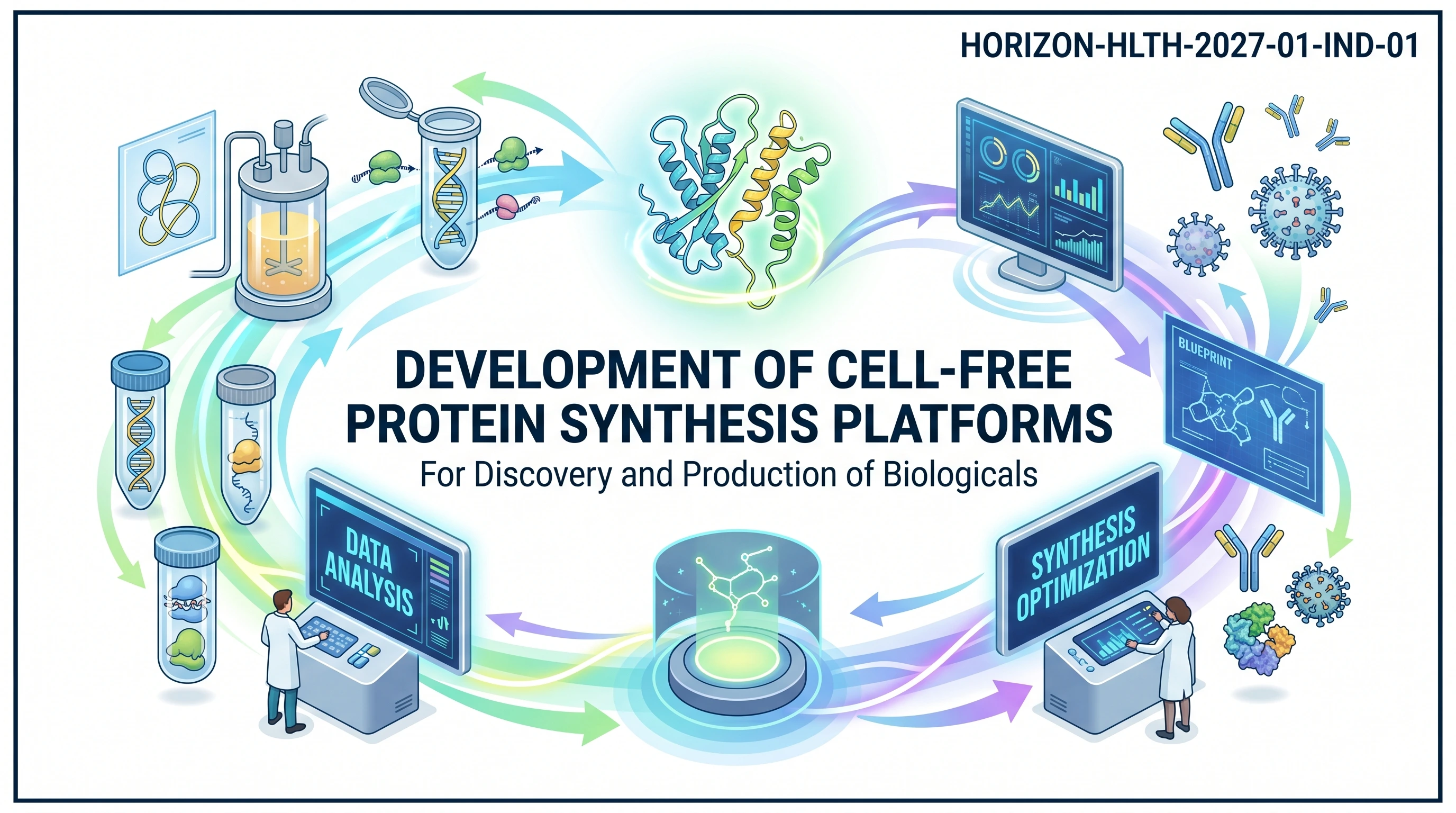
HORIZON-HLTH-2027-01-IND-01: Development of cell-free protein synthesis platforms for discovery and/or production of biologicals
The Commission is taking a technological risk by asserting that CFPS, or cell-free protein synthesis, is a significant rival to conventional cell-based bioprocessing in terms of production scale. Biotech in general doesn’t deal with this. The destination “An innovative, sustainable, and competitive EU health industry” encompasses the subject matter. It is an additional component of the biopharmaceutical industry’s quest for technological sovereignty. Four projects will be supported by the Commission, which is searching for functional platforms. Not for studies that indicate it might be effective.
Download the MIC Horizon Europe 2026/2027 Calls Calendar:
Discover more!
Administrative facts: what do we know about the HORIZON-HLTH-2027-01-IND-01 call?
Which call is it, and when is the opening and the deadline?
- Call name: Cluster 1 – Health (Single stage – 2027/1)
- Call identifier: HORIZON-HLTH-2027-01
- Destination: Maintaining an innovative, sustainable, and competitive EU health industry
- Topic: HORIZON-HLTH-2027-01-IND-01
- Opening date: 10 February 2027
- Deadline: 13 April 2027 at 17:00 Brussels local time
- Type of action: RIA (Research and Innovation Action)
What about the budget and estimated size of the project?
- Overall topic budget: EUR 24.50 million
- Indicative number of projects: 4
- Budget per project: EUR 6.00 to 8.00 million
What are the key eligibility and evaluation conditions?
- Standard Horizon Europe eligibility applies (General Annex B)
- US entities are eligible to receive Union funding under this topic.
- Evaluation thresholds: Excellence 4, Impact 4, Implementation 4, cumulative threshold 12
- IP restriction: the granting authority may object to ownership transfer or exclusive licensing up to 4 years post-project
- If satellite-based data is used, Copernicus and/or Galileo/EGNOS must be included.
- Subject to restrictions for protection of European communication networks
Scientific range: what does the Commission expect from the HORIZON-HLTH-2027-01-IND-01 grant?
What outcomes are expected?
The Commission mandates that biopharmaceutical developers truly profit from the CFPS platforms after the project is completed. This means that peptide or protein-based biologics will be developed and manufactured more quickly, making them more accessible to healthcare systems and, eventually, to patients. Clearly expressed are the commercial aspects.
What is within scope?
- CFPS systems based on prokaryotic or eukaryotic cell lysates, such as mammalian lysate systems.
- Completely synthetic CFPS systems with completely rebuilt equipment and no cells
- Biologicals such as cytokines, enzymes, antimicrobial peptides, antibody fragments, antigens, virus-like particles, and proteins with artificial amino acids.
- Synthetic biology and its de-novo design of biomolecules.
- Generative AI and machine learning for biomolecule design and high-throughput biological entity screening.
- CFPS is used in immunization and infectious and non-communicable illnesses.
- The use of decentralized manufacturing technology and personalized medicine.
What are the specifically proposed research directions?
The work program names three specific angles, and proposals must address at least two:
- Address the bottlenecks that currently hamper the large-scale deployment of CFPS, i.e. the lack of a quality-by-design approach, the need to fully characterise the underlying cell lysates and their critical quality attributes and the need for better understanding of the correlations between specific cell lysate properties and CFPS process parameters, specific product quality attributes (such as protein folding), and CFPS platform performance.
- Use synthetic biology techniques for the design of de-novo biomolecules with specific desired properties (antimicrobial, immunogenic, angiogenic, etc.) and develop suitable cell-free systems for the high-throughput screening of the designed biomolecules.
- Develop novel or optimise existing CFPS platforms for the production of the targeted biomolecule to a Good Manufacturing Practices (GMP) conform process, producing clinical-grade material that can be tested in clinical trials.
An explicit asset stated in the call is showing your CFPS platform outperforms the current production standard for a specific therapeutic protein/peptide.
Scientific strategy: how can you enhance your chances of being funded through HORIZON-HLTH-2027-01-IND-01?
Which scientific choices will count most?
- For your protein target to undergo post-translational modifications, choose mammalian lysate systems as indicated in the work programme. Systems using eukaryotes are of particular interest, especially those using mammalian lysate, which leads to the generation of human-like glycosylated proteins; otherwise, unless you have evidence of contrary benefits, do not fall back on E. coli extracts.
- Use the rule “at least two” as the minimum and not as a goal, and submit a proposal covering all three research directions. Evaluation reviewers find projects covering three directions much more convincing; if they cover a minimum of two directions they should do it thoroughly, detailing clearly the interdependence between the different aspects.
- Address the GMP aspect from the beginning. The call implies the production of clinical-grade material; it is better to present it as an added value integrated from the beginning to the development of your platform rather than at a later stage.
- Incorporate AI/generative deep learning into the proposal in a tangible manner; this call suggests the Commission has enthusiasm for the application of ML/AI to biomolecule design. One can argue this topic is one of those which benefit greatly from the digitalization of the system, which cannot be considered a peripheral factor.
- Present the scalability and the capability to distribute the production processes; this call suggests that ‘on-demand’ production and the possibility of switching quickly between different products are features directly linked to CFPS. Highlight these points in comparison to cell-based production methods.
Consortium & proposal-writing plan: what works best with this type of call?
- Four funded projects, based on 24.5 M Euro, imply high competition and strict comparisons between applications; around 8-12 partners would probably be optimal for the proposed topic, potentially more if your application covers both research and production.
- Include at least one academic biochemistry or synthetic biology group, one industry partner with production experience and one partner able to explain GMP requirements in the early stage of writing. If you will run first-in-human studies, mention the relevance of clinical partners.
- Incorporate an innovative SME, ideally with experience in CFPS or bioprocess engineering. SMEs in the field of technology platform development fit well the proposal for this topic, according to the work program’s objectives.
- The US institutions are explicitly eligible. Therefore, consider recruiting strong North American partners active in CFPS. This call represents a rare occasion where involving partners from the US can have an administrative benefit.
- Do not write a general synthetic biology proposal and adapt it to this call. The Commission has precisely defined the goals of CFPS in this context; a proposal adaptable to a wide range of topics will likely be flagged.
How can microfluidics contribute to this topic?
The standard bioreactor approach provides no molecular-level information about the synthesis process. You’re essentially waiting for the batch reaction to be finalized before discovering possible protein folding errors. Microfluidics changes that.
- In the scenario of large-scale screening of several de-novo designed molecules, droplet microfluidics allows for a real-time reading of the protein production, with a much higher yield and lower reaction and reagent costs for a given amount of reagents compared to conventional methods, by encapsulating hundreds of single CFPS reactions on nanoliter droplets.
- Microfluidic systems with integrated sensors are essential for the real-time detection of protein folding kinetics and yield, the improvement of the cellular extracts’ characterization, a bottleneck clearly addressed by the Commission in the work program. MIC’s work on AI-integrated microfluidic platforms illustrates how this can be implemented.
- Microfluidic reactors allow for tight control on small-volume production processes, suitable for continuous flow manufacturing; this system directly addresses the concept of distributed production favored by the Commission in the call. See MIC’s drug discovery microfluidics capabilities for context.
- An innovative proposal involving a partner skilled in microfluidics engineering, ideally having a background in the development of cell-free expression or organ-on-chip systems, would be very relevant.
- An advantageous aspect of incorporating microfluidics into the proposal is the direct linking of the discovery research to the production work package, enhancing the proposal’s technical feasibility and relevance to the evaluators. This is crucial for projects where a 4-page synopsis is being evaluated.
The MIC already brings its expertise in microfluidics to Horizon Europe:
H2020-NMBP-TR-IND-2020

Microfluidic platform to study the interaction of cancer cells with lymphatic tissue
H2020-LC-GD-2020-3

Toxicology assessment of pharmaceutical products on a placenta-on-chip model

FAQ – HORIZON-HLTH-2027-01-IND-01
What is HORIZON-HLTH-2027-01-IND-01 actually about?
The development of cell-free protein synthesis (CFPS) platforms for the discovery and/or production of biologicals is funded by this topic. The Commission is also demanding functional platforms rather than studies that merely indicate it might be effective. There will be four projects aimed at maintaining an innovative, sustainable, and competitive EU health industry.
Who should apply and how much funding is available?
The call aims at academic researchers, biopharmaceutical industry partners with production experience, and innovative SMEs in CFPS or bioprocess engineering. The US parties have been made specially eligible. A total indicative budget of EUR 24.50 million will be used to fund four projects, with funding ranging from EUR 6.00 to 8.00 million each.
What CFPS systems and protein targets are explicitly in scope?
This applies to prokaryotic and eukaryotic cell lysates, including mammalian systems capable of processing human-like glycosylated proteins. Entirely reconstituted CFPS systems entirely made of synthetic molecular machinery, will also be eligible. Cytokines, enzymes, antimicrobial peptides, antibody fragments, antigens, virus-like particles and proteins containing artificial amino acids are all target proteins.
What are the three research directions and which must I address?
There are three angles named in the work program. At least two of the following should be included in the proposals: scale-up bottlenecks and the quality-by-design gap; synthetic biology in de novo biomolecule design using high-throughput screening; and the development of GMP-conform platforms capable of producing clinical-grade material. The three are all covered in the call.
Why does GMP compliance matter so much in this call?
This is not the first aspect of this call to address compliance with GMP. The Commission is optimistic on the possibility of platforms that will produce clinical-grade material, which can be subjected to trials. GMP is better suited to be introduced as a value addition, which has been realized since the inception of the platform development. Such projects, which are pushed to the later work package, will not fare well on the Impact criterion.
How does generative AI fit into this topic?
Generative AI and machine learning are specifically noted in the work program as aiding technologies to design de novo biomolecules. The Commission is excited about using ML/AI to biomolecule design and high-throughput screening. Digitization of the system is a critical aspect that can significantly enhance this subject.
How can microfluidics add value to a CFPS proposal?
Droplet microfluidics is a high-throughput screening platform for CFPS-based discovery, in which hundreds of reactions are trapped in nanoliter droplets. Microfluidic systems that contain in-built sensors aid real-time determination of protein folding kinetics and yield which directly overcome the quality-by-design bottleneck. Microfluidic reactors, too, would be amenable to continuous-flow production, which the Commission favors over the distributed production concept.
What makes an ideal consortium for this topic?
The number of partners is likely to be between 8 and 12, and may be higher if the application involves both research and production. Presence of at least one academic synthetic biology group, one production experience industry partner with an innovative SME in CFPS or bioprocess engineering. Institutions of the US are explicitly open to it, a seldom-seen and strategically helpful move.
What are the eligibility specifics, including the US exception?
The eligibility criteria of Standard Horizon Europe are based on the General Annex B which has one exception: legal entities established in the United States of America are eligible to obtain Union funding under this topic. The assessment scales are 4-Excellence, 4-Impact, and 4-Implementation with a total of 12. Check the Funding and Tenders Portal for more information.
What common proposal mistakes should you avoid with this call?
The greatest mistake is to compose an overall proposal in synthetic biology and remodel it to this call. Here the Commission has explicitly stated the CFPS agenda; a proposal that can be tailored to a wide range of issues, perhaps will be ringing loudly. The second weakness is not considering AI and GMOs as components of the design, but rather as an addition to it.