Tips & Tricks for a successful HORIZON-HLTH-2027-01-ENVHLTH-MISSCLIMA-03 proposal
Opening
10 February 2027
Deadline
Keywords
Pre-commercial Procurement
climate change adaptation
health surveillance
geospatial technology
health risk
early-warning system
Adaptation Mission
data gaps
Your microfluidic SME partner for Horizon Europe
We take care of microfluidic engineering, work on valorization and optimize the proposal with you
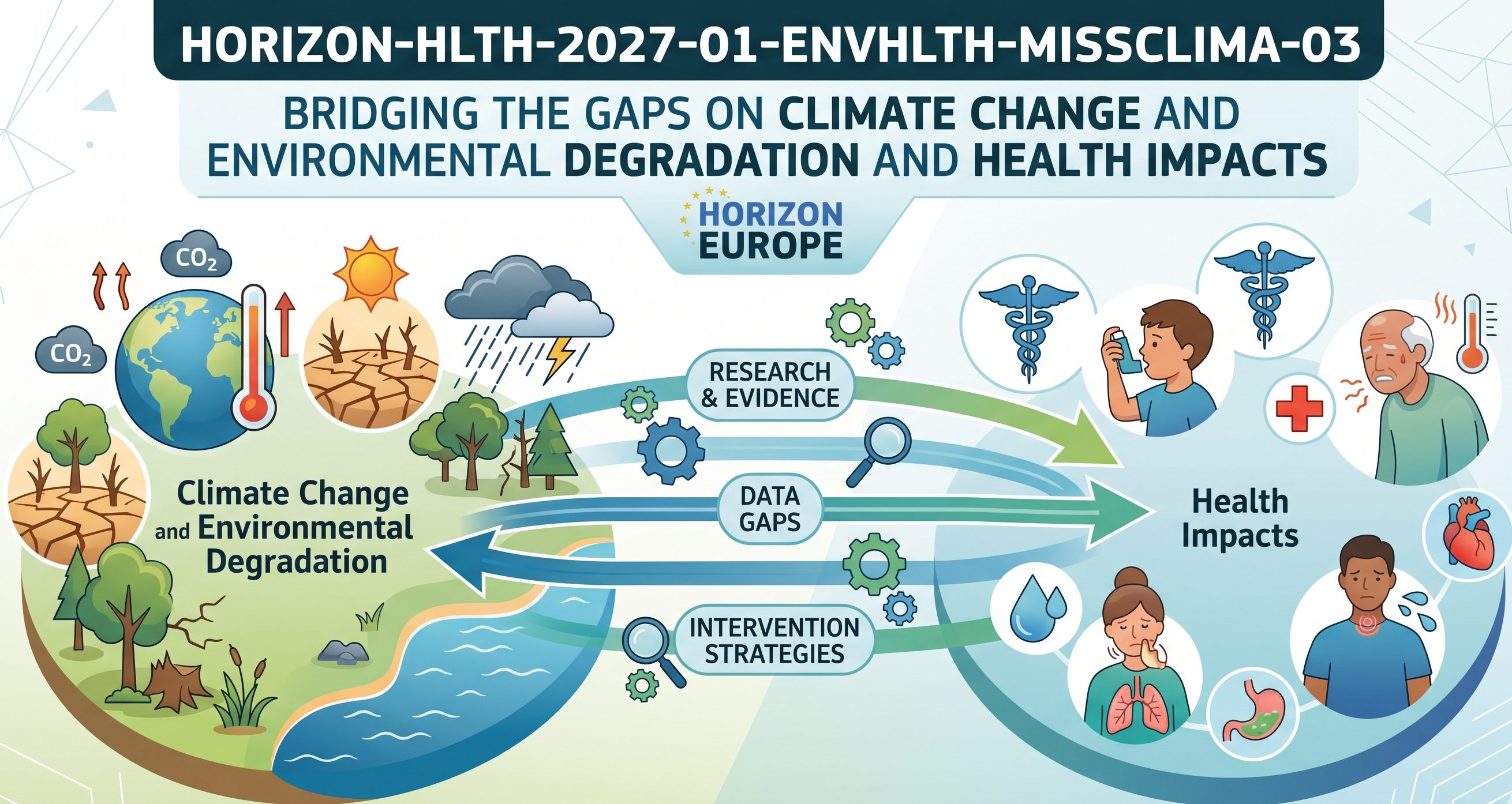
HORIZON-HLTH-2027-01-ENVHLTH-MISSCLIMA-03: Tools and technologies to support health adaptation to climate change
This is not a research grant subject. It is a Pre-commercial Procurement intervention, which implies that the Commission finances consortia of governmental purchasers who are interested in the development of early-stage solutions for health adaptation to climate change jointly. The funds are received by procurers, and not developers and labs. This will be followed by an opportunity of developers and innovators later in the form of responding to the tenders that will be issued by the funded procurers. This logic is inverted in the case of writing normal RIA proposals, and it alters everything concerning the approach to the bid.
Download the MIC Horizon Europe 2026/2027 Calls Calendar:
Discover more!
Administrative facts: what do we know about the HORIZON-HLTH-2027-01-ENVHLTH-MISSCLIMA-03 call?
Which call is it, and when is the opening and the deadline?
- Call name: Cluster 1 – Health (Single stage – 2027/1)
- Call identifier: HORIZON-HLTH-2027-01
- Destination: Living and working in a health-promoting environment
- Topic: HORIZON-HLTH-2027-01-ENVHLTH-MISSCLIMA-03 – Tools and technologies to support health adaptation to climate change
- Opening date: 10 February 2027
- Deadline: 13 April 2027
- Type of action: Pre-commercial Procurement (PCP)
What about the budget and estimated size of the project?
- Overall topic budget: EUR 20.00 million (of which EUR 10.00 million from the Adaptation to Climate Change Mission budget)
- Number of projects expected to be funded: 4
- Estimated budget per project: EUR 5.00 million
What are the key eligibility and evaluation conditions?
- Standard eligibility as per General Annex B, with PCP-specific conditions from General Annex H
- US entities are eligible to receive EU funding (recognition of NIH programme opening to European researchers)
- If using satellite-based earth observation or positioning data, beneficiaries must use Copernicus and/or Galileo/EGNOS
- Subcontracted work must be performed in the EU and Associated Countries unless the granting authority approves otherwise
- Procurers must organize an open market consultation before launching the procurement, and deliver a report on its outcomes
- Procurers must promote the call for tenders widely across EU and Associated Countries
- Financial support to third parties is allowed, up to EUR 60,000 per third party
- The granting authority may object to transfer of ownership or exclusive licensing of results up to 4 years after the end of the action
- Evaluation thresholds: as per General Annex D (no topic-specific exceptions mentioned)
Scientific range: what does the Commission expect from the HORIZON-HLTH-2027-01-ENVHLTH-MISSCLIMA-03 grant?
What outcomes are expected?
The Commission desires that the public health systems and the local authorities should find themselves with close market solutions that they are capable of putting in place to deal with health threats posed by climate changes. The term that counts in the desired results is almost fit-for-use. This is not about blue-sky research. It involves taking innovations that already exist in some primitive form and driving them through the procurement process until they are near enough to the actual deployment that procurers can implement them, or at least make a follow-up procurement to purchase them.
What is within scope?
- Geospatial technologies and decision support systems that assist local governments and healthcare professionals in monitoring and controlling both direct and indirect health risks of climate change at very small spatial scales.
- On-the-fly risk monitoring and early-warning surveillance tools to give timely information on making health-related decisions during climate events.
- Solutions and technologies to allow switching to climate-resilient healthcare facilities and services. One limit to observe: general infrastructure (ventilation systems, building construction or refurbishment) is specifically out of scope.
- Health risk management, prevention and resilience tools, procedures and solutions, both in the community and occupational settings.
- New instruments that minimize the risk and exposure to environmental aspects of climate that worsen the health issues such as air pollution and ecological factors that combine with climate change.
What are the specifically proposed research directions?
- The direction is the PCP structure itself. The Commission is also indicating towards consortia of procurers (hospitals, primary care providers, municipalities, civil protection agencies, domestic care services, government bodies) that specify actual operations requirements and then seek out developers able to fulfill them. The work programme is deliberately wide as to what particular technologies to develop, as the requirements are supposed to be made by the procurers, rather than by a top-down research agenda.
- In that context, the text is biased towards digital health surveillance, geospatial modeling of risk hotspots, early-warning systems on heat events or outbreaks of a vector-borne disease, and decision-support systems combining climate and health data that support local-level planning.
- The scope also explicitly includes the environmental and ecological factors that are not related to climate variables alone, hence the air quality surveillance systems, integrated climate-pollution exposure technologies, and cross-risk evaluation models are rightful targets.
- Association with the EU Mission on Adaptation to Climate Change does not happen as decoration. Activities are supposed to flow into projects via the Community of Practice of the Mission and the Mission Implementation Platform. We would suggest this is where the evaluators will seek evidence that your consortium is indeed serious about deployment after the project lifetime.
Scientific strategy: how can you enhance your chances of being funded through HORIZON-HLTH-2027-01-ENVHLTH-MISSCLIMA-03?
What scientific choices matter most?
- Be a leader with procurement credibility. Your consortium must have real procurers with real purchasing authority and real needs. Assuming the public buyers within your consortium are not in a position to credibly commit themselves to running a call for tenders and possibly to purchasing a solution subsequently, the proposal is undermined. Evaluators understand the distinction between ornamental letters of support and sincerity.
- Make your buying intentions known. In the proposal made by the procurers, they must indicate whether they will procure the solution as part of the PCP (fast-track PCP), or as a follow-up procurement after the PCP is complete. This is required by the work programme, so it is not to be omitted.
- Surround end-user requirements, not technology sophistication. PCP proposals that begin with we have a great technology are backwards written proposals. Begin with the health adaptation issue that the procurers are having and explain what type of solutions the call for tenders needs to receive.
- Show geographic and institutional diversity in your procurement group. Southern European hospitals that are affected by heatwaves have their own issues as compared to Nordic primary care systems that monitor emerging diseases that are spread by vectors. That variety reinforces your argument and makes the evaluators perceive potential scale-up.
- Treat the open market consultation mandate in substance. Do not make it a box-ticking exercise. Explain the way you will operate it, the countries and how the results will influence the procurement specifications. This is where reviewers get to know whether you have mastered the mechanics of PCP.
- Design post-quantum cryptography assumptions of digital solutions. It is an appendix to the working programme that is worth noting to any related health tool (this one comes as a surprise to people)
- Make physical contact with the Adaptation Mission. Coordination budget with the Mission Implementation Platform. Talk about the Community of Practice. Isolated-looking projects will not fare well on impact.
Consortium and proposal-writing plan: what works best with this type of call?
- Your coordinator is to be a public authority, or a network of hospitals with experience in procurement. PCP actions mostly fail to succeed in academic institutions due to the need of the procurement logic to be governed in a different way.
- Between four and eight procurers of at least three or four of the EU member states. An excessive number of procurers and coordination becomes a bottleneck. Fewer than that and the collective purchasing reason is weak.
- The healthcare procurers should include at least one municipality or regional government. Within the scope, there is a specific reference to the local authorities that deal with risk management, civil protection agencies, and government agencies. A hospital consortium by itself will be too small.
- In case you can introduce an innovative SME as a consortium partner with a coordination or supporting role (not as a tenderer), you should. Experienced SMEs who have experience of bridging procurer needs and technology developers will provide real value during the open market consultation and specification of procurement requirements.
- It is worth considering a special partner on legal and procurement compliance. PCP activities include certain regulations regarding intellectual property, competitive dialogue, phased procurement, and these cannot be mixed up with normal Horizon Europe grant administration.
- Burying the procurement plan in a work package description is not recommended in the writing. Provide it with a separate section. Evaluators will also be interested in seeing the call-for-tender schedule, the stages of the R&D contracts, how the suppliers will be selected and how the transition will be made between the prototype and the near-market solution.
- Remember to keep the proposal within the page limit. A frequent failure mode that we observe is PCP proposals which over-describe the science and under-describe the procurement mechanics.
How would microfluidics contribute to this topic?
Traditional environmental health monitoring is based on centralized laboratories and stationary sensor networks, which work well until the time you require to respond quickly at the community scale during a climate event. Microfluidic platforms take the analysis to the location of necessity, and that alters the speed of response of the public health teams.
- Suppose that a municipality has to keep an eye on the water quality on the spot during a flood disaster, as it is impossible to predict the peaks of contamination. A microfluidic water tester is a portable water tester that provides pathogen and chemical contamination information in less than an hour, at the location in real time without the need to transport a sample. That is the type of tool that a PCP consortium of municipal health authorities would be interested in procuring.
- Occupational health wearable or near-body microfluidic biosensors. Sweat-based measurement of analytes on a chip could be used to track workers in the field (heat stress or pollution combinations) who had been in an outdoor environment. Your consortium receives regular health information rather than regular checkups.
- Personal exposure monitored in air quality microsampling devices. The current air quality networks provide you with the city averages. A microfluidic sampler on a community health worker provides you with street-level, person-level exposure data, which you can input to the geospatial decision-support tools that the call is requesting.
- Lab-on-chip systems to conduct rapid screening of pathogens spread by vectors during outbreak warnings. Local health authorities must have diagnostics that can be used outside hospital laboratories when climate change drives the mosquito populations further north. Microfluidic PCR and immunoassay chip will provide you with consistent results in field conditions.
Microfluidics is the answer to this call since PCP activities are regarding closing the gap between early-stage innovation and solutions that are procurement ready. The type of technology that fits perfectly in that gap is chip-based diagnostic and monitoring tools: they have already been tested at prototype scale but have not yet been scaled for purchase by the general public. Your consortium would be putting itself to hasten that transition, which is what this Commission is financing.
The MIC already brings its expertise in microfluidics to Horizon Europe:
H2020-NMBP-TR-IND-2020

Microfluidic platform to study the interaction of cancer cells with lymphatic tissue
H2020-LC-GD-2020-3

Toxicology assessment of pharmaceutical products on a placenta-on-chip model

About the author

Julia Sepulveda Diaz, PhD
Chief Executive Officer, Microfluidics Innovation Center
Julia holds a PhD in glycobiology and neurobiology from Université Paris-Est Créteil. Before moving into microfluidics, she spent several years as a postdoctoral researcher at the Paris Brain Institute, on Parkinson’s disease, neuroinflammation, and the role of heparan sulfate in protein aggregation. Today she leads the Microfluidics Innovation Center as CEO, steering its researchers and engineers and its collaborative research and innovation projects.
FAQ – HORIZON-HLTH-2027-01-ENVHLTH-MISSCLIMA-03
So what is it that this call is all about?
It is a Pre-commercial Procurement (PCP) activity in Horizon Europe Cluster 1 Health. The Commission funds consortia of government buyers who lead the way in early-stage tools and technologies to adapt health to climatic changes. The funds do not directly reach the developers but go to the procurers.
Who is supposed to apply and how much money is available?
This is covered by topic HORIZON-HLTH-2027-01, which opens on 10 February 2027 and closes on 13 April 2027. The overall budget is EUR 20 million and 4 projects are anticipated to be at approximately EUR 5 million each. A half-budget is provided by the Adaptation to Climate Change Mission.
What is within scope and what is out of scope?
It includes geospatial technologies, real-time risk surveillance and early-warning technologies, technologies to render healthcare facilities climate resilient, health risk management technologies in communities and occupational environments, and technologies that minimize exposure to climate-related environmental hazards such as air pollution. General infrastructure (refurbishment, construction, ventilation) is not in scope.
Which outcomes are the evaluators really seeking?
Evaluators will be interested in near-market solutions that can be implemented by the public health systems and local authorities in practice. The most important one is the almost fit-for-use. It is not blue-sky research but rather a procurement-led innovation where the procurers establish the requirements and developers offer solutions in the form of calls to tenders.
How should we build the consortium for a PCP action?
A public authority or hospital network having actual procurement experience ought to lead your consortium. Have at least three EU member states represented by four to eight procurers, including hospitals, municipalities, civil protection entities and government agencies. A support role of an innovative SME is a real value addition.
What is the microfluidics value-added in this case?
Microfluidic platforms can take the analysis to the location of need in case of climatic events. Examples of the type of early-stage innovations that a PCP consortium would be interested in acquiring and driving to deployment would be portable water testers, wearable occupational health biosensors, air quality microsamplers, and lab-on-chip pathogen screening systems.
What is the true competition of a consortium in a PCP call?
Credibility in procurement is all. Your public purchasers need to possess real purchasing power and needs to indicate in the proposal whether they will buy solutions as part of the PCP (fast-track) or in a subsequent procurement following the PCP. The open market consultation should be substantive rather than a mere formality.
What specific research directions does the work programme point to?
Digital health surveillance systems, geospatial risk hotspots modeling, early warning systems about heat waves or outbreaks of diseases spread by vectors, and climate health information decision-support systems are explicitly in scope. Monitoring platforms and cross-risk assessment frameworks dealing with air quality are no exception.
What are the pitfalls that usually destroy PCP proposals?
One of the common failure is to over-describe the science and under-describe the procurement mechanics. Assign the procurement plan its own page: call-for-tender timeline, R&D contract phasing, supplier selection criteria, and the route to prototype through near-market solution. In addition, the linkage with the Adaptation Mission Implementation Platform and Community of Practice should not be overlooked.