
Tips & Tricks for a successful HORIZON-HLTH-2027-01-DISEASE-08 proposal
Opening
10 February 2027
Deadline
Keywords
antibody-based therapies
Clinical Trials
Antimicrobials
Drug Resistance
Carbapenem-resistant pathogens
WHO criteria of innovation
Antimicrobial resistance
Your microfluidic SME partner for Horizon Europe
We take care of microfluidic engineering, work on valorization and optimize the proposal with you
HORIZON-HLTH-2027-01-DISEASE-08: Development of innovative antimicrobials against pathogens resistant to antimicrobials
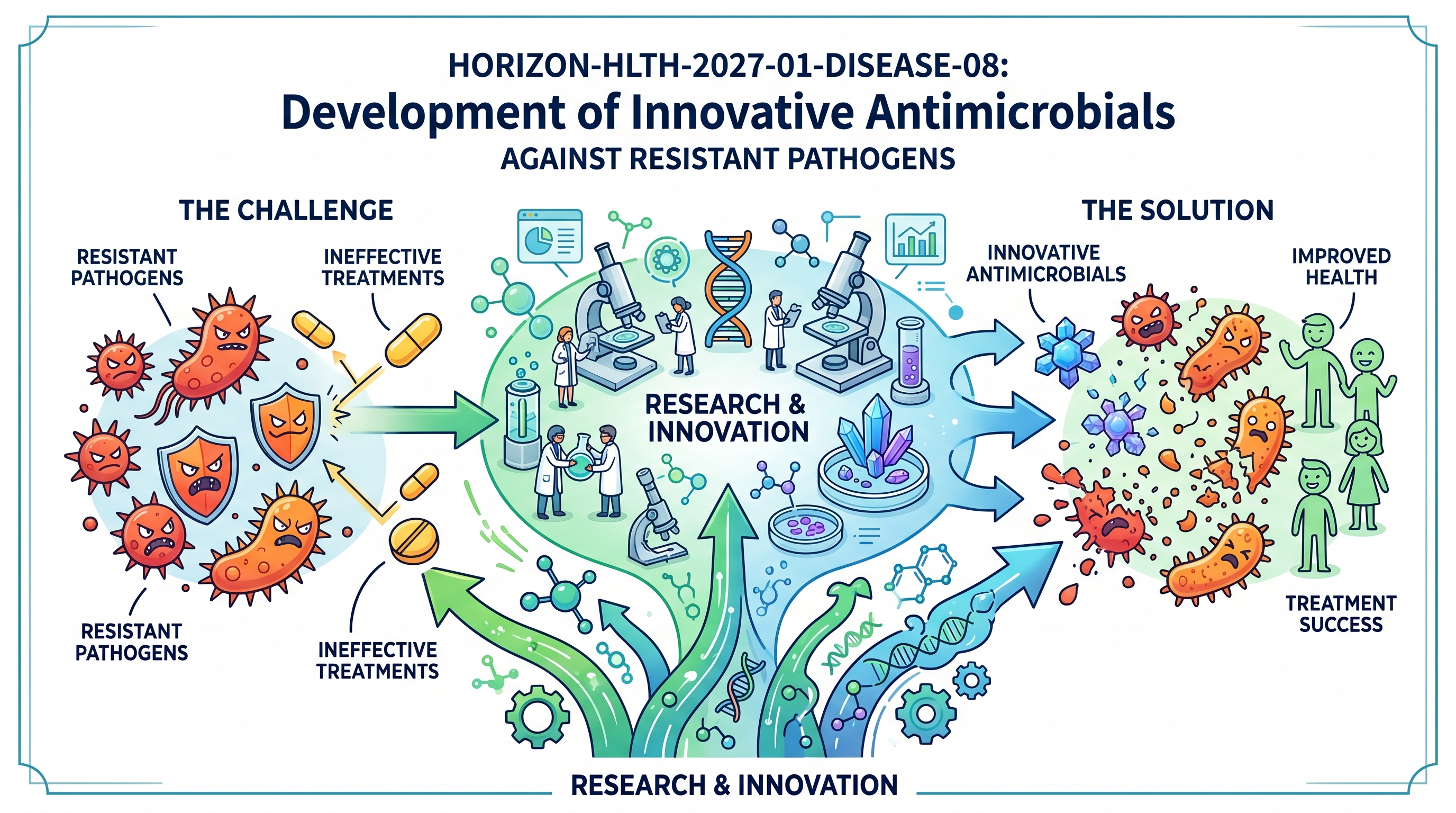
Antimicrobial resistance (AMR) is not a threat for the future; it is already here, and the Commission is treating it as such. This call is concerned solely with advancing current therapeutic candidates into first-in-human trials for six resistant bacteria and fungi. The Commission is not after discovery science or mechanism mapping here. They are interested in new treatments ready for clinical use and proposals that can actually get there.
Download the MIC Horizon Europe 2026/2027 Calls Calendar:
Discover more!
Administrative facts: what do we know about the HORIZON-HLTH-2027-01-DISEASE-08 call?
Which call is it, and when is the opening and the deadline?
- Call name: Cluster 1 – Health (Single stage 2027/1)
- Call identifier: HORIZON-HLTH-2027-01
- Destination: Tackling diseases and reducing disease burden
- Topic: HORIZON-HLTH-2027-01-DISEASE-08
- Opening date: 10 February 2027
- Deadline: 13 April 2027, at 17:00 Brussels local time
- Type of action: Research and Innovation Action (RIA)
What about the budget and estimated size of the project?
- Total indicative budget for the topic: EUR 44.20 million
- Expected EU contribution per project: EUR 8.00 to 10.00 million
- Indicative number of funded projects: 5
What are the key eligibility and evaluation conditions?
- Thresholds: Excellence 4, Impact 4, Implementation 4 – cumulative threshold 12 (all three individual thresholds must be met)
- Award procedure exception: grants are awarded not solely by ranking order, but ensuring at least one project per targeted pathogen is funded among the highest-ranked proposals that meet all thresholds, portfolio balance across the six pathogens is an explicit Commission objective
- Eligibility exception: US entities (NIH-affiliated or otherwise) established in the United States are eligible for EU funding under this topic
- IP condition: the granting authority may object to transfers of ownership or exclusive licensing for up to 4 years after project end
- Clinical studies annex required: proposals must include a dedicated annex using the template provided in the submission system
- Phage therapies: explicitly excluded from scope
Scientific range: what does the Commission expect from the HORIZON-HLTH-2027-01-DISEASE-08 grant?
What outcomes are expected?
The general outcome of a funded project under this call will be the creation of a new antibacterial and/or antifungal agent(s) (which can include antibody-based therapies) that have completed first-in-human trials and have a clear pathway to market authorization and a broad, diversified global therapeutic R&D portfolio against AMR infections. Effectively, there are two desired outcomes: an effective therapeutic and a global supply of diverse therapies.
What is within scope?
Proposals must target one and only one of the specific pathogens listed below (effects against other pathogens may be included if this directly supports the project objectives against one specific pathogen).
- Carbapenem-resistant Acinetobacter baumannii (CRAB)
- Carbapenem-resistant Enterobacterales (CRE) and third-generation cephalosporin-resistant Enterobacterales (C3GRE)
- Carbapenem-resistant Pseudomonas aeruginosa
- Methicillin-Resistant Staphylococcus aureus (MRSA)
- Drug-resistant Aspergillus fumigatus
- Drug-resistant Candida spp.
The antimicrobial candidate must fulfill at least one of the four following WHO criteria of innovation: a new chemical class, a new target, a new mode of action, or no evidence of cross-resistance. Antibody-based therapies may be included as part of a proposal’s content, phage-based therapies cannot. This work programme supports the further development of candidate drugs, and does not support earlier stages of discovery research.
What are the specifically proposed research directions?
The Commission has explicitly stated the actions that funded research is expected to cover. This topic is one of the more prescribed calls in the health cluster. The activities the Commission hopes to cover include:
- Completion of an in vivo study in at least one animal model (including a humanized immune system animal model), so that the candidate drug can be progressed into human clinical trials.
- Carrying out non-human primate studies, if these are prescribed by regulators as a prerequisite for entering into clinical studies.
- Generation of a GMP-compliant batch of the most appropriate candidates.
- Conducting a first-in-human Phase I study which demonstrates a regulatory pathway to market authorization, and clearly addressing sex, age, ethnicity, disability and vulnerability considerations.
- Participants from third countries where the specific target pathogen is endemic or epidemic are encouraged, providing the Commission with a strong opportunity for real-world relevance.
Scientific strategy: how can you enhance your chances of being funded through HORIZON-HLTH-2027-01-DISEASE-08?
What scientific choices matter most?
- Ensure you choose your pathogen wisely. Funding is allocated in a balanced way across all six pathogens so highly competitive proposals focusing on an uncontested pathogen should do better. A highly competitive proposal on drug-resistant Aspergillus fumigatus may receive funding when being the fifth best proposal in a competitive field such as MRSA, would not. Work out your level of competition.
- Focus on developing existing candidates only. This call is not for research at the discovery stage. Candidates that are already known to have an effect in vitro should form part of the research proposal.
- Clearly state your WHO criteria of innovation; evaluators will assess your proposal on this, so ensure you have concrete evidence.
- Think about clinical studies early; they should not be treated as a later afterthought. Dedicate sufficient space to the clinical part of the proposal, making it coherent and feasible. Plan out a comprehensive and realistic clinical study design.
- Consult with regulatory bodies early. As stated above, obtaining letters from regulators on scientific advice, like the EMA or FDA will greatly assist with the “regulatory pathway” requirement.
- Address equity and diversity throughout the clinical trial. Issues around sex, age, ethnicity, disability and vulnerability will be explicitly evaluated as part of the Impact criterion; ignore them at your peril.
- Partner with US investigators if you are targeting a pathogen outside of Europe and have US market interest as they benefit from funding on this call. US collaboration can also bolster your clinical trial network.
Consortium & proposal-writing plan: what works best with this type of call?
- Assemble a consortium of about 8-12 partners. It is only acceptable to be larger if you can justify a greater number of partners due to broader clinical coverage, and given the translational RIA nature, this is not normally the case.
- Ensure you have a strong team in medicinal chemistry or antibody engineering with prior experience in those areas. This is a “must-have”.
- Include a clinical partner with a Phase I facility; this will demonstrate that your human clinical studies can realistically be completed.
- It will be crucial that you incorporate regulatory expertise into the consortium instead of outsourcing it. Pro-active engagement with regulatory authorities should occur throughout the life of the project.
- You must include an organization that is representative from the country where the target pathogen is endemic/epidemic. This requirement is explicit, and your research proposal will benefit from it.
- Innovative SMEs with a good track record for both antimicrobial development or GMP manufacturing could be of great benefit and support the case for the commercial translation aspect of the proposal.
- Concerning writing the proposal itself: structure your Impact section around the two stated expected outcomes in order.
- Always be clear about which specific pathogen your research proposal aims to tackle. Both evaluation and selection are based on this.
How would microfluidics contribute to this topic?
Static cell culture can not simulate what the resistant bacterium will be doing within a real tissue, it just produces a consistent result in the lab and often cannot be extrapolated when going to an in vivo drug response – that is the real problem here. Organ-on-chips using microfluidics allows you to mimic the environment that an infection would be developing in (cell types, shear stress, tissue structure, etc.) with far more accuracy.
- If you show that a compound is active against MRSA on a static plate, it’s a good start, but does it kill the organism as part of a biofilm on a cardiac valve when immune cells pass over it? Vascularised tissue-on-chips can help you test this out, saving animal studies, money, and giving regulators something concrete to test.
- Microfluidics allows you to test the efficacy of antimicrobials against a resistant strain at the microscale, which is crucial if the compound is scarce before you have a GMP batch. Microfluidics can allow you to test activity, toxicity, and penetration in parallel rather than in series, and this is an aspect your consortium could address.
- If you have a target such as Aspergillus or Candida, a microfluidic organ-on-chip model that mimics airway or mucosal epithelium is a possible approach. The commission would require understanding mechanisms with clinical relevance, which the chip could contribute towards.
- The kinetics of resistance emergence in the target strain, if your potential compound is developing resistant organisms, could be investigated using droplet microfluidics for high-throughput screening at an early stage.
Therefore, MIC’s expertise in organ-on-chip technology and microfluidic compound screening would fit perfectly with the kind of translational research this topic encompasses. Be that for the de-risking of animal data, a good pre-GMP approach to PK or even a first look at resistance mechanisms. Microfluidics offers another level of relevance that evaluators seem to value highly in AMR proposals. It certainly would warrant some discussion.
The MIC already brings its expertise in microfluidics to Horizon Europe:
H2020-NMBP-TR-IND-2020

Microfluidic platform to study the interaction of cancer cells with lymphatic tissue
H2020-LC-GD-2020-3

Toxicology assessment of pharmaceutical products on a placenta-on-chip model

FAQ – HORIZON-HLTH-2027-01-DISEASE-08
What is HORIZON-HLTH-2027-01-DISEASE-08 about?
HORIZON-HLTH-2027-01-DISEASE-08 is a topic in Horizon Europe in Cluster 1, Health (Single stage 2027/1). It is only interested in the development of existing therapeutic candidates to first-in-human trials against six resistant bacteria and fungi. The deadline is 13 April 2027 and the overall indicative budget is EUR 44.20 million.
Which pathogens are targeted by this call?
The proposals can focus on one and only one of the following pathogens: Carbapenem-resistant (CR) Acinetobacter baumannii (CRAB), CR Enterobacterales (CRE), third-generation CR Enterobacterales (C3GRE), CR Pseudomonas aeruginosa, Methicillin-Resistant Staphylococcus aureus (MRSA), drug-resistant Aspergillus fumigatus, and Candida spp.
What is the budget and how many projects will be funded?
The indicative budget of the topic is EUR 44.20 million. It is estimated that the EU contribution will range between EUR 8.00 and 10.00 million per project. The number of funded projects is indicative with 5.
What are the WHO innovation criteria required?
The antimicrobial candidate should meet one or more of the four subsequent WHO characteristics of innovation: a new chemical class, a new target, a new mode of action or none whatsoever of cross-resistance. The applicants have to specify what criterion is applicable and present tangible evidence.
Are phage therapies eligible under DISEASE-08?
No. Phage therapies are not in scope. Antibody-based therapies can be part of a proposal content, but not phage-based therapies.
Can US-based institutions apply for this grant?
Yes. There is an exception of eligibility: any legal entity that is incorporated in the United States of America may be funded under this topic by the EU, as a sign of opening the NIH programmes to European researchers. Your clinical trial network can also be strengthened with the help of US cooperation. Check the Funding and Tenders Portal for more information.
What clinical studies are required in the proposal?
Proposals should have a specific clinical studies annex with the use of the template in the submission system. The anticipated clinical action is carrying out a first-in-human Phase I study that proves a regulating pathway to market approval, and reacts evidently to the issues of sex, age, ethnicity, disability and vulnerability.
How does the award procedure differ from standard ranking?
The awards of grants are not given based on rank only. The award process will also enable at least one project to be funded of the best projects in each targeted pathogen that pass all the thresholds. Portfolio balance of the six pathogens is a clear Commission objective. A very competitive proposal on a less competitive pathogen can thus be funded where a lower-ranked proposal on a more competitive pathogen would not.
What is the role of GMP manufacturing in this call?
The most suitable candidates should be produced in batch production that has to be GMP-compliant and is a compulsory activity under this call. It is a precondition to first-in-human clinical studies. Potential innovative SMEs with a good history of GMP manufacturing would be beneficial and justify the aspect of commercial translation of the proposal.
How can microfluidics support an AMR proposal?
The abilities of MIC in organ-on-chip technology and microfluidic compound screening would be ideal with the type of research that this subject would entail. Compared to the traditional cell culture, organ-on-chips are much more accurate in recreating the environment of infection. Droplet microfluidics allows resistance emergence to be screened at high throughput early in the process. It certainly would warrant some discussion.