
Tips & Tricks for a successful HORIZON-HLTH-2027-01-CARE-02 proposal
Opening
10 February 2027
Deadline
Keywords
multiple medications
Pharmacogenomics
health care
Adverse Drug Reactions
Personalised medicine
Polypharmacy
risk reduction
Clinical decision support
Your microfluidic SME partner for Horizon Europe
We take care of microfluidic engineering, work on valorization and optimize the proposal with you
HORIZON-HLTH-2027-01-CARE-02: Personalised approaches to reduce risks from Adverse Drug Reactions due to administration of multiple medications
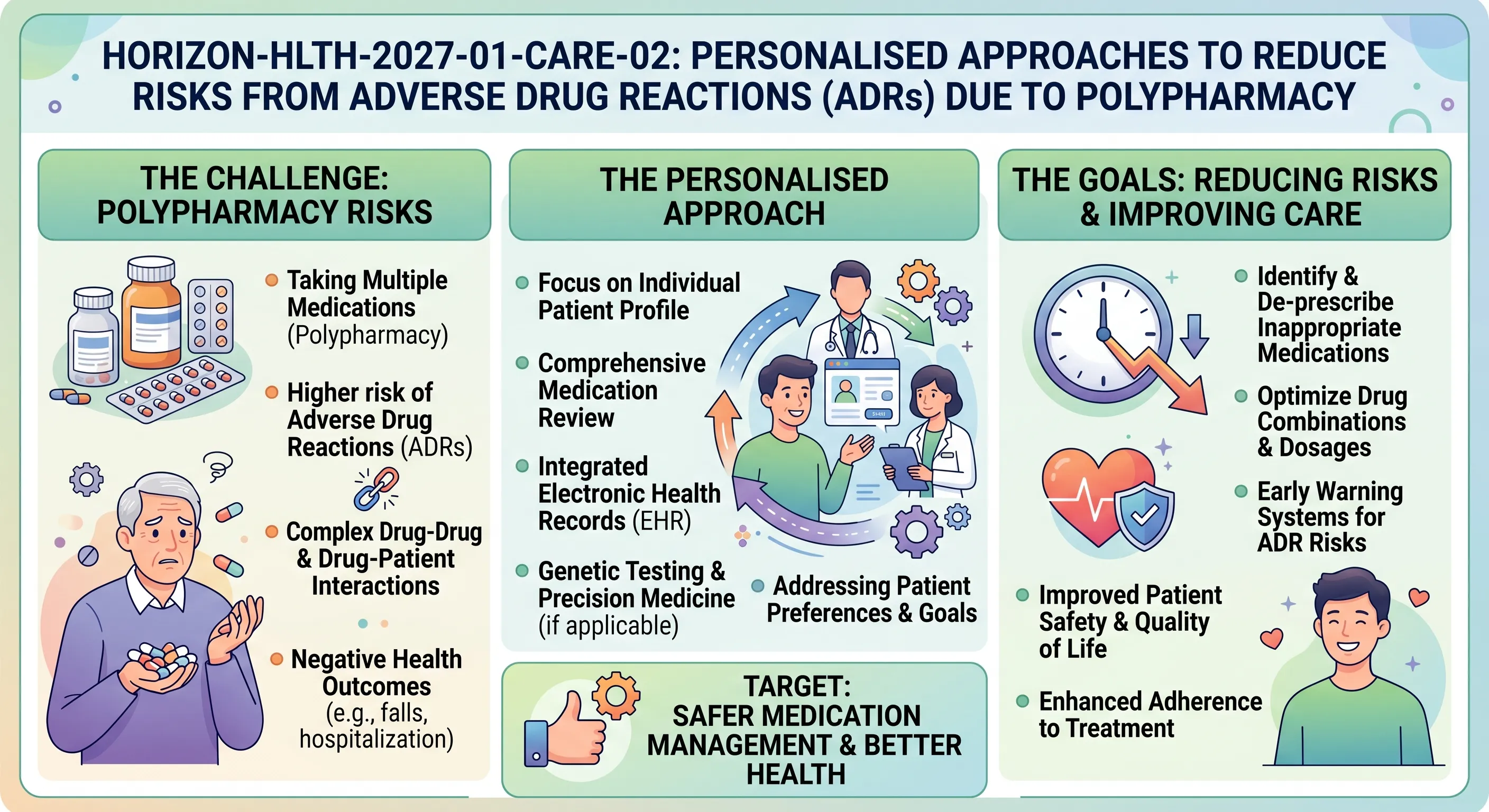
The risk posed by adverse drug reactions (ADR) to the patient is excessively great, and thus the risk posed by the combination of three or more drugs at the same time in the patient is excessively great, and this is why the Commission is seeking to reduce this risk in its call to the funding. Actually, 5% of hospital deaths can be attributed to an ADR, and in the elderly, it may escalate to 16% of a clinically significant response. This call is not trying to fund some form of academic workout in drug interactions; it is trying to fund devices, guidelines, and techniques that can be employed by the healthcare system. It is trying to invest in pharmacogenomics, health data analytics, and clinical decision support systems.
Download the MIC Horizon Europe 2026/2027 Calls Calendar:
Discover more!
Administrative facts: what do we know about the HORIZON-HLTH-2027-01-CARE-02 call?
Which call is it, and when is the opening and the deadline?
- Call name: Cluster 1 – Health (Single stage – 2027/1)
- Call identifier: HORIZON-HLTH-2027-01
- Destination: Ensuring equal access to innovative, sustainable, and high-quality healthcare
- Topic: HORIZON-HLTH-2027-01-CARE-02
- Opening date: 10 February 2027
- Deadline: 13 April 2027, 17:00 Brussels local time
- Type of action: Research and Innovation Action (RIA)
What about the budget and estimated size of the project?
- Overall topic budget: EUR 38.00 million
- Number of projects expected to be funded: 4
- EU contribution per project: EUR 8.00 to 10.00 million
What are the key eligibility and evaluation conditions?
- Evaluation thresholds: 4 (Excellence), 4 (Impact), 4 (Implementation). Cumulative threshold: 12
- US entities eligible for EU funding (NIH reciprocity clause)
- Copernicus and/or Galileo/EGNOS required if satellite-based data is used
- Subject to restrictions for protection of European communication networks
- The granting authority may object to transfer of ownership or exclusive licensing of results up to 4 years after the end of the action
Scientific range: what does the Commission expect from the HORIZON-HLTH-2027-01-CARE-02 grant?
What outcomes are expected?
The Commission hopes that the number of patients who suffer ADRs when taking 3 or more medications will decrease, as clinical professionals will be given the validated tools to utilize the genetic information and biomarkers when making their prescriptions. Health system savings in hospital admissions that are as a result of ADRs must be shown to be a reality rather than an estimate. The outcomes must be meaningful to make changes in clinical practice and European drug management policies.
What is within scope?
- Pharmacogenomics, pharmacokinetics, pharmacodynamics in the prediction and prevention of ADRs with polypharmacy.
- Personalised medicine strategies (biomarker-driven strategies, targeted therapy strategies, stratification strategies).
- In-vitro and in-silico methods of adverse drug reactions.
- Biomarkers (imaging biomarkers, drug-drug interactions, drug-gene interactions, drug-food interactions).
- Pharmaco-exposomics (nutrition, drink interactions, smoking, vaping, and pollution).
- Multidrug dose reduction studies.
- Prescription with the use of EHR, AI, and decision support systems.
- Gender differences should be incorporated; it should be the differences within the groups of population that should be studied.
- Ethical, regulatory and implementation issues of the use of the personalized medicine methods.
The definition of the topic is very general, which is why there is a great variety of personal methods in the sphere of medicine when the outcomes are not based on theoretical research.
What are the specifically proposed research directions?
- Employ the pharmacogenomic technology in the forecasting of drug combination reaction and suggest an alternative to the current practice.
- Establish the technology infrastructure to foresee the drug cascades before the beginning of the drug.
- Establish the evidence to prove the cost-effectiveness of the pharmacogenomics technology in the prescription of drugs.
- Suggest the regulatory science methods to implement the findings to viable healthcare solutions.
- Make the project aligned with the EP PerMed and the Partnership on Transforming Health and Care Systems.
- Distribute the results to the EMA to apply the European and national guidelines on deprescribing and the new drug prescription.
Scientific strategy: how can you enhance your chances of being funded through HORIZON-HLTH-2027-01-CARE-02?
What scientific choices matter most?
- Adhere to three main guidelines that have been specifically identified and mentioned in the work program. They are: EMA/HMA/EC Pharmacogenomics workshop report, EMA guideline on the use of pharmacogenomics in older patients, and CPIC guidelines. The proposal is supposed to clearly mention these.
- Make your proposal about prescription cascades. The work program evidently employs prescription cascades as a clinical narrative and demonstrates the way an ADR may precipitate prescription cascades. Demonstrate your understanding of this.
- Do not just use buzzwords such as AI. Demonstrate how your clinical decision support tool will function at a clinical decision point. Add information, anticipated notifications and measures. Avoid excessive applications of AI.
- Early regulatory interaction with the EMA budget. This cannot be in the final year of the project, but in the first year as a letter of intent.
- Consider sex differences. This is already mentioned in the scope document. But, you can also think of other groups of the population like age, ethnicity, comorbidities, etc. This will enhance your score.
- You should think of health economics as an early part of your study. Be cost-effective based on demonstrated data and not models only.
Consortium & proposal-writing plan: what works best with this type of call?
- The amount of partners in a team that would be suitable in this grant amount and budget would be between eight to twelve partners. This is due to the fact that it would be wasting coordination money on research.
- The team should have a clinical pharmacology and pharmacogenomics team. It should also encompass hospital networks to access the electronic health records, health economics, and regulatory science.
- The implementation aspect of the project would be hugely beneficial to a technology company, particularly one that is dedicated to software or AI-based drugs safety tools. Such SMEs are particularly useful.
- In the event that you can incorporate a national medicine agency or a regional prescribing authority as a partner, it would convey to the reviewer that there is an intent to apply in the real world.
- Even though there has not been a specific SSH requirement listed, the themes of health equity, patient safety, and development of clinical guidelines indicate that it will be especially important for you to think about the ethical, societal, and regulatory implications of your project.
- Speaking of the section on impact, in particular, you would find it particularly crucial to pay attention to the decrease in prescription cascades and hospitalizations, and so on.
How would microfluidics contribute to this topic?
- This can be done at the moment with the assistance of either the cell cultures on plates or by carrying out animal experiments. They are not a real imitation of the drug interaction within a physiological system. One of the new techniques that has been developed is the application of microfluidic organ chips.
- It is an innovative instrument that is capable of recreating physiological conditions that exist in human organs because it has the ability to control the flow precisely and at the same time monitor the system in real-time. Using this device, it is possible to simulate how these two drugs, a diuretic and an anti-thrombotic drug, will act in a compromised elderly liver by simulating low metabolic activity due to low perfusion rates.
- It will be achievable within a few days rather than months. It is possible to simulate different other drugs and their interactions using this device based on what kind of organ is being simulated.
- These Gut Chip devices have the ability to investigate food or drink interaction prior to absorption of the drug into the bloodstream. It is a vital form of pharmaco-exposomics information that cannot easily be acquired unless extensive studies on patients. This is a significant device to acquire this information.
- It is through this device that comparative studies can be made to demonstrate how drugs, and even drugs combinations, have varied reactions to people with particular genotypes. With this, it is now possible to perform pharmacogenomic stratification at a large level with minimal quantities of material and time.
- The outputs produced by the microfluidic systems are FAIR compatible, quantitative, and have the potential to be an ideal input in AI-driven decision support systems, thereby improving the development process of lab testing to clinical use.
The use of microfluidics will provide an experimental confirmation of a drug interaction based on pharmacogenomics, and therefore, it is a perfect solution to a proposal to make patient-specific drug prescriptions in HORIZON-HLTH-2027-01-CARE-02.
The MIC already brings its expertise in microfluidics to Horizon Europe:
H2020-NMBP-TR-IND-2020

Microfluidic platform to study the interaction of cancer cells with lymphatic tissue
H2020-LC-GD-2020-3

Toxicology assessment of pharmaceutical products on a placenta-on-chip model

FAQ – HORIZON-HLTH-2027-01-CARE-02
What is the main goal of HORIZON-HLTH-2027-01-CARE-02?
The call supports studies that will decrease the Adverse Drug Reactions in patients who use three or more drugs concomitantly. The Commission desires instruments, guidelines, and clinical-decision support systems that can be actually embraced by the healthcare systems rather than studies based in academia.
What is the budget and how many projects will be funded?
The overall topic budget is EUR 38.00 million. The Commission anticipates funding 4 projects with a EU contribution of EUR 8.00-10.00 million per project.
When does the call open and when is the deadline?
The call closes on 10 February 2027. By 13 April 2027, 17:00 Brussels local time the deadline is in place. It is a one stage call.
What type of action is funded under this topic?
This is a Research and Innovation Action (RIA) within Cluster 1 Health (Single stage -2027/1) with identifier HORIZON-HLTH-2027-01.
What are the evaluation thresholds?
These are the levels of 4 (Excellence), 4 (Impact), and 4 (Implementation) and a cumulative level of 12. The EU also offers funding to US entities through the NIH reciprocity clause. Check the Funding and Tenders Portal for more information.
Which scientific approaches are within scope?
- ADR prediction Pharmacogenomics, pharmacokinetics, pharmacodynamics.
- Individualised medicine approach and biomarker-based therapy.
- Both in-vitro and in-silico techniques, including imaging biomarkers.
- Pharmaco-exposomics and de-escalation investigations.
- AI and clinical decision support systems incorporated into EHR.
Why are prescription cascades central to this call?
Prescription cascades are a clinical narrative used by the work programme. A new prescription is activated by an unrecognised ADR, which in turn causes side effects resulting in another prescription. Proposals which show the knowledge of this mechanism fare well.
What ideal consortium size is recommended?
This budget range is suitable with between eight and twelve partners. The team is to consist of clinical pharmacology coupled with pharmacogenomics, hospital networks with EHR access, health economics, and regulatory science. The implementation story is enhanced by the introduction of an innovative SME in AI-based drug safety tools.
How does microfluidics contribute to this topic?
Microfluidic organ-on-chips are models of physiological conditions in the human organ which enables testing of drug interactions in days and not months. ADR prevention Pharmacogenomic stratification and pharmaco-exposomics studies can be conducted in liver-on-chip and gut-on-chip platforms.
Which guidelines should the proposal explicitly reference?
The work programme gives three guidelines whose names need to be mentioned: the EMA/HMA/EC Pharmacogenomics workshop recommendations, the EMA guideline on medicines in older populations and the CPIC guidelines. It is also anticipated that early involvement with EMA since the first year.