
Tips & Tricks for a successful HORIZON-HLTH-2026-03-DISEASE-13 proposal
Opening
10 February 2027
Deadline
Keywords
clinical networks
Global Health
Health Resilience
implementation research
Pandemic Preparedness
European clinical research
EU Health Programme
Your microfluidic SME partner for Horizon Europe
We take care of microfluidic engineering, work on valorization and optimize the proposal with you
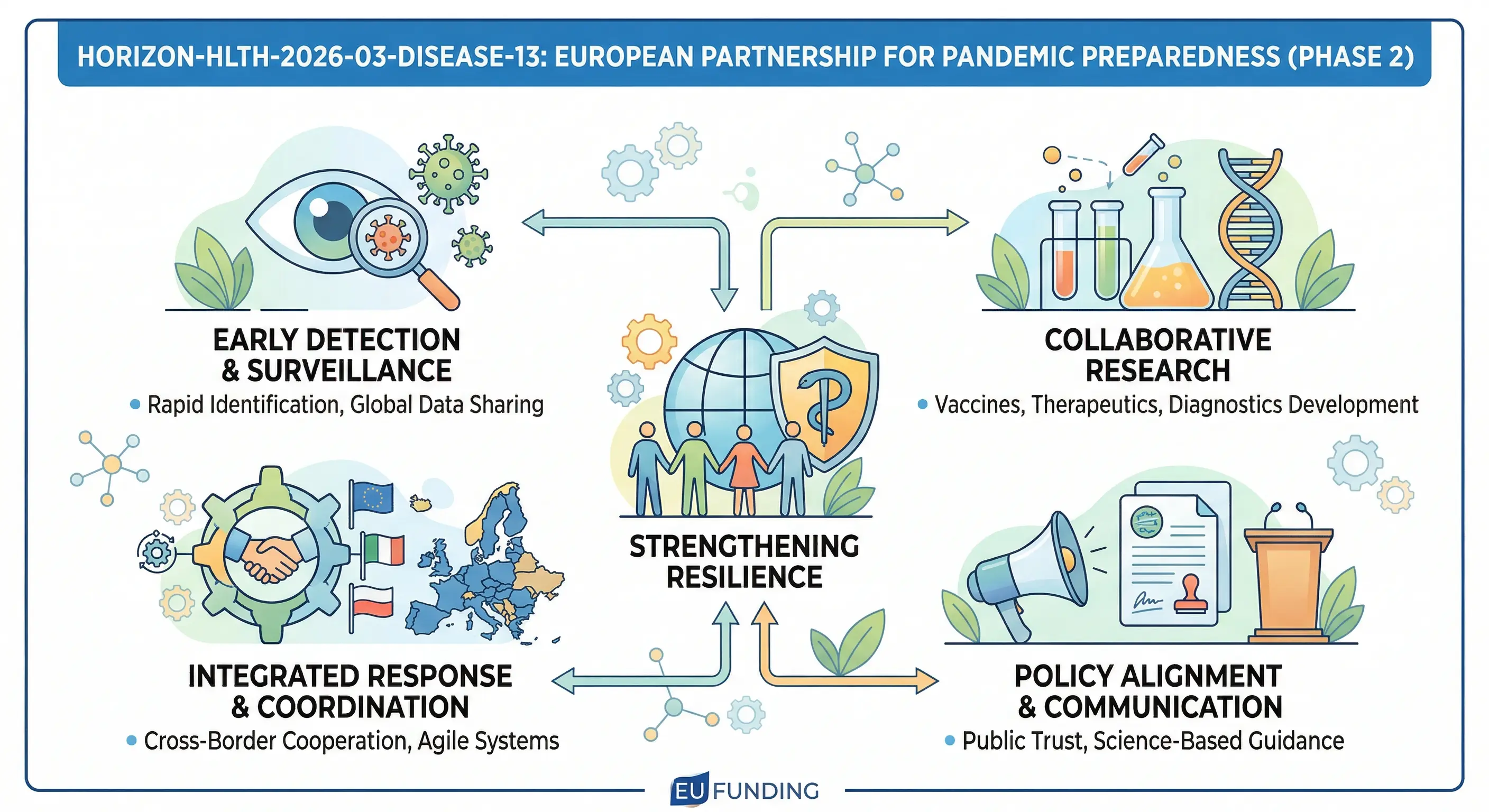
HORIZON-HLTH-2026-03-DISEASE-13: European Partnership for Pandemic Preparedness (Phase 2)
This is not some ordinary open call for proposals. What the Commission is doing here is extending, and to an already established EU co-funded partnership, new activities and, possibly, new partners, under the existing grant agreement. The Commission’s short-term goal is a truly prepared Europe ready to deal with the next pandemic before it strikes. That is, clinical networks that remain active between crises, infrastructure that is genuinely cross-border, and a research ecosystem in which national funding agencies, the EU, and researchers co-operate (and not in parallel).
Download the MIC Horizon Europe 2026/2027 Calls Calendar:
Discover more!
Administrative facts: what do we know about the HORIZON-HLTH-2026-03-DISEASE-13 call?
- Call name: Partnerships in Health (2026/2)
- Call identifier: HORIZON-HLTH-2026-03
- Destination: Tackling diseases and reducing disease burden
- Topic: HORIZON-HLTH-2026-03-DISEASE-13: European Partnership for Pandemic Preparedness (Phase 2)
- Opening date: 10 February 2027
- Deadline: 13 April 2027 (17:00 Brussels local time)
- Type of action: Program Co-fund Action (COFUND)
- Total indicative budget: EUR 63.00 million (EUR 30.00 million in 2026 and EUR 33.00 million in 2027)
- Number of projects expected to be funded: 1
- Funding rate: 50% of eligible costs
- Critical eligibility restriction: the proposal must be submitted by the coordinator of the consortium funded under HORIZON-HLTH-2024-DISEASE-12-01. No other applicant qualifies.
- Additional partners may be included, but the existing consortium is the only eligible submitter.
- US legal entities are eligible for union funding, provided the concerned consortium of research funders expressly agrees, and subject to restrictions for the protection of European communication networks.
- Award thresholds: 4 for Excellence, 4 for Impact, 4 for Implementation; cumulative threshold of 12.
- If successful, the outcome is a grant agreement amendment, not a new grant.
- Financial support to third parties (FSTP) is allowed in grant form only.
Scientific range: what does the Commission expect from the HORIZON-HLTH-2026-03-DISEASE-13 grant?
What outcomes are expected?
The Commission wants a pan-European clinical research ecosystem ready to mobilize quickly in a health emergency, rather than building from scratch each time one is declared. Besides the clinical network, the Commission wants tangible coordination among research funders, regulators, national authorities, and the scientific community, and evidence-based pandemic preparedness strategies rolled out not only across Europe but, where necessary, globally.
What is within scope?
- The entire range of preparedness research, basic and pre-clinical research, clinical research, public health research, social sciences, and implementation research.
- The role of environmental, ecological, and climatic drivers in the emergence and spread of infectious threats will be discussed within One Health framing research in the partnership.
- Establishment and integration of the always-hot clinical research network, including both observational and interventional studies.
- Coordination with the CT-CM.
- Synergies with the EU4Health Program, the Digital Europe Program, the EU preparedness union strategy, and HERA.
- Joint funding call for transnational and shared data infrastructure.
What are the specifically proposed research directions?
This is a continuation of Phase 1, which is specifically mentioned in the work program; therefore, the research directions are not abstract, but they are the continuation of the already existing SRIA:
- Nurture and sustain the ever-hot clinical research network that is prepared to switch to emergency mode.
- Establish strong, real-time operational coordination with the CT-CM and provide scientific guidance on the clinical research requirements for real responses.
- Integrate and improve data-sharing and knowledge infrastructures at the European level to conduct research on pandemics.
- Ensure that a One Health approach is encouraged and integrated, thereby further defining the origins of pathogens and combining climatic and ecological factors.
- Be aligned with the EU Preparedness Union Strategy (JOIN(2025) 130) and make concrete contributions to the EU Global Health Strategy.
- It is not that the Commission seeks individual scientific findings but research integration, coordination, and readiness.
Scientific strategy: how can you enhance your chances of being funded through HORIZON-HLTH-2026-03-DISEASE-13?
What scientific choices matter most?
- Be more innovative than Phase 1 activities: The BE READY NOW consortium will be known to the evaluators. You need to provide explicit reasons for the new activities and those that will take place beyond Phase 1. So what can be added by introducing a new activity that could not be achieved by the existing partnership alone?
- Bring the idea of the always-hot network to life: What can clinical sites do to sustain their operations and stay in touch with each other during health emergencies? A list of institutions is not enough; evaluators seek governance structure, data sharing, and trigger mechanisms.
- Liaise closely with the CT-CM: The Clinical Trial Coordination Mechanism is mentioned several times in the text; failing to discuss it as an obligatory aspect will have an adverse impact on your score. Document the points of integration.
- It is obligatory to incorporate a One Health approach: We have witnessed projects that do not take into account this and score lowly in the Impact section of the assessment. Statedly identify the connection between your study and climate and ecological risks.
- Neglect not the social sciences and humanities: This has been an invariable aspect of all pandemic preparedness calls, and its absence will certainly be detected by evaluators.
- Develop a strong argument for data infrastructure: Which national or regional data sets will become integrated? Through what type of governance structure? This is not a vague statement but a tangible project deliverable.
Consortium and proposal-writing plan: what works best with this type of call?
It is a COFUND activity that operates in a very different way from other Horizon Europe programs. The consortium is applicable as one entity. Nonetheless, the proposal has a few components that are of importance.
- If you have new partners in Phase 2, their value-add should be clearly stated and justified. Partners who are effectively duplicating competencies will not help build a stronger proposal.
- Include public health agencies and research funding agencies. Member States and Associated Countries: It is essential to ensure broad representation from both in your consortium at Phase 2.
- Ensure geographic diversity. The assessors are also keen on the European coverage of your partnership.
- Incorporate at least one innovative SME in case of incorporation of new partners, particularly those who have diagnostic, data, or platform technologies. It might be important to consider adding 8 or 15 new or increased beneficiaries, maybe even more if the clinical network is extended.
- In terms of writing, keep in mind that your proposal is partly rated against the results of the Phase 1 assessment; you cannot neglect the initial project condition. State clearly what has changed, what lessons have been learned, and how Phase 2 will deal with this, which may actually be more useful than a standard RIA.
- Have your budget section be very succinct. Since it is a 50 percent-funded program, every line item will be subject to scrutiny. FSTP requires a special argumentation.
How would microfluidics contribute to this topic?
Typical methods of pathogen identification rely on centralized labs and involve long waits for results after samples have been sent. The time delay has major implications for pandemic control. Microfluidics reconfigures the basic problem.
- Point-of-care diagnostic devices utilizing microfluidic chips can identify and detect novel pathogens quickly and consistently, thus greatly benefiting distributed clinical trials with many sites across different countries that are performing observational or interventional studies on a range of respiratory pathogens, distinguishing between those of bacterial and viral origin, as well as differentiating between the many novel and known strains.
- Earlier pre-clinical experiments can be facilitated by organ-on-chip models that simulate biological systems, enabling early-stage investigations of pathogen interactions with lung, gut, or blood vessel walls before significant patient cohorts are available for clinical observation. Such early data obtained can directly feed into the network’s observational study component.
- Underrated sample preparation is one area where microfluidic devices shine; they can process saliva, blood, and respiratory fluids in novel ways at scale that conventional techniques cannot replicate. Such standardization of upfront sample processing across a network of 20+ countries can eliminate many sources of variability that might otherwise invalidate comparative analyses.
- The always-hot network paradigm is inherently about rapid deployment; microfluidics is a perfect technology for developing and providing always-hot diagnostic tools that can be adapted for any new pathogen of interest. This is not a hypothetical; in response to COVID-19, existing microfluidic platforms were successfully repurposed faster than the development and rollout of new centralized PCR technologies.
The call is seeking an adaptable, rapid-response research system. Microfluidics presents your consortium with a practical diagnostic and pre-clinical toolkit that aligns perfectly with the readiness goal. MIC’s knowledge of miniaturized detection and organ-on-chip technology can enhance both the preparedness and the One Health components of your proposal.
The MIC already brings its expertise in microfluidics to Horizon Europe:
H2020-NMBP-TR-IND-2020

Microfluidic platform to study the interaction of cancer cells with lymphatic tissue
H2020-LC-GD-2020-3

Toxicology assessment of pharmaceutical products on a placenta-on-chip model

FAQ - HORIZON-HLTH-2026-03-DISEASE-13
What exactly is HORIZON-HLTH-2026-03-DISEASE-13?
It is not a typical open research call. It is a Phase 2 extension of an existing EU-co-funded partnership, specifically aimed at introducing new activities – and potentially new partners – to an existing grant agreement.
The Commission’s vision is of a Europe that will not have to restructure its pandemic facilities each time a health crisis is announced.
Who can actually apply?
There is only a single entity that qualifies: the coordinator of the consortium financed as part of the HORIZON-HLTH-2024-DISEASE-12-01 (the BE READY NOW consortium). Any other applicant can not submit.
It is possible for new partners to join, but the submission should be made by that particular coordinator. Within that consortium, you may not submit a proposal here
What are the key dates?
- Opening date: 10 February 2027
- Submission deadline: 13 April 2027 at 17:00 Brussels time
Note down the deadline. The 17:00 deadline is strict under Horizon Europe regulations.
How much funding is available?
The overall indicative budget would be EUR 63 million, divided between two budget years:
- EUR 30 million to spend in 2026.
- EUR 33 million to be allocated in 2027.
There will be a single project funded. The funding rate will be half of the eligible costs, i.e., the consortium will also have to co-finance the remaining half.
What type of action is this, and why does it matter?
It is a Co-fund Program Action (COFUND). This structurally contrasts with a Research and Innovation Action (RIA).
Key implications:
- The successful result is a grant amendment and not a new grant agreement.
Each line of the budget will be carefully examined under the 50 percent co-funding rule.
Financial support to third parties (FSTP) is permissible but only in the form of a grant, and justification is necessary.
What are the evaluation thresholds to clear?
It is a Co-fund Program Action (COFUND). This structurally contrasts with a Research and Innovation Action (RIA).
Key implications:
- The successful result is a grant amendment and not a new grant agreement.
Each line of the budget will be carefully examined under the 50 percent co-funding rule.
Financial support to third parties (FSTP) is permissible but only in the form of a grant, and justification is necessary.
What are the evaluation thresholds to clear?
Three independent- scored criteria:
- Excellence: minimum of 4/5.
The mind is affected by this condition in some manner or another. - Implementation: minimum of 4/5.
- Combined cumulative minimum: 12/15
The three thresholds must be met. It is disqualifying to score 5 on two criteria and 3 on one. Check the Funding and Tenders Portal for more information.
What research topics are in scope?
The coverage is purposefully wide. It covers:
- Basic and pre-clinical research.
- Clinical research, including observational and interventional studies.
- Social science and research in health and wellbeing.
- Implementation research
- One Health framing: environmental, ecological, and climate-related factors of infectious disease emergence.
This is not a narrow biomedical call. The integration of research in these areas, rather than the creation of silos, is also a clear expectation of the Commission.
What does the Commission actually want as deliverables?
No single scientific discovery. The Commission is looking for system-level outcomes:
- An active, standing clinical research network that is operational at all times and can be activated in case of emergency.
- Actual collaboration among funders of research, regulators, national authorities, and researchers.
- European level data-sharing and knowledge infrastructure.
- Hard alignment to the EU Preparedness Union Strategy and the EU Global Health Strategy.
Think preparedness infrastructure, not publications.
What is the always-hot clinical network concept, and why is it central?
The always-hot network concept implies that clinical locations are operationally connected and data-ready not only during but also before crises.
It will not be enough for the evaluators to have a list of partner institutions. They want to see:
- Governance structure for the network
- Data-sharing protocols
- Predefined triggering mechanisms to change to emergency response mode.
It is the point at which numerous suggestions fail. A site listing is not equivalent to demonstrating operational continuity.
Why is the CT-CM integration non-negotiable?
There are several mentions of the Clinical Trials Coordination Mechanism (CT-CM) throughout the work program. Not being able to do it substantially will hurt your Impact score.
Your proposal should not mention it in passing that you have specific integration points between your partnership activities and the CT-CM. Consider it as a structural need rather than an incidental remark.
What consortium composition works best for Phase 2?
The call structure is a strong indicator of several elements:
- New partners need to clearly specify their value-add; duplication of existing competencies dilutes the proposal.
- Member states and associated countries, public health agencies, and national research funding bodies are welcome.
- Geographic diversity in Europe is evaluated.
- When adding new partners, at least one innovative SME, especially in diagnostics, data, or platform technologies, is recommended.
- Social sciences and humanities representation is obligatory, as it has in the past resulted in poor Impact scores.
Where does microfluidics fit into this call?
There are four relevant contributions:
- Rapid pathogen identification diagnostic devices at point-of-care, in multi-location distributed clinical networks, including identifying bacterial or viral origin, and new strains.
- Organ-on-chip models for pre-clinical trials prior to a large patient cohort can be identified and easily integrated into an observational study design.
- High-throughput sample preparation (saliva, blood, respiratory fluids) of 20+ country networks, and minimized inter-site variations that would otherwise invalidate comparative analysis.
- Always-hot diagnostic tool development, as current microfluidic platforms have already shown faster repurposing than centralized PCR technologies in response to COVID-19.
The logic behind the call is a flexible, quick response infrastructure. Microfluidics is mapped to the same logic at the diagnostic and pre-clinical levels.