
Tips & Tricks for a successful HORIZON-CL6-2027-03-GOVERNANCE-04 proposal
Opening
04 February 2027
Deadline
Keywords
AI advisory tools
Multi-actor approach
sustainability
TRL 8
farmers
foresters
competitiveness
personalized advice
Multimodal AI
RAG
FAIR
Your microfluidic SME partner for Horizon Europe
We take care of microfluidic engineering, work on valorization and optimize the proposal with you
HORIZON-CL6-2027-03-GOVERNANCE-04: AI supporting informed advice for farmers and foresters to improve competitiveness and sustainability
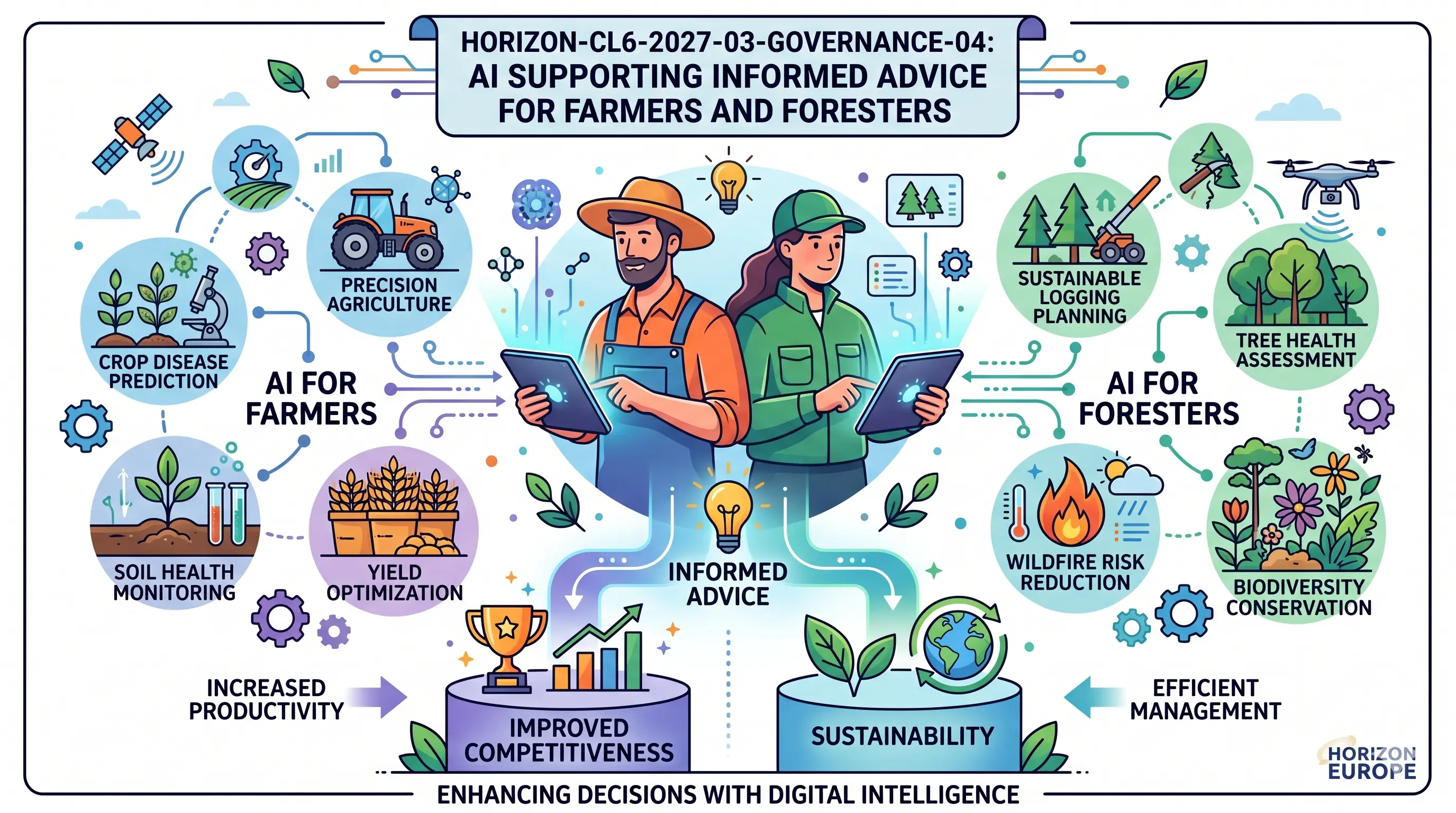
The Commission is making a bet on the artificial intelligence bridging a generational gap that has existed for years past: farmers and foresters receive inadequate, timely, relevant, and personalized advice. It is more about creating AI tools that can be practically applicable in the field rather than being demonstrated in lab. The Commission is seeking real-world solutions, which have to be tried on real end-users in Europe, and these two projects are to receive their funding. It is an Action on Innovation, implying that it is deployed and validated, rather than research.
Download the MIC Horizon Europe 2026/2027 Calls Calendar:
Discover more!
Administrative facts: what do we know about the HORIZON-CL6-2027-03-GOVERNANCE-04 call?
Which call is it, and when is the opening and the deadline?
- Call name: Call 03 – single stage (2027)
- Call identifier: HORIZON-CL6-2027-03
- Destination: Innovative governance, environmental observations and digital solutions in support of the Green Deal
- Topic: HORIZON-CL6-2027-03-GOVERNANCE-04
- Opening date: 04 February 2027
- Deadline: 11 May 2027 (17:00:00 Brussels local time)
- Type of Action: Innovation Actions (IA)
What about the budget and estimated size of the project?
- Total indicative topic budget: EUR 11.80 million
- Expected EU contribution per project: EUR 5.00 to 6.00 million
- Number of projects expected: 2
- Budget per project: roughly EUR 5.9 million at midpoint
What are the key eligibility and evaluation conditions?
- Multi-actor approach: mandatory (proposals not applying it are ineligible)
- TRL target: TRL 8 by the end of the project
- China control restriction: entities controlled directly or indirectly by China or by a Chinese legal entity are not eligible (critical technology areas restriction)
- Satellite data: if used, must rely on Copernicus and/or Galileo/EGNOS
- Subject to restrictions for the protection of European communication networks
- JRC: may participate as beneficiary with zero funding or as associated partner; does not participate in proposal preparation
- Eligible costs: lump sum format (not standard actual costs)
- No specific thresholds on the minimum number of partners beyond the standard Horizon Europe rules
Scientific range: what does the Commission expect from the HORIZON-CL6-2027-03-GOVERNANCE-04 grant?
What outcomes are expected?
At the conclusion of the project, AI-based advisory tools must be ready, and the testing must be completed by the advisors, farmers, and foresters in different parts of Europe and should be proven to work better than the currently available versions. The Commission desires better decision-making on farm and forest management, increased literacy about AI among end-users, and the release of curated and interoperable datasets as a social output. The Commission is not interested here in a collection of publications or a prototype that is locked up on a server.
What is within scope?
- Advisory solutions built on AI focusing on more than one data source (public databases, in-situ project data, private database, etc.).
- Multimedia input processing: text, images, audio, video.
- Retrieval-Augmented Generation (RAG) and other data retrieval methods are used to find up-to-date contextual information.
- Techniques for preserving privacy of sensitive data.
- Co-development with end-users (farmers, foresters, advisors) in various parts of Europe and farming systems.
- Synergies to the Common European Agriculture Data Space and European Partnership for Agriculture of Data.
- Social Sciences and Humanities (SSH) contribution which involves legal expertise, gender expertise and behavioral sciences.
What are the specifically proposed research directions?
- Creating and publishing data that is controlled and includes various data sources that are interoperable across public and private sources.
- The creation of AI solutions that understand multimodal inputs and provide contextual advice in the farm/forest.
- Testing and making tools ready at the TRL 8 on actual users in different agroclimatic systems.
- Training and capacity building of advisors and farmers on the use, trust, and critical consideration of AI outputs.
- Providing real value added in relation to the available advisory tools (the bar is clear in the text), dynamic, regulation-aware knowledge retrieval in RAG architectures.
Scientific strategy: how can you enhance your chances of being funded through HORIZON-CL6-2027-03-GOVERNANCE-04?
What scientific choices matter most?
- Meet TRL 8 design requirements: The evaluation board will question the authenticity of the project architecture to achieve deployment-level verification. Do not wait until the last six months before the pilot.
- The multi-actor approach is not a principle, but a checkbox that should take priority. Advisors, farmers, and foresters have to be included in the co-development loop in WP1, and not only as testers in WP4.
- Be responsible regarding multimodal AI: The work program refers to text, pictures, audio and video directly. A proposal focused on structured data and text will appear one-sided compared to what the Commission is signaling here.
- Address AI explainability head-on: Farmers won’t trust a black box. Show how the tool explains its advice. This one trips people up more than you’d expect.
- Make the release plan of databases credible: Listed among the expected outcomes is curated, interoperable, FAIR-compliant datasets. An indistinct data management strategy will not pass.
- Be linked to the Agriculture Data Space and GOVERNANCE-02-01 Partnership. The work program states so; evaluators will regard it accordingly.
- Integration of SSH should be authentic: The knowledge of gender and behavioral sciences influences the uptake of AI in the agricultural setting. This has not been merely on paper.
Consortium & proposal-writing plan: what works best with this type of call?
- Have a target of 10 to 14 partners, with possibly 1 or 2 additional partners if the geographic area covered by farming areas necessitates it. It is an IA on TRL 8, which means that the consortium requires functional depth in many countries.
- Everything is influenced by the multi-actor requirement. You require research and technology organizations to develop the AI, but you also require farm organizations, individual farmer groups as advisory networks, and the involvement of these networks in co-design. The rural actors are mentioned in the work program.
- Have at least one innovative SME with an AI or agtech product already in place. SMEs offer deployment experience and market realism. They also indicate to the evaluators that it is not an academic project.
- AI, data science, and SSH expertise should be brought by university partners. Not only computer science, but legal knowledge and behavioral science are directly requested.
- Why not incorporate a national or regional agricultural advisory service? They are natural communication channels and offer credibility to the multi-actor structure.
- If your consortium relies on satellite data, ensure that one of the partners has experience integrating Copernicus or Galileo. It is an eligibility requirement, and not merely a preference.
- On the writing front, It is on the impact part that IA proposals tend to score lowly. Quantitatively, where possible, spell out the number of farmers and foresters who will be contacted during piloting and dissemination. It is not sufficient to achieve the wide dissemination; the Commission requires numbers and channels.
How would microfluidics contribute to this topic?
A call about AI advisory tools to farmers may not initially be a natural place for microfluidics. However, the relationship is not imaginary. Farm decision-making variables revolve around soil health, water quality, nutrient status of plants, and pesticide residue contamination. Traditional laboratory tests are time-consuming and need licensed staff to perform. Microfluidic sensors at the point of care can provide an answer to a farmer or advisor in the field in minutes.
According to your AI advisory system, you are being asked to modify the input of nitrogen, depending on measurements of nitrogen in the soil. A microfluidic soil nitrate sensor could produce that input data on-site, without sending samples to a regional laboratory. In the same domain, same hour, practical suggestions.
Another direction is pesticide residue detection. The microfluidic chips can be screened on portable devices to identify residues in water runoff or soil extracts. That data stream would be input to the AI decision layer by your consortium.
Irrigation water check in the management of quality. pH sensors, conductivity sensors and ion-sensors. Microfluidic sensors can be run continuously and inexpensively. This is precisely the type of on-site information the work program requires to feed into AI-based solutions.
In forestry, a portable biosensor that detects the presence of pathogens or pests (e.g., fungal spores, pathogens of a particular tree species, etc.) could provide early warning signals to the advisor device. Before symptoms manifest, you would know that there is a problem.
The work program solicits multimodal data-in requests and economical, deployable solutions in the field. Microfluidic sensors are midway in between. With respect to your consortium, MIC‘s work would involve designing and testing the sensor interfaces, defining the data format as RDS-CRM, and combining the outputs of the curated dataset. When you are developing an AI advisor tool that will really be useful in practice, acquiring data requires high-quality, cost-effective field measurements. And that is the whole microfluidics seal.
The MIC already brings its expertise in microfluidics to Horizon Europe:
H2020-NMBP-TR-IND-2020

Microfluidic platform to study the interaction of cancer cells with lymphatic tissue
H2020-LC-GD-2020-3

Toxicology assessment of pharmaceutical products on a placenta-on-chip model

FAQ – HORIZON-CL6-2027-03-GOVERNANCE-04
What is this call about?
It is topic GOVERNANCE-04 of call HORIZON-CL6-2027-03, on AI-based advice tools for farmers and foresters, and advisors, under the Green Deal destination on innovative governance, environmental observations and digital solutions.
When does it open and close?
Opening: 4 February 2027. Deadline: 11 May 2027 at 17:00 Brussels time. This is a single-stage call.
What is the budget and how many projects will be funded?
The indicative budget is EUR 11.80 million, with an expected EU contribution of EUR 5-6 million per project. It will fund about 2 projects, with a lump sum funding model.
What kind of action is it and what TRL is expected?
It is an Innovation Action (IA), with a required Technology Readiness Level (TRL) of 8 at the end of the project (the tool has to be tested and validated in real environment).
Must it apply the multi-actor approach?
Yes. It is not possible to make a proposal without the multi-actor approach. Advisors, farmers and foresters need to be in the co-development loop from the beginning. Check the Funding and Tenders Portal for more information.
What are the Commission's expectations?
Practical usable AI advisory solutions, tested and proven by farmers, foresters and advisors across Europe, that result in better decisions, increased AI awareness among users, and the publication of datasets that are curated, interoperable and FAIR.
What is in scope technically?
AI-based advisory tools integrating diverse data sources (public, in-situ, private), multiple data modalities (text, images, audio, video), Retrieval-Augmented Generation (RAG) approaches, privacy protection and integration with the Common European Agriculture Data Space and the European Partnership for Agriculture of Data.
Will there be restrictions on non-EU entities?
Yes. The entity can’t be directly or indirectly controlled by China, or by an entity incorporated in China; this is covered by the critical technology areas restriction. Satellite data can only be used if it is from Copernicus and/or Galileo/EGNOS.
What works best with this type of call?
- Target 10-14 partners, with potentially 1 or 2 extra partners if the farming area calls for it.
- Have at least one innovative SME with an AI or agtech product. SMEs provide deployment and commercial experience.
- Universities should provide expertise in AI, data science, and the social sciences and humanities (SSH).
- How about a national or regional agricultural extension service? They’re a natural dissemination platform and add legitimacy to the multi-actor approach.
How would microfluidics contribute to this topic?
The emergence of an appeal for AI farm advisory systems may not be the most obvious place for microfluidics. But it’s not a figment. Decision-making factors on a farm include soil, water, plant nutrients and pesticides. Most laboratory tests are time-consuming and require a licensed technician. Point-of-care microfluidic sensors can give an answer to a farmer or advisor in the field in minutes.
Why is this an Action on Innovation rather than a research project?
It is more about developing AI tools for field use rather than for lab work. The Commission needs practical solutions, which need to be tested in real life on end-users in Europe, and these two projects are to be funded. This is an action on innovation, which means it is a demonstration rather than research. That was tested with end users.