
Tips & Tricks for a successful HORIZON-CL6-2027-02-FARM2FORK-08 proposal
Opening
20 April 2027
Deadline
Keywords
Foodomics
AI annotation
Mass spectrometry
Food exposome
Food safety
Machine learning
Farm-to-fork
foodome characterization
data analysis
Your microfluidic SME partner for Horizon Europe
We take care of microfluidic engineering, work on valorization and optimize the proposal with you
HORIZON-CL6-2027-02-FARM2FORK-08: AI-powered foodome characterization
Food contains more chemistry than we know what to do with. Literally. Over 100,000 compounds are present in the foods we eat, yet current databases track barely 150 of them. The commission wants AI to close that gap, fast. This topic sits squarely in the space between high-throughput analytical chemistry, machine learning, and food safety policy, and the expectation is a working tool at the end, not a research report.
Download the MIC Horizon Europe 2026/2027 Calls Calendar:
Discover more!
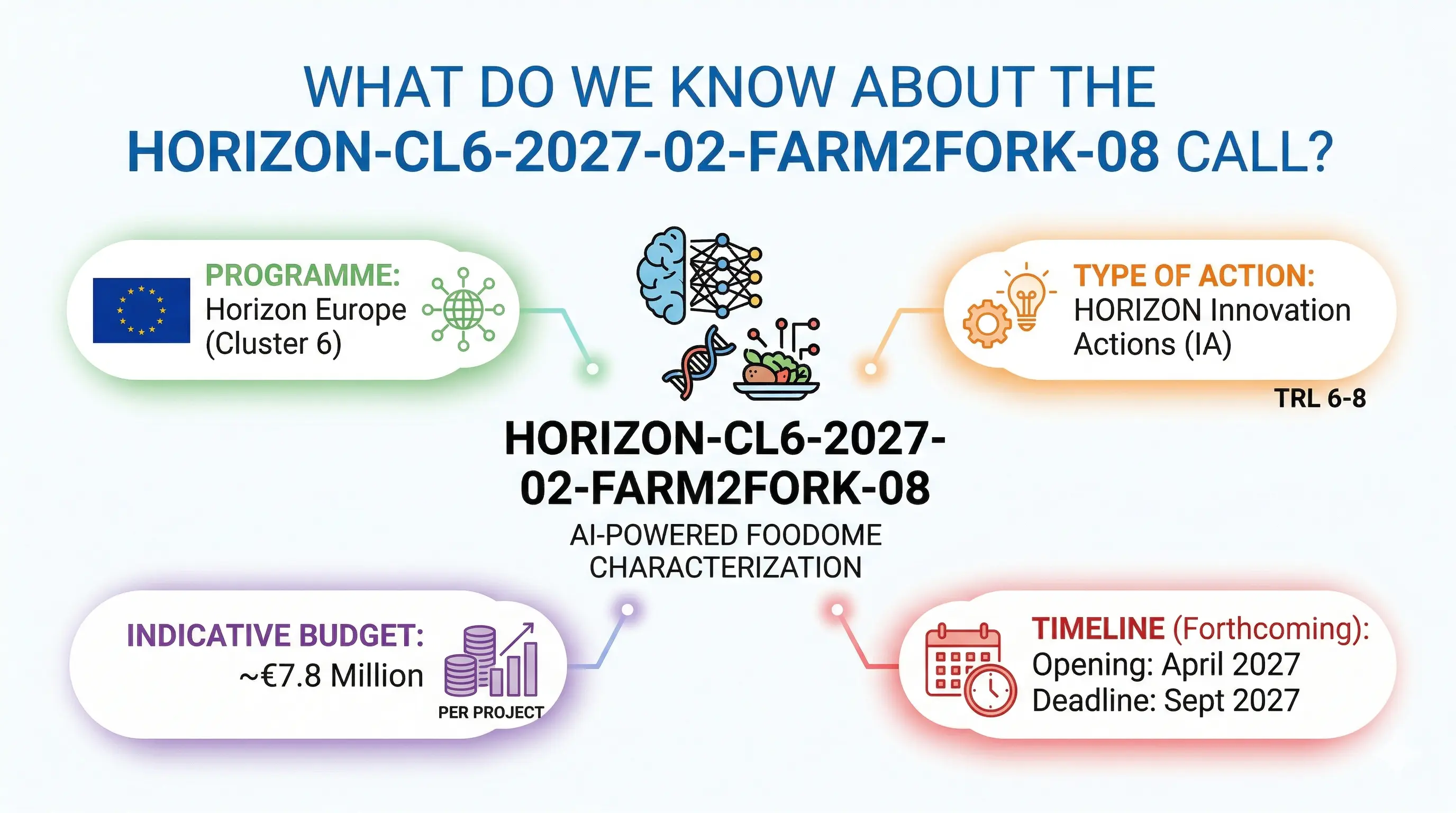
Administrative facts: what do we know about the HORIZON-CL6-2027-02-FARM2FORK-08 call?
Which call is it, and when is the opening and the deadline?
- Call name: Call 02 – single stage (2027)
- Call identifier: HORIZON-CL6-2027-02
- Destination: Fair, healthy, and environmentally friendly food systems from primary production to consumption
- Topic: HORIZON-CL6-2027-02-FARM2FORK-08 – AI-powered foodome characterization
- Opening date: 20 April 2027
- Deadline: 23 September 2027
- Type of action: Innovation Action (IA)
What about the budget and estimated size of the project?
- Overall budget: EUR 7.80 million
- Number of projects expected: 1
What are the key eligibility and evaluation conditions?
- Standard eligibility thresholds apply per General Annex B
- Specific restriction: proposals are subject to restrictions for the protection of European communication networks (this one catches people off guard; check the exact scope of that restriction before submitting)
- TRL range: starting from TRL 5, reaching TRL 7 by end of project
- Multi-actor approach: encouraged, not mandatory as an additional eligibility criterion
- JRC participation: not mentioned for this topic
- Clustering requirements: not specified; international cooperation is encouraged
Scientific range: what does the Commission expect from the HORIZON-CL6-2027-02-FARM2FORK-08 grant?
What outcomes are expected?
By the end of the project, there should be a validated AI tool capable of processing complex foodomics data, identifying and quantifying chemicals present in food far beyond what traditional databases cover. The Commission also wants improved capacity across academia, research infrastructures, and industry to do foodomics research together, not in parallel silos.
What is within scope?
The work program draws a clear line: this is about building an AI-powered analytical capability, not about nutrition policy or diet studies.
- High-throughput foodomics data interpretation using AI: untargeted mass-spectrometry, nuclear magnetic resonance, and similar methods
- Development of AI algorithms that predict or infer compound presence and concentration even from incomplete datasets
- Use of phylogenetic relationships between species to improve compound inference
- Identification of potential food safety hazards based on structural similarity to known compounds
- Building a European research and innovation network in food exposome research
- Standardisation and dissemination of AI-generated foodomics results
- Interaction with existing initiatives, such as the Centre for Excellence in the Periodic Table of Food Initiative (Wageningen University)
What are the specifically proposed research directions?
The work program is fairly explicit here. The Commission is pointing toward four specific angles:
- AI annotation of untargeted analytical data, particularly from mass-spec and NMR, with proper validation
- Predictive compound inference where experimental data is missing or partial—this is the technically hard part, and probably where evaluators will look most closely
- Food safety screening through compound similarity to known hazardous substances
- Network-building across EU Member States and Associated Countries to make the resulting data and tools accessible and interoperable
Scientific strategy: how can you enhance your chances of being funded through HORIZON-CL6-2027-02-FARM2FORK-08?
What scientific choices matter most?
- Make the AI tool the protagonist of your proposal: The Commission uses the word “tool” explicitly. Evaluators will not be satisfied with a database or a methodological framework. You need a deployable AI system with demonstrated performance on real foodomics datasets by the end.
- Validate early and validate hard: This is an IA, starting at TRL 5. Evaluators will expect a credible validation plan, not just algorithm development. Build that plan into your methodology from the start.
- Address the incomplete-data challenge directly: The work program specifically mentions predicting compound presence from incomplete foodomics data. That is technically non-trivial. A proposal that sidesteps it will read as weaker than one that names it as a core problem and proposes a concrete approach.
- Connect to existing food safety frameworks: Hazard identification through structural similarity to known compounds links your AI tool to regulatory relevance. Frame it that way.
- The phylogenetic angle is unusual and worth developing: We’d argue this is one of the more original aspects of the call, and proposals that ignore it miss an opportunity to differentiate.
- Plan your network activities carefully: The Commission wants a European research network, not just a consortium. Think about how your dissemination and standardisation activities will reach beyond your own partners.
Consortium & proposal-writing plan: what works best with this type of call?
- Aim for somewhere between eight and twelve partners, maybe fewer if you have strong vertically integrated players. With only one project funded, a tight, credible consortium is better than a broad one.
- You need analytical chemistry labs with mass-spec and NMR infrastructure. No way around it. Those are the data generators.
- Pair them with AI/bioinformatics groups that have a track record in omics data processing. Food safety or nutrition science alone won’t cut it here.
- Include at least one industry partner, ideally a food company or an analytical services company. The multi-actor approach is encouraged, and evaluators will notice if industry is absent.
- An innovative SME specialized in AI-driven data analysis or food analytics would fit naturally. This is a strong slot for a smaller, agile company with credibility in the field.
- International collaboration is explicitly encouraged. A partnership with a North American or APAC group active in the food exposome space strengthens your network-building narrative.
- For the proposal itself: lead with the deployment gap, not the technology. The problem is that food chemistry is largely unknown, and that represents a public health blind spot. Start there.
How would microfluidics contribute to this topic?
Standard analytical pipelines aren’t built for the scale this topic demands. Running hundreds of thousands of compounds across thousands of food samples using conventional benchtop methods is slow, expensive, and hard to standardize. Microfluidics changes that equation.
- Sample preparation is where most foodomics projects lose time. Microfluidic extraction and concentration platforms reduce solvent use, shrink processing time, and, most importantly, produce consistent inputs for downstream AI analysis. Garbage in, garbage out, as they say.
- Say you need to screen the same food matrix across fifty different production conditions to build a training dataset for your AI algorithm. A droplet-based microfluidic system lets you generate those fifty conditions in parallel, with the same volume, the same temperature, and the same contact time. Same compound, different source, consistent result.
- Coupling microfluidic sample handling directly to mass spectrometry is increasingly mature. Your consortium would benefit from that integration, particularly when running untargeted analyses at scale.
- Lab-on-chip platforms can also handle fractionation steps that are normally manual. That reduces inter-lab variability, which matters a lot when you’re building a network of labs across multiple Member States.
For a topic that asks for a validated, deployable AI tool, the quality and consistency of the input data are not a secondary concern. It’s foundational. Microfluidics addresses that problem concretely, and your proposal is stronger if it can show not just a smart algorithm but a pipeline that feeds it well.
The MIC already brings its expertise in microfluidics to Horizon Europe:
H2020-NMBP-TR-IND-2020

Microfluidic platform to study the interaction of cancer cells with lymphatic tissue
H2020-LC-GD-2020-3

Toxicology assessment of pharmaceutical products on a placenta-on-chip model

FAQ – HORIZON-CL6-2027-02-FARM2FORK-08
What makes HORIZON-CL6-2027-02-FARM2FORK-08 different from standard food safety research calls?
It is not the subject of identifying known contaminants or validating databases. The Commission desires an AI device that can describe unknown or poorly documented compounds in foods, despite missing information, and forecast what is likely present in foods based on phylogenetic relationships and structural similarity. It is quite a different scientific challenge than most food safety calls.
Is the multi-actor approach mandatory for this call?
No, it is not required, but it is encouraged as an additional eligibility criterion. That being said, it will undoubtedly be sought by evaluators in practice. A consortium without an industry partner will need an extremely compelling reason to offset it.
What TRL level does the project need to reach by the end?
The project begins at TRL 5 and must be at TRL 7 by the end. It is an Innovation Action, so evaluators anticipate a plausible road to deployment – not a working prototype in a controlled laboratory setting.
Can a consortium include non-EU partners in this call?
In this topic, international cooperation is directly promoted. Third-country partners may join, but are generally ineligible to receive EU funding unless a bilateral agreement exists. Their contribution is best applied to support the network-building and food exposome coverage story- especially in areas that have abundant foodomics information. Check the Funding and Tenders Portal for more information.
What AI methods are best suited for foodomics data annotation?
The work program refers to approaches appropriate for untargeted mass spectrometry and NMR data annotation. Graph-based models and transformer architectures have demonstrated good performance in molecular prediction. The key distinguishing factor is the ability to handle missing or incomplete experimental data; thus, models with uncertainty quantification as part of their design will perform better with evaluators than black-box classifiers.
What does the Commission mean by food exposome research?
The food exposome is the sum of all chemical food exposures that an individual has had throughout his or her lifetime – not only the nutrients, but the entire chemical picture of all that is consumed. This is a gap in present-day public health science to the Commission. This call is just one brick in the wall of bridging that gap, namely by refining the means of mapping and annotating that chemical landscape.
How should we handle the missing-data compound prediction requirement?
Head-on. It is explicitly mentioned in the work program, and evaluators will anticipate a particular technical plan. The combination of structural similarity scoring, phylogenetic inference, and probabilistic modeling approaches is more likely to excel in this particular case. Make this a fundamental work package, not an added functionality. It is likely the most difficult aspect of the proposal to persuade, and this is also the aspect that distinguishes good from poor propositions.
What existing initiatives should we align our proposal with?
The work program specifically mentions the Center of Excellence in the Periodic Table of Food Initiative at Wageningen University. Consistency with that effort – and maybe FoodDataCentral (USDA) or any other national food composition databases – gives your interoperability narrative a boost. The Commission does not want the outputs to be an isolated database but rather to be integrated with the existing infrastructure.
What are the main evaluation criteria for this Innovation Action?
The Standard Horizon Europe evaluation criteria are used: excellence, impact, and the quality and efficiency of implementation. In this subject, excellence will be primarily based on the AI method and the originality of the compound-prediction technique. Influence will depend on the network-building aspect and the way to open interoperable tools. The implementation will be evaluated based on the TRL progression, credibility, and realism of the validation plan.