
Tips & Tricks for a successful HORIZON-CL6-2027-01-ZEROPOLLUTION-03 proposal
Opening
20 April 2027
Deadline
Keywords
air quality
Zero pollution
Air pollution
MRV tools
agricultural emission monitoring
farm environment
Multi-actor
low emission spreading
agri-businesses
Your microfluidic SME partner for Horizon Europe
We take care of microfluidic engineering, work on valorization and optimize the proposal with you
HORIZON-CL6-2027-01-ZEROPOLLUTION-03: Improve the capacity to monitor and reduce air pollution from agriculture
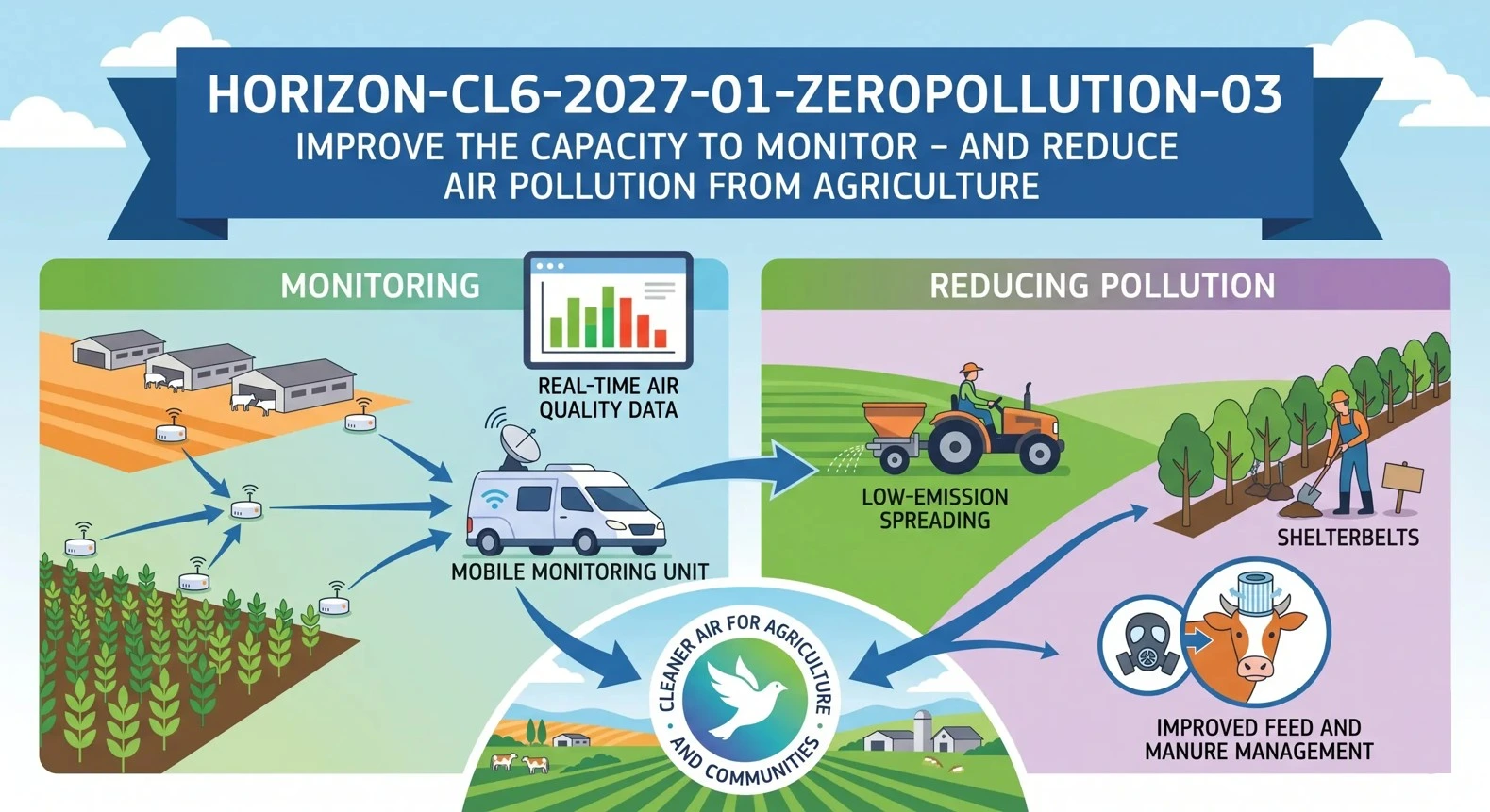
Agriculture contributes significantly to air pollution in Europe, and the Commission is aware that the sector lacks the means to quantify what is released from farms and what can be done in practice to reduce those figures. The subject matter of this topic finances research that fills the two gaps simultaneously: enhanced monitoring, reporting and verification of the pollutants on farm level, and new practices that actually diminish emissions. The desire is not scholarly. The Commission is interested in results that can be picked up and used by the farmers, advisors, and policymakers.
Download the MIC Horizon Europe 2026/2027 Calls Calendar:
Discover more!
Administrative facts: what do we know about the HORIZON-CL6-2027-01-ZEROPOLLUTION-03 call?
Which call is it, and when is the opening and the deadline?
- Call name: Call 01 – single stage (2027)
- Call identifier: HORIZON-CL6-2027-01
- Destination: Clean environment and zero pollution
- Topic: HORIZON-CL6-2027-01-ZEROPOLLUTION-03
- Opening date: 20 April 2027
- Deadline: 22 September 2027, 17:00 Brussels local time
- Type of action: Research and Innovation Action (RIA)
What about the budget and estimated size of the project?
- Overall topic budget: EUR 12.00 million
- Number of projects expected to be funded: 2
- Budget per project: around EUR 6.00 million
What are the key eligibility and evaluation conditions?
- Standard Horizon Europe thresholds apply (General Annex B)
- Multi-actor approach is mandatory: the consortium must include farmers, researchers, advisors and businesses in a balanced mix
- International organisations headquartered in a Member State or Associated Country are exceptionally eligible for funding
- If the project uses satellite-based earth observation, positioning or timing data, Copernicus and/or Galileo/EGNOS must be used
- Eligible costs take the form of a lump sum
- TRL target: activities are expected to reach TRL 4 to 5 by end of project, starting from any TRL
- FAIR data principles are required
- A dedicated task for cooperation with the other project funded under this topic and with HORIZON-CL6-2025-02-CLIMATE-04 must be included
Scientific range: what does the Commission expect from the HORIZON-CL6-2027-01-ZEROPOLLUTION-03 grant?
What outcomes are expected?
The Commission would like to see farm-level monitoring of air pollutants to be measurably improved, in terms of accuracy, cost, and ease of use. At the completion of the grant, the projects are expected to provide better MRV tools that can be practically adopted by farmers and advisors and practices of reducing emissions tested in the real farm environment. The bigger picture is to inject better science into the EU air quality policy and also provide the agricultural community with new knowledge and technology they can use.
What is within scope?
- MRV techniques and computer-based instruments (such as AI and IoT) to measure air pollutants besides greenhouse gas in the farm level that are enhanced by analysis, field tests and demonstrations.
- Emission factors and mitigation potential of farm-level practices that will be included into the further development of the EMEP/EEA air pollutant emission inventory guidebook 2023.
- Agricultural activities and technologies that are aimed at controlling manure management and application, animal feeding and grazing, fertilisers and pesticides utilisation in cattle, poultry and pig systems.
- Assessment of the potential for the reduction of pollutants in accordance with the UNECE Guidance documents.
- Training and outreach to create capacity among farmers, advisors and other parties involved in the implementation of the practices, such as biodiversity impact, to be widely adopted.
The area is clear on the air pollutants other than greenhouse gases. This is not the type of GHG-specific work that the Commission is seeking here, but the call does seek collaboration with a related GHG-focused subject in 2025.
What are the specifically proposed research directions?
- Enhance the precision, cost-effectiveness, and ease of use of MRV tools on non-GHG air pollutants at farm level, facilitating the reduction of uncertainties and allowing the use of the higher level of emissions to report them.
- Make the knowledge base on emission factors more consolidated and expanded, so that the EMEP/EEA guidebook reflects what is going on in European farms today.
- Develop and pilot novel or superior farming methods to reduce emissions and there should be a requirement to encompass various livestock species and various sources of emissions (manure, feed, fertilisers, pesticides).
- Develop real capacity by training and reaching out, and clearly connecting it with the biodiversity loss and not merely air quality.
Here work programme is rather directive. Creative reinterpretation does not have much room. However, the phrasing of the sentence before the expression of practical solutions to assist farmers, is indicative that the Commission is more comfortable with instruments and techniques that can be put in practice, rather than with peer-reviewed models.
Scientific strategy: how can you enhance your chances of being funded through HORIZON-CL6-2027-01-ZEROPOLLUTION-03?
What scientific choices matter most?
- Include the entire MRV chain of sensors to report. Proposals that simply build up monitoring equipment without explaining how the information will be incorporated into emission inventories and the policy reporting will appear to be incomplete.
- And do not confine yourself to a single kind of livestock. The names of the work programme are cattle, poultry and pigs. A proposal that covers only dairy cows, e.g. will most likely have low score coverage in terms of scope.
- Demonstrate fieldwork at the beginning and frequently. This is an RIA, however, it specifies the demonstration activities and field experiments by the Commission. Modeling and desk studies will not suffice in this case.
- Associate reduction of the emission with the biodiversity co-benefits. The text also talks about the loss of biodiversity and air quality, and we would say that any proposal which helps us make this connection tangible will be distinguished as compared to the ones which consider it as a footnote.
- Discuss the EMEP/EEA guidebook per se. Make targeted contributions: new factors on emissions, better tier procedures, and data to close any gaps in knowledge. The reviewers will understand whether you demonstrate the fact that you are aware of what the guidebook is missing at the moment.
- The request is in the AI and IoT. Get them on board, but do not oversell. A sensor network that uses EUR 50,000 per farm is not a viable solution. Have the technology based on what a mid-size European farm can deploy.
- Prepare to collaborate at the very beginning. The compulsory cooperation with the sibling project and 2025 GHG topic is not a box-ticking. Insert it into your work plan as mutual work or common deliverables. We have witnessed this journey up more than one of these consortia which had made it an afterthought.
Consortium and proposal-writing plan: what works best with this type of call?
- The multi-actor approach is obligatory thus your consortium cannot be constructed with labs only. Farmers, farm advisors, farm agri-businesses must not be passive partners or members of the advisory board, they must be real partners as well as do real work on the project.
- Target between eight to twelve partners possibly a few more in case you require wide geographical coverage of the various farming systems. There will be two funded projects and therefore geographic diversity within each consortium prevents the overlapping with the other grant.
- When you import an atmospheric science institute, have an agricultural extension service. The Commission prefers science to be field oriented and not vice versa.
- Add a new SME preferably doing precision agriculture, environmental sensors or farm data management. This profile aligns with the focus of the call on practical tools and online solutions, and it enhances your impact story.
- Cooperation on the international level is promoted. An external partner whose competencies lie in agricultural emission monitoring can be of use, particularly the regions that are grappling with the same issue of intensive livestock systems.
- There is no need to hide the multi-actor logic in an annex in the proposal text. Describe early the contribution of each type of actor. This is what evaluators will look for on the initial read through, and in case it is not obvious, they draw attention.
- Lump sum budgeting implies that credible and detailed cost estimates must be used at the beginning. Guest estimates will not pass the evaluation test as they did in some occasions when it is under real cost.
How would microfluidics contribute to this topic?
Traditional air quality measurements of the farm level are based on bulky and costly equipment that typically occupies a few sites and captures data at a few time points. What you are left with is a snapshot as opposed to the entire picture. Microfluidic sensor platforms would redefine that equation by reducing the size of the detection of relevant agricultural pollutants (ammonia, particulate matter, volatile organic compounds) into miniaturised devices that are cheap and can be installed at several locations on the same farm.
- You might like to monitor ammonia levels around a manure storage area and compare them with what is occurring at the edge of the field when applying the slurry. A microfluidic gas sensor network provides you with continuous spatially resolved information which a single analyser in a shed can only be capable of matching.
- Lab-on-chip systems for water and soil runoff analyses allow you to identify secondary pollutants (nitrates, phosphate residues) at the source of the discharge, as opposed to taking samples and forwarding them to a laboratory three days later. Your consortium obtains quicker responses, and the information can be immediately used on the MRV reporting.
- Microfluidic devices are able to connect to IoT platforms and send information on a real-time basis. This is true in the case of a project that requires demonstrating an enhanced MRV tools at the scale of a farm and thus, your monitoring network can be directly fed to the models of the emission inventory that the EMEP/EEA guidebook uses.
- Cost matters. One reference grade ammonia analyser is in the tens of thousands. Per-unit costs can be reduced to manageable levels by microfluidic sensor arrays which means you can deploy twenty or thirty of them to a pilot farm and not fill half your grant with it.
Microfluidics will not substitute all the instruments in the agricultural air quality surveillance. However, to a proposal which must demonstrate practical, scalable and affordable MRV solutions at TRL 4-5, it is a gap that traditional instrumentation leaves very gaping. Your suggestion is more powerful when the monitoring technology that you propose can be effectively implemented to other locations outside of the pilot site.
The MIC already brings its expertise in microfluidics to Horizon Europe:
H2020-NMBP-TR-IND-2020

Microfluidic platform to study the interaction of cancer cells with lymphatic tissue
H2020-LC-GD-2020-3

Toxicology assessment of pharmaceutical products on a placenta-on-chip model

About the author

Julia Sepulveda Diaz, PhD
Chief Executive Officer, Microfluidics Innovation Center
Julia holds a PhD in glycobiology and neurobiology from Université Paris-Est Créteil. Before moving into microfluidics, she spent several years as a postdoctoral researcher at the Paris Brain Institute, on Parkinson’s disease, neuroinflammation, and the role of heparan sulfate in protein aggregation. Today she leads the Microfluidics Innovation Center as CEO, steering its researchers and engineers and its collaborative research and innovation projects.
FAQ – HORIZON-CL6-2027-01-ZEROPOLLUTION-03
What is HORIZON-CL6-2027-01-ZEROPOLLUTION-03 actually about?
This topic provides funding for research that enhances monitoring of agriculture-related air pollution at farm level and how to reduce it via improved practices. The Commission is looking for both sides of the coin: better MRV, and practices that reduce emissions. Read more about the topic in our overview of Cluster 6.
Who can apply and how is the budget split?
The topic has a total budget of EUR 12 million for 2 projects, each expected to cost roughly EUR 6 million. The usual Horizon Europe rules apply, except: one relevant international organisations with headquarters in a Member State or Associated Country is exceptionally eligible. Check the Funding and Tenders Portal for more information.
What does the multi-actor approach mean here in practice?
It means farmers, advisors, academics and business must be involved and not just on an advisory board. The multi-actor approach is required and the reviewers will check if there are tasks and budget for the actors. An empty seat will be highlighted.
Are greenhouse gases in scope?
No. The call is about air pollutants other than GHGs. But the call requests co-operation with HORIZON-CL6-2025-02-CLIMATE-04, which is about non-CO2 GHGs and other air pollutants from agriculture. You must include that in your workplan as a task.
What TRL should we aim for?
We expect the work to be at TRL 4-5 at the end of the project. You can start at any TRL. This means significant field experiments and demonstration, not just laboratory testing.
How can microfluidics fit into this topic?
For on-farm assessments of ammonia, particulate matter and VOCs, microfluidic sensor systems provide lightweight, inexpensive real-time data that cannot be obtained with high-end reference grade analysers in terms of geographical spread.
What kind of consortium works best?
Between eight and twelve partners with expertise in atmospheric science, agronomy, farm advisory services, agri-businesses and one innovative small to medium enterprise (SME). It is important to be diverse as two projects will be selected and the Commission likes to avoid duplication.
What is the deadline and when does the call open?
The call will be open from 20 April 2027 until 17:00 (Brussels Time) on 22 September 2027. It is a one-stage call – you submit the full proposal.
What about lump sum funding?
The cost is in the form of a lump sum. This alters the way you put together your budget: the costing must be realistic and detailed to begin, because you can’t make changes later on as you can do in actual cost reporting.
Where can I learn more about MIC participation in EU projects?
See our research projects page and our About Us page for more information on how MIC fits in EU projects. For all Cluster 6 projects, the microfluidic relevance overview is the place to start.