
Tips & Tricks for a successful HORIZON-CL6-2026-01-ZEROPOLLUTION-03 proposal
Opening
17 April 2026
Deadline
Keywords
aquifer recharge
RIA
Clean environment
zero pollution
climate change forecasts
MRV Sysstem
Climate Adaptation Strategy
MAR-based water supply
Your microfluidic SME partner for Horizon Europe
We take care of microfluidic engineering, work on valorization and optimize the proposal with you
HORIZON-CL6-2026-01-ZEROPOLLUTION-03: Developing managed aquifer recharge techniques (MAR) in a rural context
Drought in Europe is increasing in severity, frequency and is invading places where it was previously not a problem. The Commission seeks research beyond merely documenting the problem. They want to explore what they can tangibly find, field-proven techniques for managed aquifer recharge adapted to European agricultural use, and a realistic business model that European farmers can adopt. In a nutshell: demonstrate that it works, demonstrate how to finance it, and demonstrate how to make it farm and catchment level workable.
Discover more!
Administrative facts: what do we know about the HORIZON-CL6-2026-01-ZEROPOLLUTION-03 call?
Which call is it, and when is the opening and the deadline?
● Call name: Call 01, single stage (2026)
● Call identifier: HORIZON-CL6-2026-01
● Destination: Clean environment and zero pollution
● Topic: HORIZON-CL6-2026-01-ZEROPOLLUTION-03 Developing managed aquifer recharge techniques (MAR) in a rural context
● Opening date: 17 April 2026
● Deadline: 17 September 2026
● Type of action: Research and Innovation Action (RIA)
What about the budget and estimated size of the project?
● Overall budget for the topic: EUR 12.00 million
● Number of projects expected to be funded: 2
● Budget per project: around EUR 6.00 million
What are the key eligibility and evaluation conditions?
● Standard Horizon Europe thresholds apply (General Annex D)
● Multi-actor approach is mandatory. This is an additional eligibility criterion, not a recommendation.
● Target TRL: activities are expected to reach TRL 4-5 by project end
● Eligible costs take the form of a lump sum
● No JRC participation clause for this topic
● Proposals should follow the CIS Working Group on Groundwater guidance document on MAR techniques
● Data must follow FAIR principles
● Collaboration with Mission Soil and Mission Ocean & Waters projects is expected
● Building on results from relevant H2020 and Horizon Europe projects is encouraged
Deadlines of European Programmes 2026/2027
Get the MIC Horizon Europe 2026/2027 Calls Calendar:
-All Horizon Europe deadlines (by cluster and call).

Scientific range: what does the Commission expect from the HORIZON-CL6-2026-01-ZEROPOLLUTION-03 grant?
What outcomes are expected?
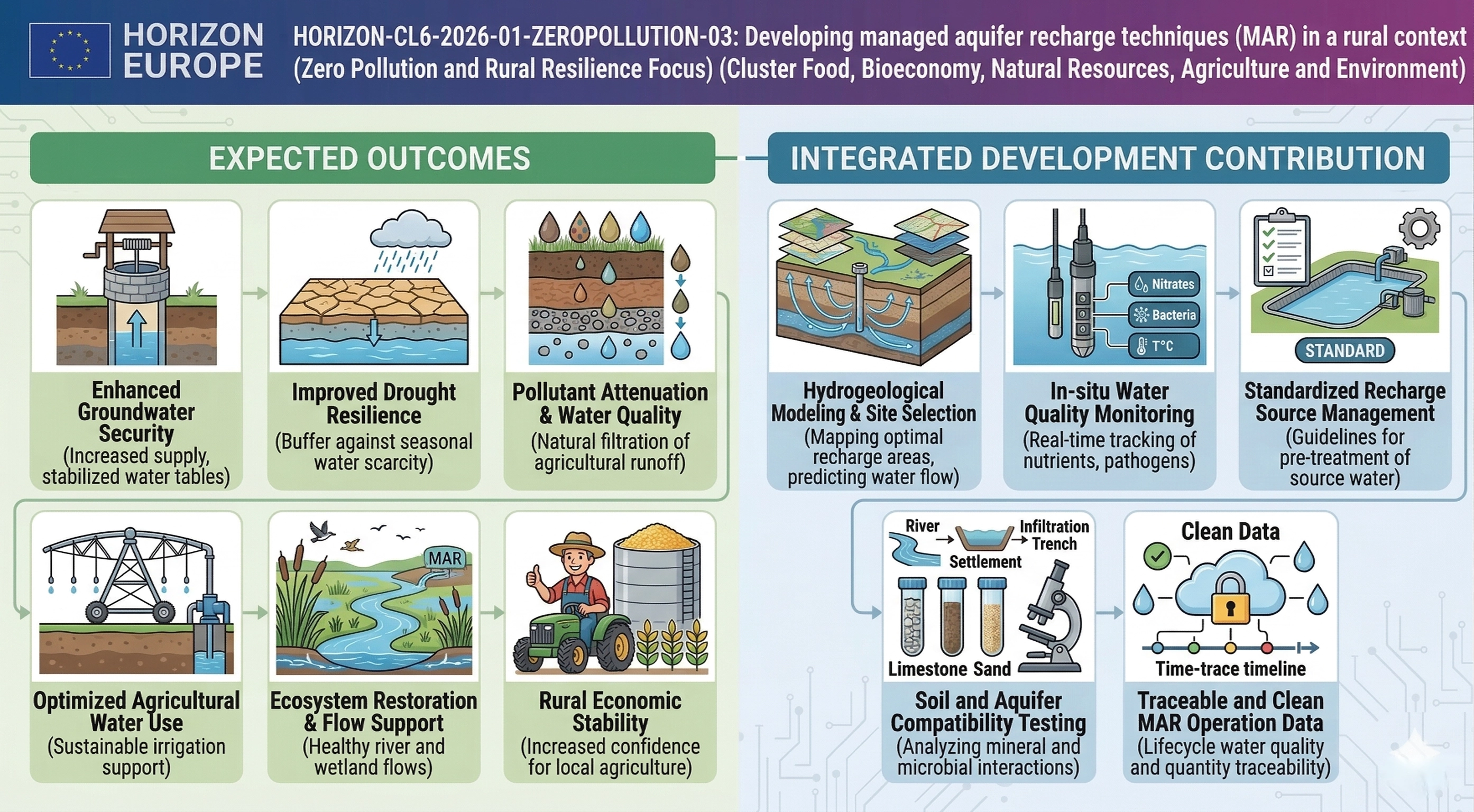
The Commission is not pursuing a literature review of the concepts of aquifer recharge. They desire the MAR methods that have been scaled, refined, and adapted to actual European farm conditions, taking into consideration the climate change forecasts. The work programme is rather precise concerning what the project is to deliver.
Technically, the proposals must come up with a methodology of determining where and when MAR techniques are most appropriate, followed by testing it on a representative sample of case-study areas. It is also anticipated to have a user-friendly monitoring, reporting, and verification (MRV) system to monitor the groundwater quality and quantity, as well as effects on related water and terrestrial ecosystems.
What is within scope?
But the Commission transcends the technical layer. They expect you to:
● Assess the sustainability of MAR not only to the aquifer itself but also to groundwater ecosystems, water bodies around, reliant terrestrial systems, and drinking water. The multi-objective framing is direct.
● Determine cost-benefits and suggest business models to the farmers who will host MAR initiatives. There are payment schemes, nature credits, carbon credits, water credits and so on.
● At least 2 case studies should be in different pedoclimatic zones to demonstrate the feasibility of those business models. not merely modelling, but real-life demonstration at the local level.
● Provide a system of governance that can vary to the local socio-economic, regulatory and climatic conditions.
What are the specifically proposed research directions?
The expected results are associated with three axes, i.e., actual access of farmers to MAR-based water supply and viable business models, healthier and more resilient water ecosystems, and evidence-based informational insights given to the policy makers about tools to enhance agribusiness water resilience. The policy is in line with the EU Vision of Agriculture and Food, the European Water Resilience Strategy and the EU Climate Adaptation Strategy.
Scientific strategy: how can you enhance your chances of being funded through HORIZON-CL6-2026-01-ZEROPOLLUTION-03?
Which scientific decisions are the most important?
● Cover a variety of pedoclimatic areas. The minimum are two case studies. In case your consortium can seriously address three or four climate areas, you will be outstanding.
● The design should involve farmers, land managers, water governance authorities, and local authorities, not merely consulted at the end. This will be carefully verified by evaluators as it is one of the eligibility criteria.
● Connect your MRV system with EU environmental data structures. FAIR compatibility with European Open Science Cloud is indicated. Do not consider this a box to be ticked.
● It is explicitly asked to be integrated with Nature-based Solutions. A proposal detailing engineered MAR without NbS connection to reduce runoff and landscape resilience is likely to receive less points.
● As we have witnessed in other cases of such calls, proposals that consider business models an afterthought are punished. The Commission desires something that farmers would, in a real sense, adopt: payment schemes, credit mechanisms… Make this a full work package.
● Do not disregard the governance aspect. The call seeks to explore localized models of governance. This is where social sciences come in (the work programme references SSH integration nearby in the same destination).
● Construct conspicuous bridges with Mission Soil and Mission Ocean and Waters projects. Budget a coordination task.
Consortium & proposal-writing plan: what works best with this type of environment RIA?
● Target between eight and twelve partners perhaps two more in case the pedoclimatic coverage needs the same. In lump sum mode, EUR 6 million, you do not wish to have such a large consortium that the management consumes the budget.
● As part of your core, they should be hydrogeologists, agricultural scientists and at least one partner with good MRV and remote sensing potential, and a socio-economic team to do the business model and governance work packages. The multi-actor dimension will be enhanced by involving water governance bodies as partners or other closely related entities.
● If you can include one partner who has worked on CIS Working Group on Groundwater guidance on MAR, then that is a good sign of credibility.
● A new SME in sensor technologies, groundwater monitoring systems, or environmental data platforms would come both with technical worth and the sort of close-to-market mindset evaluators like in this type of RIA.
● All consortium members should not only be advisory board members, but at least two farmer organisations or agricultural cooperatives. The multi-actor eligibility criterion implies that they have to be apparent in the work plan.
● Lump sum format implies that you must be clean in cost structure at the start of the day. Lump sum call reviewers are more severe with budget coherence.
● Use the 2 case studies to form the basis of your story in the proposal. These field demonstrations should be designed to be the basis of methodology, MRV, business models, and governance. This has worked well with many actor issues.
How would microfluidics contribute to this topic?
The key aspect of this call is monitoring the quality of groundwater and the well-being of ecosystems related to it. Traditional laboratory analysis of water is time-consuming, expensive, and difficult to install at the rate at which you would require a full-fledged MRV system to monitor water across multiple MARs in various locations.
● Microfluidic sensors can be directly applied to MAR locations and recharge points as a method to monitor water quality parameters in near real-time. You get nitrate, phosphate, pesticide levels, pH readings without having to take samples to a laboratory on a regular basis. Same site, same parameters, same results with all your case-study regions.
● Ask your consortium to ensure that recharged water does not transport agricultural water runoff contaminants to the aquifer. A microfluidic chip at the infiltration site operates that verifies itself continually, creates time-series data and delivers it directly to your MRV platform. That is the type of installation that evaluators will deem as valid field monitoring.
● To conduct the ecosystem impact assessment, the portable microfluidic instruments enable quick on-site screening of water samples of the dependent terrestrial and aquatic ecosystems around the MAR zones. Your field crews will be able to service more locations in less time.
● And on the business model front, reduced costs of monitoring make the entire MAR system more affordable to farmers. When the cost of compliance with water quality decreases, the barrier to adoption decreases as well.
The integration of microfluidic water quality monitoring into your proposal provides the MRV work package with a realistic technological foundation and makes the argument for scalability across pedoclimatic zones more concrete. In a call that requires you to prove feasibility, having field-ready, low-cost analytical tools is not a detail.
The MIC already brings its expertise in microfluidics to Horizon Europe:
H2020-NMBP-TR-IND-2020

Microfluidic platform to study the interaction of cancer cells with lymphatic tissue
H2020-LC-GD-2020-3

Toxicology assessment of pharmaceutical products on a placenta-on-chip model