Tips & Tricks for a successful HORIZON-CL6-2026-01-ZEROPOLLUTION-01-two-stage
Opening
12 February 2026
Deadline
Keywords
Stage 2 Proposal
Bioremediation
Aquatic Pollution
Contaminants of Emerging Concern
ocean health
Water Framework Directive
PFAS
Biotechnology
Your microfluidic SME partner for Horizon Europe
We take care of microfluidic engineering, work on valorization and optimize the proposal with you
HORIZON-CL6-2026-01-ZEROPOLLUTION-01-two-stage: Decontaminate and bioremediate aquatic pollution -
Stage 2 preparation
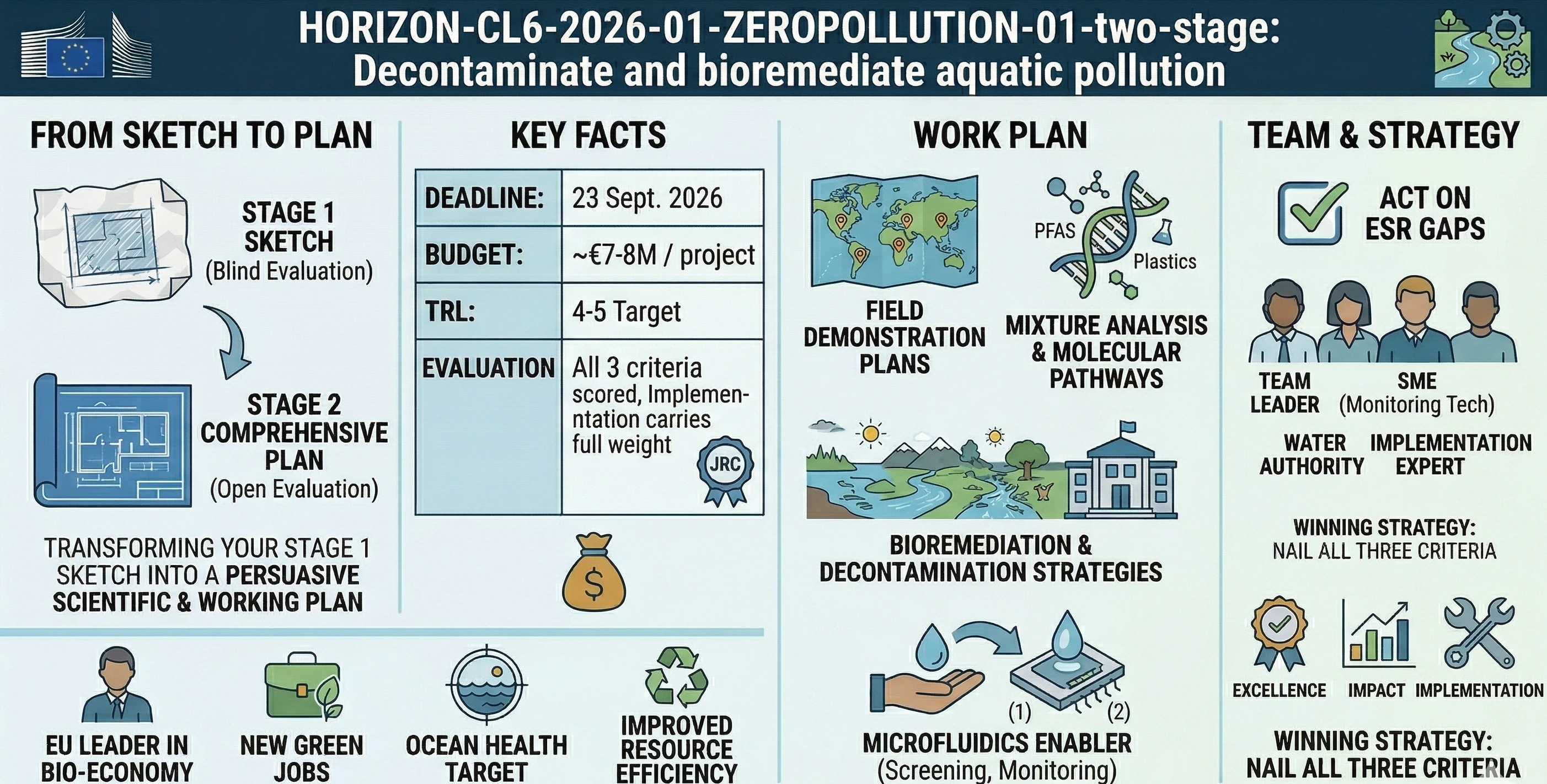
Stage 1 of this call expires 16 April 2026. When your consortium turned in, then it is in the next 5 months that the real work occurs. Stage 2 is a quite another thing: the blind test has disappeared, the three criteria are fully applicable, and the Commission requires an entire, comprehensive proposal that transforms your Stage 1 sketch into a persuasive scientific and working plan. Two stages, a substantial budget, and a blind first evaluation: this one is worth preparing properly.
Download the MIC Horizon Europe 2026/2027 Calls Calendar:
Discover more!
Administrative facts: what do we know about the HORIZON-CL6-2026-01-ZEROPOLLUTION-01-two-stage call? What changes at Stage 2?
Key Stage 2 dates and conditions
- Stage 2 deadline: 23 September 2026
- Budget per project: EUR 7.00 to 8.00 million
- Total available: EUR 23.00 million for 3 projects
- Type of action: Research and Innovation Action (RIA)
- The blind evaluation rule no longer applies: organisation names, acronyms, logos, and personnel names can now appear throughout the proposal
- TRL target remains TRL 4-5 by end of project
- JRC participation: may now be formally named as associated partner or beneficiary with zero funding
What the Stage 2 evaluation covers
- Three criteria: Excellence, Impact, Implementation (all three scored, all three thresholds must be met)
- Implementation now carries full weight: work plan quality, team competence, and resource allocation are scored
- The Evaluation Summary Report from Stage 1 will describe what reviewers flagged. Read it carefully before writing a single word of Stage 2.
Scientific range: what does the Commission expect from the HORIZON-CL6-2026-01-ZEROPOLLUTION-01-two-stage grant?
What outcomes are expected?
The Commission desires effective tools among water authorities. Proven bioremediation and decontamination strategies, enhanced surveillance of emerging issues of concern, such as PFAS, antimicrobials, microplastics, and a better scientific understanding of the flow of these compounds in marine and freshwater environments. It is not a pile of publications they are seeking.
What is within scope?
- Microorganism-based and microbial community-based bioremediation of marine waters, rivers, lakes, groundwater and sediments
- Nanoparticles made by biosynthesis and microbial remediation (recovery of nanoparticles is an asset, not a requirement)
- Decontamination of PFAS, pharmaceutical, antimicrobial, pesticide, micro- and nano-plastic, persistent organic pollutant, oil, hydrocarbon, and marine mucilage
- High-resolution monitoring and effect-based techniques of assessing risk of CECs in complex multi-polluted environments
- Locally adaptable solutions, site-specific – regional climate diversity is embraced
What specifically needs to be developed in Stage 2?
- Field demonstration plans: under what conditions, where and how will you demonstrate the bioremediation at realistic scale
- An explicit experimental design that deals with the mixtures of contaminants, not the individual compounds
- The mechanistic narrative: how do microbial communities evolve, what are the molecular pathways that are important and how does that translate to treatment design
- A route to the fate of pollutants following treatment, including metabolites and transformation products
- The involvement of the stakeholders is integrated with the work plan, and it is not mentioned as a communication activity at the end
Scientific strategy: how can you enhance your chances of being funded through HORIZON-CL6-2026-01-ZEROPOLLUTION-01-two-stage?
What does Stage 2 demand that Stage 1 did not?
- Act on the Stage 1 Evaluation Summary Report. Gaps will have been flagged by the reviewers. Discuss each of them in Stage 2, even briefly. When feedback is not considered, evaluators observe.
- Bring idea to practice. The 1st stage was about the idea. Stage 2 requires experimental procedures, field location contracts, and initial data where you are. Scorers of Excellence rate a score on the plausibility of your methodology.
- Nail the Implementation criterion. Many good things fall short here. Work packages, milestones, risk mitigation, partner roles, budget allocation – everything must make sense internally. We witness this ride up to more than one consortium.
- Complementary to PARC and Mission Ocean & Waters. The work programme queries explicitly. A work package or specific task, where coordination is done with these initiatives, would be helpful, but even a well-reasoned paragraph in the impact section will prove you have done the homework.
- Relate to the Water Framework Directive and Marine Strategy Framework Directive objectives. Your impact section ought to be in the language of regulatory milestones and not in scientific goals.
- Right amount of budget. EUR 7-8 million per project. Going way out of bounds draws red flags in regard to efficiency. Assemble the budget out of the bottom, basing on the real work plan requirements and verify that it fits the range.
Consortium & proposal-writing plan: what to consolidate for Stage 2?
- Stage 2 shows your team on paper: names, CVs, track records. In case any of the partners was a placeholder in Stage 1, then this is the time to close the consortium, not in August.
- Between nine and twelve partners is approximately the right number. Only add partners when there is real scientific gap need to do so – evaluators can see when a consortium swells between phases without apparent reason.
- Whether you already have a water authority or river basin management body in the consortium or not, it makes a difference. They bring your impact pathway to life.
- The team should include an innovative SME – a monitoring technology company, a nano-material company, and a field bioremediation services company. That is explicitly stated in the work programme.
- Give the Implementation part to a person who has previously written it. It is the part that makes the difference between funded and well-intentioned proposals.
- In case JRC had been listed as a possible contributor in Stage 1, formalise the same. They have specialised expertise in nanotechnology, metagenomics and effect-based chemical detection methods which are on-scope.
What would microfluidics contribute to Stage 2?
Stage 2 assessors desire to hear the technology options explained, not enumerated. Traditional water sampling and laboratory testing is time-consuming and costly to be scaled up to numerous field locations, and this is the sort of thing this proposal will be required to do. It is then that microfluidics turns into an argument of practicality, not a capability statement.
- You may have three field sites in two climate regions and you want to follow the changes in PFAS concentrations as your microbial consortium labors. Lab-on-chip biosensors provide real-time field information without having samples shipped to and from. Your monitoring work package is more data-rich and faster.
- During the microbial screening phase, prior to investing in a remediation strategy at scale, droplet microfluidics allows you to screen hundreds of microbial mixtures under realistic pollutant conditions in a fraction of the time of traditional procedures. Equivalent scientific query, far quicker response.
- The CEC requirement of risk assessment is explicitly tackled with effect-based toxicity testing on cell-based microfluidic platforms. And you can systematically make comparisons between before-and-after treatments. No description of what could be done, a tangible work package deliverable.
- Your consortium would name a specific SME as the partner handling field monitoring integration and microbial consortium screening. It is not a generic microfluidics expertise line in the partner table, but a particular position. Evaluators are specific.
This argument is made to land in the Implementation criterion. Having an appropriate microfluidics collaborator will streamline your field demonstration program, lower the cost, and enhance the analysis depth. This is what should be written in the proposal.
The MIC already brings its expertise in microfluidics to Horizon Europe:
H2020-NMBP-TR-IND-2020

Microfluidic platform to study the interaction of cancer cells with lymphatic tissue
H2020-LC-GD-2020-3

Toxicology assessment of pharmaceutical products on a placenta-on-chip model

About the author

Julia Sepulveda Diaz, PhD
Chief Executive Officer, Microfluidics Innovation Center
Julia holds a PhD in glycobiology and neurobiology from Université Paris-Est Créteil. Before moving into microfluidics, she spent several years as a postdoctoral researcher at the Paris Brain Institute, on Parkinson’s disease, neuroinflammation, and the role of heparan sulfate in protein aggregation. Today she leads the Microfluidics Innovation Center as CEO, steering its researchers and engineers and its collaborative research and innovation projects.
FAQ – HORIZON-CL6-2026-01-ZEROPOLLUTION-01-two-stage
What is the Stage 2 deadline for HORIZON-CL6-2026-01-ZEROPOLLUTION-01-two-stage?
The Stage 2 deadline is 23 September 2026, 17:00 local time Brussels. Stage 1 Consortia with Stage 1 submitted by 16 April 2026 have approximately five months to formulate their complete proposal.
What is the difference between Stage 2 assessment and Stage 1?
Stage 1 was assessed blind on Excellence and Impact alone – no names of organisations, logos or names of staff allowed. Stage 2 has all three criteria: Excellence, Impact, and Implementation. The identities of organisations are completely transparent and the entire work plan, budget justification and team track records are evaluated.
What is the budget range that a Stage 2 proposal should have?
The Commission estimates an EU contribution of EUR 7.00 to 8.00 million per project. Anything that goes far beyond this range is likely to give flags as far as the efficiency sub-criterion is concerned. Construct the budget bottom up on what you need to actually work, then check to see that it fits within the range.
What contaminants are specifically within this call?
PFAS, antimicrobials, pharmaceuticals, pesticides, micro- and nano-plastics, persistent organic pollutants, oil, hydrocarbons, and marine mucilage are covered in marine waters, rivers, lakes, groundwater, wastewater, drinking water, and sediments. The scope text strongly suggests that the contaminants mixtures, and not the individual compounds, be addressed.
What will be the TRL level at the conclusion of the project?
By the end of the project, activities will be at TRL 4-5. Starting TRL is not restricted, but to present a viable proposal, realistic field or pilot-scale demonstration conditions must be provided to realistically achieve TRL 4-5 within the project timeframe. Reviewers will not be pleased with lab-only validation.
Is JRC able to join a Stage 2 consortium?
Yes. The JRC can be involved as a zero-funds beneficiary or as a partner. Stage 1 preparation and submission was not involved with the JRC, and now can be officially added to Stage 2. Their nanotechnology, metagenomics and effect-based chemical detection technique experiences are directly on scope on this topic.
What should we do with the Stage 1 Evaluation Summary Report?
The Stage 1 Evaluation Summary Report lists the particular gaps and weaknesses, which were noted by reviewers. Read it thoroughly and write one section of Stage 2. Address each flagged point explicitly, even briefly, in the relevant parts of the proposal. Stage 1 feedback is either ignored or noticed by evaluators.
Which consortium size would be optimal in Stage 2?
The number of partners should be about nine to twelve. Only add partners when it is necessary due to a real scientific or field-coverage gap. The presence of a water authority or river basin management body as a consortium member is a considerable enhancement to the impact pathway. The work programme specifically encourages an innovative SME that can be in the field of monitoring technology, nano-materials, or field bioremediation services.
What is so important about Implementation criterion in Stage 2?
Stage 2, Implementation, has equal points as Excellence and Impact and all the three thresholds have to be achieved. The work package structure, milestones, risk mitigation, role clarity, and budget allocation of partners are all evaluated. This is the place where scientifically robust proposals often fail: the work plan not only has to be internally consistent, but also show that the consortium is aware of how to deliver.
What can microfluidics do to enhance a Stage 2 bioremediation proposal?
Microfluidics plays a concrete role in Stage 2 in three ways. First, biosensors on chips allow real-time monitoring of PFAS and other emerging contaminants of fields in real time without the turnaround delays of the laboratory. Second, droplet microfluidics enables high throughput screening of hundreds of microbial combinations in realistic pollutant conditions – much faster than established techniques. Third, microfluidic cell platforms can be used to do effect-based toxicity testing both prior to and after treatment with bioremediation techniques, which directly addresses the risk assessment need within the scope. To make a technology claim into an Implementation argument, naming a particular microfluidics SME to these work packages makes it concrete.