Tips & Tricks for a successful HORIZON-CL6-2026-01-BIODIV-02 proposal
Opening
17 April 2026
Deadline
Keywords
Developing methods
sensitivity of groundwater
ecosystems
RIA
antimicrobial resistance
EU water law
KCBD
LifeWatch ERIC
Your microfluidic SME partner for Horizon Europe
We take care of microfluidic engineering, work on valorization and optimize the proposal with you
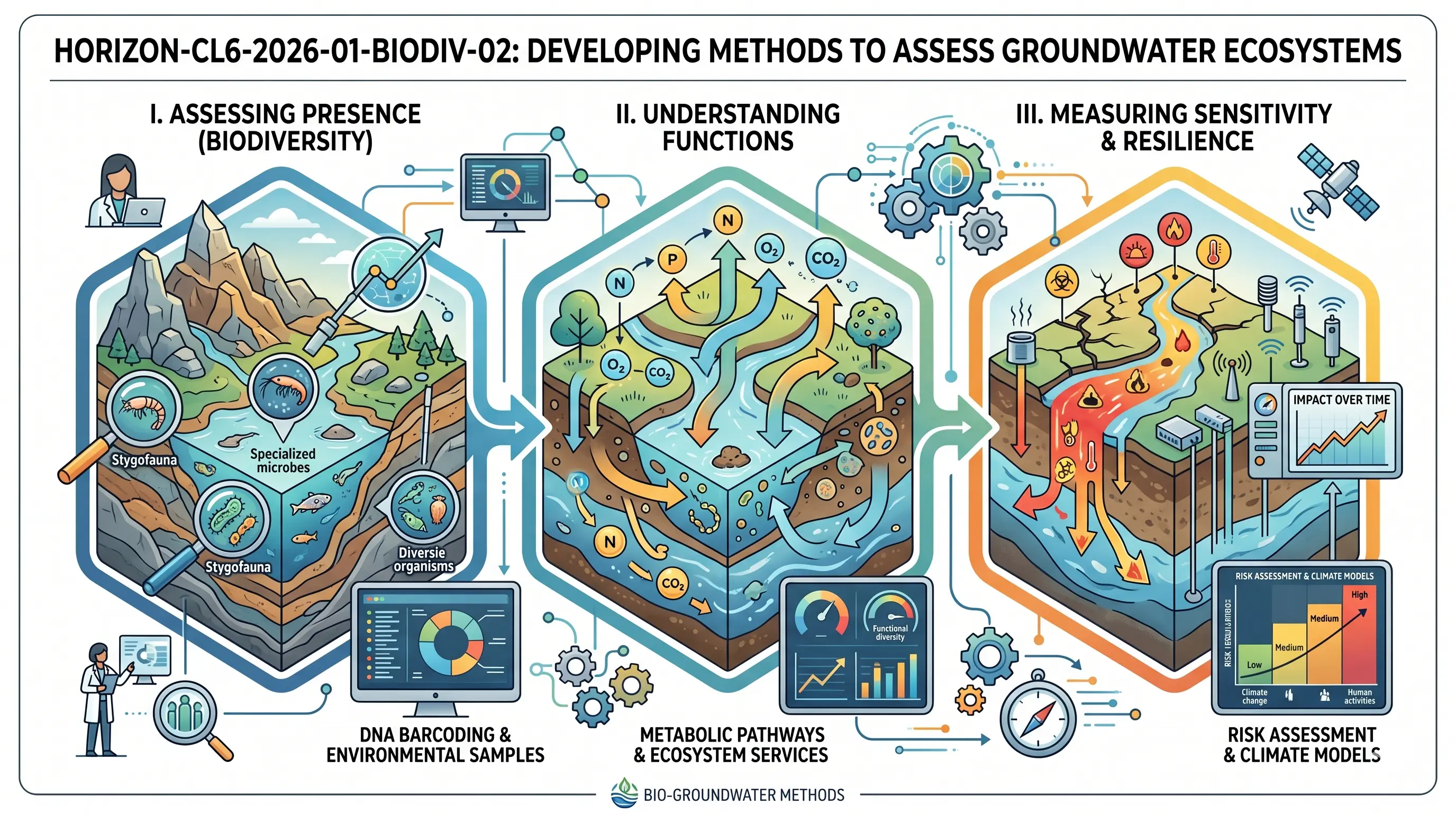
HORIZON-CL6-2026-01-BIODIV-02: Developing methods to assess the presence, functions and sensitivity of groundwater ecosystems
In Europe, two-thirds of its drinking water comes from groundwater, and we know very little about what dwells down there. The Commission desires projects that bridge this gap: ways to identify groundwater organisms, devices to quantify the impacts of pollution on them, and scientific bases of what may become a new framework of an ecological status under the EU water law. This is not the quantity of water to manage. It concerns the biology under our feet and the question of whether the present pollution standards adequately safeguard it or not.
Download the MIC Horizon Europe 2026/2027 Calls Calendar:
Discover more!
Administrative facts: what do we know about the HORIZON-CL6-2026-01-BIODIV-02 call?
Which call is it, and when is the opening and the deadline?
- Call name: Food, Bioeconomy, Natural Resources, Agriculture and Environment
- Call identifier: HORIZON-CL6-2026-01
- Destination: Biodiversity and ecosystem services
- Topic: HORIZON-CL6-2026-01-BIODIV-02
- Opening date: 17 April 2026
- Deadline: 17 September 2026
- Type of action: Research and Innovation Action (RIA)
What about the budget and estimated size of the project?
- Overall indicative budget: EUR 10.00 million
- Number of projects expected to be funded: 2
- Budget per project: around EUR 5.00 million
What are the key eligibility and evaluation conditions?
- Standard Horizon Europe RIA thresholds apply (General Annex D)
- The JRC may participate as a consortium member with zero funding, or as an associated partner; the JRC will not participate in proposal preparation or submission
- No specific restriction on country participation beyond General Annex B
- FAIR data requirementsapply; proposals should consider EOSC and relevant research infrastructures (LifeWatch ERIC, eLTER, DiSSCo, MIRRI-ERIC, Catalogue of Life)
- Cooperation with the EC Knowledge Centre for Biodiversity (KCBD) and its Science Service is expected
- International cooperation with Mediterranean countries is encouraged (General Annex D)
Scientific range: what does the Commission expect from the HORIZON-CL6-2026-01-BIODIV-02 grant?
The 2024 state of water report by the EEA put under warning that although 77% of groundwater bodies have good chemical status, the situation is not accurate. The known problems include nitrates, pesticides, and pharmaceuticals, but PFAS, microplastics, and antimicrobial resistance are still unknown. Current freshwater standards may not protect groundwater organisms at all, and that is known to the Commission.
The proposals should address all three of the following:
- Identify new ways of measuring groundwater ecosystems, such as biosensors and remote sensors, to determine the sensitivity of the ecosystems and the taxonomic groups inhabiting them.
- Develop unified and proven procedures to test the ecotoxicity of pollutants to groundwater organisms, and the idea here is to prioritize the substances and come up with protecting groundwater standards (the Commission is considering both acute and chronic effects in this case)
- Determine biological and physicochemical quality factors that might underpin a future system for the ecological status of groundwater under EU water law.
Besides that, proposals ought to come up with criteria for evaluating the temporary and long-term effects on the groundwater ecosystems. Follow-up on the findings of the Water4All co-funded venture is likely to be built where necessary. The JRC will be able to bring continental-scale hydrological modelling to estimate groundwater recharge and possibly test project procedures on European scale. The generated data must be used in the future evaluation of IPBES.
Scientific strategy: how can you enhance your chances of being funded through HORIZON-CL6-2026-01-BIODIV-02?
Which scientific decisions are the most important?
- Discuss the entire range of groundwater environments directly. The premise of the definition of groundwater ecosystems is wide, covering water-filled areas in sediments and rocks, the hyporheic layer of rivers, springs and lake interfaces, cave waters. Do not confine yourself to a single type.
- Innovation of biosensor should be a highlight. The Commission has, on numerous occasions, cited sensors, and we have observed that evaluators have rewarded a proposal that provides useful monitoring instruments in addition to research-based work.
- Think policy-ready outputs. The third exercise requests quality aspects that are befitting EU water laws. The proposal must be able to relate scientific results with regulatory frameworks, and not just writing papers.
- The ecotoxicity testing of groundwater species is not well-developed. With partners in your consortium capable of chronic exposure studies of stygofauna or microbial communities of groundwater, that makes a difference.
- Connection to PFAS and novel contaminants. They are named in the text of the work programme.
- Mediterranean cooperation is not only recommended, it is an indication. A partner in North Africa or the eastern Mediterranean would add to your international aspect with very little effort.
- The language used in the context of standardised methods informs you that the Commission would like to see outputs that can be replicated between laboratories, and not a single experiment in a single aquifer. Conduct legitimization campaigns between locations.
Consortium and proposal-writing plan: what works best with this type of Biodiversity RIA?
- A target of between eight and twelve partners, perhaps a couple more, in case you require both the hydrogeological and ecotoxicological versatility. The competition will not be very huge, but the bar will be high as two projects will be financed.
- You require hydrogeologists, groundwater ecologists, ecotoxicologists, biosensor engineers and at least one partner with EU water policy experience. When you have not been able to cover the five, you are likely to have no viable consortium.
- This is well suited to an innovative SME that may be a sensor or biotech powerhouse. It will not say so, but panels of reviewers will be attracted to proposals that involve small companies that can introduce physical innovation into the consortium.
- The research infrastructure aspect should not be overlooked. The name of the calls is Lifewatch ERIC, eLTER, DiSSCo. Mark it in case one of your partners is already contributing to these networks.
- The expectation is not a bonus but is interdisciplinary. Proposals that remain within one field (such as just microbiology, or just hydrogeology) will get low marks on Impact.
- Write the policy uptake pathway in a clear manner. It is a call in which the outputs may directly influence the future water directives of EU. Evaluators must observe that your consortium recognizes this and has got this figured out.
How would microfluidics contribute to this topic?
The traditional ways to examine groundwater organisms are based on pumping the samples to the surface, thereby interfering with the conditions that you are analyzing. That equation is altered by lab-on-chip platforms. They allow you to use small sample volumes, study microbial communities or stygofauna behavior in situ, and obtain results without taking liters of water to the laboratory.
- You want to test the hypothesis that a certain concentration of PFAs is detrimental to ground water bacteria. Microfluidic chip will be able to subject communities to unambiguous gradients of said compound and measure cell viability in real time. One experiment with different concentrations of the same compound.
- Microfluidics would be of real use to this call in biosensor integration. Biological recognition can be incorporated directly into a chip and detector fields can monitor nitrates, pharmaceuticals, or new pollutants at concentrations unnoticed by the conventional sensors.
- In ecotoxicity applications, organ-on-chip or organism-on-chip systems allow you to run chronic exposures on small invertebrates under controlled flow conditions, which is difficult to do with bench-scale aquaria with cave-dwelling or interstitial species.
- Standardisation campaigns across many field sites using the same chip design could be performed using microfluidic platforms by your consortium, which directly responds to the request of the Commission, to harmonised and validated methods.
Having a microfluidics partner would provide your proposal with a specific innovation track of sensor creation and ecotoxicity testing, two out of the three activities explicitly called in the call.
About the author

Julia Sepulveda Diaz, PhD
Chief Executive Officer, Microfluidics Innovation Center
Julia holds a PhD in glycobiology and neurobiology from Université Paris-Est Créteil. Before moving into microfluidics, she spent several years as a postdoctoral researcher at the Paris Brain Institute, on Parkinson’s disease, neuroinflammation, and the role of heparan sulfate in protein aggregation. Today she leads the Microfluidics Innovation Center as CEO, steering its researchers and engineers and its collaborative research and innovation projects.
FAQ - HORIZON-CL6-2026-01-BIODIV-02
What is this call actually trying to solve?
Approximately two-thirds of drinking water in Europe is supplied by groundwater but the biological communities inhabiting the systems are highly undercharacterized. Although the majority of EU groundwater bodies (77%) are of good chemical status, there are knowledge gaps regarding their biological communities and ability to withstand pollution. The call aims to bridge that gap with solid, tested and standardized assessment techniques that can be directly inputted into the future EU water laws.
Who should be in the consortium?
The call requires a real interdisciplinarity. An effective consortium unites:
- Hydrogeologists and ecologists who can gain access to underground systems and aquifers.
- Microbiologists and toxicologists accustomed to low-biomass, oxygen-limited conditions.
- Experts and engineers in environmental monitoring and ability to develop sensors.
- Policy and regulatory experts that will be able to place findings on the basis of EU water governance.
- Data scientists to guarantee FAIR-by-design data processes at the beginning.
The EC also promotes the incorporation of the social sciences and humanities approaches in understanding the socio-environmental context of groundwater degradation. Environmental agencies and the public authorities need to be engaged in order to make sure that methods are practically adopted.
What ecosystems are in scope?
The appeal is specifically geared towards underground freshwater habitats. Practically this consists of:
- Alluvial aquifers (porous sediment-based systems connected with surface rivers)
- Karst systems (limestone fractured environments with special cave biodiversity)
- Deep confined aquifers on which biological communities are poorly known.
- Hyporheic areas – the zone of contact between surface and groundwater.
The inherent limitation is that the ecosystem needs to be largely underground. Check the Funding and Tenders Portal for more information.
Why are groundwater ecosystems so poorly understood?
There are three practical reasons why there is a knowledge gap:
- Direct sampling is hectic and costly because of physical inaccessibility.
- The organisms found (stygofauna, microbial biofilms) tend to be scarce, slow-growing, and need special collection procedures.
- Normal ecotoxicology models were developed around surface water and historically are unable to represent the special circumstances of underground ecosystems in which the availability of oxygen, nutrient cycling, and microbial communities vary radically.
This implies that traditional monitoring systems can not just be moved. It is a request to purpose-built approaches.
Which contaminants are specifically highlighted?
One of the main arguments that support this call is that there are no credible ways to assess the impact of new contaminants, like per- and polyfluoroalkyl substances (PFAS), microplastics, and antimicrobial resistance (AMR) in groundwater systems.
The three types are similar in that they are intractable, long-lasting, and their impacts to the ecosystem in underground systems are nearly unknown. Proposals that will come up with detection and hazard assessment methods of these contaminants will be well placed.
What methods and technologies is the EC expecting?
The Commission is not dictating a particular course but is evidently indicating desired directions:
New biosensors and sensors that can identify contaminants in small amounts in low-volume samples.
- Adapted eDNA (environmental DNA) and eRNA.
- Multi-stressor assessment: biological, chemical, and physical indicators.
- Not single-site studies: harmonised, validated and finally standardised methodologies.
- Time-interacting predictive models of multiple stressor relationships.
- Interoperable data systems in line with the European Open Science Cloud (EOSC).
What specific outcomes will evaluators reward?
Evaluators seek four deliverables at the heart of what they are looking for:
- Dependable procedures to identify and describe groundwater biota and their processes.
- Risk indicators and ecological sensitivity levels which can actually be used by the authorities.
- Experimental results of acute and chronic effects of pollutants in underground conditions.
- Determination of biological quality factors that can be used to classify ecological status of groundwater in the future.
The final aspect is a very strategic one: EC is specifically aimed at a potential ecological status indicator of groundwater within a new Water Framework Directive. Setting aside the proposals that can directly contribute to that ambition will score better on impact.
How important is the link to EU policy?
It is not peripheral, but core. The end-point is to offer scientific data that can underpin EU water policies to assist authorities to develop effective steps towards the preservation of groundwater biodiversity and ecosystems that rely on groundwater.
Proposals should demonstrate clear links to:
- The EU Biodiversity Strategy 2030
- Zero Pollution Action Plan.
- The continuing revision of the groundwater pollutant lists in the Water Framework Directive.
The EC also emphasizes the cooperation with the Knowledge Centre of Biodiversity (KCBD) and the Joint Research Centre (JRC) whose modelling tools are able to validate and upscale the outcomes of projects to the level of the continent.
What does "standardisation" actually require in practice?
Standardisation here is beyond good science. Concretely, it means:
Conducting inter-laboratory comparisons studies to demonstrate that your procedure yields consistent findings in other groups and other locations.
Climate testing (in different climatic zones, in hydrogeological settings (karst versus alluvial versus confined aquifers act very differently))
Liaising with CEN/ISO standardization authorities in order to practically incorporate your approach into formal monitoring systems once the project is completed.
The project will be based on current EU studies (Water4All Partnership and previous projects) instead of creating a new one.
Proposals that have a feasible validation pathway but supply no plausible validation pathway will be viewed unfavorably by reviewers.
What are the FAIR data expectations?
The idea of data management does not come in at the end of this call. The Commission wants:
- Findable, Accessible, Interoperable, and Reusable datasets, achieved via the project, on day 1.
- Linked to the European Open Science Cloud (EOSC) where feasible.
- European data governance-compatible interoperable formats.
- An accessibility plan of long-term data when the project is no longer available.
- Engage or contract a data manager at an early stage. The projects that attach data management to the last reporting stage in general do not fulfill this expectation convincingly.
Where does microfluidics add genuine value in this call?
- This is one of the most microfluidics-related calls of Cluster 6 20262027. There are four concrete contributions:
- eDNA and eRNA detection: In-situ and portable eDNA/eRNA detection chips, including pre-concentration, capture, and qPCR/CRISPR-based detection of low-biomass samples in groundwater, directly solve the inherent detectability issue in sparse biological signals in groundwater.
- Functional micro-ecosystem assays: On-chip micro-ecosystem assays can be used to probe functional responses like redox cycling and nutrient turnover under controlled gradients simulating aquifer conditions, which can offer mechanistic understanding not available in bulk sampling.
- AMR quantification and rare taxa: Droplet and digital assays can achieve sensitive quantification of rare taxa and AMR genes, otherwise undetectable at natural groundwater concentrations.
- Deployment in the field: Miniaturized platforms enable sample-to-answer workflows in situ at the borehole or point of sampling, avoiding the sample degradation and logistical issues that bedevil the study of groundwater biology.