
Tips & Tricks for a successful HORIZON-CL5-2027-07-D3-32 proposal
Opening
04 August 2027
Deadline
Keywords
CCUS
Industrial clusters
CO2 capture
Societal Readiness
Hard-to-abate sectors
Innovation Action
Energy Destination D3
Your microfluidic SME partner for Horizon Europe
We take care of microfluidic engineering, work on valorization and optimize the proposal with you
HORIZON-CL5-2027-07-D3-32: Delivery of industrial CCUS clusters - Societal Readiness pilot
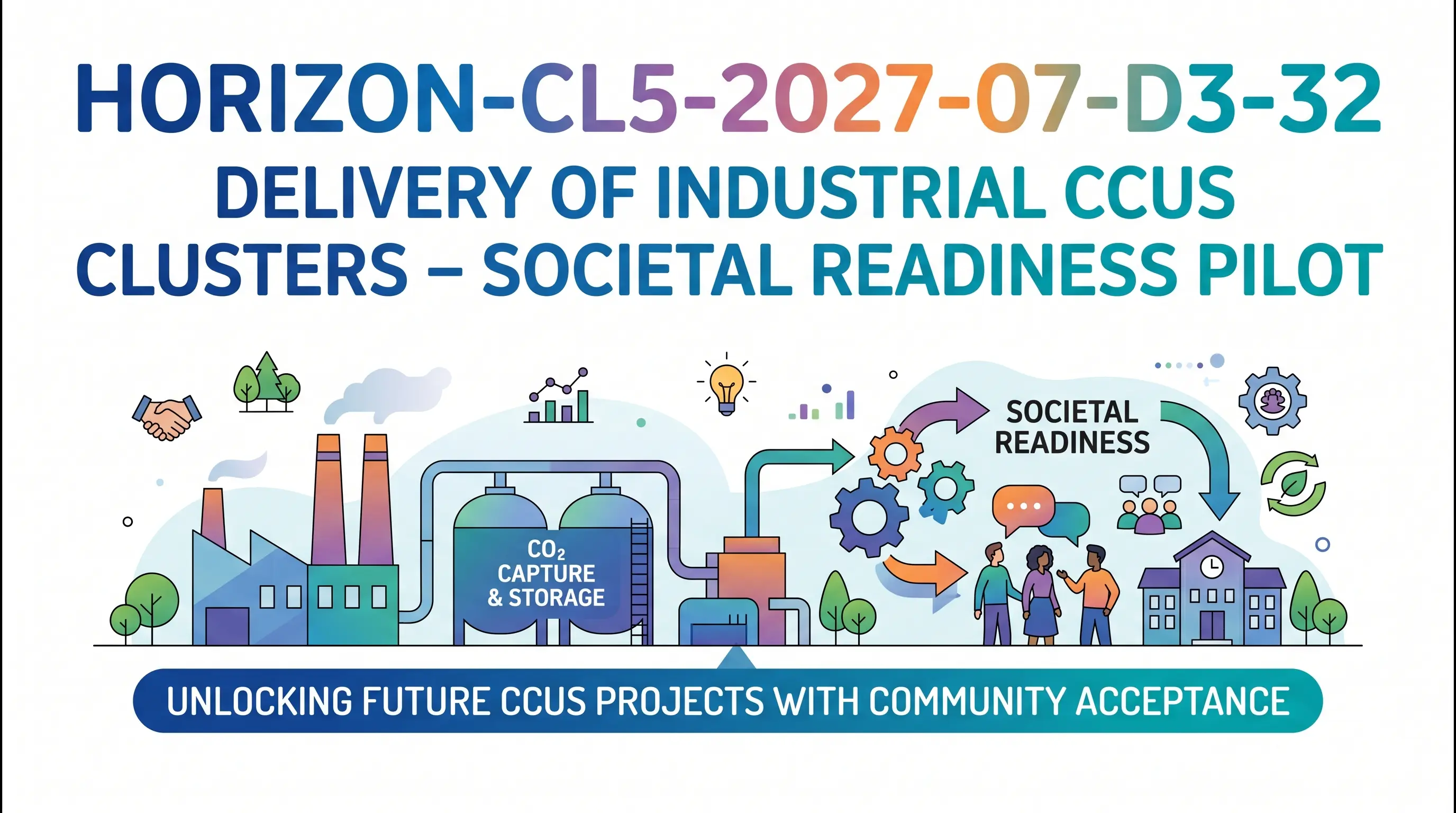
This topic is not about proving that CO₂ capture works. The Commission already accepts that. What they want here is evidence that a cluster of industrial emitters can actually share infrastructure, get local communities on board, and lay the groundwork for full-scale commercial deployment. The “Societal Readiness” in the title is not decoration. It signals that public acceptance is treated as a hard deliverable, not a communication task.
Download the MIC Horizon Europe 2026/2027 Calls Calendar:
Discover more!
Administrative facts: what do we know about the HORIZON-CL5-2027-07-D3-32 call?
Which call is it, and when is the opening and the deadline?
- Call name: ENERGY
- Topic identifier: HORIZON-CL5-2027-07-D3-32
- Destination: D3 – Sustainable, secure and competitive energy supply
- Topic full name: Delivery of industrial CCUS clusters – Societal Readiness pilot
- Opening date: 04 August 2027
- Deadline: 01 December 2027
- Type of action: Innovation Actions (IA)
What about the budget and estimated size of the project?
- Total indicative budget: EUR 30 million
- Number of projects expected: 3
- Budget per project: around EUR 10 million
What are the key eligibility and evaluation conditions?
- Standard eligibility per General Annex B applies.
- Legal entities established in China are not eligible for Innovation Actions under Destination D3.
- Satellite-based earth observation data: Copernicus and/or Galileo/EGNOS must be used if applicable
- TRL target: TRL 6-8 by the end of the project; projects may start at any TRL
Scientific range: what does the Commission expect from the HORIZON-CL5-2027-07-D3-32 grant?
What outcomes are expected?
The Commission wants near-to-market solutions for integrating CCUS safely in energy-intensive industry, a pipeline of scalable follow-on projects, and documented community engagement. A project that works technically but fails to build public trust won’t score well. That third outcome is weighted as seriously as the first two.
What is within scope?
- Local and regional industrial CCUS clusters (multi-source, multi-sink) for hard-to-abate sectors: steel, cement, chemicals, ceramics
- Retrofitting capture systems to existing industrial plants
- Shared CO2 transport and geological storage infrastructure
- Cross-border cluster development, including enlargement countries (Western Balkans, Ukraine, Moldova)
- Integration of CO₂ infrastructure with hydrogen, natural gas and electricity networks
- Deliberative engagement with civil society organisations, NGOs and local communities
What are the specifically proposed research directions?
- Detailed engineering preparation for retrofitting capture systems to existing plants
- Mapping of regional CO₂ emitters and characterisation of clustering potential
- Tools for managing CO₂ streams with variable composition, flow rate and pressure across shared pipelines
- Business models for regional CO2 transport networks, covering dispersed industrial sites
- Multimodal transport assessments and re-use of existing gas infrastructure
- Permitting roadmaps and regulatory preparatory actions leading to licensing
Scientific strategy: how can you enhance your chances of being funded through HORIZON-CL5-2027-07-D3-32?
What scientific choices matter most?
- Make public acceptance a real scientific workstream: Design deliberative activities with a traceable methodology. Evaluators will read this section carefully, and a thin stakeholder plan will lose points.
- Anchor in a real industrial site: The work program says “substantial industrial involvement” directly. A proposal heavy on modelling but light on industrial partners won’t convince.
- Show the path to commercial scale: Include a scalability plan and name prospective follow-on funding routes: InvestEU, Innovation Fund, EU Catalyst Partnership. The Commission is funding the de-risking step, not the full deployment.
- Cross-border cluster potential is implicitly preferred: Include at least one partner from an enlargement country if your geography allows it.
- Handle mixed CO₂ streams explicitly: Industrial emitters don’t produce identical CO₂. Tools for variable composition and flow regimes need to appear in your technical plan (this one catches people off guard).
Consortium & proposal-writing plan: what works best with this type of call?
- Somewhere between 10 and 14 partners, give or take a couple if cross-border coverage demands it.
- An industrial anchor is non-negotiable: a steel plant, cement producer, or chemicals company that actually emits CO₂ in volume.
- Include a pipeline or infrastructure operator for transport credibility.
- Add a social science team for the societal readiness work. A token outreach plan will be spotted immediately.
- A geosciences or energy geology group strengthens the storage feasibility component.
- An innovative SME specializing in capture technology, sensors, or monitoring adds both technical depth and a commercialization narrative the Commission responds to.
- In the proposal text, lead with the deployment problem, not the technology. “Plant X emits Y Mt/year with no viable decarbonization route” lands better than a description of capture solvents.
How would microfluidics contribute to this topic?
Testing CO₂ behavior under realistic industrial conditions is slow and expensive at full scale. Microfluidic platforms compress that process. They replicate pressure, temperature, and fluid composition in miniature and produce consistent results across dozens of scenarios without touching the actual plant.
- Say your cluster links two industrial sources with different capture chemistries and variable CO₂ concentrations entering a shared pipeline. A microfluidic flow cell characterizes that blended stream quickly, cheaply, and with data you can bring directly to the permitting conversation.
- CO₂ absorption kinetics in amine solvents can be studied using segmented flow reactors at the micro-scale—useful for screening solvent performance under the variable flue-gas compositions typical of cement or steel production. Same compound, different source, different result.
- Corrosion at CO₂/water interfaces in pipeline materials is a real concern for shared infrastructure. Microfluidic corrosion cells give your consortium reproducible material compatibility data without building a full test loop.
- Membrane separation of CO₂ from mixed flue gases can be characterized at controlled partial pressures in microfluidic test rigs, well before committing to pilot units.
For a topic where de-risking is literally in the title, the MIC platform fits directly. Your consortium reduces uncertainty in the engineering models early, and that feeds the permitting and stakeholder engagement work with solid numbers rather than estimates.
The MIC already brings its expertise in microfluidics to Horizon Europe:
H2020-NMBP-TR-IND-2020

Microfluidic platform to study the interaction of cancer cells with lymphatic tissue
H2020-LC-GD-2020-3

Toxicology assessment of pharmaceutical products on a placenta-on-chip model

FAQ - HORIZON-CL5-2027-07-D3-32
What is HORIZON-CL5-2027-07-D3-32 actually about?
It underpins the Innovation Actions that demonstrate reported Societal Readiness for industrial CCUS clusters. The Commission is also interested in finding evidence that a group of industrial emitters can share infrastructure, local communities can be taken along, and the preparations can be made to deploy at full scale.
Who should coordinate and who should apply?
Consortia having an industrial emitter (steel, cement, chemicals, or ceramics), a pipeline operator, or an infrastructure operator. There should be considerable industrial participation. At least one innovative SME working on capture technology, sensors, or monitoring strengthens both the engineering depth and the commercialization narrative.
What does “Societal Readiness” actually mean here?
The acceptance of the people is deemed as a hard deliverable and not a communication task. The work program envisions a participative relationship with the civil society organizations, NGOs and local communities. A skinny stakeholder plan will be deducted.
How much funding is available and how many projects?
The indicative budget will be EUR 30 million and is going to cover 3 projects. That equates to about EUR 10 million per project via the Innovation Actions (IA) tool.
Which industrial sectors are in scope?
The problem areas that are hard to abate: steel, cement, chemicals and ceramics. It concerns local and regional industrial clusters of CCUS (multi-source, multi-sink) to the energy-intensive industries.
Are cross-border and enlargement-country clusters encouraged?
Yes. Developed on the basis of cross-border clusters, the names of work programs explicitly contain enlargement countries: Western Balkans, Ukraine, and Moldova. To add at least one of the partners, who is an enlargement country, where possible, in your geography, would be a natural logical step to take.
What TRL is expected at the end of the project?
TRL 6-8 by the project completion. Any TRL can be used to launch projects, but we aim at close to the market maturity of integrating CCUS safely into the energy-intensive industries. Check the Funding and Tenders Portal for more information.
What are the main eligibility restrictions?
General eligibility under General Annex B. Innovation Actions under Destination D3 are not applicable to legal entities set up in China. Where needed, Copernicus and /or Galileo/EGNOS satellite data should be used.
How can microfluidics contribute to a CCUS cluster proposal?
Microfluidic systems re-scale the pressure, temperature and fluid composition to a small scale, and produce reproducible outcomes under dozens of conditions without interacting with the actual plant. That contributes to the kinetics of CO2 absorption, mixed-stream characterization, corrosion at the CO2/water interfaces and membrane separation, preceding commitments to pilot units.
What should the proposal lead with?
It is not the technology, but the deployment issue. Plant X generates Y Mt/year and no plausible decarbonization route is a lot more compelling than an examination of capture solvents. Follow-on funding sources, including InvestEU, the Innovation Fund, and the EU Catalyst Partnership, should be clearly stated in the scalability plan.