
Tips & Tricks for a successful HORIZON-CL5-2027-07-D3-27 proposal
Opening
04 August 2027
Deadline
Keywords
Energy Storage
Infrastructure Retrofitting
Grid Flexibility
Circularity
Decommissioned Sites
Secure-by-Design
BRIDGE Initiative
Your microfluidic SME partner for Horizon Europe
We take care of microfluidic engineering, work on valorization and optimize the proposal with you
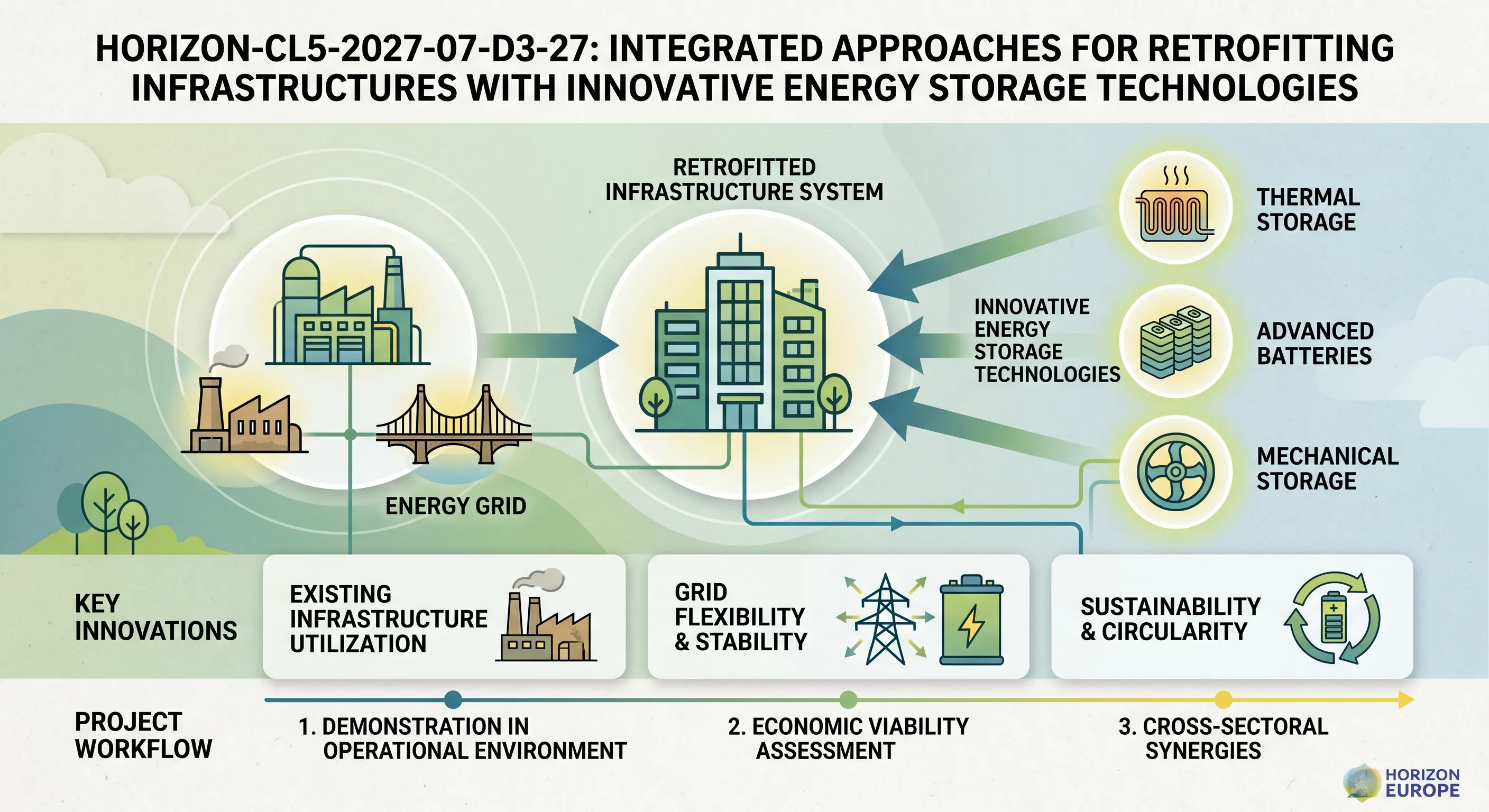
HORIZON-CL5-2027-07-D3-27: Integrated Approaches for Retrofitting Infrastructures with Innovative Energy Storage Technologies
Europe holds a lot of obsolete infrastructure. Old hydropower basins, decommissioned power plants, coal mines, and retired fossil fuel sites. The Commission wants to turn these into working energy storage assets. The point is to prove reuse is scalable, circular, good for the grid, and accepted locally.
Download the MIC Horizon Europe 2026/2027 Calls Calendar:
Discover more!
Administrative facts: what do we know about the HORIZON-CL5-2027-07-D3-27 call?
Which call is it, and when is the opening and the deadline?
- Call name: ENERGY
- Call identifier: HORIZON-CL5-2027-07
- Destination: D3, Sustainable, secure and competitive energy supply
- Topic: HORIZON-CL5-2027-07-D3-27
- Opening date: 04 August 2027
- Deadline: 01 December 2027
- Type of action: Innovation Action (IA)
What about the budget and estimated size of the project?
- Overall indicative budget for the topic: EUR 22.50 million
- Expected number of funded projects: 3
- Expected EU contribution per project: around EUR 7.50 million
- Funding model: lump sum grant
What are the key eligibility and evaluation conditions?
- Standard Horizon Europe eligibility conditions apply (General Annex B).
- If satellite-based earth observation, positioning, navigation or timing services are used, beneficiaries must use Copernicus and/or Galileo/EGNOS. Other data sources may be used in addition.
- TRL target: activities are expected to reach TRL 6 to 8 by the end of the project. Starting TRL is open.
- Selected projects must contribute to the BRIDGE initiative and actively participate in its activities.
- Evaluation thresholds and award criteria follow the standard Horizon Europe rules (General Annexes C and D).
Scientific range: what does the Commission expect from the HORIZON-CL5-2027-07-D3-27 grant?
What outcomes are expected?
By the end, the Commission wants evidence that old infrastructure can store energy cheaply. Flexible new capacity that shores up energy security. Storage that stays circular. Proof that retrofitting beats greenfield on cost. Publication series are not what they’re after. Show the tech works, then prove reuse pays off.
What is within scope?
- New or improved storage technologies built into retrofitted obsolete infrastructure, not greenfield builds.
- Sites such as old hydropower dams and basins, decommissioned power plants, former industrial facilities, coal mines, and fossil fuel infrastructure.
- Storage that contributes to grid flexibility.
- Circularity and end-of-life handling of storage materials and components.
- Socioeconomic and environmental sustainability of the retrofit via stakeholder outreach and impact checks.
- Secure-by-design, with built-in security in the energy systems.
This is an innovation action. Pure modeling or simulation sits outside the scope.
What are the specifically proposed research directions?
- Match the storage tech to the host site’s structural limits (the real puzzle: fitting new storage into a place built for something else)
- Optimize capacity and round-trip efficiency within the host’s physical constraints.
- Build circularity into the storage components, not only the host site.
- Assess and reduce the retrofit’s environmental impact, named directly in the call.
- Develop a community engagement model fitted to repurposed sites (consortia obsess over the tech and forget the social license).
Scientific strategy: how can you enhance your chances of being funded through HORIZON-CL5-2027-07-D3-27?
What scientific choices matter most?
- Pick real sites: The better your access to real-life decommissioned infrastructure to be demonstrated, the better your chances. Evaluators will seek site commitments and not letters of interest that are not specific.
- Demonstrate the financial argument at an early stage: Propose it based on cost savings over greenfield, not on technological novelties, per se.
- Circularity is not to be added: Add storage component lifecycle analysis and infrastructure conversion lifecycle analysis.
- Incorporate cybersecurity into the design: The work program refers to secure-by-design directly, and evaluators will check on it.
- Conquer the problem of community acceptance: The fact that the proposals have a real stakeholder engagement plan with the identified local actors is likely to result in a higher score on impact. Do not take this as an afterthought dissemination.
- The participation in BRIDGE is obligatory: Allocate time and money towards it.
- The TRL scale is wide (you can start anywhere; there 6 to 8), which means that you are flexible. However, since this is an IA, proposals with most of their proposals below TRL 5 on project start will likely appear feeble.
Consortium and proposal-writing plan: what works best with this type of call?
- Aim for somewhere between eight and twelve partners, a couple more if your sites span several countries. Only three projects get funded, so quality must be high.
- One infrastructure owner or operator is non-negotiable. No site host, no credibility.
- Bring a storage technology provider, ideally an innovative SME with a near-market product. It adds TRL credibility and industrial relevance.
- Academic partners for life cycle assessment, environmental modeling, and grid integration. Two or three, no more.
- If your site is a former mine or fossil fuel facility, add remediation or environmental engineering know-how.
- One social science or just-transition partner strengthens the impact section.
- Write the proposal around the demonstration sites first, technology second. IA evaluators want to know where things happen and who runs them after.
- Lump sum grants reward careful upfront budgeting. You can’t fix costing mistakes later.
How would microfluidics contribute to this topic?
Retrofitting old infrastructure for storage means handling materials, corrosion, water chemistry, and monitoring in places never built for it. Standard lab testing is slow, and samples ship off-site. Microfluidic platforms bring the analysis to the site.
- Say you’re turning an old hydropower basin into pumped or compressed-air storage. You want to know what the water is doing all the time, not in a quarterly report. On-site sensors track pH, dissolved metals and contaminants live.
- Corrosion is the quiet problem in repurposed pipes, tanks, and cavities. Microfluidic electrochemical cells catch the early signs before they get expensive.
- For batteries dropped into old industrial sites, microfluidic systems check electrolyte quality and catch breakdown products at tiny concentrations. That backs up your lifetime claims.
- Former mines and fossil sites need groundwater and leachate monitoring for compliance. Portable kits run those tests on the spot, cutting turnaround to hours.
Your proposal has to show the retrofit is monitored and sustainable. Microfluidics gives you the inline, real-time analytical backbone that makes those claims believable.
In your proposal, it must be demonstrated that the retrofitting is monitored and sustainable. Microfluidics provides you the inline real-time analytical backbone, which renders the environmental and the operational claims plausible.
The MIC already brings its expertise in microfluidics to Horizon Europe:
H2020-NMBP-TR-IND-2020

Microfluidic platform to study the interaction of cancer cells with lymphatic tissue
H2020-LC-GD-2020-3

Toxicology assessment of pharmaceutical products on a placenta-on-chip model

FAQ – HORIZON-CL5-2027-07-D3-27
What is the HORIZON-CL5-2027-07-D3-27 call about?
The HORIZON-CL5-2027-07-D3-27 aims to demonstrate the use of innovative energy storage technologies in retrofitted abandoned or out-of-date infrastructure (old hydropower dams, decommissioned power plants, coal mines, and fossil fuel sites). It is aimed at demonstrating that it is technically and economically viable to reuse existing infrastructure to store energy, and that it would help to make a grid flexible and circular.
When does the HORIZON-CL5-2027-07-D3-27 call open and close?
The call opens on 04 August 2027 and closes 01 December 2027. It is a one phase call with HORIZON-CL5-2027-07 identifier, Destination D3 (Sustainable, secure and competitive energy supply).
What is the budget for HORIZON-CL5-2027-07-D3-27?
The indicative budget amounts to EUR 22.50 million in total and around EUR 7.50 million per project is expected to be contributed by the EU. The Commission envisions to finance 3 projects. Funding is based on lump sum model.
What types of infrastructure can be retrofitted under this topic?
The work program specifically refers to old hydropower dams and basins, closed thermal power plants, old industrial facilities, coal mines, and fossil fuel infrastructure. Other similar disused assets can also be used. The main requirement is that the infrastructure should be obsolete or old enough and appropriate for converting it into an energy storage facility.
What TRL level is expected at the end of the project?
By the project, activities will be at TRL 6 to 8. TRL is open, i.e. you can start at whatever level of readiness you want. But, because this is an innovation action, suggestions with an initial TRL of mostly less than TRL 5 can seem feeble to reviewers. Check the Funding and Tenders Portal for more information.
Is participation in the BRIDGE initiative mandatory?
Yes. The chosen projects will become part of the BRIDGE initiative and be actively involved in its work. This is an engagement that you ought to budget in your proposal. The BRIDGE portal on smart grid, storage and digital projects has more information.
What cybersecurity requirements apply to this call?
Proposals should take a secure-by-design approach and embed security in the energy systems. This is a requirement explicitly defined in the work program, and, therefore, evaluators will ensure your proposal includes cybersecurity considerations at the design level, not as a post-design consideration.
What role can microfluidics play in an energy storage retrofitting project?
Microfluidic systems introduce real-time on-site analysis to existing retrofitted infrastructure. They may be used to test water quality of repurposed hydropower basins, identify early signs of corrosion in pipes and underground features, characterize electrolyte quality in battery storage systems, and do environmental compliance testing (groundwater, soil leachates) at former mining or fossil fuel locations. This inline monitoring enhances environmental and operational credibility of your proposal.
What type of consortium is best suited for this Innovation Action?
It is recommended that there be 8 to 12 partners as a consortium. Partners required include at least one infrastructure owner or operator (preferably an innovative SME), academic partners to assess the lifecycle and integrate into the grid, and a partner with social science or community engagement expertise. In case the demonstration location is mining or fossil fuel history, a remediation specialist can be of great use.
Does the lump sum funding model affect proposal preparation?
Yes, significantly. In the lump sum funding, the cost estimation should be precise initially since once the grant agreement is signed the costs cannot be revised. Precede to plan your work packages and partner budgets. The lump sum method makes the reporting of the finances easier in the course of the project yet demands strict preparations in the proposal phase.