
Tips & Tricks for a successful HORIZON-CL5-2027-07-D3-16 proposal
Opening
04 August 2027
Deadline
Keywords
tandem PV
EUPI-PV Partnership
Innovation Action
D3 energy supply
manufacturing readiness
TRL 6-7
pilot lines
Your microfluidic SME partner for Horizon Europe
We take care of microfluidic engineering, work on valorization and optimize the proposal with you
HORIZON-CL5-2027-07-D3-16: Industrial processes and equipment for innovative, reliable, and scalable tandem technologies (EUPI-PV Partnership)
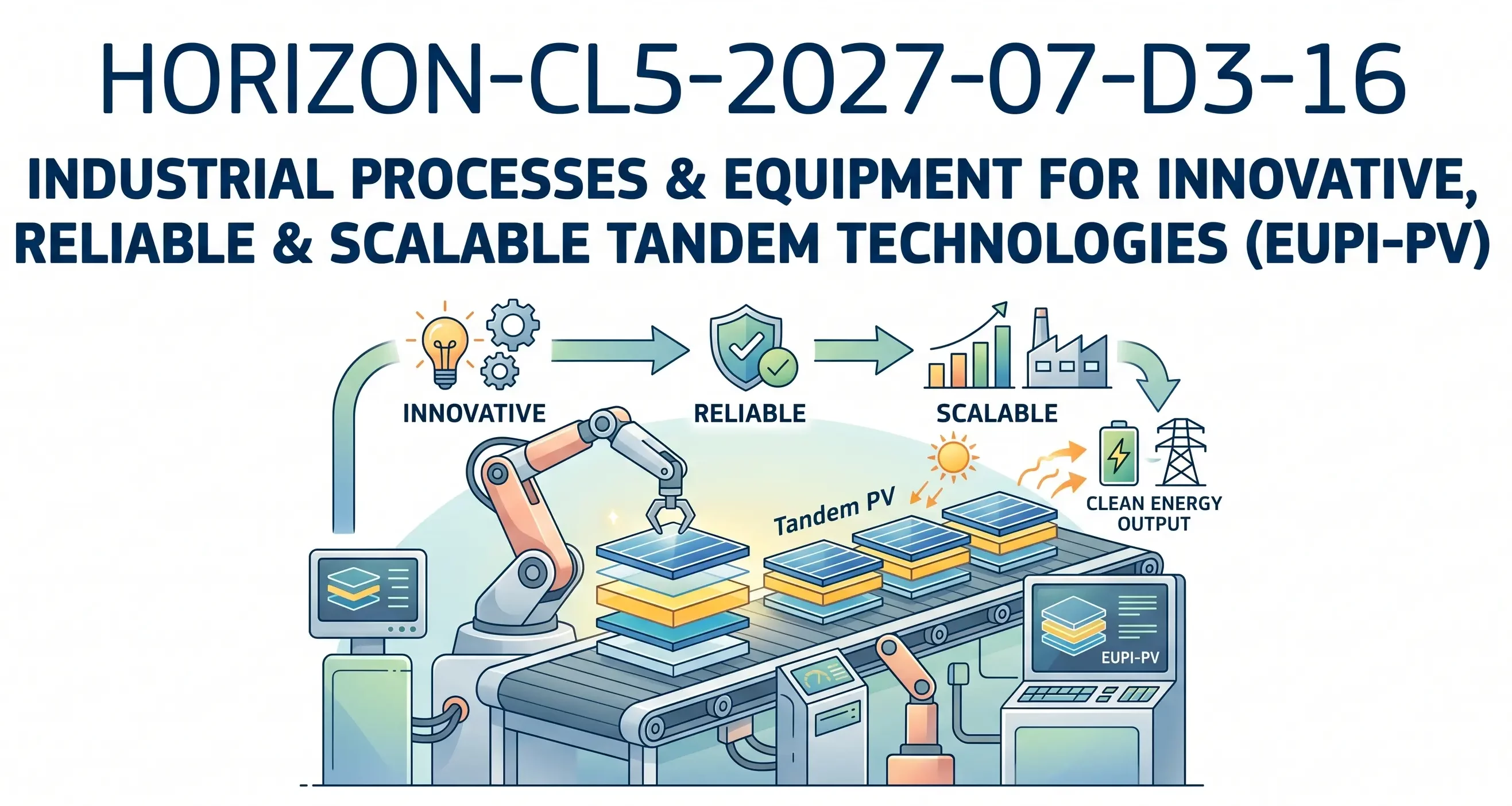
The Commission wants tandem solar cells out of the lab and into factories. This topic is squarely about manufacturing readiness: proving that next-generation tandem PV can be produced at scale with the efficiency, lifetime, and reliability the market actually requires. It sits inside the EUPI-PV co-programmed partnership, which means your results will feed into a shared monitoring framework. The business case isn’t optional here.
Download the MIC Horizon Europe 2026/2027 Calls Calendar:
Discover more!
Administrative facts: what do we know about the HORIZON-CL5-2027-07-D3-16 call?
Which call is it, and when are the opening and the deadline?
- Call name: ENERGY
- Call identifier: HORIZON-CL5-2027-07
- Destination: D3 – Sustainable, secure and competitive energy supply
- Topic: HORIZON-CL5-2027-07-D3-16
- Opening date: 04 August 2027
- Deadline: 01 December 2027
- Type of action: Innovation Action (IA)
What about the budget and estimated size of the project?
- Overall indicative budget for this topic: EUR 28.50 million
- Number of projects expected: 3
- Budget per project: around EUR 9.50 million
What are the key eligibility and evaluation conditions?
- Standard eligibility per General Annex B
- TRL 6-7 expected by the end of the project; may start at any TRL
- Proposals must include a strong business case, exploitation strategy, and preliminary plans for scalability and commercialization.
- Potential funding sources for post-project scale-up must be identified, including the Innovation Fund.
- Special provision: the granting authority may object to the transfer of ownership or exclusive licensing of results up to 4 years after the project end (Annex 5)
- Projects must report to the EUPI-PV Partnership on KPI monitoring.
- No JRC or clustering conditions noted for this topic
Scientific range: what does the Commission expect from the HORIZON-CL5-2027-07-D3-16 grant?
What outcomes are expected?
The Commission is after demonstrated manufacturing readiness for tandem PV, not a new record efficiency on a lab-scale cell. By the end of the project, there should be functional production processes and equipment at a scale that European manufacturers could realistically adopt. The goal is to build competitive know-how that feeds the EU Solar PV Industry Alliance and the broader solar joint research agenda.
What is within scope?
- Tandem solar cell and module technologies with efficiencies exceeding silicon limits
- Lifetime and degradation performance at least matching commercial silicon reference technologies
- Interface engineering and thin-film processing at large scale
- Production equipment and pilot lines, including digitised and automated processing
- Commercialisation planning and business models linked to scale-up
What are the specifically proposed research directions?
The work program names three concrete demonstration targets. They’re fairly precise for an innovation action:
- Tandem technologies demonstrating silicon-comparable lifetimes and higher efficiencies
- Large-scale interface and thin-film engineering
- Production processes and equipment genuinely ready for industrial deployment (this one is the hardest, and probably the one evaluators will push on)
The wording doesn’t say which tandem architecture, which gives teams room to argue for perovskite/silicon, III-V/silicon, or others. That framing flexibility is an advantage if you use it consciously.
Scientific strategy: how can you enhance your chances of being funded through HORIZON-CL5-2027-07-D3-16?
What scientific choices matter most?
- Anchor the narrative on industrialization, not performance records: Evaluators know 30%+ efficiencies on small cells exist. Show the process chain that can produce them consistently at a multi-MW scale.
- Make reliability central, not secondary: Tandem technologies have a credibility problem with lifetime data. If your consortium can show accelerated aging protocols and results comparable to certified silicon modules, that’s worth more than another efficiency figure.
- Demonstrate interface engineering maturity at scale: The thin-film, multi-junction interface is where most industrial tandem lines fail. Concrete data on defect density and process window at meaningful substrate sizes will be noticed.
- Quantify the automation and digitization layer: The Commission mentions it explicitly. Don’t treat it as a paragraph in WP5; make it a deliverable with KPIs.
- Prepare a plausible route to the Innovation Fund: The work program flags it as a post-project funding pathway. Evaluators will look for whether your team has actually thought this through or just mentioned it.
- TRL 6-7 targets mean you need a demonstrator, not a prototype: Be honest about where you start.
Consortium & proposal-writing plan: what works best with this type of call?
Aim for somewhere between eight and twelve partners, maybe a couple more if you need to cover multiple tandem architectures.
- One or two research institutes or universities for the materials and device physics depth, but keep them genuinely focused on process translation, not fundamental research
- At least one equipment manufacturer — this is probably the most undervalued partnership type for this topic; the Commission is explicitly asking for equipment readiness
- A PV module manufacturer or industrial pilot line operator for realistic scale-up data
- An innovative SME working on specialised deposition, coating, or metrology tools (worth including; their agility often compensates for larger partners’ inertia)
- If you’re building toward multiple tandem technologies, geographic spread matters for EUPI-PV KPI alignment
On writing: don’t open the scientific section with a paragraph on why tandem PV is promising. The evaluators know. Start with the manufacturing bottleneck your consortium addresses.
How would microfluidics contribute to this topic?
Tandem PV manufacturing looks like a thin-film problem from a distance. Get closer, and you see it’s also a fluid dynamics problem. Precursor delivery, surface treatment, and encapsulant deposition all depend on how liquids behave at very small scales and under precisely controlled conditions. That’s where microfluidics comes in.
- Perovskite layer deposition is inherently a wet process. Conventional slot-die and blade coating tools work, but they struggle with uniformity at large substrate sizes. Microfluidic dispensing heads can control flow rate and concentration with a precision that standard coating equipment doesn’t offer, especially for the ultra-thin layers tandem architectures require.
- Say your consortium wants to optimize the buffer layer between the silicon bottom cell and the perovskite top cell. That’s a nanometer-scale interface where chemistry, uniformity, and defect density all interact. A microfluidic reactor lets you screen dozens of precursor compositions in hours, not weeks. You get faster iteration without burning expensive substrate area.
- Your consortium could also use microfluidic encapsulation platforms to test moisture barrier performance under controlled humidity gradients, much faster than conventional damp-heat aging chambers. Consistent results matter here, and that’s exactly what a well-designed microfluidic test bench delivers.
- Inline quality control is another angle. Microfluidic sensors integrated into a pilot line can monitor electrolyte or precursor concentration in real time, flagging process drift before it shows up as cell performance degradation.
Microfluidics doesn’t replace the deposition equipment in a tandem PV line. But it compresses the development cycle for the process steps that most often block industrialization. For a consortium trying to hit TRL 6-7 within the project timeline, that kind of acceleration is not just useful. It’s the difference between a credible demonstration and a delayed one. The Microfluidics Innovation Center has experience supporting exactly these kinds of precision process challenges in photovoltaic and thin-film manufacturing contexts.
The MIC already brings its expertise in microfluidics to Horizon Europe:
H2020-NMBP-TR-IND-2020

Microfluidic platform to study the interaction of cancer cells with lymphatic tissue
H2020-LC-GD-2020-3

Toxicology assessment of pharmaceutical products on a placenta-on-chip model

About the author

Céleste Chidiac, PhD
Scientific writer and digital marketing specialist
Céleste Chidiac holds a doctorate in neuroscience and molecular biology from the University of Strasbourg. Since joining the Microfluidics Innovation Center in 2023, she has combined scientific writing with website management. For MIC’s Horizon Europe topic pages, she draws on her research background to explain scientific challenges and clarify funding priorities. Her writing helps prospective applicants understand each topic’s scope, expected outcomes and research directions.
FAQ – HORIZON-CL5-2027-07-D3-16
What is the HORIZON-CL5-2027-07-D3-16 call about?
The Commission desires tandem solar cells to leave the laboratory and be taken to the factories. This is a subject matter directly on the manufacturing readiness: demonstrating that next-generation tandem PV can be manufactured in large quantities with the efficiency, lifetime, and reliability that the market actually needs. It will be embedded within the EUPI-PV co-programmed Partnership so that your findings will be incorporated into a common monitoring platform. The business case is not a choice in this case.
Which call is it, and when are the opening and the deadline?
- Call name: ENERGY
- Call identifier: HORIZON-CL5-2027-07
- Destination: D3 – Sustainable, secure and competitive energy supply
- Topic: HORIZON-CL5-2027-07-D3-16
- Opening date: 04 August 2027
- Deadline: 01 December 2027
- Type of action: Innovation Action (IA)
What about the budget and estimated size of the project?
- Overall indicative budget for this topic: EUR 28.50 million
- Number of projects expected: 3
- Budget per project: around EUR 9.50 million
What are the key eligibility and evaluation conditions?
- Standard eligibility per General Annex B
- TRL 6-7 expected by the end of the project; may start at any TRL
- Proposals must include a strong business case, exploitation strategy, and preliminary plans for scalability and commercialization.
- Potential funding sources for post-project scale-up must be identified, including the Innovation Fund.
- Special provision: the granting authority may object to the transfer of ownership or exclusive licensing of results up to 4 years after the project end (Annex 5)
- Projects must report to the EUPI-PV Partnership on KPI monitoring.
- No JRC or clustering conditions noted for this topic
What outcomes are expected?
The Commission is seeking proven manufacturing readiness for tandem PV, rather than a new record efficiency on a lab cell. At the completion of the project, they should have functional production processes and equipment at a scale that could be adopted by the European manufacturers. This is aimed at building competitive know-how that supports the EU Solar PV Industry Alliance and the solar joint research agenda more broadly.
What is within scope?
- Tandem solar cell and module technologies that have efficiencies that are even above silicon.
- Lifetime and degradation at least as good as commercial silicon reference technologies.
- Large-scale interface engineering and thin-film processing.
- Pilot lines and production equipment, digitized and automated production equipment.
- Business models and commercialization planning associated with scale- up.
What are the specifically proposed research directions?
Three tangible demonstration targets are given in the work program. They are quite specific enough on an Innovation Action:
- Tandem technologies with silicon-like lifetimes and better efficiencies.
- Large-scale interface and thin-film engineering.
- The production processes and equipment that are real, ready to be used in the industry (it is the most difficult, and most likely the one the evaluators will stress)
The language does not specify which tandem structure, leaving groups free to pursue perovskite/silicon, III-V/silicon, or other configurations. It is good that framing is flexible when applied on purpose.
What scientific choices matter most?
- Basing the story on industrialization as opposed to performance records. Evaluators are aware that there are 30% or more efficiency gains with small cells. Demonstrate the process chain that can generate them reliably at a scale of multi-MW.
- Keep reliability as the main consideration, not the secondary one. Tandem technologies have a lifetime data problem in terms of credibility. And when your consortium is capable of demonstrating accelerated aging protocols and equivalent results as those of certified silicon modules, that is worth other than another efficiency figure.
- Board-level interface engineering. The multi-junction interface is thin-film and this is where the majority of industrial tandem lines fail. Meaningful substrate-size-specific data on defect density and the process window will be observed.
- Measure the automation and digitization level. It is specifically mentioned by the Commission. Do not treat it as a paragraph in WP5; treat it as a deliverable with KPIs.
- Work out a realistic path to the Innovation Fund. It is a post-project funding pathway flagged in the work program. Evaluators will scrutinize whether or not your team has actually thought this through or has mentioned it.
- TRL 6-7 target implies the need for a demonstrator, not a prototype. Be frank about where you begin.
What works best for the consortium and proposal writing?
- Get between 8 and 12 partners, perhaps two or three more to the degree that you are dealing with multiple tandem architectures.
- One or two research institutes or universities for the materials and device physics depth, but keep them focused on process translation, not fundamental research
- One of the equipment manufacturers at minimum – this is likely the most underestimated type of partnership to this subject; the Commission is specifically requesting equipment preparedness.
- A PV module manufacturer or an industrial pilot-scale up operator to provide real-scale-up data.
- A new SME that is specialized in deposition, coating or metrology tools (worth including; their agility can usually offset the inertia of larger partners)
- In the case of a multi-tandem technology development, geographic dispersion is important to EUPI-PV KPI correspondence.
- On writing: do not start the scientific part by writing a paragraph about why tandem PV is a promising concept. The evaluators know. Begin with the manufacturing bottleneck that your consortium is dealing with.
How would microfluidics contribute to this topic?
Tandem PV production resembles thin-film in appearance. Come up to it, and it is a fluid dynamics problem as well. The behavior of liquids at very small scales as well as in highly controlled conditions, is important to precursor delivery, surface treatment, and encapsulant deposition. And this is where microfluidics comes in.
The deposition of the perovskite layer is a wet process. The traditional slot-die and blade coating instruments are effective, though they struggle with uniformity at large substrate sizes. Microfluidic dispensing heads can regulate flow rate and concentration to a precision never achieved by standard coating equipment, particularly for the very thin layers tandem architectures demand.
Microfluidics does not displace the deposition equipment of a tandem PV line. It, however, shortens the development cycle of the process steps that most frequently cripple industrialization. That sort of acceleration is not just handy for a consortium attempting to reach TRL 6-7 in the project schedule. It is the distinction between a believable show and a timely one.