
Tips & Tricks for a successful HORIZON-CL5-2027-03-D5-18 proposal
Opening
15 December 2026
Deadline
Keywords
ZEWT Partnership
battery durability
electric vessels
fast charging
maritime batteries
degradation modes
full-scale demonstration
sustainable mobility
Your microfluidic SME partner for Horizon Europe
We take care of microfluidic engineering, work on valorization and optimize the proposal with you
HORIZON-CL5-2027-03-D5-18: Enhanced electric operation and battery durability (ZEWT Partnership)
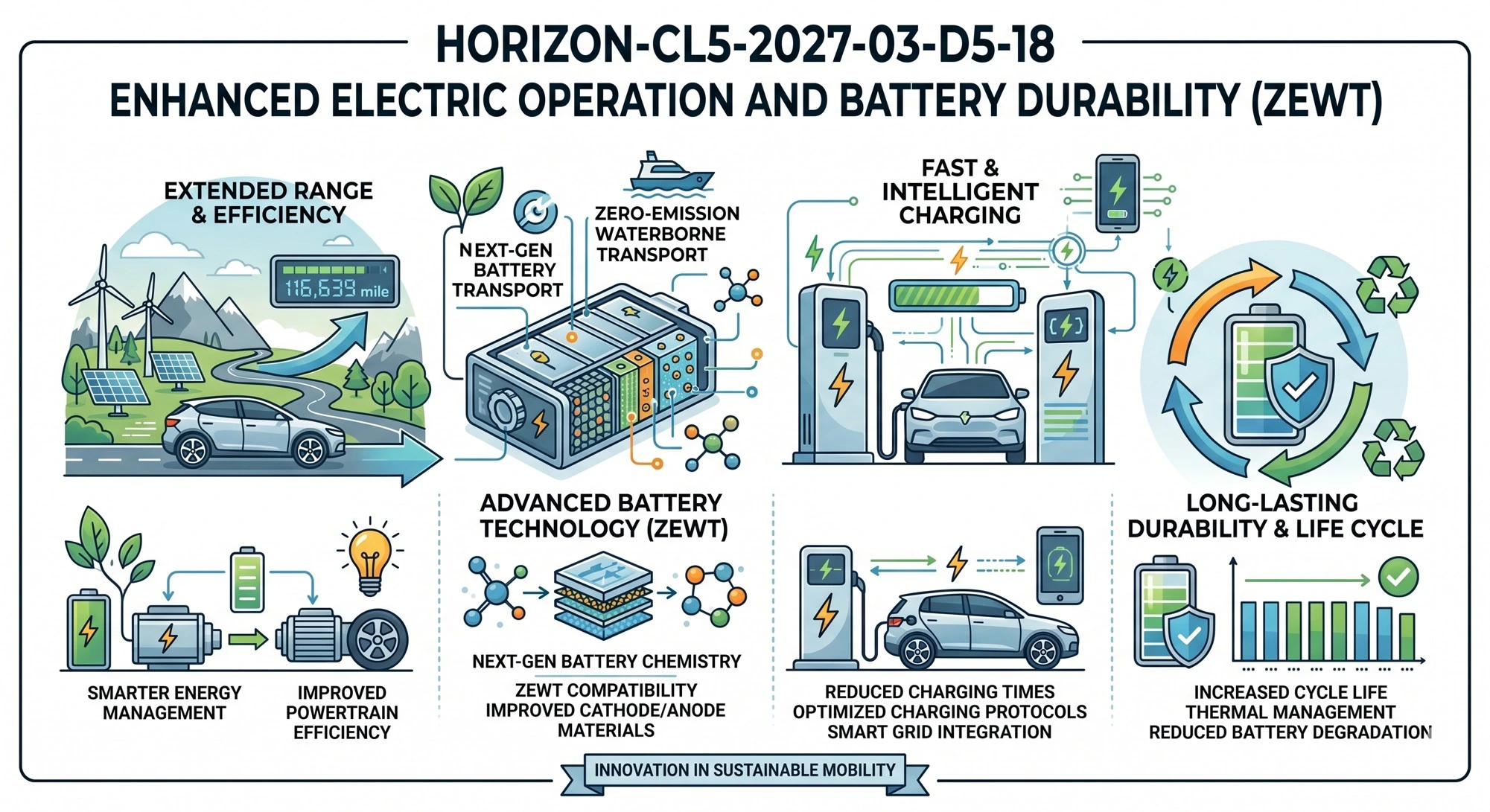
Battery-powered ships face particular issues that electric vehicles do not, including long-distance, saltwater, quick-docking, and enormous power consumption. Another incremental improvement to the existing commercial batteries is not what the Commission is seeking. It desires, what it wants, full-scale, manifested solutions that will extend the electric vessels’ range to at least 150 nautical miles and withstand the charging strains that accompany that desire. This subject is located within the ZEWT co-programmed Partnership, thus findings are incorporated into a wider European zero-emission waterborne transport surveillance system.
Download the MIC Horizon Europe 2026/2027 Calls Calendar:
Discover more!
Administrative facts: what do we know about the HORIZON-CL5-2027-03-D5-18 call?
Which call is it, and when is the opening and the deadline?
- Call name: MOBILITY
- Call identifier: HORIZON-CL5-2027-03
- Destination: D5 – Clean and competitive solutions for all transport modes
- Topic identifier: HORIZON-CL5-2027-03-D5-18
- Opening date: 15 December 2026
- Deadline: 14 April 2027
- Type of action: Innovation Actions (IA)
What about the budget and estimated size of the project?
- Total indicative topic budget: EUR 20.00 million
- Expected number of projects: 2
- Estimated EU contribution per project: around EUR 10.00 million
What are the key eligibility and evaluation conditions?
- Standard eligibility: General Annex B applies
- Satellite data exception: if satellite-based earth observation or positioning services are used, beneficiaries must use Copernicus and/or Galileo/EGNOS
- TRL target: TRL 8 by the end of the project; activities may start at any TRL
- IP transfer restriction: the granting authority may object to ownership transfer or exclusive licensing of results for up to 4 years after project end
- ZEWT reporting: projects must report results to the ZEWT Partnership for KPI monitoring
- No China restriction explicitly named for this topic (check the portal to confirm)
Scientific range: what does the Commission expect from the HORIZON-CL5-2027-03-D5-18 grant?
What outcomes are expected?
By the end of the project, you must have proven that a fully electric vessel can travel a range of 150 nm or 277.8 km over inland waterways with only the electric storage, which can be charged within a short period of time, and the range without any emissions. Besides that, the battery systems must be capable of enduring the increased cycling stress of the high-power charging, and they must be able to operate safely in the maritime environments which are just not what battery engineers are normally designing. The Commission also desires transparent business cases and replication roadmap, and not a demo once.
What is within scope?
- Short sea shipping, ferries, offshore vessels (400-6500 GT) and inland river vessels (86-135 metres).
- Battery architecture optimization: Chemistry, monitoring, management, and energy modelling.
- Vessel-wide electrical design, such as AC-DC grid, thermal design, and high-voltage design.
- Rapid and on-the-road charging, charging offshore, replaceable battery designs.
- Designing and retrofitting of vessels that are modular and replicate technology.
- Life cycle assessment that was incorporated throughout the design life and end-of-life.
- Safety evaluation based on EMSA and CESNI inland standards.
- Crew and port operator training and training.
Explicit signals are out of scope: here the call is not concerned with hydrogen or other fuels propulsion, and basic scaling of the existing commercial off-the-shelf battery packs is likely to fall short with assessors.
What are the specifically proposed research directions?
- Increasing the range of autonomy beyond the existing commercial batteries, and showing in actual operating conditions.
- Maximum propulsion power over 5 MW of ships where the safety of operation requires it.
- Smart battery management systems which prolong the cycle life in high-power charge up.
- Adaptive energy control of battery, propulsion and hotel loads in real-time.
- In-route replenishment systems based on rapid zero-emission which are applicable in the vessels with short docking windows.
- Fire safety solutions for battery rooms and regulatory recommendations extending EMSA/CESNI frameworks to novel installations
- One complete retrofit exercise and a number of replications in similar types of vessels.
Scientific strategy: how can you enhance your chances of being funded through HORIZON-CL5-2027-03-D5-18?
What scientific choices matter most?
- Test at full scale, not in the laboratory. The Commission expressly states that it is full scale demonstration. TRL 8 target does not allow the proposal of prototypes only.
- Develop your battery management system based on maritime specific degradation modes. Salt spray, vibration, changing humidity: such failure modes are no longer the same as in road vehicles. Evaluators will become aware whether or not your BMS is merely an automotive system with a coat of paint.
- Display the 150 nm range, but do not give it too much space at the expense of lifecycle story. Each cycle, we receive proposals that also met the technical target and then underinvest in end-of-life and circularity. The work programme is made clear regarding lifecycle by design.
- Regulatory contribution matters. Offering specific recommendations to improve EMSA or CESNI guidelines is not an option: it is among the products that the Commission will demand. Include it as part of your work packages.
- Cybersecurity: Monitoring and optimization data. It is mentioned in parallel ZEWT topics and it is assessed by evaluators.
- The FitFor55 framing (FuelEU Maritime, AFIR, Naiades III, RED) must be there in your impact section.
Consortium & proposal-writing plan: what works best with this type of call?
- Have between 10 and 14 partners, perhaps a few more should offshore operations or inland waterways need to be covered separately.
- You have to have a shipyard or vessel operator. In the absence of one, there is no home of the full-scale demonstration requirement. This is the gap that is most widespread in the waterborne proposals.
- The core technical profile is made up of the naval architects and marine electrical engineers. Battery chemists come in handy, although they need to know the specifics of maritime operation.
- Have a port operator or a charging infrastructure provider. The vessel-port interface is directly scoped.
- The presence of an innovative SME that develops battery management technology or fast charging technology makes the consortium more competitive and lends the commercialisation story some truth.
- In case you are able to include a training or vocational education body, the crew skills requirement is an organically evolved work package, and not a bolt-on.
- On proposal writing: do not start with the technology but with the barrier of deployment. Evaluators say “existing electric ferries can not run this route profitably due to battery range limitations before you get to the next port stop” than they do to a description of your BMS architecture.
- The roadmap of replication should be particular. Type of name vessels, routes, approximate fleet size. One of the surest methods of losing points in impact scoring is the use of vague language which is scalability potential.
How would microfluidics contribute to this topic?
Marine batteries perform poorly and this cannot be easily caught before something goes bad. The electrolyte deteriorates, gas accumulation occurs, there is uneven distribution of heat in large cells. The conventional monitoring is not fast enough to monitor what is actually going on in the cell when it is being charged at a fast rate. Microfluidics comes in at that point. In real time, small-scale flow control and electrochemical sensing will provide you with access to the inside of the cell.
- You are interested in knowing why large-format marine battery decays more rapidly after 200 high-current cycles than lab tests suggest. Microfluidic electrochemical cells allow you to recapitulate those cycles at the controlled conditions and observe what happens at the electrode level, first-hand. You get cause and effect not only correlation.
- Thermal control has been an ongoing issue with high power maritime batteries. By incorporating microfluidic cooling channels in battery modules, it is possible to remove heat with very high precision at extremely low parasitic energy cost. Your consortium would be in a position to show better temperature homogeneity among large battery packs.
- Gas sensing in sealed battery compartments: microfluidic gas-phase sensors are able to detect early signs of electrolyte decompositions before reaching a hazardous level. This will be the direct input for the fire safety deliverable the Commission needs.
- To make the regulatory contribution to the EMSA guidelines, microfluidic diagnostic data gives the type of granular, uniform evidence that regulatory organizations require. It may not seem immediately apparent, but we would say that it is one of the less polluted means of making the safety work package stand out.
In the case of a consortium developing a proposal based on HORIZON-CL5-2027-03-D5-18, microfluidics is not the focus. However, it provides your battery testing, thermal management, and safety monitoring work packages with a technical advantage that is not found in standard approaches. The skills that MIC has in the field of electrochemical microfluidics and on-chip sensing can be readily applied to the maritime battery application.
The MIC already brings its expertise in microfluidics to Horizon Europe:
H2020-NMBP-TR-IND-2020

Microfluidic platform to study the interaction of cancer cells with lymphatic tissue
H2020-LC-GD-2020-3

Toxicology assessment of pharmaceutical products on a placenta-on-chip model

About the author

Julia Sepulveda Diaz, PhD
Chief Executive Officer, Microfluidics Innovation Center
Julia holds a PhD in glycobiology and neurobiology from Université Paris-Est Créteil. Before moving into microfluidics, she spent several years as a postdoctoral researcher at the Paris Brain Institute, on Parkinson’s disease, neuroinflammation, and the role of heparan sulfate in protein aggregation. Today she leads the Microfluidics Innovation Center as CEO, steering its researchers and engineers and its collaborative research and innovation projects.
FAQ – HORIZON-CL5-2027-03-D5-18
What is HORIZON-CL5-2027-03-D5-18 really about?
It is an Innovation Action in the ZEWT Partnership to demonstrate that fully battery-electric ships can operate on real maritime and inland waterway routes. The Commission desires a full size demonstration, not another prototype that remains at the dock. The four pillars are range, fast charging, lifetime under cycling stress and safety in salt-spray environments.
How much money is on the table and how many projects?
The topic budget is EUR 20.00 million, divided into 2 anticipated projects. An average of EUR 10.00 million per project. That would be a realistic number of consortium members, eight to twelve, perhaps a few more in case you have to do each maritime and inland scope independently.
When does the call open and close?
Opening: 15 December 2026. Deadline: 14 April 2027. Approximately four months to write. Snug, yet manageable, should your consortium not be half-developed by the time opening day arrives.
What range and TRL must we hit by project end?
By the completion of the project, the target is TRL 8, and it should be demonstrated that the electric storage alone have a range of at least 150 nautical miles. The activities may begin at any TRL level, although the proposal’s deliverables section must demonstrate a plausible path to a full-size, functioning vessel by the final reporting period. Check the Funding and Tenders Portal for more information.
Which vessel types are in scope?
Short sea shipping, ferries, offshore vessels up to 400-6500 GT, and inland river vessels up to 86 to 135 meters. When one of your consortia chooses a segment, you should still have a story about a nearby segment. Reviewers like to observe the technology in motion.
Is hydrogen propulsion eligible under this topic?
No. This subject is battery-only electric. Alternative fuels, such as hydrogen, are explicitly out of scope and are discussed in parallel with ZEWT topics. It would be wrong to install a fuel cell in your propulsion system.
What does the ZEWT Partnership reporting imply?
Projects must report to the ZEWT Partnership to monitor KPIs. Practically, that means your data contributing to a Europe-wide dashboard on zero-emission waterborne transport. Schedule a special work package activity on this, and estimate the time. Coordinators sometimes forget.
Who absolutely must sit in the consortium?
A ship owner or a ship operator. The entire demonstration cannot be made without one. And on top of that: naval architects, marine electrical engineers, a port operator or charging infrastructure provider, a battery chemist with maritime experience, and an innovative SME on the BMS or fast-charging side to put the commercialization narrative into place.
Where does microfluidics actually fit in a battery proposal?
Not the headline technology. As a facilitating layer under the battery testing, thermal management, and safety monitoring work packages. Microfluidic electrochemical cells, micro-cooling channels and gas-phase sensors provide your consortium with granular data that traditional monitoring can never even come close to. Especially useful for the fire safety deliverables and the regulatory recommendations to EMSA and CESNI.
What gets a proposal down-scored on this topic?
Three usual culprits. Suggesting a prototype instead of a full-scale. Considering lifecycle and circularity as a secondary consideration once the 150 nm range has been exceeded. And vague replication roadmaps with no named vessel types or routes. Add a fourth: forgetting the FitFor55 framing in the impact section. That one trips coordinators up more than you would expect.