
Tips & Tricks for a successful HORIZON-CL5-2027-03-D5-17 proposal
Opening
15 December 2026
Deadline
Keywords
ZEWT Partnership
waterborne transport
RIA
zero-carbon fuels
marine ecosystems
TRL 5
pollution mitigation
Water Resilience Strategy
Your microfluidic SME partner for Horizon Europe
We take care of microfluidic engineering, work on valorization and optimize the proposal with you
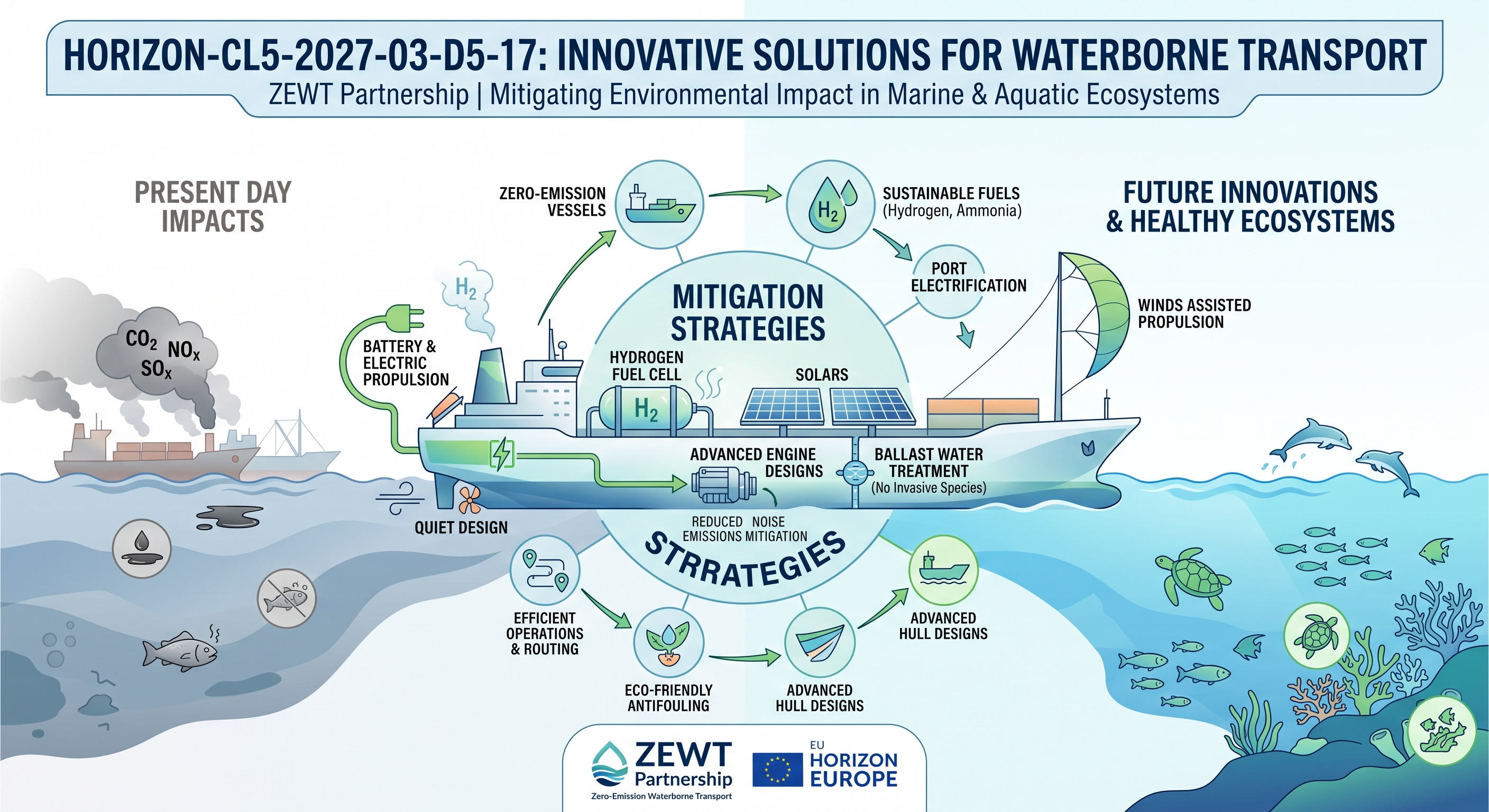
HORIZON-CL5-2027-03-D5-17: Innovative Solutions for mitigating the environmental impact of waterborne transport in marine and aquatic Ecosystems (ZEWT Partnership)
How can ships affect aquatic ecosystems even when no fuel is spilled?
Shipping can affect water through routine discharges, substances released from hull coatings and atmospheric deposition, when airborne pollutants reach the water surface. These pathways need to be assessed alongside accidental fuel releases. For HORIZON-CL5-2027-03-D5-17, the challenge is to connect pollution sources to exposure in marine waters, rivers, lakes and ports, then demonstrate measures that reduce the resulting harm. The focus on renewable low- and zero-carbon fuels therefore extends from normal vessel operation to emergency response, with attention to both water and air pollution. ec.europa.eu
Download the MIC Horizon Europe 2026/2027 Calls Calendar:
Discover more!
Administrative facts: what do we know about the HORIZON-CL5-2027-03-D5-17 call?
Which call is it, and when is the opening and the deadline?
- Call name: MOBILITY
- Call identifier: HORIZON-CL5-2027-03
- Destination: Destination 5, Clean and competitive solutions for all transport modes
- Topic: HORIZON-CL5-2027-03-D5-17
- Opening date: 15 December 2026
- Deadline: 14 April 2027, 17.00.00 Brussels time
- Type of action: Research and Innovation Action (RIA)
What about the budget and estimated size of the project?
- Overall topic budget: EUR 14.00 million
- Number of projects expected: 2
- EU contribution per project: around EUR 7.00 million
What are the key eligibility and evaluation conditions?
- Eligibility: General Annex B, with one exception
- Exception: satellite data must come from Copernicus and/or Galileo/EGNOS
- Technology Readiness Level: TRL 5 by the end of the project, any TRL at the start
- Funding form: lump sum grant
- IP: the granting authority may object to a transfer of ownership or exclusive licensing, for 4 years after the action ends
- Award criteria: General Annex D, no topic-level exception, no JRC clause, no clustering
- Reporting: results reported to the ZEWT Partnership for KPI monitoring
Scientific range: what does the Commission expect from the HORIZON-CL5-2027-03-D5-17 grant?
What outcomes are expected?
The Commission wants a clear picture of what low and zero-carbon fuels do to water, plus abatement systems that work. Water resilience and Good Environmental and Good Ecological Status are the targets, tied to the Water Resilience Strategy and the Ocean Pact. A series of publications is not what the Commission is after.
What is within scope?
Impact assessment and mitigation. Fuel development sits in neighbouring ZEWT topics.
- Impacts on marine waters, rivers, lakes and port areas
- Pollution from normal operation on low and zero-carbon fuels, and from spills
- Prevention, abatement and mitigation systems
- Modelling of water and air pollution per ship type
- Antifouling coatings, wastewater discharges, invasive species from hulls and ballast water
- Training needs and emergency response preparedness
What are the specifically proposed research directions?
- Evaluate and forecast impacts, with spill experiments explicitly allowed
- Response scenarios for uncontrolled releases: equipment, procedures, guidelines
- Cost-effective abatement systems demonstrated at TRL 5
- Solutions improving the resilience of European waters
- Stakeholder engagement with environmental, industry and academic associations
EMERGE is named as prior work. Read that as a baseline you are expected to beat.
Scientific strategy: how can you enhance your chances of being funded through HORIZON-CL5-2027-03-D5-17?
What scientific choices matter most?
- Pick your fuels early: Ammonia, methanol, and hydrogen behave nothing alike in water. Two covered properly beats four covered thinly.
- Put the spill experiments in the workplan: The text permits them, and most proposals will not dare.
- TRL 5 is the contract: Name the site, the vessel, or the port, and the date.
- Tie every result to a Good Environmental or Good Ecological Status indicator.
- Don’t neglect air: Water gets the attention, but atmospheric deposition is in the text.
Consortium & proposal-writing plan: what works best with this type of call?
- Somewhere between ten and fourteen partners, a couple more if you need several sea basins covered.
- Marine ecotoxicology labs, hydrodynamic modellers, a classification society, a port authority, a shipowner to host.
- An innovative SME carrying sensing or abatement hardware is worth having. Small teams move faster on a TRL 5 demonstrator, and evaluators like the supply chain argument.
- If you can get a national maritime authority onto your advisory board, use it. Regulatory uptake is half the impact story.
- Map each work package to one expected outcome bullet. Evaluators check.
- Lump sum: the work package split is the budget.
How should pollution-mitigation systems be validated for waterborne transport?
Validation should connect technical performance to a measurable reduction in environmental harm. The work programme calls for relevant demonstrations of abatement and mitigation systems at Technology Readiness Level 5. A laboratory toxicity result can inform this work, but does not by itself validate the mitigation system. ec.europa.eu
A useful validation plan would:
- Define the operating scenario: identify the fuel or discharge, release conditions, receiving water and intended response.
- Measure treatment performance: compare pollutant loads before and after treatment, accounting for flow, captured residues and any transfer to air or other waste streams.
- Check biological effects: compare treated and untreated samples using appropriate controls, organisms and exposure periods, alongside chemical analysis.
- Test practical use: assess reliability, resource consumption, maintenance, response time and operator training under conditions representative of the intended application.
The resulting evidence should explain where the solution works, its operating limits and how it can be used by vessel operators, ports and emergency-response teams.
The MIC already brings its expertise in microfluidics to Horizon Europe:
H2020-NMBP-TR-IND-2020

Microfluidic platform to study the interaction of cancer cells with lymphatic tissue
H2020-LC-GD-2020-3
Toxicology assessment of pharmaceutical products on a placenta-on-chip model

About the author

Céleste Chidiac, PhD
Scientific writer and digital marketing specialist
Céleste Chidiac holds a doctorate in neuroscience and molecular biology from the University of Strasbourg. Since joining the Microfluidics Innovation Center in 2023, she has combined scientific writing with website management. For MIC’s Horizon Europe topic pages, she draws on her research background to explain scientific challenges and clarify funding priorities. Her writing helps prospective applicants understand each topic’s scope, expected outcomes and research directions.
FAQ – Aquatic impact assessment for HORIZON-CL5-2027-03-D5-17
These questions examine how to interpret toxicity tests, assess complex discharges and connect experimental evidence to pollution-response decisions.
Can one toxicity threshold represent every aquatic species?
No. Konstantinopoulos and colleagues found that ammonia and methanol responses differed among species and populations in northern Baltic Sea zooplankton experiments. A toxicity value therefore needs its test organism, exposure duration and environmental conditions; it is not a universal ecosystem threshold. [1]
Why report ammonia concentration together with water chemistry?
Specify whether the value concerns total ammonia or un-ionised ammonia (NH3), and report pH, temperature and salinity. In the Baltic zooplankton experiments, researchers controlled pH and corrected ammonia concentrations; these conditions are part of interpreting the exposure. [1]
Does short-term survival rule out biological harm?
No. Reproduction can be affected as well as survival. Ammonia reduced egg-hatching success in Eurytemora affinis during 72-hour tests. An assessment based only on mortality would omit this reproductive endpoint. [1]
Can acute exposure tests establish long-term ecological safety?
No. The Baltic study measured mortality over 24–48 hours. Such experiments describe acute responses; they do not establish the consequences of repeated exposure, recovery or effects across generations. [1]
Can exhaust treatment improve air quality while harming water?
Yes. Scrubbers can transfer contaminants into washwater. Jönander and colleagues observed harmful effects of diluted closed-loop scrubber washwater on marine zooplankton. Air-emission reduction and aquatic effects therefore need separate assessment. [2]
Why test whole effluents alongside individual chemicals?
Effluents contain mixtures. Jönander and colleagues combined chemical analysis, mixture-toxicity estimates and biological tests of scrubber washwater. This approach examines the combined sample while helping identify substances that may drive its effects. [2]
What can community tests reveal beyond single-species tests?
Community tests can reveal changes in species composition and feeding relationships. In seasonal laboratory experiments, scrubber-washwater exposure altered zooplankton communities and their grazing on microzooplankton. These findings concern the tested communities and exposure conditions. [2]
Why check monitoring indicators against biological effects?
A chemical indicator may miss important toxicity drivers. In the scrubber-washwater study, phenanthrene was neither the most abundant nor the most toxic measured polycyclic aromatic hydrocarbon. One proxy cannot represent every component of that mixture. [2]
How should laboratory results be used in spill models?
Use laboratory results to define effect relationships within their tested range. Keep measured toxicity separate from predicted exposure, and document assumptions about release rate, dilution and water movement. The topic’s modelling work should connect these evidence streams without presenting simulated impacts as field observations.
What makes an emergency-response exercise informative?
An exercise should test whether people can detect the release, select a suitable response and deploy equipment within the scenario’s constraints. Record delays, communication failures and training needs. This gives practical substance to the topic’s response scenarios and operational guidelines.
References
[1] Konstantinopoulos, T., Rist, S. and Koski, M. Acute effects of ammonia and methanol on dominant zooplankton species in the northern Baltic Sea. Ecotoxicology and Environmental Safety. 2026;322:120350. doi:10.1016/j.ecoenv.2026.120350
[2] Jönander, C., Egardt, J., Hassellöv, I.-M., Tiselius, P., Rasmussen, M. and Dahllöf, I. Exposure to closed-loop scrubber washwater alters biodiversity, reproduction, and grazing of marine zooplankton. Frontiers in Marine Science. 2023;10:1249964. doi:10.3389/fmars.2023.1249964