
Tips & Tricks for a successful HORIZON-CL5-2027-02-D3-30 proposal
Opening
03 December 2026
Deadline
Keywords
Direct Air Capture
Carbon Capture
DAC
TRL 7
Sorbent Materials
CCUS
IA
pilot demonstration
renewable energy
scalable design
lower energy
Your microfluidic SME partner for Horizon Europe
We take care of microfluidic engineering, work on valorization and optimize the proposal with you
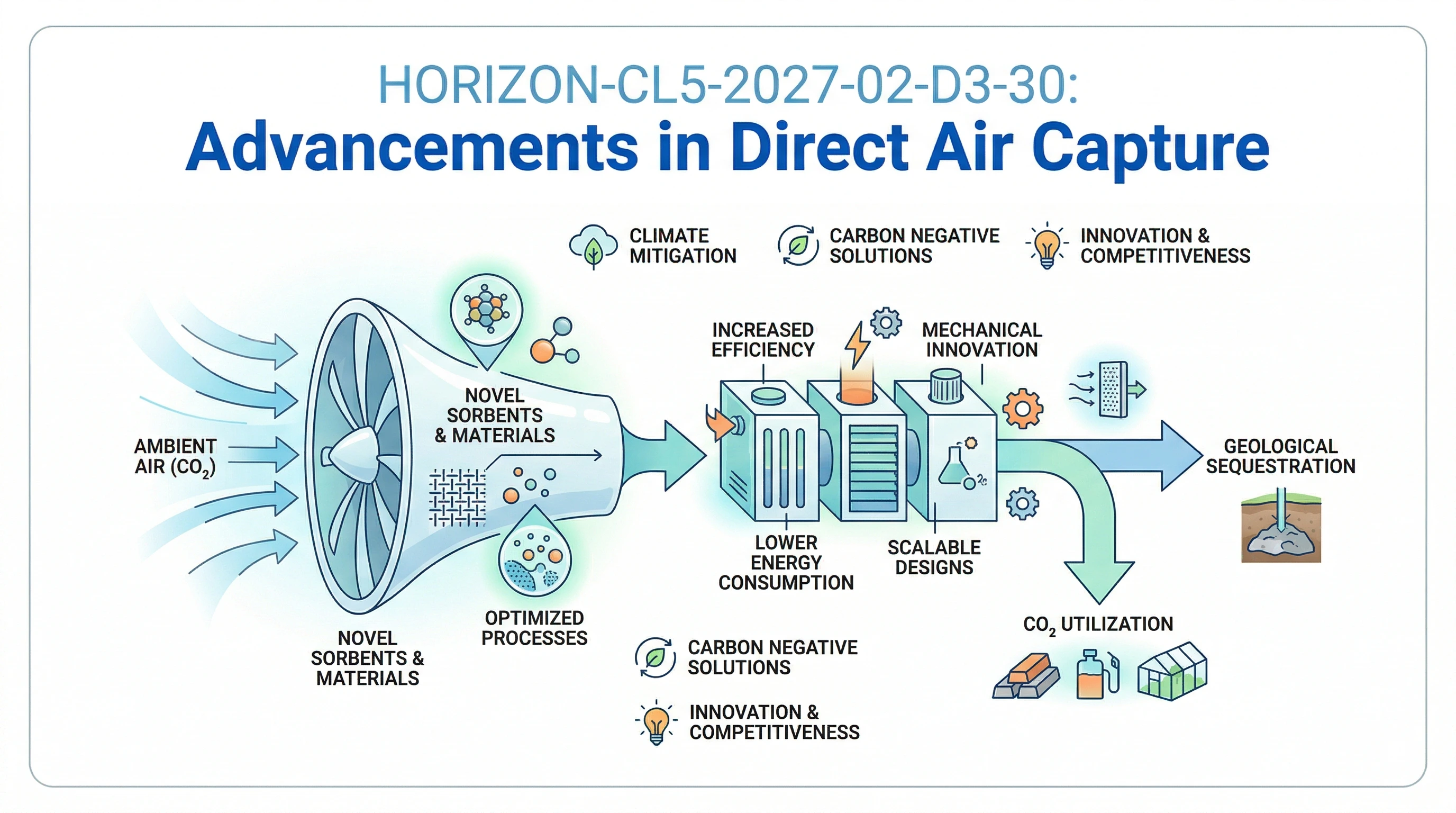
HORIZON-CL5-2027-02-D3-30: Advancements in Direct Air Capture
Direct Air Capture sits at the awkward intersection of climate ambition and commercial reality. Costs are still high, somewhere in the range of $100 to $1,000 per tonne of CO2 depending on who you ask, and there is no dedicated EU initiative for DAC yet. This topic intends to fill exactly that gap. The Commission wants to see working, scalable systems at pilot demonstration level, not more lab data. The underlying logic is simple: get the cost curve moving before 2030.
Download the MIC Horizon Europe 2026/2027 Calls Calendar:
Discover more!
Administrative facts: what do we know about the HORIZON-CL5-2027-02-D3-30 call?
Which call is it, and when is the opening and the deadline?
- Call: BATTERIES and ENERGY, HORIZON-CL5-2027-02
- Topic identifier: HORIZON-CL5-2027-02-D3-30
- Destination: D3, Sustainable, secure and competitive energy supply
- Topic name: Advancements in Direct Air Capture
- Opening date: 03 December 2026
- Deadline: 31 March 2027
- Type of action: Innovation Action (IA)
What about the budget and estimated size of the project?
- Total indicative budget: EUR 16.00 million
- Expected number of projects: 2
- Expected EU contribution per project: around EUR 8.00 million
What are the key eligibility and evaluation conditions?
- Standard eligibility conditions per General Annex B
- TRL target: achieve TRL 7 by end of project; projects may start at any TRL
- Satellite data users must use Copernicus and/or Galileo/EGNOS
- Eligible costs take the form of a lump sum
- China restriction applies: legal entities established in China are not eligible for IAs under this destination
- No JRC participation restriction mentioned
- Use of the ECCSEL research infrastructure for CCUS is encouraged but not mandatory
- International cooperation with Mission Innovation Carbon Dioxide Removal partners is encouraged
Scientific range: what does the Commission expect from the HORIZON-CL5-2027-02-D3-30 grant?
What outcomes are expected?
The Commission wants only one thing: to speed up the commercialization of DAC technology. No proof-of-concept and no more benchmark studies. The projects must reach TRL 7, have a credible implementation plan, include life-cycle costing, and provide evidence that the technology will be profitable at scale. The future needs to be tackled without any subsidy.
What is within scope?
- Scaling up of current DAC technical solutions to pilot level (TRL 7 minimum)
- Lowering the cost-effectiveness of the capture and regeneration process, including the BoP (Balance of Plant)
- Enhanced material performance: capacity for capture and desorption, kinetics, duration of use and long-term stability in air
- Manufacturing capacity and potential for scale-up, including recyclability and re-use of sorbent/solvent materials
- Flexible operation even during fluctuating power supply from renewable energy
- Design and demonstration of materials suited for cold temperatures, humid environments and polluted air
- New high-flux air contactor designs for enhanced efficiency
- Detailed analysis of the life cycle assessment of the entire DAC system
What are the specifically proposed research directions?
The work program clearly lays out these:
- Energy use reduction for sorbent/solvent regeneration (highest impact on cost)
- Alternative materials and ways of capturing CO2 from ambient air
- More accurate simulation data through real data validation
- Optimization of air contactor geometry to maximize throughput
- Economic assessment of DAC, comparing it to operating without subsidies, for both CO₂ storage and usage and a variety of energy sources
- No specific DAC technology types are preferred by the call; therefore, solid sorbents, liquid solvents, and electrochemical technologies all have potential in the Commission’s eyes.
No specific DAC technology types are preferred by the call; therefore, solid sorbents, liquid solvents, and electrochemical technologies all have potential in the Commission’s eyes.
Scientific strategy: how to enhance your chances of being funded through HORIZON-CL5-2027-02-D3-30?
What scientific decisions are crucial?
- Ensure your proposal focuses on a concrete, large-scale pilot demonstration. Evaluators will not fund projects that remain at bench scale; target TRL 7 and integrate it into your project from the start, not as an add-on.
- Clearly define your energy input. Regeneration energy is the main cost factor in DAC. Your technical approach needs to address this directly, as well as how it handles fluctuating renewable energy sources.
- Address cold or humid conditions if your sorbent system is sensitive to them. These conditions are explicitly mentioned by the Commission; if your material performs poorly in humidity or at temperatures below 10°C, provide solutions for these issues.
- A robust LCA is essential; it is a requirement from the Commission that covers materials, energy, emissions, and end-of-life, and projects that neglect it often have lower evaluation scores.
- Avoid exaggerated cost reduction claims. The IEA range for DAC is between $100 and $1,000 per ton. Aim for credible cost reduction trajectories rather than optimistic final figures.
- Integrate your scale-up plan with CO2 transport and storage infrastructure or with direct utilization. The Commission wants to see what happens with the captured CO2.
Consortium & proposal-writing plan: what works best with this type of call?
- A consortium of about 8-12 partners should be appropriate, or slightly more if covering multiple climate zones or technologies. IA projects in this budget category do not require very large groups of partners.
- A material science team should be a fundamental partner, focusing on sorbent/solvent development and characterization to ensure credibility of the pilot demonstration.
- An engineering company or industrial operator that already has piloting infrastructure is crucial; this is not a project that can be run solely from a university laboratory.
- An energy systems expert is necessary to manage renewable energy integration; the Commission’s focus on intermittent energy supply is not superficial.
- Include a geological partner for underground CO2 storage or a partner specialized in CO2 valorization for direct use, depending on the target of your project.
- A niche SME that specializes in materials, modular systems, or technologies related to DAC can add valuable credibility to the consortium.
- For proposal writing, the unusual requirement for the financial viability without subsidies at this early stage must be addressed directly, even if the outcome is that it is currently not viable but could be in the future under certain conditions. Failure to do so will likely result in a lower evaluation score.
- Be aware that legal entities from China are not eligible to apply.
How would microfluidics contribute to this topic?
Conventional sorbent testing in DAC is time-consuming. It involves sending samples for TGA analysis, then adjusting formulations based on results and re-testing, a cycle that needs to be much faster. Microfluidic platforms enable simultaneous testing of multiple sorbent formulations or solvent mixtures under controlled temperature and humidity conditions at speeds that are impossible with conventional techniques.
For instance, if a consortium has developed a new amine-functionalized solid sorbent and needs to test its degradation during repetitive capture/desorption cycles in humid air at 5°C. A microfluidic chip can run many such tests under varying atmospheric and cycle conditions with precise control over temperature and humidity. Data that used to take weeks can now be gathered in days.
- Microreactors for simultaneous screening of sorbent and solvent formulations under realistic conditions like cold, polluted air as identified by the scope.
- Minimized gas flow systems for kinetic and stability studies of materials with small amounts of sample.
- Lab-on-chip configurations for validation of simulation data and improved accuracy prior to scale-up.
- Precisely controlled temperature and humidity for material durability studies that are highlighted in the work programme.
In the context of a consortium, this means that material testing will be faster and the scientific validation of TRL assertions will be stronger. Microfluidics will not replace a pilot plant, but will substantially strengthen the scientific basis for the materials used in one. Expertise in gas-liquid interfaces, controlled microenvironments, and high-throughput characterization platforms, like those held by MIC, makes a research institution or company like it an ideal partner in DAC projects involving material and process development.
The MIC already brings its expertise in microfluidics to Horizon Europe:
H2020-NMBP-TR-IND-2020

Microfluidic platform to study the interaction of cancer cells with lymphatic tissue
H2020-LC-GD-2020-3

Toxicology assessment of pharmaceutical products on a placenta-on-chip model

FAQ – HORIZON-CL5-2027-02-D3-30
What is the aim of this call?
The Commission would like to hasten commercialisation of DAC. Projects should produce working pilot systems, and not further laboratory research. The idea is to push its cost curve downward by 2030 and demonstrate that the technology will one day be able to run without government subsidies.
What are the size of the funds available and the number of projects to be chosen?
The overall indicative budget will be EUR 16 million divided between two projects. It is estimated that each project would have an EU contribution of some EUR 8 million. The type of action is Innovation Action (IA), and the costs that can be reimbursed are in the form of a lump sum.
What Technology Readiness Level does the project have to get to?
The projects are expected to reach TRL 7 (system prototype is shown to operate in an working environment) at the expiry of the funding time. No minimum starting TRL, although the whole proposal should be constructed based on achieving that pilot demonstration milestone. Check the Funding and Tenders Portal for more information.
What are the eligible families of DAC technologies?
No preference is stated. Strongly sorbent systems, liquid solvent systems and electrochemical capture systems are all explicitly covered. The Commission does not assess the technology family but the quality of the science and the plausibility of the scale up plan.
How does the work programme draw attention to scientific priorities?
There are four areas that are notable. To start with, less energy will be consumed to regenerate sorbent or solvent, which is the largest cost driver. Second, finding alternative capture materials with superior capacity, quicker kinetics and extended operating lifetimes. Third, testing simulation models on actual operating data. Fourth, to optimise air contactor geometry to maximise the CO₂ throughput per unit energy and capital.
Does the proposal need to address any particular environmental conditions?
Yes. The work programme specifically states cold temperatures, humid and polluted air. In the event that the suggested sorbent or solvent system is susceptible to any of the above, the proposal should contain specific technical solutions and not simply note the problem and proceed with the proposal.
What are the Commission expectations on economic viability?
Proposals should encompass an in-depth economic evaluation of the cost of the technology with and without subsidies, of the various energy sources and both CO 2 storage and CO2 utilisation cases. Unjustified positive cost estimates with no substantiating information will undermine the assessment. The present IEA target is between 100 and 1,000 tonnes; realistic reduction curves are more important than the headlines.
What is a perfect consortium?
Eight to twelve partners is a good number. The consortium should at least have a materials science team to develop sorbent or solvent, an engineering partner with available pilot infrastructure, an energy systems partner to handle renewable integration, and a storage or valorisation partner to handle CO2. There is a dedicated SME with DAC related hardware or modular systems, which lends credence. It should be noted that this call is not available to legal entities that are created in China.
What can microfluidics do to enhance a DAC proposal?
Microfluidic systems enable high-throughput screening of both solvent and sorbent formulations under controlled temperature and humidity conditions, compressing weeks of testing in traditional systems into days. They also allow kinetic and stability investigations to be made with minimum sample amounts, and offer lab-on-a-chip validation on simulation data before scale-up. Microfluidics will not take the place of the pilot plant as such, but it will go a long way in supporting the scientific basis of material choice and TRL assertions.