
Tips & Tricks for a successful HORIZON-CL5-2027-02-D3-15 proposal
Opening
03 Dec 2026
Deadline
Keywords
Solar Photovoltaics
EUPI-PV Partnership
Perovskite
Tandem PV
Pilot Production Line
PV Manufacturing
European manufacturing line
silicon solar cells
Your microfluidic SME partner for Horizon Europe
We take care of microfluidic engineering, work on valorization and optimize the proposal with you
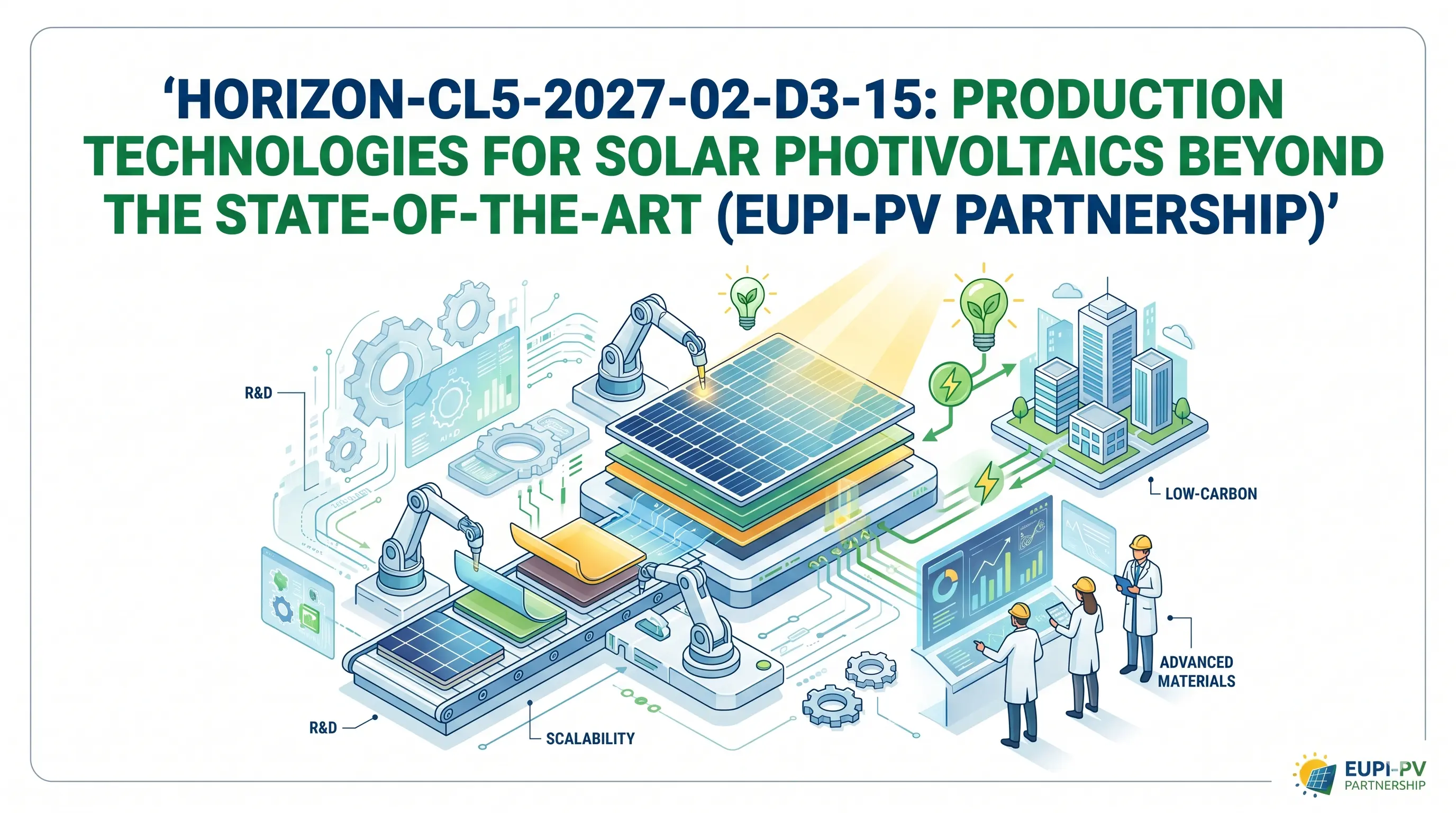
HORIZON-CL5-2027-02-D3-15: Production technologies for solar photovoltaics beyond the state-of-the-art (EUPI-PV Partnership)
The Commission is no longer looking for incremental improvements to existing silicon solar cells. What are they seeking? To push beyond the production-scale efficiency limits that currently exist; this entire call is about that. They want Europe to reclaim a position in solar manufacturing, not just as an R&D innovator, but as a manufacturer taking ownership of its own industrial future. This isn’t about presenting a high-efficiency cell in a clean room. What’s expected is a prototype that can be implemented in a European manufacturing line.
Download the MIC Horizon Europe 2026/2027 Calls Calendar:
Discover more!
Administrative facts: what do we know about the HORIZON-CL5-2027-02-D3-15 call?
Which call is it, and when is the opening and the deadline?
- Call name: BATTERIES and ENERGY
- Call identifier: HORIZON-CL5-2027-02
- Destination: D3 – Sustainable, secure and competitive energy supply
- Topic: HORIZON-CL5-2027-02-D3-15 – Production technologies for solar photovoltaics beyond the state-of-the-art (EUPI-PV Partnership)
- Opening date: 03 Dec 2026
- Deadline: 31 March 2027
- Type of action: Innovation Actions (IA)
What about the budget and estimated size of the project?
- Overall topic budget: EUR 36.00 million
- Indicative number of projects: 3
- Expected EU contribution per project: around EUR 12.00 million
What are the key eligibility and evaluation conditions?
- Standard eligibility conditions apply per General Annex B.
- Target TRL: activities are expected to reach TRL 7 by the end of the project; start TRL is open
- Satellite data exception: if Copernicus or Galileo/EGNOS data is used, it must be used; other sources can supplement but not replace it
- IP protection clause: the granting authority may object to ownership transfer or exclusive licensing of results for up to 4 years post-project
- Exploitation plan required: must include business case, commercialization strategy, and scalability plans; Innovation Fund should be cited as a potential follow-on funding source.
- SSH integration: explicitly required, social sciences and humanities must be genuinely embedded, not added as an afterthought
- EUPI-PV reporting: projects must report results to the European Partnership for Innovation in Photovoltaics in support of partnership KPI monitoring
Scientific range: what does the Commission expect from the HORIZON-CL5-2027-02-D3-15 grant?
What outcomes are expected?
Ultimately, working solar cells/modules are desired that exceed the efficiency of current commercial modules, along with a multi-megawatt-scale manufacturing process that is productive, reliable, and ready for deployment beyond the lab environment. They seem to value the roadmap to commercialization at least as highly as technological advancement.
What is within scope?
- PV cells and modules that exceed the efficiency of current commercial devices, matching or exceeding current commercial products in terms of endurance and reliability.
- Manufacturing process that can be scalable to multi-MWp, productive, reliable, and ready for use beyond the lab.
- Equipment and pilot production lines required for implementing new processes and/or innovative module concepts, including digital and automated production techniques.
- Robust business case and market strategy for the deployment and commercialization of the technology, integrated throughout the project.
- There is no specific mention as to which PV tech family is to be targeted; it could be perovskite, tandem, or advanced crystalline silicon. However, the focus should be on the technology’s scalability and high efficiency.
What are the specifically proposed research directions?
- Overcoming the current commercial conversion efficiency barrier (currently in the 22-24% range for Si modules).
- Energy-efficient, automatable, and defect-tolerant fabrication processes.
- Digitalization integrated into production lines (e.g., use of AI for optimization of processes, automated inspection, etc.).
- Proof of a deployable multi-MWp pilot production line (for modules as well as cells).
- A direct link between technological outputs and business strategy is heavily emphasized in the work program.
Scientific strategy: how can you enhance your chances of being funded through HORIZON-CL5-2027-02-D3-15?
What scientific choices matter most?
- Focus on a technology that is capable of producing step changes in efficiency rather than incremental improvements. Perovskite-silicon tandem solar cells, novel thin film PV, or breakthrough silicon cell architectures are more likely to impress.
- Provide a realistic and detailed description of the pilot line, including specification of the relevant equipment, expected throughput, defect management, and throughput considerations.
- Integrate social science into the technical work from the very beginning rather than as an afterthought, as is expected in this program. Include aspects relating to business and public acceptance within the planned work.
- Provide an ambitious but feasible path to a production factory from the pilot line phase, going beyond the conventional exploitation plan. Indicate the route via the Innovation Fund if applicable.
- Demonstrate the long-term endurance of the new devices and their capability to perform well in various environmental conditions.
- Make IP explicitly clear. Consortium partners should not be surprised to learn that the Commission can block the granting of exclusive licenses for up to four years from the end of the project.
Consortium & proposal-writing plan: what works best with this type of call?
- 8-12 good partners, but be prepared to broaden slightly if necessary in order to include the relevant production aspects. This is an Innovation action, and with €12 million at stake, the industrial component should be significant beyond the inclusion of a single token company.
- Include at least one equipment manufacturer that will take ownership of the production line development and implementation.
- Ensure a European PV manufacturer is involved for scaling up. Industry involvement will be a key aspect of the evaluation of this proposal in relation to building a European PV manufacturing based on EUPI-PV.
- Include an innovative SME working in PV manufacturing, automation, or related fields; SMEs are valuable in this role due to their often greater drive and ability to implement quickly, in contrast to the relatively slower progress of large companies.
- Include only one university or research institute (at most two) for R&D focusing on efficiency. It is important not to overload the consortium with academics, given the emphasis placed upon innovation in the project description.
- Keep the proposal tightly focused; concentrate on the three key points of the call—efficiency, manufacturing process, and pilot line, and do not dwell excessively on the long scientific background. The work plan is looking for impact rather than pure academic history.
- Ensure the business case and commercialization are addressed from the outset, especially if you are the coordinator, and do not defer it to the exploitation plan.
How would microfluidics contribute to this topic?
Current conventional methods for PV testing and production involve slow, large-scale approaches. Microfluidics allows the testing and control of materials at the material/manufacturing frontier:
- With microfluidics, you could develop processes for precise inline control of compositional changes during the perovskite deposition step to prevent batches from being ruined by deviations.
- The small scale is also an advantage when looking to rapidly explore small variations on a parameter to determine optimal values and limit material wastage on larger, slower processes.
- Droplet microfluidics may allow for rapid screening of different surface passivation chemistries and different concentration levels on one wafer so there are no expensive, lengthy batch tests needed.
- The creation of a microfluidic ‘aging’ setup allows a researcher to quickly stress test a module encapsulant or adhesive under controlled temperature/humidity conditions for example, so that there are real data before committing expensive production-scale hardware to a lengthy test cycle.
- When the microfluidic process can be directly integrated into a production process, this is a move that can be taken, but this proposal is likely aimed at researchers already capable of implementing the process into a larger-scale manufacturing environment. See how AI-assisted microfluidic automation supports this kind of integration.
A successful proposal will utilize microfluidics not just as a niche testbed but as a key component in developing manufacturing processes. If a proposal team already possesses expertise with microfluidics in production scale environments, then a strong proposal could readily be written as the Commission explicitly desires such an integration and innovation. Explore the full MIC overview of Horizon Europe solar PV topics for more context.
The MIC already brings its expertise in microfluidics to Horizon Europe:
H2020-NMBP-TR-IND-2020

Microfluidic platform to study the interaction of cancer cells with lymphatic tissue
H2020-LC-GD-2020-3

Toxicology assessment of pharmaceutical products on a placenta-on-chip model

FAQ – HORIZON-CL5-2027-02-D3-15
Who is eligible to apply to HORIZON-CL5-2027-02-D3-15?
This call is open to any legal entity established within an EU Member State or any of the countries related to it. Standard eligibility conditions are in compliance with General Annex B. This topic does not mention any particular country limitations. JRC involvement is permitted on a regular basis. Check the Funding and Tenders Portal for more information.
What is the budget and expected project size for this call?
The budget in total topic is EUR 36.00 million and the amount of the projects that will be financed is indicative. This gives an estimated EU contribution of EUR 12.00 million per project. As this is an Innovation Action, the partners will most likely co-fund the EU contribution.
Which PV technologies are eligible under this call?
No particular PV technology family is mentioned in the call. It can be perovskite, tandem or high-end crystalline silicon. The thing is, it must be a clear increase in efficiency compared to consumer standards and a reasonable path to multi-MWp production.
What TRL is expected at the start and end of the project?
By the end of the project, activities are expected to reach TRL 7 – a prototype of the system that has been demonstrated to function in an operational environment. TRL Entry is not limited, so more recent stage technologies may be deployed, assuming that the path to TRL 7 is viable.
Is SSH integration really mandatory or just recommended?
Yes. There has to be integration of SSH – social sciences and humanities should be integrated and not an appendix. It means the real development of business cases, analysis of social impacts, and social acceptance.
What does the IP protection clause mean in practice?
The IP protection clause means that the authority that granted it has the option to object to the ownership or exclusive licensing of results up to 4 years after the project. This should be considered by consortium partners in their IP agreements from the very beginning.
What should the exploitation plan include?
The exploitation plan must include a realistic business case, a commercialization plan, and scalability plans. The Innovation Fund must be mentioned as a possible follow-on source of funds, indicating knowledge of the broader EU industrial direction.
What are the EUPI-PV reporting obligations?
The European Partnership in Innovation in Photovoltaics (EUPI-PV) should report its outcomes through project-level KPI monitoring. This is compulsory and has to be scheduled in the work packages initially.
How important is digitalization in the pilot line design?
The Commission clearly anticipates digitalized and automated production processes, such as AI-based process optimization, automated inspection, and data-driven quality control. Proposals that regard digitalization as an add-on to pilot line design, rather than a structural element, are likely to score low on impact.
How can microfluidics contribute to a HORIZON-CL5-2027-02-D3-15 proposal?
Microfluidics is also valuable at the process development and quality control levels: precise in vivo control of the perovskite deposition routine, high-throughput droplet microfluidics screening of passivation chemistries on the module surface, and rapid aging of module encapsulants. It is paralleled in the context of a digitalized production workflow with the call of focus on automation. Take a look at the MIC solar PV call.