
Tips & Tricks for a successful HORIZON-CL5-2027-02-D2-06 proposal
Opening
03 December 2026
Deadline
Keywords
battery cell manufacturing
lithium-ion batteries
IA
sodium-ion batteries
BATT4EU Partnership
TRL 6-7
pilot production line
Safe & Sustainable by Design
Your microfluidic SME partner for Horizon Europe
We take care of microfluidic engineering, work on valorization and optimize the proposal with you
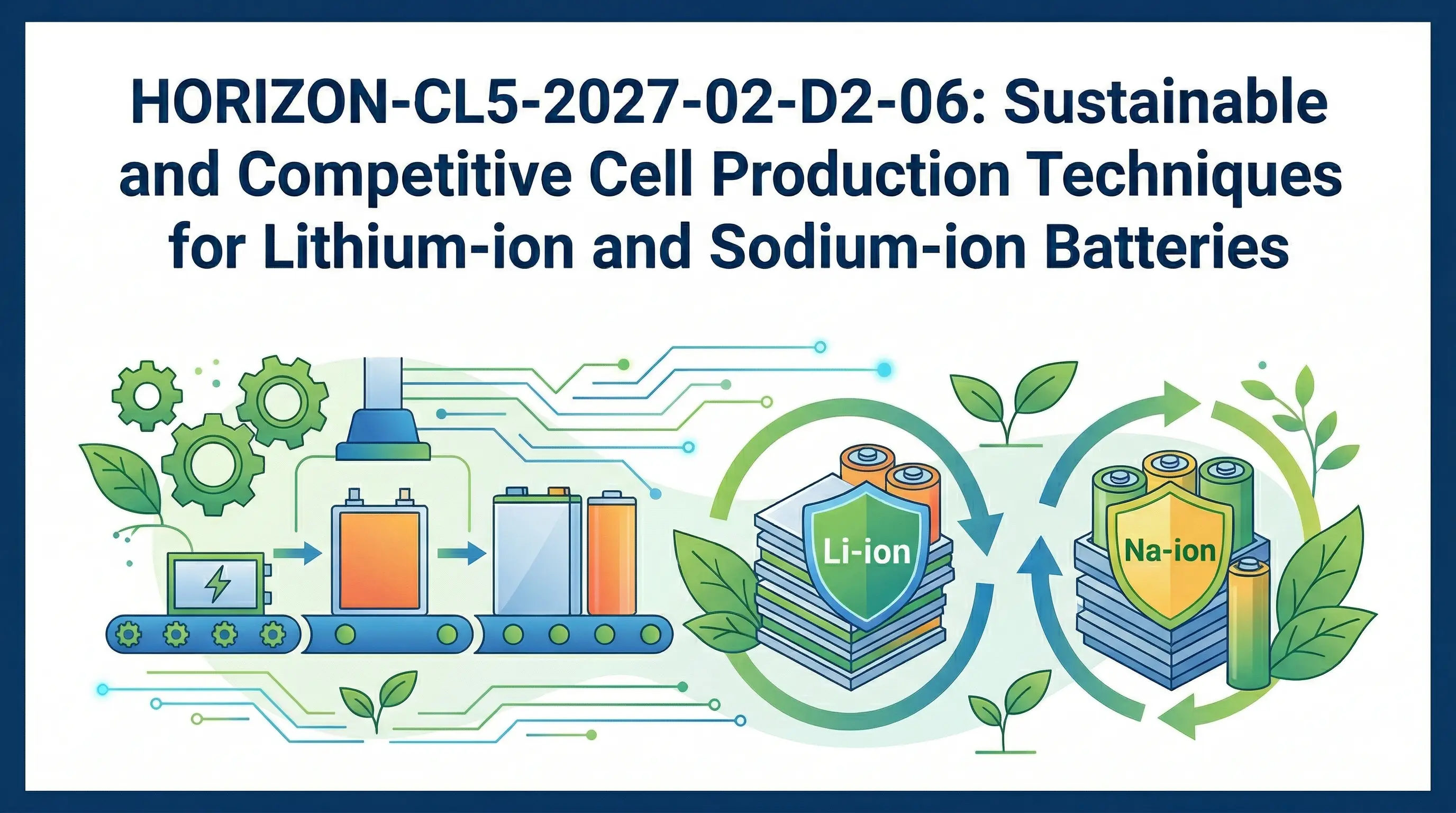
HORIZON-CL5-2027-02-D2-06: Sustainable and competitive cell production techniques for Lithium-ion and Sodium-ion batteries (BATT4EU Partnership)
High costs are a problem for the European battery manufacturing industry. The Commission is eager to reverse the trend of European gigafactories falling behind their Asian counterparts in terms of energy efficiency and capital expenditure. Instead of focusing on battery chemistry, this area of work supports large-scale innovation programs that aim to completely reinvent battery manufacturing processes, including production machinery, quality controls, and other manufacturing processes. The goal is to demonstrate that it is feasible to produce higher-quality cells for lithium-ion and sodium-ion chemistries while reducing costs and energy consumption.
Download the MIC Horizon Europe 2026/2027 Calls Calendar:
Discover more!
Administrative facts: what do we know about the HORIZON-CL5-2027-02-D2-06 call?
Which call is it, and when is the opening and the deadline?
- Call name: BATTERIES and ENERGY
- Call identifier: HORIZON-CL5-2027-02
- Destination: D2 – Cross-sectoral solutions for the climate transition
- Topic: HORIZON-CL5-2027-02-D2-06
- Opening date: 03 December 2026
- Deadline: 31 March 2027 at 17:00 Brussels time
- Type of action: Innovation Actions (IA)
What about the budget and estimated size of the project?
- Total indicative budget for the topic: EUR 37.80 million
- Number of projects expected to be funded: 2
- Expected EU contribution per project: EUR 18.90 million
What are the key eligibility and evaluation conditions?
- General eligibility: standard Horizon Europe conditions (General Annex B)
- TRL target: activities expected to reach TRL 6-7 by end of project
- JRC: may participate as consortium member with zero funding, or as associated partner; JRC does not take part in proposal preparation
- Satellite data: if used, must rely on Copernicus and/or Galileo/EGNOS
- Exploitation plans required: must include scalability, commercialisation strategy, and preliminary business plan; the Innovation Fund is specifically mentioned as a potential follow-on funding source
- BATT4EU reporting: projects must contribute to BATT4EU Partnership KPI monitoring
Scientific range: what does the Commission expect from the HORIZON-CL5-2027-02-D2-06 grant?
What outcomes are expected?
The Commission prefers pilot manufacturing lines that are not only documented but also actually running. By the end of the project, you should have demonstrated flexible production equipment capable of switching between sodium-ion and lithium-ion chemistries, with CAPEX and OPEX significantly lowered compared to existing benchmarks and with undeniable evidence of improved cell quality. Having a credible exploitation strategy focused on industrial scale-up is not optional.
What is within scope?
- Modular and adaptable machinery that may be rearranged and added to production pilot lines
- Modern inline quality monitoring combined with sophisticated electrode production techniques
- Improving dry-room cell assembly procedures to increase output and use less energy.
- Quick and low-energy techniques for cell development and aging
- Digitizing production lines (quality testing, inline defect detection)
- In-depth life-cycle assessment (LCA) and techno-economic analysis (TEA)
- Using the Safe and Sustainable by Design (SSbD) framework as a guide
What are the specifically proposed research directions?
The call makes its desires quite clear. There will undoubtedly be new mixing systems for electrode production. Setting up a dry room is a completely distinct focus that, in our opinion, represents the energy waste in EU production. Another term is “cell formation shortening,” most likely because the formation and aging cycles are the primary causes of the throughput slowing. Furthermore, the decision to fully digitize the production line shows that the Commission views real-time quality monitoring as a sign of competitiveness and a means of cutting costs.
- Manufacturing electrodes using innovative mixing techniques
- Redesigning dry-room assembly equipment to significantly lower energy use and cross-contamination
- Using accelerated cell formation and aging treatments
- Automated flaw detection and in-line quality testing systems
- Flexibility in multiple chemistries (Na-ion and Li-ion on the same pilot line)
Scientific strategy: how can you enhance your chances of being funded through HORIZON-CL5-2027-02-D2-06?
What scientific choices matter most?
- Tag the progress you made with the help of a well-known benchmark that defines the frontier of technology. The requirement clearly states this. Select a trustworthy reference point and demonstrate how your method outperforms it based on the metrics of cost, energy, and quality.
- It is necessary to rethink both chemistries. A submission that engages only lithium-ion will be less competitive. The whole rationale behind the flexible machinery trick is that the same line can accommodate sodium-ion chemicals. So, in your technical argument, you have to prove that this is your capability, not just your theory.
- Turn your TEA and LCA into the most important arguments for your case. Do not use them just as a supplement. The Commission expects that techno-economic and lifecycle assessments are not only validatory tools, serving to back up post-facto design choices, but also that they actually lead to these choices.
- Show genuine pilot-scale enthusiasm. Reaching TRL 6-7 is the goal here. This call is obviously for something beyond a lab proof-of-concept. Make a clear connection to the Innovation Fund. It is identified as a subsequent finance route in the work program.
- The veracity of your exploitation strategy is significantly increased by proving that you are aware of the path to this source.
- Put SSbD into practice right away. Safe and Sustainable by Design is more than just a checkbox. Instead of focusing only on the reporting, include it in your design strategy
Consortium & proposal-writing plan: what works best with this type of call?
- Eight to twelve partners, perhaps a few more if the industrial footprint is quite broad. You need partners with significant industrial capabilities because the IA typically invests about EUR 19 million each project.
- Manufacturers of equipment ought to be important members of your consortium. The partners you choose should be players who construct manufacturing machines, not just those who use them, because the topic is about technology, not just processes.
- One or several automakers or battery cell producers. Without an end user to verify battery cell quality at the pack level, an exploitation scenario would be somewhat weak.
- Given the need for inline quality control, a partner in digitalization or industrial AI truly adds something additional. Make this role a full-fledged part rather than an afterthought.
- You may include a state-of-the-art research center that specializes in process automation or quality monitoring if some of your partners are from business. These professionals typically own the precise proprietary tools that distinguish a proposal.
- When writing, avoid describing the manufacturing problem in your abstract. Rather, start by outlining your consortium’s actual capabilities and scale. A pilot line is what reviewers want to see.
- Within the first three pages, give them something concrete. This section about exploitation is undoubtedly not standard text. It will be read by the judges. Be modest about the timescale, specify the follow-on vehicle (Innovation Fund), and outline the practical procedures to scaling up.
How would microfluidics contribute to this topic?
- Electrode slurry mixing is a precise process. Viscosity, homogeneity, and particle size distribution are important factors that affect cell performance. Before full-batch production, slurry formulations can be characterized and optimized at a very small scale using microfluidic mixing systems. It functions similarly to a brief feedback loop for your electrode recipe. It will be much appreciated by your quality engineers.
- Inline quality monitoring is another area. Conventional inline testing often catches defects too late. Microfluidic sensor integration can monitor electrolyte composition, ionic concentration, or contamination markers in real time during formation cycles. Faster detection, less scrap.
- Another worthwhile area to concentrate on is inline quality control. Defects are typically found relatively late by traditional inline testing. During formation cycles, real-time monitoring of electrolyte composition, ionic concentration, or contaminant markers is possible with the incorporation of microfluidic sensors. Defects are found more quickly in this manner, which reduces scrap.
- Laboratory-level optimization of cell development. Understanding the chemistry of these processes is essential to shortening the creation and aging cycle periods. Before proceeding to pilot-line conditions, one can quickly and affordably test various formation processes using small-scale electrochemical cells on a microfluidic chip.
The MIC already brings its expertise in microfluidics to Horizon Europe:
H2020-NMBP-TR-IND-2020

Microfluidic platform to study the interaction of cancer cells with lymphatic tissue
H2020-LC-GD-2020-3

Toxicology assessment of pharmaceutical products on a placenta-on-chip model

FAQ – HORIZON-CL5-2027-02-D2-06
Who should apply to this call?
The call focuses on organizations that have real scale-up manufacturing. The profile fits battery cell manufacturers, equipment manufacturers, automotive OEMs, research institute access to pilot lines, and innovative SMEs in process automation. Unless your organization is capable of showing activity at TRL 5 or higher in battery production, you may find it difficult to meet the minimum ambition threshold.
Is this a research or an industry-led call?
This is squarely an Innovation Action, which entails industrial leadership and an evident exploitation route, as anticipated by the Commission. Research-only consortia that lack industrial partners capable of operating and running a pilot production line will not score well on impact. In our case, at least, more substantial proposals are made by or alongside equipment manufacturers or cell manufacturers.
Can a project focus on one battery chemistry only?
Yes, technically, but the work program specifically mandates that there must be evidence of the ability to switch between lithium-ion and sodium-ion chemistries on the same line. An offer that disregards sodium-ion will find it more difficult to persuade evaluators that the offer has addressed the entire topic. We would say this is one of the characteristics of this very call as compared to previous BATT4EU subjects.
What TRL should the project start from?
The call indicates that the activities can commence at any TRL, though they must attain TRL 6-7 by the project’s completion. This practically implies that you should have a realistic starting point of TRL 4-5 at least in the core manufacturing processes. Proposals beginning at TRL 2-3 will have a hard time convincingly explaining their ability to achieve TRL 6-7 in a standard four-year period.
Is the TEA/LCA assessment mandatory?
Yes. The work program clearly stipulates the necessity of techno-economic analyses and life-cycle analyses and mandates that they will demonstrate clear benefits over existing state-of-the-art battery cell production. It is not a box-ticking exercise. Proposals that are made with TEA/LCA as an afterthought, as opposed to being made as design drivers, will be rated poorly on the impact criterion.
Can the JRC participate in the consortium?
Yes. The JRC can be either a consortium member with zero funding or an associated partner. The JRC will not be involved in preparing or submitting the proposal. If you want to involve the JRC, you should get in touch with them early to see what experimental or analytical input they can provide for battery performance or safety tests. Check the Funding and Tenders Portal for more information.
What does the BATT4EU reporting requirement involve?
Projects funded within this topic should provide reports of their outcomes to the BATT4EU Partnership to support its KPI monitoring framework. In practice, it is not a high administrative load, but it does imply that your project governance must include activities for BATT4EU alignment, reporting, and participation in partnership-level activities and information-gathering exercises.
How important is the exploitation plan?
Very important. The Commission cites the Innovation Fund, in particular, as a possible follow-on vehicle, indicating that it anticipates projects will give serious consideration to industrial deployment. At least you should have a preliminary business plan, a viable pathway for scaling, and identify the funding instruments you will mobilize after the grant. Efforts to vaguely refer to commercialization without taking action will negatively affect your mark.
What does Safe and Sustainable by Design (SSbD) mean in practice?
Safe and Sustainable by Design (SSbD) is a Commission structure for evaluating the safety and sustainability of chemicals and materials throughout their lifecycles. In this instance, it implies that your design of the manufacturing process should consider SSbD principles, not just in the reporting stage. Practically, this impacts material choice, process chemistry, waste stream, and energy consumption decisions throughout your pilot line design.
How can microfluidics contribute to a HORIZON-CL5-2027-02-D2-06 project?
Microfluidic devices are used at various stages in the battery production process. To characterize electrode slurry, microfluidic setups enable small-volume screening of mixing conditions before scale-up. Microfluidic sensors can be used to monitor electrolyte composition and contamination markers in real time as cell formation cycles occur, enabling in-line quality monitoring. To test the development of sealing materials, microfluidic test rigs confirm moisture performance at a small fraction of the cost of full dry-room tests. MIC can assist your consortium with all these work packages.