
Tips & Tricks for a successful HORIZON-CL5-2027-02-D2-05 proposal
Opening
03 December 2026
Deadline
Keywords
Cluster 5
battery recycling
Batt4EU partnership
black mass processing
recycling processes
hydrometallurgy
EU Batteries Regulation
Adaptability
Your microfluidic SME partner for Horizon Europe
We take care of microfluidic engineering, work on valorization and optimize the proposal with you
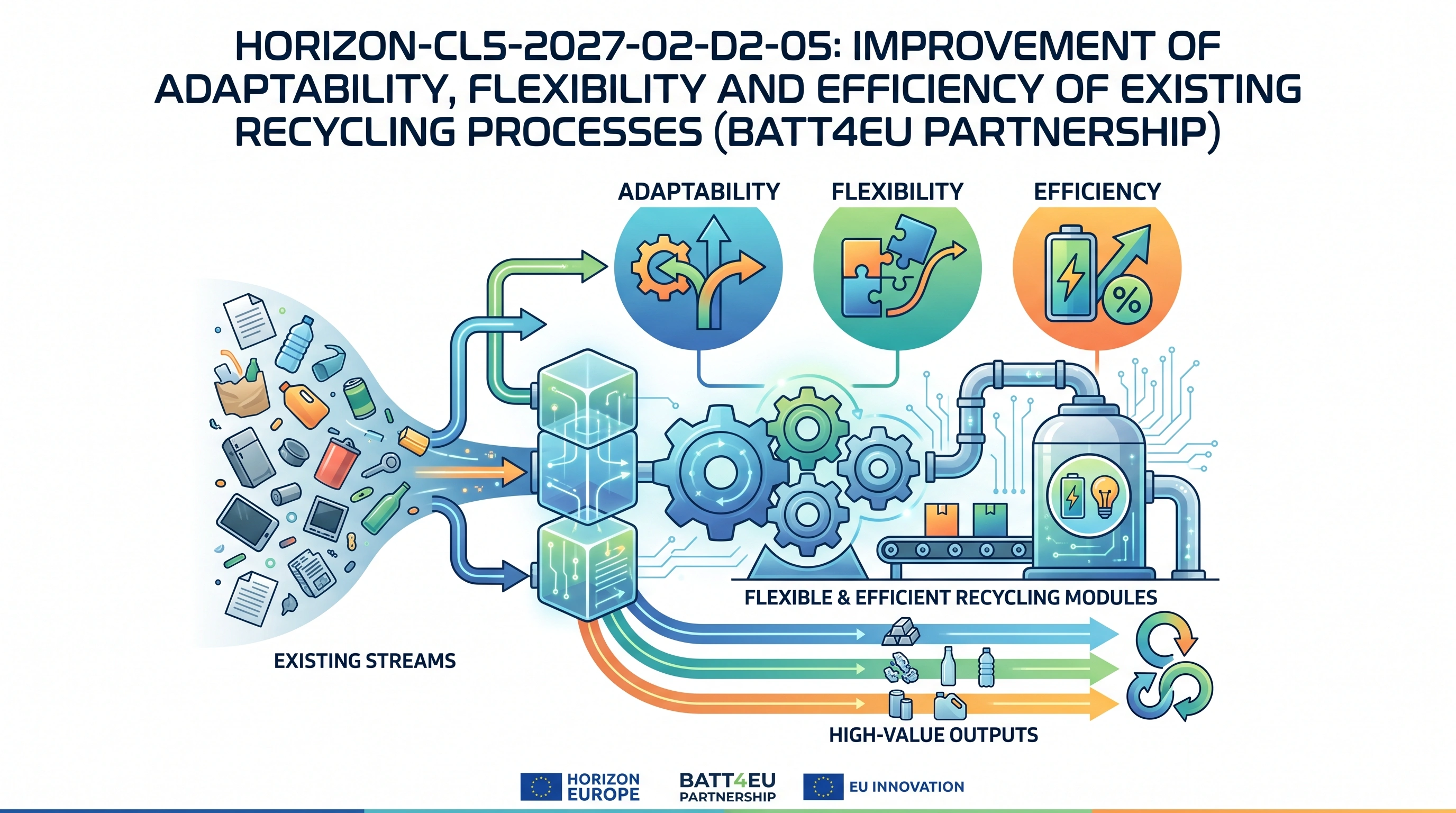
HORIZON-CL5-2027-02-D2-05: Improvement of Adaptability, Flexibility and Efficiency of Existing Recycling Processes (BATT4EU Partnership)
Battery recycling in Europe already works. It just doesn’t work well enough on messy input. The Commission wants existing lines to swallow production scrap and mixed lithium-ion chemistries without losing yield or blowing up costs. Two projects, both expected to end close to industrial scale.
Download the MIC Horizon Europe 2026/2027 Calls Calendar:
Discover more!
Administrative facts: what do we know about the HORIZON-CL5-2027-02-D2-05 call?
Which call is it, and when is the opening and the deadline?
- Call name: BATTERIES and ENERGY
- Call identifier: HORIZON-CL5-2027-02
- Destination: Cross-sectoral solutions for the climate transition (Destination 2)
- Topic: HORIZON-CL5-2027-02-D2-05
- Opening date: 03 December 2026
- Deadline: 31 March 2027, 17:00 Brussels time
- Type of action: Innovation Action
What about the budget and estimated size of the project?
- Topic budget: EUR 18.80 million
- Number of projects: 2
- Budget per project: around EUR 9.40 million
What are the key eligibility and evaluation conditions?
- General Annex B conditions apply
- TRL 6 to 7 expected at project end; activities may start at any TRL
- JRC may join as a zero-funding beneficiary or associated partner, but not in proposal preparation
- Copernicus and/or Galileo/EGNOS mandatory if satellite or positioning data are used
- The granting authority may object to transfer of ownership or exclusive licensing of results, up to 4 years after the action ends
- Batt4EU partnership: KPI reporting required
Scientific range: what does the Commission expect from the HORIZON-CL5-2027-02-D2-05 grant?
What outcomes are expected?
By the end, an existing process should handle feedstock it previously could not, at better cost and recovery. The Commission is after demonstrated compliance with EU Batteries Regulation targets, not a projection of it. Reduced dependence on imported raw materials is the political payoff, so make it visible.
What is within scope?
- Technologies handling variable composition feedstocks, potentially within the same batch
- Production scrap and mixed lithium-ion chemistries as priority inputs
- Black mass processing recovering high-purity battery-grade materials
- Hydrometallurgical and/or pyrometallurgical optimisation for critical raw material recovery
- Digitalised sorting and advanced pre-treatment where needed
- Techno-economic assessment and life-cycle assessment, both required
Not a call for brand new recycling concepts. Already scaled processes are the starting point.
What are the specifically proposed research directions?
- Recovery efficiencies at or above Batteries Regulation requirements, measured not modelled
- Energy efficiency, CO2 and footprint reduction, quantified through LCA
- Safe and Sustainable by Design as an assessment reference
- Recovered materials fed back into European cell manufacturing
The work programme stays vague on which chemistries matter most. That vagueness gives you room. Our reading: LFP is the case everyone struggles with economically, and sodium-ion is coming.
Scientific strategy: how can you enhance your chances of being funded through HORIZON-CL5-2027-02-D2-05?
What scientific choices matter most?
- Start from a real line, not a lab flowsheet. Evaluators want the process you are improving, named and characterised.
- Quantify feedstock variability. Show composition ranges, then what your process does at both ends.
- Make the TEA and the LCA load-bearing. We see this a lot: bolted on in the last work package. They should drive design from month one.
- Get purity specifications from an actual cell manufacturer.
- Show your monitoring and control strategy. Adaptability means reacting to input changes, and you cannot react to what you never measure.
Consortium & proposal-writing plan: what works best with this type of call?
- Somewhere between eight and thirteen partners, a couple more if you cover several chemistries. An IA at this budget rarely works with fewer.
- A recycler with an operating plant is non-negotiable. Without one, the “existing processes” framing collapses.
- Cell or material manufacturer at the other end, closing the loop on purity.
- Innovative SMEs usually bring the process analytics and sensing that large operators never develop in-house. Build one or two into the core, not as subcontractors.
- If you want the JRC involved, contact them early. Same information goes to everyone, so waiting buys nothing.
- Write the exploitation plan like a business plan. The call names the Innovation Fund. Take the hint.
- Keep the impact section tied to European raw material dependence. That argument travels.
How would microfluidics contribute to this topic?
Screening leaching chemistry at bench scale is slow and eats material. Litres of reagent for one condition, sometimes more. Microfluidic systems run that screening inside droplets, hundreds of conditions in parallel, on milligrams of black mass.
- Say you want to know which extractant separates nickel from cobalt best at a given pH. Droplet microfluidics sweeps pH, extractant ratio and contact time in one run. Answer in days.
- Inline sensors on a leachate stream give metal ion concentration continuously. Exactly the input your adaptive control needs.
- Micro contactors have a huge surface-to-volume ratio. A separation needing several mixer-settler stages runs faster, with less organic phase.
- Impurity screening. Fluorine, phosphorus, aluminium traces decide whether your output is battery grade or scrap. Chip detection catches them early.
- On-site diagnosis of incoming scrap, before it enters the line.
Microfluidics will not replace your pilot line. It de-risks it. Your consortium tests more chemistries, faster, and reaches the demonstrator understanding its own process window. For a call built on adaptability, that is a concrete answer rather than a promise.
The MIC already brings its expertise in microfluidics to Horizon Europe:
H2020-NMBP-TR-IND-2020

Microfluidic platform to study the interaction of cancer cells with lymphatic tissue
H2020-LC-GD-2020-3

Toxicology assessment of pharmaceutical products on a placenta-on-chip model

FAQ - HORIZON-CL5-2027-02-D2-05
What exactly does HORIZON-CL5-2027-02-D2-05 fund?
It funds Innovation Actions that make existing battery recycling processes more adaptable, more flexible and more efficient. Not new recycling concepts. The starting point is a process that already runs at scale, and the project has to leave it working better on harder feedstock.
How much money is available and how many projects will be funded?
The topic budget is EUR 18.80 million, split across 2 projects. That puts each grant at around EUR 9.40 million. You can request a different amount, but you would need a good reason.
When does the call open and close?
Opening is 03 December 2026, deadline 31 March 2027 at 17:00 Brussels time. Both dates are indicative in the work programme, so keep an eye on the Funding and Tenders Portal.
What TRL is expected at the end of the project?
TRL 6 to 7. Activities may start at any TRL, so early-stage work is allowed inside the project, but the demonstrator has to reach a relevant or operational environment by the end.
Check the Funding and Tenders Portal for more information.
Which feedstocks should the proposal target?
Production scrap first, then mixed lithium-ion chemistries. The call insists on variable composition inputs, potentially within the same batch. If your process only works on one clean chemistry, you are answering a different call.
Is the EU Batteries Regulation a hard requirement?
Yes, in practice. The expected outcomes ask for demonstrable compliance with recycling efficiency and material recovery targets. Recovery figures should be measured on your demonstrator, not extrapolated from a model.
Do we have to include a techno-economic assessment and an LCA?
Both are listed as points the proposal must address. Our advice: make them structural. A TEA and an LCA parked in the final work package rarely convince evaluators.
Can the Joint Research Centre join our consortium?
The JRC may participate as a beneficiary with zero funding or as an associated partner. It does not take part in preparing the proposal, and the same information is shared with all applicants. Contact them early if you want them involved.
What consortium size works for this kind of Innovation Action?
Somewhere between eight and thirteen partners, more if you cover several chemistries. You need at least one recycler with an operating plant, a cell or material manufacturer to validate purity, and one or two innovative SMEs for the analytics and separation steps.
Where does microfluidics fit in a battery recycling project?
Mostly upstream of the pilot line. Droplet screening of leaching and extraction chemistries, inline metal ion sensing on leachate streams, and micro contactors for solvent extraction. It shortens the process development loop and gives you a process window you can defend.