
Tips & Tricks for a successful HORIZON-CL5-2026-11-D3-14 proposal
Opening
04 August 2026
Deadline
Keywords
agrivoltaics
offshore/nearshore PV
solar energy
EUPI-PV Partnership
Innovation Action
system design
SSH integration
climate resilience
LCoE
Your microfluidic SME partner for Horizon Europe
We take care of microfluidic engineering, work on valorization and optimize the proposal with you
HORIZON-CL5-2026-11-D3-14: Improved system design for innovative PV applications (EUPI-PV Partnership)
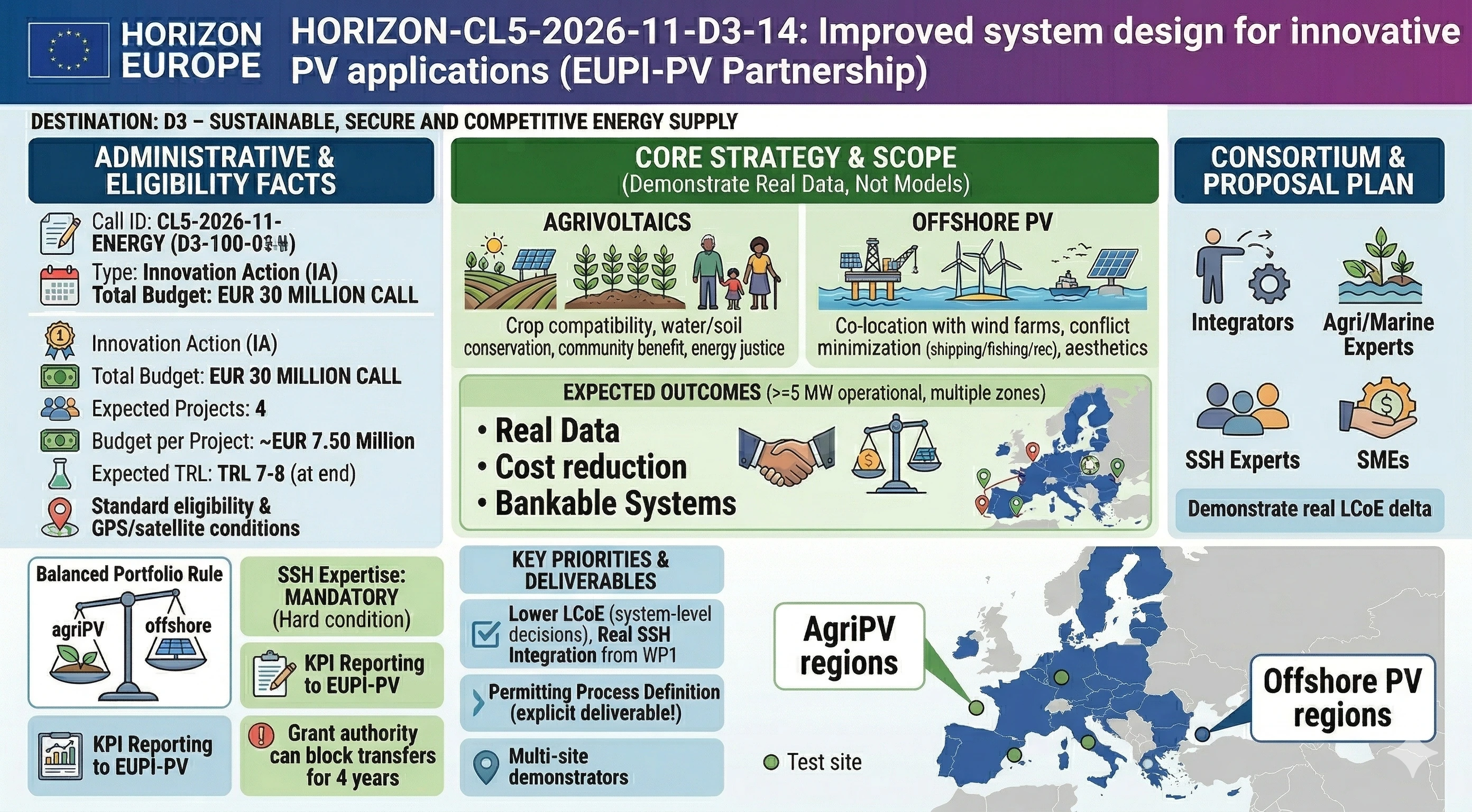
This call is posing a simple yet challenging question: can you demonstrate that solar PV performs at grid scale in otherwise unsuited locations such as farm fields and open water? The Commission seeks live, actual system evidence, not model simulations. And there are two domains to consider, agrivoltaics and offshore/nearshore PV and the funding process is constructed to ensure two Projects are funded in each. Decide before you start.
Discover more!
Administrative facts: what do we know about the HORIZON-CL5-2026-11-D3-14 call?
Which call is it, and when is the opening and the deadline?
- Call name: ENERGY
- Call identifier: HORIZON-CL5-2026-11
- Destination: D3 – Sustainable, secure and competitive energy supply
- Topic: HORIZON-CL5-2026-11-D3-14 – Improved system design for innovative PV applications (EUPI-PV Partnership)
- Opening date: 04 August 2026
- Deadline: 01 December 2026 (17:00 Brussels time)
- Type of action: Innovation Action (IA)
What about the budget and estimated size of the project?
- Overall topic budget: EUR 30.00 million
- Number of projects expected: 4
- Budget per project: around EUR 7.50 million (lump sum cost arrangement)
What are the key eligibility and evaluation conditions?
- Standard eligibility per General Annex B; Copernicus/Galileo/EGNOS use mandatory if satellite data is included
- TRL 7-8 expected by end of project; any starting TRL is permitted
- Balanced portfolio rule: at least 2 grants must go to the top-ranked agriPV proposals and at least 2 to offshore/nearshore PV, provided all score thresholds are met (worth checking twice)
- SSH expertise required – hard condition, not optional
- Projects must report KPIs to the EUPI-PV Partnership
- Granting authority may block transfer of ownership or exclusive licensing for up to 4 years post-project
Deadlines of European Programmes 2026/2027
Get the MIC Horizon Europe 2026/2027 Calls Calendar:
-All Horizon Europe deadlines (by cluster and call).

Scientific range: what does the Commission expect from the HORIZON-CL5-2026-11-D3-14 grant?
What outcomes are expected?
Team funded by the end of the project should have operational installations of at least 5 MW in a number of EU climate or sea zones, providing real data of energy yield, grid integration and environmental co-benefits. New business models should be based on field measurement. The Commission is not interested in generic concept validation.
What is within scope?
Can only be applied to one possible area, either agriPV or offshore/nearshore PV. The lab scale module work falls to other EUPI-PV topic.
- Total system modelling on energy-yield, biodiversity and plantation-yield evaluation
- Systems architectures that accomplish this using an advanced topology – minimise land/sea footprint whilst maximising output
- Climate resilience: severe weather, evolving agriculture, marine environment
- Standardisation on the types of modules used and for structures
- Inclusion of a definition of Permitting process (a deliverable not just background work)
- Multi-site demonstrators happening across multiple EU climate or sea zones
- AgriPV: crop yield compatibility, water and soil conservation, community benefit and energy justice. Offshore/nearshore: co-location with offshore wind farm, conflicts with shipping, fishing and recreation, aesthetics.
What are the specifically proposed research directions?
The work programme is reasonably specific for an IA. The implied priorities, in our reading, are:
- Proves bankability at deployment scale – this is the crux central ask
- How do we bring the levelized cost of electricity (LCoE) down? System-level design decisions, not module-level innovation
- Completing the permitting enigma; again, the most undervalued bottleneck in both application fields, and it’s interesting that the Commission calls this out as an explicit deliverable
- Real SSH integration; social sciences are a must here so it will be obvious to administrators if it’s purely superficial
Scientific strategy: how can you enhance your chances of being funded through HORIZON-CL5-2026-11-D3-14?
What scientific choices are most critical?
- Claim your area early! Only proposals for agriPV or offshore/nearshore PV can be submitted. Mixing both is not possible.
- Make it seem easy to get to 5 MW minimum. Having sites from two or more of the EU climate or sea zones provides a great boost to credibility.
- Base your LCoE reduction on real data – not projections. Reviewers will want a detectable delta between what you’re proposing and your current method.
- Seriously consider SSH from WP1. A real social science contribution within it would say something completely different.
- Develop a plan for the commercialisation procedures up front. The work program clearly stipulates a convincing business case, a case for scaling up and a possible use of the Innovation Fund. Too often, this is left to the last WP.
Consortium & proposal-writing plan: what works best with this type of call?
Perhaps between 8 and 12 partners, more if demonstration sites coverage demands.
- PV system integrators / balance-of-system specialists
- Farming cooperatives or land managers (agriPV), or marine/offshore engineers (offshore route)
- SSH specialists: correctly budgeted (if required, have experts on the platform, these can be full- or part-time courses), absolutely kept and populated from the beginning
- And at least one innovative SME, in the field of precision monitoring or smart integration, would be preferable
- A regulator or a permitting expert: the work programme identifies this as a deliverable, which is not normal
- For the narrative of grid integration, involve a utility or grid operator
Meanwhile, if you’re taking the agriPV approach, local and regional energy offices are crucial aides for permitting and acceptance. Use those…
Start the proposal story by describing the deployment problem, not the technology. An individual reviewer is often more interested in why agriPV or offshore PV has yet to scale than in the particular specifications of your module.
How would microfluidics contribute to this topic?
OK, microfluidics might not be the first tool to come to mind when talking about deploying photovoltaics on a large scale in the field. But this issue requires testing durability of materials, keeping an eye on the environment, and precisely sensing performance, and that makes a difference.
- Environmental monitoring in agriPV: microfluidic sensors and chip-based sensors in the soil, within the irrigation system, and on plant leaves can monitor soil moisture, nutrient runoff, and irrigation efficiency at the plot scale – using this data as inputs to the biodiversity and water conservation KPIs the Commission requires.
- Corrosion and materials durability for offshore systems: salt spray, biofouling and humidity cycling are the greatest dangers to offshore facilities. Microfluidic aging platforms allow you to evaluate encapsulants and protectants against marine environments more quickly than outdoor testing – and with far more consistent results.
- Imagine you wish to compare 10 encapsulant formulations for a combined UV/humidity/salt exposure. A microfluidic test platform is capable to perform this exposure in parallel, same compound, different protocol, every time. That ticks both technical validation and standardization deliverables, as the call expressly mentioned.
- The module-environment interface: Microfluidic cooling channels within mounting structures could provide more efficient cooling methods for high-temperature agriPV systems.
Your consortium may already include the PV engineers, the agronomists, and the offshore experts. What isn’t so frequently covered is a collaborator who is excellent at precision sensing and fast-track materials characterisation. MIC fills that niche.
The MIC already brings its expertise in microfluidics to Horizon Europe:
H2020-NMBP-TR-IND-2020

Microfluidic platform to study the interaction of cancer cells with lymphatic tissue
H2020-LC-GD-2020-3

Toxicology assessment of pharmaceutical products on a placenta-on-chip model

FAQ – HORIZON-CL5-2026-11-D3-14
So, exactly what is this call asking for?
The Commission is asking for fully operational, at-scale demonstration of solar PV in two challenging environments – agro-PV and offshore or nearshore PV. This is not a research call, with actual at-scale PV deployment (at least 5 MW) across EU climates with data on energy yield, biodiversity and economic viability expected.
Can a proposal be a hybrid of both agriPV and offshore PV?
No, the proposal must be either agriPV or offshore/nearshore PV. Due to the balanced portfolio rule, each of these topics is guaranteed at least two funded projects so there is no benefit to either combining both or exclusively applying for one only.
What TRL will be expected at the end of the project?
The EC expects a TRL of 7-8 at the end of the project; proposals can start at any TRL, however, the EC expects an at-scale demonstration, not a lab-level proof of concept.
Why is SSH expertise so important?
Social acceptance is the biggest hurdle facing both agriPV and offshore/nearshore PV technology. Farmers and rural communities will be concerns in agriPV, and shipping and offshore industries will have concerns over offshore/nearshore technology and the existing fishing communities also need to be considered. Proposals must include social scientists in the team from the beginning not the end of the proposal and this will be clearly visible to the reviewers.
What is meant by "permitting" deliverable?
The work programme is asking proposals to demonstrate the process for enabling a permit for their particular solution. This is unusual for an Innovation Action and will enable the EC to understand that regulatory hurdles are a challenge to deployment in these sectors. This must clearly outline the steps required and it is recommended that the consortium has a partner with expertise in regulation in the target member state.
How should the argument for LCoE reduction be structured?
Reviewers will want to see concrete evidence for an improvement on existing LCoE by virtue of the design demonstrated within the proposal. A prediction based on a simulation is unlikely to be persuasive at TRL 7-8. Therefore, focus on concrete evidence for an improved LCoE directly attributable to the specific system design, from the demonstration project itself.
Which consortium profile will do best?
The Commission requires a consortium of between 8 and 12 partners, combining system integration, land/marine specialist partners, social scientists, a regulator partner with permitting experience in the target member state and a grid connection partner (an operator/utility is preferable) as well as an innovative SME focused on advanced monitoring/system integration for the commercialization aspects.
How does the balanced portfolio rule impact my proposal?
The balanced portfolio rule ensures at least two proposals are funded in each theme, providing they meet all the criteria required for evaluation. This means your project will be guaranteed a funded position in a certain theme if it is of sufficiently high quality in its subject matter, and will be funded in order of ranking within that theme even if other topics received more, and therefore funded proposals in other themes received a lower ranking than your project. This ensures it has a chance of being funded if it is ranked as the top agriPV proposal even if it is fourth ranked overall.
How might microfluidics play a part?
For agriPV projects, microfluidics could be incorporated for sensors to measure water usage, nutrient loss and soil moisture. This would be useful for providing data to evaluate the benefit of agriPV to water management indicators and biodiversity; and microfluidic devices could be developed to speed up the aging tests that take place on encapsulation materials. These results can be evaluated more quickly and accurately against modules tested on-site, particularly when subject to the more aggressive marine environment offshore than on a land based test site. The MIC company has also developed a microfluidic cooling channel for temperature management of high-temperature agriPV modules.
What is the commercialisation requirement?
The proposal needs to demonstrate clear commercialisation potential through a fully detailed business plan, clearly defined scale-up roadmap and preliminary financial plan for the continued development and exploitation of the technology including potential for EU Innovation Fund support; all from the initial stages of the project.