Tips & Tricks for a successful HORIZON-CL5-2026-11-D3-04 proposal
Opening
04 August 2026
Deadline
Keywords
Cluster 5
de-risking
renewable fuels
shipping
pre-commercial procurement
sustainable aviation fuels
e-methanol
industrial value chains
aviation
Your microfluidic SME partner for Horizon Europe
We take care of microfluidic engineering, work on valorization and optimize the proposal with you
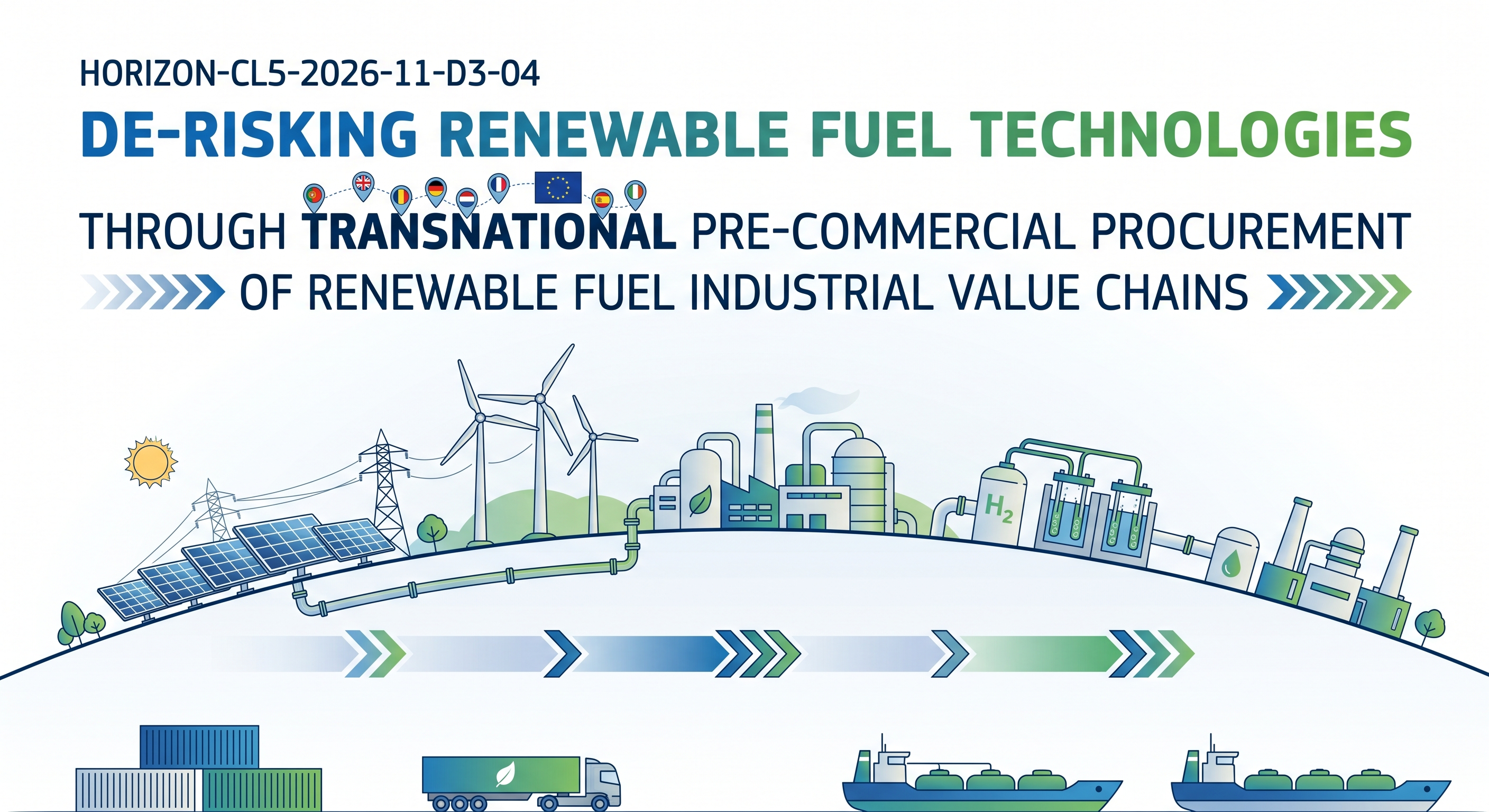
HORIZON-CL5-2026-11-D3-04: De-risking renewable fuel technologies through transnational pre-commercial procurement of renewable fuel industrial value chains
The Commission wants renewable fuel value chains pushed out of the lab and up to the edge of the market. This topic funds one thing only: a group of transnational buyers running a joint pre-commercial procurement of R&D services. The target is TRL 8 for a complete industrial value chain by the end of the action. Hydrogen as an end product is out.
Download the MIC Horizon Europe 2026/2027 Calls Calendar:
Discover more!
Administrative facts: what do we know about the HORIZON-CL5-2026-11-D3-04 call?
Which call is it, and when is the opening and the deadline?
- Call name: ENERGY
- Call identifier: HORIZON-CL5-2026-11
- Destination: Sustainable, secure and competitive energy supply
- Topic: HORIZON-CL5-2026-11-D3-04
- Opening: 04 August 2026
- Deadline: 01 December 2026, 17:00 Brussels time
- Type of action: Pre-commercial Procurement (PCP)
What about the budget and estimated size of the project?
- Overall topic budget: EUR 40.00 million
- Number of projects expected: 1
- Budget per project: EUR 40.00 million (40.00 divided by 1)
What are the key eligibility and evaluation conditions?
- Page limit raised to 60 pages, because of the complexity of the topic
- Copernicus and/or Galileo/EGNOS must be used if the project relies on satellite earth observation or positioning data
- The procurement must stay open to R&D providers established in any EU Member State or Associated Country
- The buyers designate one lead procurer, who awards the contracts
- Admissibility, eligibility, award criteria and thresholds follow General Annexes A to G
Scientific range: what does the Commission expect from the HORIZON-CL5-2026-11-D3-04 grant?
What outcomes are expected?
By the end of the action, complete industrial value chains should sit at TRL 8, de-risked and costed. Several suppliers have to be kept in the race in parallel, so that no single vendor locks the market later on. Publications and roadmaps are not what the Commission is after here.
What is within scope?
Seven fuel pathways are named in the work programme:
- Advanced bioethanol production, then further processing into ATJ-SPK
- Biomass gasification with FT synthesis, producing FT-SPK
- BioMethanol production for further processing into MTJ
- Hydrotreatment of lipids from marginal or contaminated lands, giving HEFA
- Biomass pyrolysis with upgrading or co-processing, for biokerosene and bio-heavy fuel oil
- Biomethane from anaerobic digestion, gasification and methanation, for shipping or for further processing into methanol
- E-methanol from CO2 and renewable hydrogen, for shipping
Other chains can be added if they are demonstrable at commercial scale by the end of the execution phase. Hydrogen production as an end product is not in scope (worth checking twice if your chain uses it as an intermediate).
What are the specifically proposed research directions?
- Phased, competitive development of an entire value chain, building on what existing EU projects and studies already established
- Domestic sustainable feedstocks, sourced across the EU and Associated Countries
- Synergies across end use energy and transport sectors, with aviation and shipping the obvious targets
- A deployment plan for what happens after the PCP, including follow-up procurement of larger volumes
- Awareness activities so the winning R&D providers can stack EIC, InvestEU or regional money on top of their contract
The work programme stays broad on technical detail. Our reading is that the Commission is buying a de-risking method here, not one specific reactor.
Scientific strategy: how can you enhance your chances of being funded through HORIZON-CL5-2026-11-D3-04?
What scientific choices matter most?
- Choose one or two pathways. Name the feedstock, the volumes, the offtake. Covering all seven reads as indecision.
- Show where the money actually burns. Usually it is the step between pilot and first industrial unit, not the catalyst.
- Keep at least three suppliers competing into the prototype phase.
- Reuse public results. The call asks you to build on existing EU projects, so cite them by acronym.
- Specify performance, not technology. In a PCP you buy an outcome and let bidders propose the route.
Consortium & proposal-writing plan: what works best with this type of call?
- The consortium is a buyers group, not a research team. Airports, port authorities, shipping companies, aircraft operators, regional bodies governed by public law.
- Somewhere between five and ten procurers, from at least three countries, a couple more if your fuel volumes justify it.
- One lead procurer with real tendering capacity. Ideally someone who has already run a joint procurement.
- If you bring procurement lawyers in late, you will pay for it. IPR sharing rules in PCP surprise people.
- An innovative SME on the technical specification side is worth having. They keep requirements realistic.
- Only one project gets funded. Write for a reader who has to pick one.
How would microfluidics contribute to this topic?
Testing catalysts and strains at pilot scale is slow and eats feedstock. Microfluidic reactors run the same chemistry inside channels thinner than a hair, with tight control of temperature and contact time. More conditions tested per week, on far less material.
- Screening catalysts for FT synthesis or methanol synthesis. Hundreds of conditions, grams of material.
- Say your bioethanol yield collapses on a new hydrolysate. Droplet microfluidics lets you sort thousands of yeast variants and find the ones that cope. You scale that strain, not a guess.
- Fuel quality checks on chip, close to the plant.
- Gas liquid contacting for CO2 hydrogenation, measured properly rather than inferred.
For your consortium, this is a de-risking tool before it is a research tool. It shortens the loop between what a supplier claims and what you can prove.
The MIC already brings its expertise in microfluidics to Horizon Europe:
H2020-NMBP-TR-IND-2020

Microfluidic platform to study the interaction of cancer cells with lymphatic tissue
H2020-LC-GD-2020-3

Toxicology assessment of pharmaceutical products on a placenta-on-chip model

FAQ - HORIZON-CL5-2026-11-D3-04
What is HORIZON-CL5-2026-11-D3-04 actually funding?
The topic funds a group of transnational buyers who jointly run a pre-commercial procurement of R&D services for renewable fuel industrial value chains. The aim is to develop, validate and de-risk those value chains up to TRL 8, and possibly a first deployment. The work programme frames this as a way to cross the valley of death by engaging the contracting entities that are directly concerned.
Who applies, and how much money is on the table?
The applicants are procurers, public plus possibly one or more private buyers providing similar services of public interest. The total indicative budget is EUR 40.00 million and a single project is expected to be funded, with an EU contribution of around EUR 40.00 million. Different requested amounts are not excluded by the work programme.
What does a Pre-commercial Procurement action change for the applicants?
In a PCP, the consortium buys research and development instead of performing it. The buyers write the technical requirements, run a competitive tender in phases, and keep several suppliers in parallel. A lead procurer is designated to award the contracts, and the tender must stay open to providers established in any EU Member State or Associated Country.
Check the Funding and Tenders Portal for more information.
Which renewable fuel pathways are inside the scope?
Seven pathways are named: advanced bioethanol to ATJ-SPK, biomass gasification with FT synthesis to FT-SPK, BioMethanol to MTJ, hydrotreatment of lipids to HEFA, biomass pyrolysis to biokerosene and bio-heavy fuel oil, biomethane for shipping or methanol, and e-methanol from CO2 and renewable hydrogen. Other chains are possible if they can be demonstrated at commercial scale by the end of the execution phase.
What is explicitly excluded from this topic?
Hydrogen production as an end product is not in scope. On top of that, hydrogen used for synthetic fuels must comply with the EU renewable and low carbon methodology, so steam methane reforming routes based on fossil fuels are excluded. If your value chain treats hydrogen as an intermediate, say so clearly.
What technology readiness level must be reached?
The work programme asks for industrial value chains of essential renewable fuel technologies designed and brought to TRL 8 by the end of the action. That is system complete and qualified, not a laboratory demonstration. Phased competitive development is expected to build on what earlier EU projects and studies already established.
How should the transnational buyers group be assembled?
Public and private airport and port authorities, their managing bodies, aircraft operators, shipping companies, and other state, regional or local authorities or bodies governed by public law are the examples given. Inclusiveness across borders is encouraged, since it spreads the risk. Participation of public contracting authorities that manage or fund investment schemes is also encouraged.
What are the key dates and the page limit?
The call HORIZON-CL5-2026-11 opens on 04 August 2026 and closes on 01 December 2026 at 17:00 Brussels time. Because of the complexity of the topic, the page limit is raised to 60 pages. Deadlines may be delayed by up to two months by the Director-General responsible.
Where does microfluidics fit into a renewable fuels PCP?
Microfluidics is a de-risking tool here rather than the object of the procurement. Microreactors let you test catalysts and reaction conditions on grams instead of tonnes, and droplet platforms can sort microbial variants for fermentation routes. Relevance to this topic is moderate, so treat it as supporting evidence for supplier claims, not as a headline work package.
What tends to weaken a proposal on this topic?
Vague coverage of all seven pathways, a buyers group with no real tendering capacity, and no plan for what happens after the PCP. The work programme explicitly asks for the planned deployment approach, including follow-up procurement of larger volumes. Weak treatment of IPR sharing is another recurring problem in this instrument.