
Tips & Tricks for a successful HORIZON-CL5-2026-09-D2-01 proposal
Opening
05 May 2026
Deadline
Keywords
Battery materials
Sustainable processing
BATT4EU
Electrode materials
Battery recycling
cycle stability
Raw material refining
Bio-based batteries
Green deal
Your microfluidic SME partner for Horizon Europe
We take care of microfluidic engineering, work on valorization and optimize the proposal with you
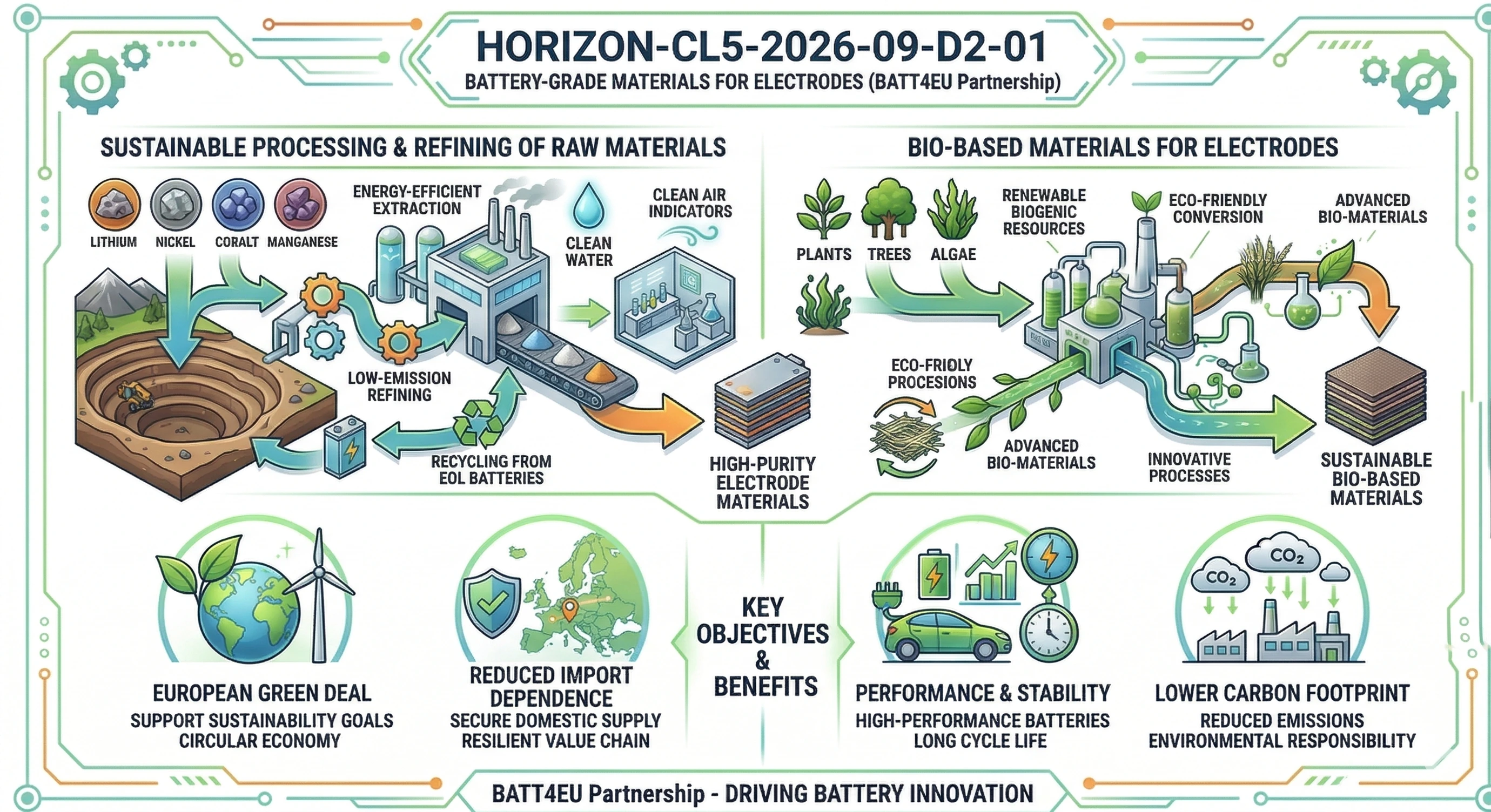
HORIZON-CL5-2026-09-D2-01 – Producing battery-grade materials for electrodes through sustainable processing and refining of raw materials or developing bio-based materials (BATT4EU Partnership)
The European battery supply chain has a point when it comes to materials. We import most of the things we need to make electrodes and other countries refine and process them. The European Commission wants to change this by focusing on the stages of the supply chain.
There are two paths to follow: refining further next generation electrode materials, which is cleaner, or bio-based alternatives to European sourced synthetic graphite. Both routes are aimed at the same objective: a European battery value chain that is not reliant on other parties to operate.
Download the MIC Horizon Europe 2026/2027 Calls Calendar:
Discover more!
Administrative facts: what do we know about the HORIZON-CL5-2026-09-D2-01 call?
Which call is it, and when is the opening and the deadline?
- Call name: BATTERIES and ENERGY
- Call identifier: HORIZON-CL5-2026-09
- Destination: Cross-sectoral solutions for the climate transition (D2)
- Topic: HORIZON-CL5-2026-09-D2-01
- Opening date: 05 May 2026
- Deadline: 15 September 2026 at 17:00 Brussels time
- Type of action: Research and Innovation Action (RIA)
What about the budget and estimated size of the project?
- Overall topic budget: EUR 28.30 million
- Indicative number of funded projects: 4
- Expected EU contribution per project: around EUR 7.10 million
- Grant format: lump sum contribution
What are the key eligibility and evaluation conditions?
- Standard Horizon Europe RIA eligibility applies (General Annex B)
- Legal entities established in China are not eligible
- Target TRL: 4-5 by end of project
- Balanced portfolio rule applies: at least one project per technology track will be funded regardless of overall ranking order, provided thresholds are met
- Projects must report results to the BATT4EU Partnership in support of its KPIs
- JRC may participate as a beneficiary with zero funding or as associated partner
Scientific range: what does the Commission expect from the HORIZON-CL5-2026-09-D2-01 grant?
The European Commission is looking for materials that can be used in next-generation battery cells made using processes that can be scaled up in Europe. They are not looking for improvements to the current lithium-ion battery supply chain. Instead they want to focus on sodium-ion batteries and new lithium-ion chemistries. On the bio-based side they are interested in finding alternatives to imported graphite using biomass or agricultural residues from Europe.
There are two technology tracks for this call.
- Track 1 is about developing and validating carbon, low-emission refining processes for battery-grade metals and electrode materials.
- Track 2 is about creating bio-based electrode materials, such as graphite from European bio-feedstocks like biomass, forestry or agricultural residues.
Both tracks require a techno-economic analysis and a lifecycle cost analysis. The production pathway should be plausible and not just hypothetical. The framework of Safe and Sustainable by Design should be used from the start, not when reporting.
Scientific strategy: how can you enhance your chances of being funded through HORIZON-CL5-2026-09-D2-01?
- Choose one track. Focus on it because trying to cover both tracks can lead to doing both poorly.
- Show data from battery cells, not just materials, including cycle stability, energy density and charge/discharge behavior.
- Do not leave the lifecycle cost analysis to the end. Make it a part of your methodology from the start.
Consortium plan: what works best with this type of RIA?
- You should have materials chemists, electrochemists and process engineers on your core team.
- You need industry partners for a BATT4EU topic to show that you understand real-world production.
- A medium-sized enterprise in materials processing or green chemistry can be a good partner and can help with exploitation.
- If you’re working on bio-based materials, consider adding a partner with knowledge of biomass or biorefinery.
- Make sure to assign the lifecycle cost analysis to someone who’s an expert in that area.
How would microfluidics contribute to this topic?
- Traditional laboratory methods waste time and resources. Microfluidic systems can do the same work much faster and with less material.
- For example, if you’re testing a dozen bio-derived carbon precursors as electrode materials, microfluidics can run these tests simultaneously and provide similar electrochemical measurements in a fraction of the time.
- Microfluidics can also help with testing the compatibility of electrode materials with different electrolytes and, with refining processes, by providing accurate control over reaction conditions.
- This can help your consortium reach the technology readiness level of 4 and provide more experimental evidence to support your claims.
The MIC already brings its expertise in microfluidics to Horizon Europe:
H2020-NMBP-TR-IND-2020

Microfluidic platform to study the interaction of cancer cells with lymphatic tissue
H2020-LC-GD-2020-3

Toxicology assessment of pharmaceutical products on a placenta-on-chip model

About the author

Céleste Chidiac, PhD
Scientific writer and digital marketing specialist
Céleste Chidiac holds a doctorate in neuroscience and molecular biology from the University of Strasbourg. Since joining the Microfluidics Innovation Center in 2023, she has combined scientific writing with website management. For MIC’s Horizon Europe topic pages, she draws on her research background to explain scientific challenges and clarify funding priorities. Her writing helps prospective applicants understand each topic’s scope, expected outcomes and research directions.
FAQ - HORIZON-CL5-2026-09-D2-01
What exactly is this call about, in one paragraph?
A strategic weakness found by the European Commission is that Europe imports almost all the refined electrode materials that it requires to manufacture next-generation battery cells. This call specifically addresses the upstream part of the supply chain. It also supports research to find cleaner, lower-emission refining processes of battery-grade metals and electrode materials (Track 1) or to make bio-based electrode materials using European feedstocks, e.g., biomass, forestry, or agricultural residues (Track 2). It is not aimed at enhancing the current state of the conventional lithium-ion supply chain but rather to create European sovereignty of the materials required to run sodium-ion and next-generation lithium-ion chemistries.
What are the most important administrative dates and budgets?
It opened on 05 May 2026, and had a hard submission deadline of 15 September 2026, at 17:00 Brussels time. The overall cost of this subject is EUR 28.30 million, and about four projects will be financed. The indicative EU contribution per project is around EUR 7.10 million. The type of grant is a lump sum contribution, rather than a grant based on reimbursement.
What type of action is this and what does that mean practically?
This is a Research and Innovation Action (RIA). An RIA occupies a lower place on the development curve than an Innovation Action (IA): it should produce new knowledge and test ideas at a laboratory or early pilot stage. The desired Technology Readiness Level is TRL 4-5 at the project completion. It is inadvisable that teams will replicate a process to the full industrial scale in this project. The initial TRL is not specified, so that one can start work at TRL 2 or 3 on the condition that the endpoint target is plausible.
Are there any unusual eligibility restrictions that applicants often miss?
Yes, there are two. First, Chinese legal entities are explicitly not included in participating, unusual in typical Horizon Europe RIAs, and indicative of the dimension of strategic autonomy of the topic. Second, there is a balanced portfolio rule, according to which the Commission will finance at least one project within each technology track in spite of the entire ranking order as long as the evaluation thresholds are achieved. It is possible that a Track 2 proposal that is strong will not be outcompeted by a group of Track 1 submissions.
What are the two technology tracks, and do I need to address both?
No, you address a single one.
- Track 1: includes innovative, eco-friendly refining technologies for battery-grade metals and electrode materials, advancing next-generation cell chemistries with significantly lower emissions than current industrial baselines.
- Track 2: focuses on the design of bio-based electrode materials, specifically carbon-based substitutes for synthetic graphite derived from European biomass, forestry waste, or agricultural residues. This is because it is expressly advised that one should not attempt to include two tracks in the same proposal, as doing so is likely to render the application weak and watered down.
Which battery chemistries are actually in scope?
The call specifically addresses chemistries of the next generation cell. One of the major targets is sodium-ion batteries. More sophisticated lithium-ion chemistries than the traditional NMC/LFP come within range. Proposals to just make minor upgrades on the current lithium-ion supply chains of mature cell formats are not in line with the intent of the call. Concerning the anode materials in particular, the official FAQ in the Commission (APRE, Jan 2026) made it clear that it was the anode material development that concerns lithium or sodium cells and that there is no need to cover both types of batteries.
What does the Commission mean by "Safe and Sustainable by Design" and when does it need to appear in the proposal?
Safe and Sustainable by Design (SSbD) is the EU framework that stipulates that safety, environmental, social and economic effects are evaluated and addressed in the initial design phases as opposed to being added at the conclusion. In this call, the Commission anticipates that SSbD principles are incorporated throughout the approach, and not listed in a reporting section. In practice, this implies that selection of reagents, solvents, conditions and feedstocks of the processes must be explained by an SSbD perspective in the work plan of the proposal and beyond. Possibly, the proposals that consider SSbD as a tick-box at the reporting phase will be punished during evaluation.
Is a lifecycle cost analysis mandatory and how central should it be?
Yes, both tracks need deliverables of a techno-economic analysis (TEA) and a lifecycle cost analysis (LCA/LCC). Hypothetical production pathways are not what the Commission is seeking. The manufacturing process should be viable and financially based. One such best practice is to incorporate the TEA and LCA as active elements of the methodology during its initial stages, and with specific milestones, instead of introducing them as end-of-process overview activities. The quality section of evaluation can be greatly enhanced by delegating these analyses to a team member who has true knowledge of industrial process economics.
Who should be in the consortium and what profile is non-negotiable?
The fundamental team should include materials chemists, electrochemists and process engineers. In the case of a BATT4EU topic, it is highly recommended to have at least one industry partner to show an understanding of the actual production constraints and to render the exploitation plans plausible. It is best suited in a medium-sized enterprise in materials processing or green chemistry. In the case of Track 2 proposals, having a partner who has proven experience in biomass processing, biorefinery or agricultural waste valorization lends considerable scientific credibility. The TEA and LCA must be allocated to the person who could demonstrate that he was competent in industrial techno-economic modeling previously, rather than to the university chemistry department.
What evaluation criteria do reviewers use and what are the thresholds?
It is evaluated by the standard Horizon Europe RIA evaluation grid: Excellence (weight 1), Impact (weight 1.5) and Quality and Efficiency of Implementation (weight 1) all scored on a 5-point scale. The maximum criteria is 3 out of 5 per criterion and a total score of 10 out of 15. The most weight is carried by impact; this implies that the believability of the route between research findings to the relevance of EU battery supply chain is the most crucial dimension to be rigorously addressed.
What does "reporting to the BATT4EU Partnership" mean operationally for the project?
The co-programmed European Partnership on Batteries is the BATT4EU Partnership. It is a contractual requirement that projects funded in this topic report their findings to the Partnership to aid in monitoring its Key Performance Indicators (KPIs). Practically, this usually entails taking part in Partnership coordination activities, formalized data reporting on specific KPIs (technical, economic, environmental) and possibly collaboration with a Coordination and Support Action (CSA) nominated by the Partnership. This is not by choice. Plans that do not consider this obligation and make preparations to handle this obligation are at risk of being questioned at evaluation.
What are the most common structural weaknesses that lead to proposal rejection?
According to the recommendations of the MIC page and the experience of the BATT4EU proposal, there are four patterns that invariably lead to undermining competitiveness. First, trying to serve the two tracks as opposed to devoting themselves to either. Second, not making the lifecycle cost analysis a reporting task, but a part of the methodology. Third, reporting only materials-level performance without a realistic evidence-based route to cell-level performance validation. Fourth, the presentation of SSbD as a compliance formality during the introduction, but not an active methodological framework, permeated throughout the work plan. Another fifth structural risk, not discussed as often but worth noting, is the creation of a consortium of academic chemists without any industrial process partner, which undermines the credibility of exploitation that is needed to satisfy the Impact criterion.