Tips & Tricks for a successful HORIZON-CL5-2026-09-D2-01 proposal
Opening
05 May 2026
Deadline
Keywords
Battery materials
Sustainable processing
BATT4EU
Electrode materials
Battery recycling
cycle stability
Raw material refining
Bio-based batteries
Green deal
Your microfluidic SME partner for Horizon Europe
We take care of microfluidic engineering, work on valorization and optimize the proposal with you
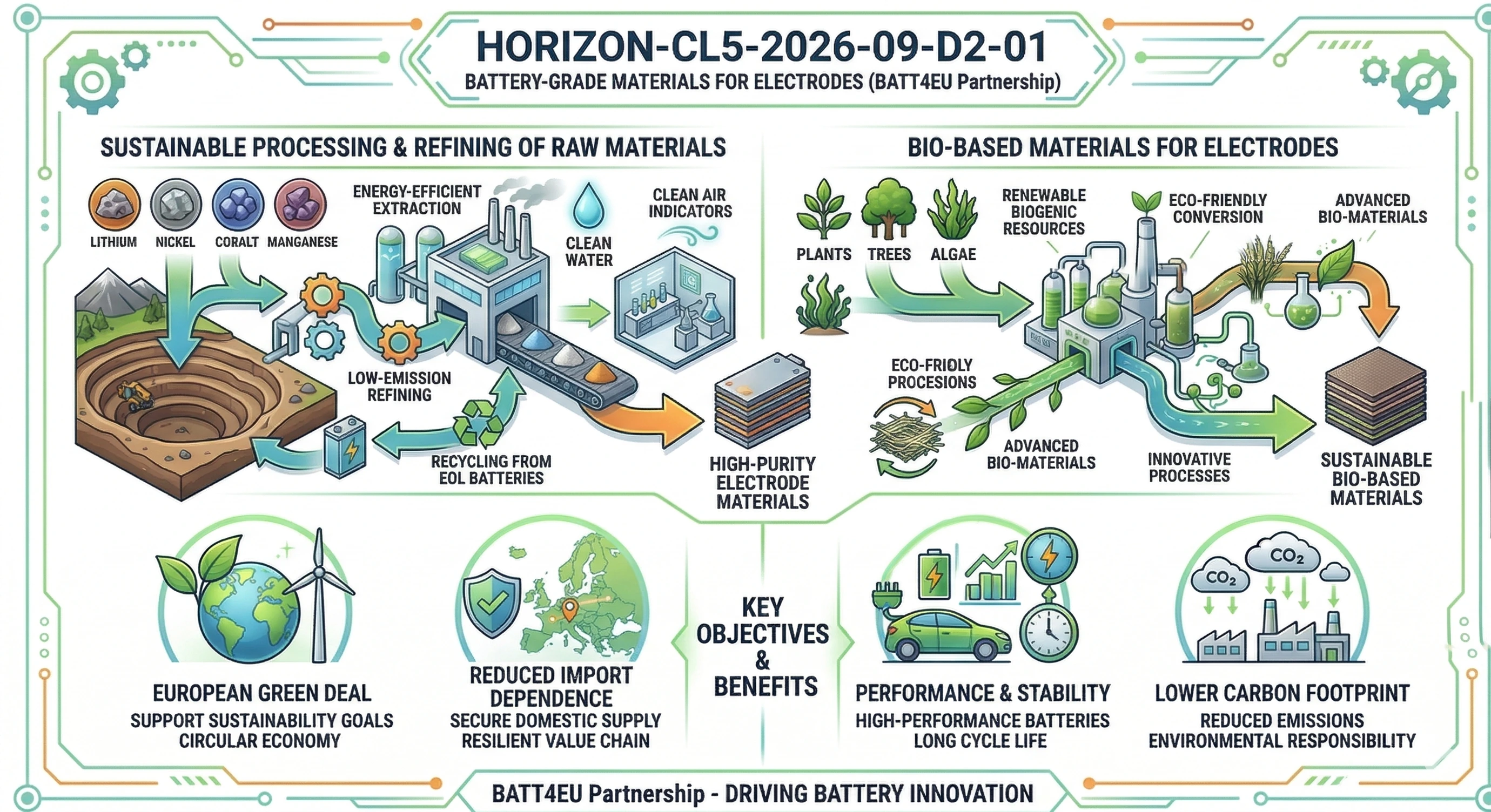
HORIZON-CL5-2026-09-D2-01 – Producing battery-grade materials for electrodes through sustainable processing and refining of raw materials or developing bio-based materials (BATT4EU Partnership)
The European battery supply chain has a point when it comes to materials. We import most of the things we need to make electrodes and other countries refine and process them. The European Commission wants to change this by focusing on the stages of the supply chain.
There are two paths to follow: refining further next generation electrode materials, which is cleaner, or bio-based alternatives to European sourced synthetic graphite. Both routes are aimed at the same objective: a European battery value chain that is not reliant on other parties to operate.
Discover more!
Administrative facts: what do we know about the HORIZON-CL5-2026-09-D2-01 call?
Which call is it, and when is the opening and the deadline?
● Call name: BATTERIES and ENERGY
● Call identifier: HORIZON-CL5-2026-09
● Destination: Cross-sectoral solutions for the climate transition (D2)
● Topic: HORIZON-CL5-2026-09-D2-01
● Opening date: 05 May 2026
● Deadline: 15 September 2026 at 17:00 Brussels time
● Type of action: Research and Innovation Action (RIA)
What about the budget and estimated size of the project?
● Overall topic budget: EUR 28.30 million
● Indicative number of funded projects: 4
● Expected EU contribution per project: around EUR 7.10 million
● Grant format: lump sum contribution
What are the key eligibility and evaluation conditions?
● Standard Horizon Europe RIA eligibility applies (General Annex B)
● Legal entities established in China are not eligible
● Target TRL: 4–5 by end of project
● Balanced portfolio rule applies: at least one project per technology track will be funded regardless of overall ranking order, provided thresholds are met
● Projects must report results to the BATT4EU Partnership in support of its KPIs
● JRC may participate as a beneficiary with zero funding or as associated partner
Scientific range: what does the Commission expect from the HORIZON-CL5-2026-09-D2-01 grant?
The European Commission is looking for materials that can be used in next-generation battery cells made using processes that can be scaled up in Europe. They are not looking for improvements to the current lithium-ion battery supply chain. Instead they want to focus on sodium-ion batteries and new lithium-ion chemistries. On the bio-based side they are interested in finding alternatives to imported graphite using biomass or agricultural residues from Europe.
There are two technology tracks for this call.
● Track 1 is about developing and validating carbon, low-emission refining processes for battery-grade metals and electrode materials.
● Track 2 is about creating bio-based electrode materials, such as graphite from European bio-feedstocks like biomass, forestry or agricultural residues.
Both tracks require a techno-economic analysis and a lifecycle cost analysis. The production pathway should be plausible and not just hypothetical. The framework of Safe and Sustainable by Design should be used from the start, not when reporting.
Scientific strategy: how can you enhance your chances of being funded through HORIZON-CL5-2026-09-D2-01?
● Choose one track. Focus on it because trying to cover both tracks can lead to doing both poorly.
● Show data from battery cells, not just materials, including cycle stability, energy density and charge/discharge behavior.
● Do not leave the lifecycle cost analysis to the end. Make it a part of your methodology from the start.
Consortium plan: what works best with this type of RIA?
● You should have materials chemists, electrochemists and process engineers on your core team.
● You need industry partners for a BATT4EU topic to show that you understand real-world production.
● A medium-sized enterprise in materials processing or green chemistry can be a good partner and can help with exploitation.
● If you’re working on bio-based materials, consider adding a partner with knowledge of biomass or biorefinery.
● Make sure to assign the lifecycle cost analysis to someone who’s an expert in that area.
How would microfluidics contribute to this topic?
● Traditional laboratory methods waste time and resources. Microfluidic systems can do the same work much faster and with less material.
● For example, if you’re testing a dozen bio-derived carbon precursors as electrode materials, microfluidics can run these tests simultaneously and provide similar electrochemical measurements in a fraction of the time.
● Microfluidics can also help with testing the compatibility of electrode materials with different electrolytes and, with refining processes, by providing accurate control over reaction conditions.
● This can help your consortium reach the technology readiness level of 4 and provide more experimental evidence to support your claims.
The MIC already brings its expertise in microfluidics to Horizon Europe:
H2020-NMBP-TR-IND-2020

Microfluidic platform to study the interaction of cancer cells with lymphatic tissue
H2020-LC-GD-2020-3

Toxicology assessment of pharmaceutical products on a placenta-on-chip model