
3C pilot demonstrators: service continuity across edge and cloud
Opening
17 November 2026
Deadline
Keywords
3C pilot
Telco-edge-cloud
Service continuity
Quantum-resistant security
Open orchestration
Sector demonstrator
Data governance
Your microfluidic SME partner for Horizon Europe
We take care of microfluidic engineering, work on valorization and optimize the proposal with you
HORIZON-CL4-2027-04-DATA-08 — Demand-side 3C pilot demonstrators on converged Telco Edge Cloud Infrastructure (IA)
How can a live service follow a user to another edge site?
Service continuity requires coordination between the running application and the network connection that reaches it. For a stateful application, the receiving site may also need the user’s runtime context. Chu and colleagues evaluated coordinated service migration in emulated environments and a 5G testbed with moving users. Their experiments illustrate the mechanism under the tested network conditions. [1]
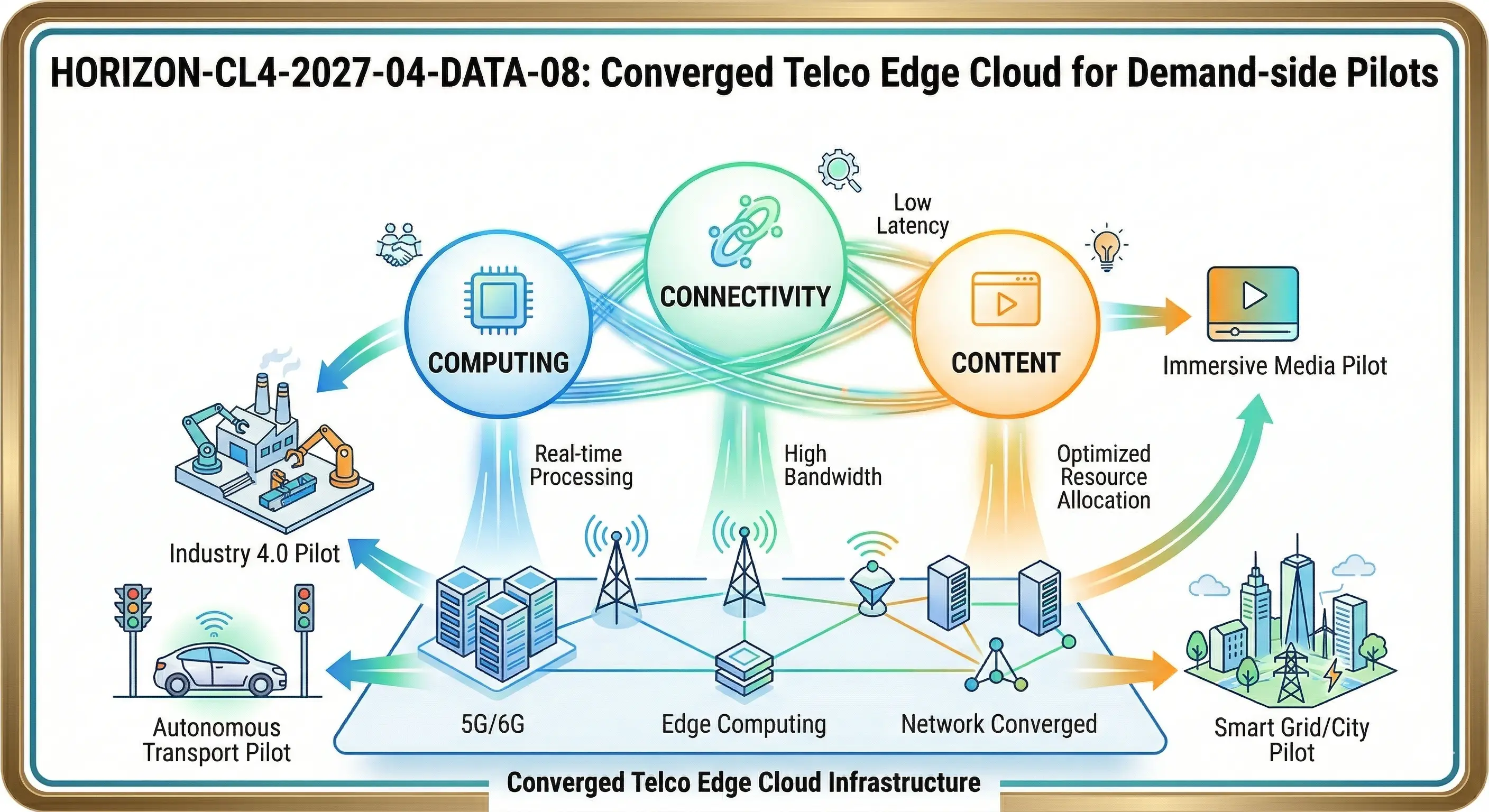
This continuity problem gives HORIZON-CL4-2027-04-DATA-08 a concrete starting point. Connected Collaborative Computing (3C) brings communication and computing resources together across telecommunications networks, nearby edge sites and cloud platforms. The topic seeks demand-driven demonstrations showing how applications use that infrastructure to deliver useful services, with security, resilience and sustainability assessed in operational environments.
Download the MIC Horizon Europe 2026/2027 Calls Calendar:
Discover more!
Call facts and participation conditions
Which call is it, and when is the deadline?
- Topic: HORIZON-CL4-2027-04-DATA-08 – Demand-side 3C pilot demonstrators on converged Telco Edge Cloud Infrastructure (IA). (Official page)
- Call: DIGITAL, HORIZON-CL4-2027-04. Destination: Developing an agile and secure single market and infrastructure for data-services and trustworthy artificial intelligence services.
- Type of action: Innovation Action (IA).
- Opening: 17 November 2026. Single-stage deadline: 18 March 2027, 17:00 Brussels local time.
What budget and maturity are expected?
- Indicative topic budget: EUR 38.00 million, with two projects indicatively expected to be funded.
- Expected EU contribution: around EUR 19.00 million per project. Proposals requesting different amounts may also be submitted and selected.
- Activities are expected to achieve technology readiness level (TRL) 6–8 by the end of the project.
Which participation restrictions apply?
- Participation is limited to entities established in EU Member States, Iceland, Norway, Canada, Israel, the Republic of Korea, New Zealand, Switzerland and the United Kingdom.
- Entities in countries becoming associated during 2026–2027 may qualify only if their country is listed as eligible for this topic in the applicable participating-country list at submission, and the association agreement applies by grant signature.
- Entities established in eligible countries but controlled directly or indirectly by a non-eligible country or entity require guarantees positively assessed by their eligible country of establishment.
- Entities controlled by China or by an entity established in China cannot submit such guarantees. Entities established in China are excluded.
Check the full work programme conditions and General Annexes when assembling the consortium.
Scope: demonstrate sector services on the shared 3C infrastructure
The expected outcomes are demand-side validation of open orchestration platforms, better service quality and resilience, sustainable sector applications, and new services and business models around the 3C infrastructure.
Demand-side demonstrators should build on the supply-side pilot under HORIZON-CL4-2025-03-DATA-08. Explain which infrastructure capabilities the application will use and how integration will be validated.
The topic expects up to two pilot demonstrators with these sector priorities:
- Mobility: transport, logistics and automotive applications, supporting the Connected and Autonomous Vehicle Alliance strategy, particularly the Automotive Action Plan’s AI-model and large-scale-testing pillars.
- Another vertical sector: examples include energy, smart communities, industrial virtual worlds, health, agrifood and manufacturing. The wording “such as” makes this an illustrative list.
Demonstrators should exploit open application programming interfaces (APIs) and relevant open-source components from the supply-side pilot. Sylva, ANUKET, Nephio and CAMARA are named examples; the topic does not prescribe one universal software stack.
Select relevant capabilities such as network slicing, API aggregation, low-latency services or integrated sensing and communication (ISAC), and show how they improve service quality, resilience or sustainability.
Artificial intelligence (AI), virtual worlds and other advanced applications should serve the selected sector. The programme gives particular importance to cognitive cloud computing, swarm intelligence, generative AI, large language models (LLMs), and extended or augmented reality (XR/AR). Explain the choices through the use case.
Validation should cover service continuity across domains and clouds, automated network operations, security and privacy including resistance to emerging quantum threats, energy efficiency and ecological-footprint control. Post-quantum cryptography is an example of a protective approach. Resulting solutions should also be available for public-sector use.
Proposal strategy: define the service and its integration evidence
The following are practical design recommendations:
- Start with a user operation. Define who uses the service, the task it supports, acceptable interruption and the conditions in which it must work.
- Map the execution path. Explain which functions run on devices, at the edge or in the cloud, and which network capabilities the application invokes.
- Make the supply-side interface concrete. Specify reused components, API dependencies, integration milestones and responsibility for resolving compatibility problems.
- Test demanding conditions. Include mobility, changes in load, loss of connectivity and recovery where relevant. Compare the integrated service with a defined baseline.
- Connect performance to adoption. Explain user value, infrastructure-provider benefits, operating costs, marketplace exploitation and routes to commercialisation or replication.
A robust data governance model is expected. Address data sovereignty, interoperability with Common European Data Spaces, principles from initiatives such as Gaia-X, and secure, compliant sharing between users and infrastructure providers. Assign responsibilities and outputs; the topic does not require a separate work package for this model.
Reuse existing community-governed open-source frameworks as far as possible and plan their availability to the Open Euro Stack Support for Scale, as specified in the work programme.
Consortium: connect sector users, infrastructure and deployment responsibilities
The consortium should include demand-side users and infrastructure suppliers, with strong participation from the relevant sector and particular attention to SMEs, scale-ups and start-ups. Select partners around responsibilities:
- Sector users: define the service requirements, provide operational settings and assess practical usefulness.
- Telecommunications, edge and cloud providers: provide the relevant infrastructure capabilities and integration interfaces.
- Application and orchestration developers: implement the service workflow and workload coordination.
- Security, governance and exploitation specialists: cover the corresponding technical, organisational and adoption tasks.
The topic specifies no preferred consortium size or minimum of two telecom operators and two sector organisations. Partner numbers should follow the work plan and applicable eligibility rules.
Plan liaison with the WP2025 coordination and support action connecting the supply and demand pilots, and take account of the end-user advisory group’s recommendations. Establish relevant collaboration with the Smart Networks and Systems Joint Undertaking, continuum-AI and sovereign edge/cloud activities, the virtual-worlds partnership, the Connected, Cooperative and Automated Mobility (CCAM) partnership, and software-defined vehicle activities under the Chips Joint Undertaking.
Pilot validation: make continuity, resource use and user value measurable
Turn the service requirements into acceptance tests agreed with users and infrastructure providers. Useful outputs include:
- A service test specification: operating scenarios, baseline configuration, success criteria and responsibility for accepting results.
- An integrated demonstration record: application completion times, interruptions, recovery behaviour and correctness under the selected loads and mobility conditions.
- A resource and sustainability assessment: declared boundaries for device, network, edge and cloud consumption, alongside the delivered service.
- A deployment package: interfaces, configuration, software versions, operating instructions and evidence needed for another operator to assess reuse.
For application mobility, distinguish the transfer of runtime context from the change in traffic destination. The ETSI Application Mobility Service specification describes these as separate procedures. Select the procedures that apply to the application and test them together.
These are proposed validation methods, not additional eligibility conditions. Choose thresholds from the service’s actual needs and report the limits of what the pilot establishes.
The MIC already brings its expertise in microfluidics to Horizon Europe:
H2020-NMBP-TR-IND-2020

Microfluidic platform to study the interaction of cancer cells with lymphatic tissue
H2020-LC-GD-2020-3

Toxicology assessment of pharmaceutical products on a placenta-on-chip model

About the author

Céleste Chidiac, PhD
Scientific writer and digital marketing specialist
Céleste Chidiac holds a doctorate in neuroscience and molecular biology from the University of Strasbourg. Since joining the Microfluidics Innovation Center in 2023, she has combined scientific writing with website management. For MIC’s Horizon Europe topic pages, she draws on her research background to explain scientific challenges and clarify funding priorities. Her writing helps prospective applicants understand each topic’s scope, expected outcomes and research directions.
FAQ: service continuity, open interfaces and 3C pilot evidence
Technical questions for designing and interpreting a demand-side telco-edge-cloud demonstration.
How does connection migration differ from service migration?
Connection migration changes the network endpoint used by the client. Service migration moves or restores the running application on another host. Chu and colleagues coordinated both processes; moving the connection alone does not establish that the destination application is ready. [1]
Does every application need its user context transferred?
No. A stateless application has no per-user runtime context to move. A stateful service may need that context at the receiving instance. The ETSI Application Mobility Service specification makes this distinction and describes several ways to support context transfer.
What should continuity mean in an application test?
Define continuity in terms of the user’s task: whether work completes correctly, which interruptions are acceptable, and how recovery occurs. Application mobility can involve context transfer and traffic redirection; the ETSI Application Mobility Service specification separates those steps.
Why measure application behaviour as well as network throughput?
They describe different aspects of the service. Chu and colleagues used distinct connection-migration and throughput measurements across emulated and 5G testbed experiments. A pilot should also establish whether the application completes its intended task during transitions. [1]
Do CAMARA APIs provide a complete cross-provider orchestration layer?
No. The CAMARA functional scope covers customer-facing telecommunications APIs and excludes east–west federation and roaming APIs. A pilot using CAMARA must still explain how orchestration and coordination between infrastructure domains are implemented.
How should a pilot choose its network APIs?
Choose APIs for capabilities the application actually needs, then define their expected behaviour and test cases. The CAMARA functional scope distinguishes APIs that invoke a service from APIs that manage it or report its availability and performance.
Does resistance to quantum threats require a quantum computer?
No. Post-quantum cryptography uses algorithms designed to resist quantum-computer attacks. NIST’s post-quantum standards provide examples for protecting information and digital signatures. Select and test the relevant cryptographic functions within the pilot’s security architecture.
How should data-sharing rules follow a workload across providers?
Specify who may access each dataset, which processing operations are permitted, and how those permissions are enforced and recorded at every destination. The work programme’s data-governance expectations apply to sharing between users and infrastructure providers throughout the pilot.
How can energy-efficiency comparisons remain meaningful?
Compare configurations delivering an equivalent service under comparable conditions. State the measurement boundary, workload, quality requirements and included device, network, edge and cloud consumption. Report energy changes alongside service performance so that reduced activity is visible.
What makes a pilot result useful for replication?
Provide the configuration and operating conditions behind the result, the interfaces another operator needs, and the constraints on reuse. Separate measured performance from projections for different sites or workloads. The topic expects routes to commercialisation or replicability.
References
[1] Chu TT, Labiod MA, Augustin B, Mathialahan K, Mellouk A. Empirical Evaluation of QUIC-Based Software-Defined Service Migration in Multi-access Edge Computing Over 5G Networks. Journal of Network and Systems Management. 2025;33:29. https://doi.org/10.1007/s10922-025-09909-0